Spectator Life

Spectator Life

An intelligent mix of culture, style, travel, food and property, as well as where to go and what to see.

In defence of public displays of affection

The Duke and Duchess of Sussex had a rather awkward moment recently when they were caught on the ‘kiss-cam’ at a basketball game in Los Angeles. The couple, sitting in a private box (but in very public view), were faced with a decision: to kiss or not to kiss.  Harry went in for the kill (his 26th?), leaning over to his wife for a kiss. But Meghan simply laughed and patted his arm. There, there, little prince – not today. The couple haven't been shy about public displays of affection in the past, and this was somewhat of a departure from her days on camera frolicking in her role as Rachel Zane in Suits. But people change and, I suppose, that was acting.  https://www.youtube.com/watch?v=hknSd04iBdE So what would you have done in a similar situation?

How to bag the best spot in the supermarket car park

Our local Sainsbury’s, though admirable in every other way, has a slightly inflated estimate of the disabled population of Seven-oaks, with all the plum parking spaces near the entrance reserved for blue badge holders. Every time I drive in, a voice from my inner bastard says: ‘Jeez, if it weren’t for all these bloody disabled spaces, I’d be able to park right next to the door.’ This of course is rubbish, because if those spaces were not designated as disabled, other people would have parked in them first. It is a perfect example of asymmetry of perception. In fact, next time you go shopping, it might pay to adopt the trademark Sutherland method of superstore parking, which is to park as close as possible to one of the trolley return points in the car park.

London’s car drivers are being bullied

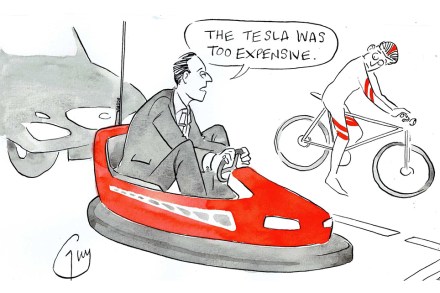
Any historic London footage inevitably features cars busily rounding Hyde Park Corner and shooting off up Park Lane, against the background of sky-scraping hotels and thriving offices. Have you seen the same bit of London now? It’s a giant car park, brought to a standstill by an administration with seemingly little idea how to promote a thriving capital. The city’s best-known thoroughfare has been reduced from three lanes to just one open for traffic northbound, one for bicycles (used sparingly in rush hour) and one for buses, usually empty. That’s just one lane for normal traffic, used by Londoners simply trying to get from A to B via one of the main routes across the capital. Any world capital needs to offer choice in the way its population gets around.

Carrie Johnson and the truth about children’s parties

The email was apologetic in its tone, if apocalyptic in its content. The entertainer I’d booked for my daughter’s fifth birthday party was no longer available – she’d been invited to perform as an extra on Strictly Come Dancing, an opportunity too good to miss. I swallowed my surprise (aren’t these appearances negotiated months in advance?) but couldn’t quell the mounting panic that anyone who has struggled to source a children’s entertainer at short notice without remortgaging their house will recognise.  With no expert in charge, a kids’ party is simply a mass socially-sanctioned sugar-fuelled breakdown – and that’s just for the parents.

Will AI make Tinder redundant?

The world is home to 7.8 billion people. Roughly one in 14 of these people (530 million) are on Tinder. Badoo, the second most popular dating app, has ‘only’ 318 million users. Tinder is the most popular dating app in the world, by far. Now, though, a new challenger appears to be emerging. Unlike Badoo and other less robust dating apps, all of whom try to offer a variation of what Tinder provides, this competitor offers something completely different. You see, this new dating app, a next generation dating app, plans to inject artificial intelligence into matchmaking.

Why the UK does so badly at Eurovision

Some 160 million will have watched Britain staging a successful Eurovision Song Contest in Liverpool: the world’s most-watched non-sporting TV event. But our own act, Mae Muller, finished second-last. Had it not been for a generous vote from Ukraine's jury, we'd have been last. It's a familiar trend. With the spectacular exception of Sam Ryder last year, our entries have tended to flop badly – leading to questions like 'Why did the BBC pick another dud act?' and 'Why does everyone hate Britain?' But we struggle at Eurovision for a number of systemic reasons, all of which come down to the way we lazily pick an act and give them none of the practise that other countries have. Every year, our singer is sent naked into battle.

Carmageddon: the electric vehicle boondoggle

A couple of years ago I thought seriously about buying an electric car. Not a hybrid, but the full monty. There was one in particular I liked the look of and I even contacted a dealership to ask whether they’d accept my diesel-powered VW Touran in part-exchange. The answer was yes, but it was still eye-wateringly expensive. Was it worth it? I tried to persuade myself it would be, given the savings on fuel costs, the waiving of the congestion charge, etc. Boy, am I glad I dodged that bullet. Scarcely a day passes without a new horror story about electric vehicles in the press.

Why British women are turning to Danish sperm donors

‘Hello, my current occupation is police officer,’ says Dex in a thick Danish accent. ‘It seems very adventurous and exciting to do, and to make a difference for the people I meet out in the world.’ Dex is just over 13 stone, around six feet tall, has very fair skin and blue eyes. His favourite animal is the dog. Dex is also a Danish sperm donor, and I’m listening to the beginning of an 11-minute voice-recording on his profile. On the website of the European Sperm Bank, which bills itself as ‘Europe’s leading sperm bank’ and is based in Copenhagen, there are hundreds of profiles like Dex’s available to British women. Create a free profile and, in under a minute, you can scroll through smiling baby pictures of Danish men as if looking for a new party frock.

The secrets of London by postcode: WC (West Central)

Our journey around London’s postcode areas has reached its final destination: WC. One of Evelyn Waugh’s female friends always insisted on referring to it in full as ‘West Central’, because she said ‘WC’ had ‘indelicate associations’. We’ll learn what happened at Spike Milligan’s memorial service, why Agatha Christie married an archaeologist and where you can find the official definition of an inch… York Place, just south of the Strand, used to be called Of Alley (the modern street sign still commemorates the fact). The name came about because when George Villiers, the Duke of Buckingham, sold the land to developers in 1672, he insisted that every element of his name be reflected in newly created streets.

Where to go to hear a nightingale sing

The first cuckoos are audible, skylarks are singing their hearts out, the dawn chorus is in full, joyous effect and more bitterns are booming than in decades. But the real highlight of the birdsong calendar is only now beginning in earnest: nightingale season. Nightingales have been winging their way from sub-Saharan Africa across Spain and France and into the wilder fringes of the southern part of England, where they are beginning their attempts to seduce each other by means of song. And it’s this seductive sound that has given this tiny bird such a huge place in our culture.  There are two guaranteed reference points for any discussion about nightingales. So I may as well get Keats and Berkeley Square out of the way immediately.

Tale of the tape: how cassettes made a comeback

Move over vinyl: the cassette tape is back. According to the British Phonographic Industry, sales of this retro piece of technology last year came close to a two-decade peak. Having been the top-selling format for albums in the UK from 1985 to 1992 and then seemingly disappearing (selling only 4,000 units in 2012), last year saw more than 195,000 cassette tapes shifted. HMV, which recently announced that it will reopen its flagship store on Oxford Street after a four-year closure, plans to bring out cassettes for ‘specific new releases’ and has credited its return to profit with a growing interest in ‘collectable’ music from an analogue era.

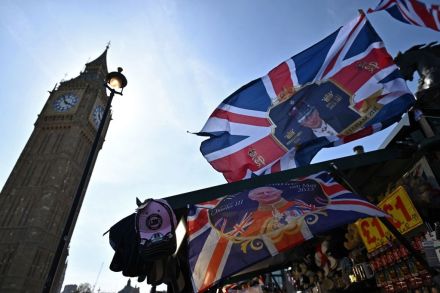
Stamped out: Royal Mail’s plan to shrink Queen Elizabeth’s head

As King Charles’s stamps begin landing on our doormats more frequently, we’ll be saying goodbye to the familiar Arnold Machin silhouette of Queen Elizabeth II that has appeared on our envelopes for 55 years. But what is less familiar is the story of how that silhouette almost changed dramatically two decades ago.  Early in this millennium, the Royal Mail’s design director, Barry Robinson, led a secret initiative to design a new set of ‘definitive’ stamps – the everyday 1st and 2nd class ones. The aim was to make it easier for visually impaired or partially sighted people to see the class of stamp by making the ‘1’ or ‘2’ much larger. The only way to do this? Shrinking the Queen’s head.

Why the coronation matters

At one level, asking why the coronation matters is to slightly miss the point. Living as we do in a constitutional monarchy, the coronation doesn’t need to make a case for itself. It is simply an indispensable part, primarily in symbolic terms, of the installation of our new head of state. But setting aside for a moment its constitutional and religious significance, the coronation is important for another reason. Unlike almost every other nation state, the UK does not have an official national day. The patron saint days of the respective countries of the UK, of course, are celebrated to varying degrees ­– though St George’s Day far less so than the others.

What happens when coronations go awry

Despite weeks of preparation and rehearsal, coronations don’t always go according to plan. Indeed, a botched coronation or one plagued by misfortune can be taken by the superstitious as a poor augury for coming reigns – sometimes justifiably. Case in point: the celebrations of Tsar Nicholas II and Alexandra Feodorovna in Moscow’s Dormition Cathedral on 14 May 1896. While the hours-long ceremony for the last Tsar and Tsarina went off without a hitch, the following national holiday and public feast in Khodynka Field led to a stampede where at least 1,300 died and 1,300 more were left with serious injuries. The cause?

In praise of minor royals

On a scaffold hung with black cloth, on a freezing January day in 1649, the instinct for sumptuousness died in these islands. It was killed alongside Charles I, kingly excess and belief in divine right and, with intermittent exceptions, has never recovered. And so when, time and again since September, we’ve heard about our new King’s plans for downsizing the monarchy, the bulk of the population has calmly nodded its assent. Trim, slim, streamline, skimp. Time to dispense with peripheral royal family members! Farewell to the jostling chorus line of the Buckingham Palace balcony of yesteryear, all oversized hats, Ruritanian frippery and excitable small children! Away with the hangers-on!

The best coronations in literature

‘In her big, white dress the Queen looks like a balloon that’s about to float up to the roof of Westminster Abbey and bob about up there amongst the gilded arches and roof bosses. To prevent this happening people keep weighing her down with cloaks and robes, orbs and spectres, until she’s so heavy that bishops and archbishops have to help propel her around.’ This is the coronation of Elizabeth II in 1953 as described by one-year-old Ruby Lennox in Kate Atkinson’s Behind the Scenes at the Museum. These observations might seem preternaturally advanced from a narrator not yet old enough to walk and talk, but that is consistent for this witty novel. It opens with Ruby being fully aware of her own conception: ‘I exist!

Why millennial men are turning to the Book of Common Prayer

The Book of Common Prayer is enjoying a revival in the Church of England, despite the best efforts of some modernists to mothball it. Over the past two years, more and more churchgoers have asked me about a return to Thomas Cranmer’s exquisite language, essentially unaltered since 1662, for church services and private devotions. Other vicars tell me they have had a similar increase in interest.   It helps that the Book of Common Prayer has had a fair bit of attention recently. The late Queen Elizabeth’s insistence on the use of Prayer Book texts in her funeral rites meant that in September more people witnessed the beauty of this liturgical treasure than watched Neil Armstrong’s first steps on the Moon.

What happened to Jonathan Aitken’s young meteors?

I am not bragging when I say that 56 years ago I was a young meteor. No: it is official. In 1967, Jonathan Aitken, then a young journalist on the Evening Standard (his uncle, Lord Beaverbrook, owned it at the time) wrote a book about the upcoming young movers and shakers in London – the stars of the Sixties (to mix celestial bodies). The Young Meteors it was called, and I was one of them.  At that time, I was 27 years old and the fashion editor of the Sunday Times and Aitken put me in as one of the three powerful influencers in that world. (The others were Marit Allen of Vogue and Georgina Howell of the Observer – both dead now, sadly.

Thank you Jerry Springer, pioneer of reality TV

Those of us who worship at the altar of reality television have Jerry Springer to thank (or to blame).  Springer was an early pioneer of reality TV. His show was the beginning of the end of television as the world once knew it. You didn’t need to be talented or interesting or rich or even beautiful to garner attention. He brought a new kind of intrigue and voyeurism on to our screens – he showed people to people as entertainment.  He made ordinary humanity extraordinary: shouting, screaming, even, on occasion, violence featured on his show Despite beginning his career in politics, working for Bobby Kennedy before becoming the mayor of Cincinnati, Springer was best known for the self-titled Jerry Springer Show which ran for 27 years.

My blue tick humiliation

I was one of the first people to take up Elon Musk’s offer to purchase a blue tick, the Twitter equivalent of VIP status. Not because I didn’t have a complimentary one – I did, believe it or not – but because if you sign up to Twitter Blue it means you can post videos on the site that are longer than a couple of minutes. Poor Elon Musk then had to do a reverse ferret, announcing he’d be restoring the merit badges to a select few I had noticed that my friend Konstantin Kisin had put up a speech he’d made at the Oxford Union and it was getting lots of views. I spoke in the same debate and gave what I thought was a much better speech, so wanted to put mine on Twitter, hoping it would prove even more popular.

Inside America’s Satanist movement

The largest gathering of Satanists in history is taking place in Boston this weekend. It’s not open to the public. Or, to be more precise, no longer open to the public. That’s because all the tickets have been sold. They’ve downgraded the supernatural in favour of aggressive secularism, with an emphasis on trans issues The second annual SatanCon is being organised by The Satanic Temple or ‘TST’, the world’s biggest Satanic sect, at the Marriott Hotel in Copley Square. That’s the same Marriott chain founded by a devout Mormon family who, back in the 1960s, only agreed to serve alcohol to guests after securing permission from the president of the Church of Latter Day Saints.

Could you become a spy?

Why spy? Why do people become spies, what are their motives, their justifications, and how do they perceive what they are doing? Could any of us do it? Are we all potential spies? Short answer: yes. Long answer: depends on circumstances. The Sunday Times ran a story about Abdi (a pseudonym), who was recruited in the wake of 9/11 by MI5 to spy on UK-based terrorists. He was subsequently sent by MI6 to penetrate training camps in Waziristan, despite both agencies allegedly being aware that he was mentally unstable. When he returned to the UK he killed his own child, claiming that this was a psychotic episode resulting from the stress of spying. The jury did not believe he was unable to control himself and convicted him of murder.

There’s nothing wrong with leaving a sick partner

Danielle Epstein’s story is a sad one; last year she was in the process of buying a house with her boyfriend when he was diagnosed with a brain tumour, underwent a serious operation and had to learn to walk again. He wasn’t the only one who walked; Miss Epstein did also, and not just down the road where she could keep an eye on him, but all the way to sunny Thailand. She said in her defence: 'I felt like the most awful person, leaving somebody because they have cancer, but it was damaging my mental health and it wasn't helping him… I couldn't sleep or eat, I was having panic attacks and was on so much medication to sort myself out I just couldn't function.

How useful is a Twitter blue tick?

Alex Salmond was one of the first to fall victim to Twitter’s blue tick cull. An account with the same name as his began sending out disparaging tweets about his sub-optimal bowel movements. The account was tweeting shortly after Elon Musk removed 400,000 ‘legacy verified’ blue ticks, little badges that sit next to a user's name, which were originally designed to stop impersonation. Musk’s removal of the verified ticks – previously given to celebs, politicians and journalists to prove they are who they said they are – makes way for a free market approach to verification. Any tweeter can now pay £9.60 a month for the blue tick (provided their email address has been verified).

AI and the end of immigration

There are many things to be learnt from visiting an airport. A trip to Stansted Airport, for instance, will teach you that Stansted is a really dim place to locate an airport. Meanwhile, JFK in New York City will inform you that America is becoming seriously pricey for European tourists. But a recent trip to Bangkok airport taught me something more profound. There I was, supping some pleasant Singapore Laksa, and I saw this thing hove into view. It was an autonomous robot cleaner, busily keeping all the shiny floors of Suvarnabhumi airport in pristine condition.

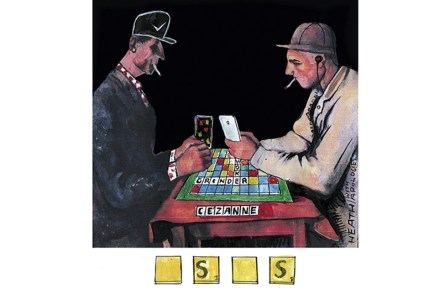
How I found friendship through online Scrabble

The internet, as we all know, is a place for rage and hate. It’s a free-fire zone in which even something as apparently innocuous as Facebook – original use-case: posting family snaps for your gran – ends up incubating armed insurrection and spreading 5G conspiracy theories. But what if there was some corner of it untouched by death threats, disinformation and the baleful influence of Vladimir Putin’s troll farms? What if there was still some corner of the world wide web which lived up to its original promise of connecting people who would not otherwise be connected, and what if once connected they were nothing but agreeable to each other? Be of good cheer. That corner exists. Not everyone is arguing with Owen Jones and India Willoughby.

Pay and dismay: the nightmare of ‘smart’ parking apps

In Notes from a Small Island, Bill Bryson bemoaned the ‘wilfully unhelpful’ ticket machines in car parks: ‘You go hunting for some distant pay-and-display machine, which doesn’t make change or accept any coin introduced since 1976, and wait on an old guy who likes to read all the instructions before committing himself and then tries to insert his money through the ticket slot. The remarkable thing is that everything about this process is intentionally – mark this, intentionally – designed to flood your life with unhappiness.’ While these apps are an annoyance for me, they’re positively prohibitive for those without smartphones Almost three decades later, you’d be lucky to find a parking meter at all.

Why are beds flat?

Last month in a Swiss hotel, I came across an idea so beautifully simple that I felt it would be immoral of me not to share it. The bed in our room, rather than having one king-sized duvet, was covered by two double-size duvets overlapping in the middle. Eureka! Given that the Swiss are world leaders in conflict-avoidance, it seems likely the idea originated there, although I have since learned the practice is also common in Scandinavia. Back in Blighty, when one person in a double bed rolls towards the edge, they take three feet of duvet with them, leaving their partner out in the cold. This typically leads to retaliation and often escalation. The Scandi-Swiss system, by contrast, creates a buffer, a DMZ of surplus duvet, which means that bedding fights are no longer a zero-sum game.

Self-obsession is killing music

Though I’m not the most avid fan of her oeuvre, I was cheered recently to see that Ellie Goulding wanted her new album to be less personal: ‘It was such a relief and really refreshing to not be sitting in the studio going through all the things that happened to me and affected me… it’s the least personal album, but I think it’s the best album because I got to just explore other things about myself. I just really, really enjoy writing; really enjoy being a singer.’ What a refreshing take on the creative process, which in modern times can often seem like a cross between a bulletin from the therapist’s couch and a ceaselessly-picked sore. Millennials can’t seem to get enough of spilling the tea, and that goes especially for their most successful singers.