Culture

Culture

The good, the bad and the ugly in books, exhibitions, cinema, TV, dance, music, podcasts and theatre.

The world has yet to see the best of Chinese literature

- Hong Kong  Imagine if every British novel published since the 1940s was about the Second World War. That’s about as accurate a view of contemporary China held by readers in the Anglophone West, say experts here. On the eve of this year’s Man Asian Literary Prize announcement, it’s worth considering why that’s still the case. The prize celebrates Asian literature written in, or translated into, English. While eligible authors span the continent from Japan to Iran, all previous winners have come from East Asia, and three out of those five from China. Harvey Thomlinson, a Hong Kong-based publisher, also had a mission to highlight quality Chinese literature in English translation.

Douglas Adams’s big idea

Had he not died 12 years ago, Douglas Adams would have been 61 yesterday. Google produced a doodle in his memory, and the Guardian published an interesting piece which declared that Adams remains the king of comedy SF, before going on to argue that he was unique, pretty much the only writer in that genre. Take a bow Mr Adams; you’re top of a league of one. But, in a way, Adams was, or very nearly was, unique. The Hitchhiker’s Guide to the Galaxy and its sequels are comedies of ideas flavoured with lashings of silliness: the restaurant at the end of the universe and Marvin the Paranoid Android, a robot beset by depression because he never uses his planet-sized brain – how gloriously silly and how very clever. How unique, almost.

Help! What is ‘lurching’?

David Cameron is not for lurching. No lurch to the right, he says. The word ‘lurch’ underscores commentary on the government’s difficulties; but what does it actually mean? As so often in these matters, Dot Wordsworth, our language correspondent, has a few erudite suggestions, one of which is this: ‘Lurching is a nicely pejorative word. A lurch could only be welcome accidentally. The word suddenly popped up in the 19th century. No one is known to have used it earlier than Byron in 1819, in Don Juan, where he contrives a Byronic rhyme: ‘A mind diseased no remedy can physic/ (Here the ship gave a lurch, and he grew sea-sick.’)’ The quotation is apt because the word’s origins are believed to be nautical.

Review: Mod! – A Very British Style, by Richard Weight

Doesn’t it all seem a long time ago? For years, the 1960s remained a key cultural reference, universally understood. But then, at some point, probably around the turn of the millennium, the Eighties took over and the Sixties began to fade into a psychedelic version of 1920s sepia. The two periods, separated by the shame and loon pants of the Seventies, were both about being young and “cool”. They were also about being bang up-to-date and liberated from “old” thinking. And, in the way of things, both have aged badly. The Mods of 1960s Britain were a social movement wrapped up in a fashion statement. Modernism, by contrast, is timeless.

The worst idea in literary history: Sebastian Faulks is writing a “PG Wodehouse” novel

The history of literature is replete with folly but the news that Sebastian Faulks is writing a novel featuring Reginald Jeeves and Bertram Wooster knocks all other blunders into a cocked-hat. We are not gruntled. Madness, not to put too fine a point on it, seems the only explanation for such a project. Perhaps, like Gussie Fink-Nottle, Mr Faulks is a glutton for punishment. Like the newt-fancier, one supposes he must spend a good deal of time staring at himself in the mirror. As for the rest of us, well, like the BBC's present lamentable adaptation of Blandings this news has us groaning and wincing "like Prometheus watching his vulture dropping in for lunch". Harry Mount says most of what needs to be said about this nonsense (though he is too kind by far to Faulks' lame Bond novel).

Books do furnish a room | 7 March 2013

The first time you run out of space for your books is a rite of passage for booklovers. It’s the moment that you realise the extent of your addiction to these papery worlds. It’s also a time of anxiously wondering what on earth you’ll do with all the books you have yet to accumulate. Double stacking, piles on the floor, and visits to the charity shop are really just temporary measures; the only satisfactory solution is to get a new bookcase. Ikea has just released colourful limited editions of their Billy bookcases – thrilling news for spatially challenged booklovers. There are three new styles of this bestselling piece of Ikea design: one has an orange background, another a blue, and the last features a queasy-making black-and-white pattern.

Betty Friedan’s The Feminine Mystique at 50

More from Books

It’s the 50th anniversary this year of the publication of Betty Friedan’s The Feminine Mystique. According to the quote on the cover of my Penguin edition, ‘Feminism … began with the work of a single person: Friedan.’ Quite something, then. In fact any mention of Betty Friedan brings out something like post-traumatic stress symptoms in me, even though she died in 2006. When I was a student I invited her to take part in a Cambridge Union debate on feminism. She came, and frankly it was like entertaining Cleopatra. She was heroically grand, heroically ugly and with a brilliantly American, unabashed sense of her own importance. She asked me what subject I was reading and I said clumsily that I was ‘in history’.

‘Diana Vreeland’, by Amanda Mackenzie Stuart – review

More from Books

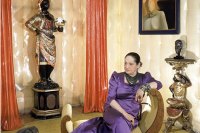
Over 80 and almost blind, Diana Vreeland was wheeled around a forthcoming costume exhibition at the Metropolitan Museum, issuing instructions all along the way about hats, shoes, lights and mannequins. She seemed, recalled the writer Andrew Solomon, an impossible old lady who couldn’t let go of her control and who was making everyone’s lives miserable for no good reason. And they did everything she’d said, and it was transformed. Her nearly sightless eyes could pick out things my youthful vision could not; enfeebled, she was still supreme at the discipline of chic. From childhood, Diana Vreeland had operated with deep faith in the power of self-presentation.

‘On Glasgow and Edinburgh’, by Robert Crawford – review

More from Books

Glasgow and Edinburgh are so nearby that even in the 18th-century Adam Smith could breakfast in one city and be in the other for early-afternoon dinner. For all that, these two cities cherish a rivalry and have followed different paths. Edinburgh, a royal capital until 1603 and a seat of parliament until 1707, and again in recent years, home to a great university and medical school and nurse to writers from Walter Scott to Joanne Rowling, has made almost as much history as Jerusalem. Edinburgh peers down from Castle Hill as if over a newspaper on its toiling rival to the west, besmirched with tobacco and slavery and laden with locomotives, boilers, ships, Vanguard-class nuclear submarines and incessant rain.

‘Mimi’, by Lucy Ellmann – review

More from Books

Harrison Hanafan is a plastic surgeon in New York. Every day, he slices and stitches deluded women, reshaping healthy flesh to pander to 21st-century aesthetics. One Christmas Eve, absent-minded Harrison finds himself prostrate on the icy sidewalk of Madison Avenue. ‘Ya can’t sit there all day, buddy, looking up people’s skirts,’ says a plump, sweaty-faced middle-aged woman as she hauls him to his feet. This is Mimi, the antithesis of Harrison’s neurotic patients, and — it transpires, after a few more twists and turns — the love of his life. Harrison has recently parted from pretentious Gertrude, a woman who conceived a child by ‘parthenogenesis’ and ‘batiks without irony’.

The Childhood of Jesus’, by J.M. Coetzee – review

More from Books

Stripping down prose is not a risk-free undertaking. The excision of adverbs and the passive voice is sound practice in journalism. However, to make very bare writing a thing of beauty in fiction requires enormous skill. Hemingway’s short stories — those clean, well-lighted places — manage it. Despite its author’s fellow possession of a Nobel prize, J.M. Coetzee’s new novel does not. In The Childhood of Jesus the South African eschews the baroque only to tend to the banal. Davíd and Simón arrive by boat in an unmanned Hispanophone country. They come to the city of Novilla, where a bureaucracy serves the needs of newcomers. Davíd is about five.

William Burges and the High Victorian Dream’, by J. Mordaunt Crook – review

More from Books

It is 32 years since the first edition of this hefty book appeared in 1981. The original was based on the research materials amassed by Charles Handley-Read, the pioneer scholar and collector of Victorian decorative arts and one-time art master at Bryanston, who killed himself in 1971. Other people’s research notes are often not easy to use, and Joe Crook has greatly expanded that core material, and presented it in an illuminating schematic way. This second, revised and enlarged edition, as well as correcting errors and fine-tuning matters of detail, incorporates many hitherto ‘lost’ art objects by Burges, rediscovered in the aftermath of the first edition. The rich ‘cream and brandy’ literary mannerisms have also been toned down slightly.

‘Fanny and Stella: The Young Men Who Shocked Victorian England’, by Neil McKenna – review

More from Books

Mick Jagger, the Danny La Rue of rock, impersonates a woman on the cover of the 1978 Stones album Some Girls. Vaudeville performers in the Jagger mould love to put on lipstick and ‘false bubbies’ (as Neil McKenna calls them). Boy X-Factor contestants, with their shaved eyebrows, diamond earrings and nails lovingly manicured, present an almost Gloria Swanson-like image of adornment. Perhaps it is merely romantic to suggest that the stylised wigs and gowns worn by our bishops and high court judges also have a homoerotic component. The former Pope Benedict XVI’s ruby-red pumps were nothing compared to the faux ermines worn in the House of Lords.

‘O My America!’, by Sara Wheeler – review

More from Books

You might not expect Sara Wheeler, the intrepid literary traveller, to be anxious about passing the half-century point. Surely a person who can survive the mental and physical rigours of Antarctica, as she brilliantly documented in Terra Incognita, can cope with ageing and menopause? Wheeler herself was not so certain. In her restless, creative way, she met the advent of what she calls ‘the Frumpy Years’ by taking to the road, following the trails of six indomitable Victorian women across the United States. The combination of that nation of eternal makeover and of Wheeler’s travelling companions makes O My America! a curious and teasing book.

‘The Infatuations’, by Javier Marías – review

More from Books

A café in Madrid. From her table across the room a solitary woman watches an attractive couple share breakfast morning after morning and speculates pleasurably about their relationship. One day they fail to appear and as time passes she feels a deepening sense of loss. Later she learns that the man has been murdered, stabbed to death in the street — an apparently senseless crime. The tragedy of the happy couple touches and disturbs her. Then, almost accidentally, she finds herself becoming involved with the widow and the dead man’s best friend. At first all is straightforward: loss, grieving, consolation. Gradually the relationship becomes more complex: she begins an affair with the friend, recognising that she is little more than a stopgap in his life.

‘Daphne du Maurier and Her Sisters: The Hidden Lives of Piffy, Bird and Bing’, by Jane Dunn – review

Lead book review

Jane Dunn is something of a specialist on sisterhood. She has — we learn from the dedication — five sisters of her own; she has already written a book about the sisters Virginia Woolf and Vanessa Bell, and another about the cousins Elizabeth I and Mary, Queen of Scots. Now the du Maurier sisters are in line to capture the public imagination like the Brontës or the Mitfords, their group celebrity fortified by genuine claims to fame. The fascination for readers is the different character and destiny of each sister, plus their relationships with one another and with the dynamics of the family romance —  and few family romances have been more potent than that of the du Mauriers.

The importance of Pakistan’s literary festivals

For a country often conceived of only in terms of its troubles with terrorism, extremists and bombs, you could easily be forgiven for thinking that, in Pakistan, all forms of cultural expression have long ceased. But, in the latest edition of Time, there's an interesting piece by Omar Waraich about the cultural flipside of Pakistan that caught my eye. As the world’s attention has been drawn to Pakistan’s problems with Islamist militancy in recent years, a flurry of exciting new voices have stepped forward to share with their readers a more intimate and rounded look at the country and its people — winning many plaudits along the way.

Interview with a writer: Lars Iyer

People call Lars Iyer a ‘cult author,’ which is odd, because almost every paper to have reviewed him from here to Los Angeles has praised him endlessly. The ‘cult’ thing is probably down to people naturally associating innovative, serious and challenging art with the marginal. This no doubt plays up to Iyer’s own theories about the climate of contemporary literature, but the reception of these books tells quite a different story. While his manifesto claims masterpieces cannot be produced in our age, and that no contemporary literature could be as important as anything by Samuel Beckett, critics call his books masterpieces and constantly compare him to Beckett.

Review – Invisible Romans, by Robert Knapp

It's tempting to reduce the Roman Empire to a roll call of famous men and their infamous deeds. The Republic toppled with Caesar on the steps of the senate; freedom of speech was curtailed as brutally as Cicero's tongue; democracy became an act on Octavian assuming his stage name. However Robert Knapp, Professor Emeritus at the University of California, isn't interested in that version of history. Like Mary Beard, who pottered around Rome deciphering inscriptions for the BBC, he’s concerned with ordinary folk. His Invisible Romans range ‘from fairly wealthy to modestly well-off and downright poor, male and female, slave and free, law-abiding and outlaw’.

Discovering poetry: Samuel Daniel and the art of outliving death

from Delia When winter snows upon thy golden hairs, And frost of age hath nipped thy flowers near; When dark shall seem thy day that never clears, And all lies withered that was held so dear;    Then take this picture which I here present thee, Limned with a pencil not all unworthy; Here see the gifts that God and Nature lent thee; Here read thyself, and what I suffered for thee.    This may remain thy lasting monument, Which happily posterity may cherish; These colours with thy fading are not spent; These may remain, when thou and I shall perish.    If they remain, then thou shalt live thereby;    They will remain, and so thou canst not die. Nicholas Hilliard’s miniature portraits are bewitchingly beautiful.

Bookbenchers: Nick de Bois

Nick de Bois is the Conservative MP for Enfield North, and is part of the Tory Class of 2010. He talks spies, Eurovision and Machiavelli as he tells us about his favourite books. 1) Which book is on your bedside table at the moment? Lyndon Johnson, The Passage of Power 2) Which book would you read to your children? Harry Potter, good to read and good to listen too - win, win. 3) Which literary character would you most like to be? George Smiley - Tinker Tailor Soldier Spy 4) Which book do you think best sums up ‘now’? Joseph Heller's Catch 22 5) What was the last novel you read? The Governor's Wife - Mark Gimenez 6) Which book would you most recommend? The Help by Kathryn Stockett 7) Given enough time, which book would you like to study deeply?

Interview with a writer: Jared Diamond

In his latest book The World Until Yesterday, Jared Diamond analyses the behavioral differences between human beings in tribal stateless-societies and those living in bureaucratic nation states. Diamond says that if states only came into existence 5,400 years ago, and agriculture in the last 11,000, human beings have been wandering nomads for most of history. Therefore, if modern nations are relatively new concepts, we have much to learn from traditional cultures. Drawing on his experience of 50 years of field research in New Guinea, Diamond attempts to prove his thesis with a mixture of personal anecdotes and academic research.

The Last Days of Alfred Hitchcock

For the last 40 years it’s been impossible to interview Anthony Hopkins without him doing his Tommy Cooper impression. He’s obsessed with the bloke, constantly interrupting Silence of the Lambs anecdotes to do Cooper’s chuckle and hand flicking and patter. He was, therefore, the absolutely perfect choice to play Alfred Hitchcock. Actually, the new film’s not that bad. It tells a good yarn about the director’s wife Alma rescuing both him and Psycho, not to mention the 800 grand of their own money they’d sunk into the movie. The other actors are so good that most of the time you can almost forget Anthony Hopkins is wandering around in the middle of it all wearing a ridiculous fat-suit, itching to throw in a ‘just like that’.

The curse of the mummy

More from Books

The former Soviet Union is so down on its economic luck that it can no longer maintain Lenin’s embalmed body. A brash official from rural China called Liu Yingque decides to buy the deteriorating corpse, create a red tourist attraction in his own county, and so make the area rich beyond its wildest dreams. Liu’s only difficulty is finding the millions of yuan necessary to purchase Lenin. He soon hits upon a solution: he recruits a performing troupe from nearby Liven, a village in which every resident is disabled in some way, and dispatches them on a nationwide fundraising tour.

Of vice and verse

More from Books

‘All human life is binary’, explains a Vestal Virgin to the time-travelling heroine of Ranjit Bolt’s verse novel, Losing It. Young and lovely, Lucy’s plan is to lose her virginity. Entertainingly delivered, it’s an engaging subject, universal and rich in comic scope. Bolt’s burlesque is a frolicsome addition to a scanty genre, reminiscent of The Canterbury Tales via Pope’s ‘The Rape of the Lock’. He plunders deep erudition for this bawdy bildungsroman; not so much virtue rewarded as its abandonment thwarted.

Journalist, novelist, patriot, spy

More from Books

When I was a new MI5 recruit, working in Leconfield House in 1970, there was a group of middle-aged men who came and went at unusual times of the day, often gathering in the late afternoons, talking loudly and cheerfully. They were the F4 agent runners and I envied them; they seemed to be having a lot more fun than I was. F Branch, the counter subversion branch, was responsible, amongst other things, for monitoring the activities of the Communist Party of Great Britain and in particular for identifying its members, in support of Clement Attlee’s 1948 ‘Purge Procedure’, excluding communists and fascists from work vital to the security of the state. By 1970, the F4 agent runners, of whom John Bingham was one, had done a pretty thorough job.

What dogs know about us

More from Books

In Aesop’s fable of the Dog and the Wolf, the latter declares that it is better to starve free than be a fat slave, but the fact is that, without man, there would be no dog at all. When people eventually began to form permanent settlements, a new food source appeared: waste. Wolf packs, less fearful of man than others, less aggressive too, took advantage, and turned themselves into dogs. Natural selection works in mysterious ways. Years ago, before the gender police were on the prowl, this book’s top title would have been Man’s Best Friend, for the ‘genius’ that it describes is the dog’s talent for inter- action with humans. Neither a teaching manual nor an anthology of heroic dog stories, this is a work of scholarship. It has 67 pages of notes.