Culture

Culture

The good, the bad and the ugly in books, exhibitions, cinema, TV, dance, music, podcasts and theatre.

Across the universe – John and Paul are in each other’s songs forever

More from Books

The world’s love affair with the Beatles began, arguably, with the release in October 1962 of the group’s first single ‘Love Me Do’, full-blown Beatlemania following hard on its Cuban heels. Will we still need them, will we still feed them, when they’re 64? The answer appears to be a resounding and remunerative yes. Beatlemania is for life, not just for Christmas. Beatles books increasingly obtain to the condition of poetry, in that more people want to write them than read them. Yet still they keep appearing in bookshops. And every time a new volume about the group is published – like all those of sound mind, I have loved their music, films and minutiae since childhood – I ask myself: what is different about this one? Will it be in the style or the substance?

How Anne Frank’s photograph became as recognisable as the Mona Lisa

Lead book review

Anne Frank died of typhus in Bergen-Belsen in late February 1945. Her last days were spent in the sick barracks caring for her sister Margot, who had a high fever and smiled contentedly, her mind already wandering. Anne, too, had been feverish, but ‘friendly and sweet’, according to witnesses. Her last recorded words were: ‘Margot will sleep well, and when she sleeps I won’t need to get up again.’  Ruth Franklin’s superb and subtle book pivots around this moment, which is described in a starkly titled central chapter, ‘Corpse’. Half her study tells Anne’s story up to the tragedy of her death.

Fight or flight?: 33 Place Brugmann, by Alice Austen, reviewed

More from Books

In May 1940, as the Nazis invade Belgium, the residents of a sedate apartment block in Place Brugmann, Brussels, wake to find that their longtime neighbours, the Raphaëls, have disappeared. Alice Austen uses this moment as the starting point for her subtle debut novel about how a diverse group of Belgians react to the Nazi occupation. She tells her story in snapshots, writing in the multiple first-person voices of those who remain at 33 Place Brugmann and those who flee. Charlotte is a young artist who may not see colours, but has ‘vision’. Miss Hobert is a gossip with ‘a rabid imagination’. The courageous and pragmatic Colonel Warlemont resists the occupation with the assistance of his dog Zipper.

Why are we routinely buying disgusting bread in Britain?

More from Books

‘Bread is simple. Or is it?’ That is the question David Wright poses about a keystone food that spans the globe and the whole of history. Breaking Bread examines the science behind the ur-loaf, the development of the Chorleywood method, the economics of selling the stuff, the role that it has played in religion and politics – and what its future might look like. The author is a third-generation baker. After a childhood spent in the Suffolk bakery his father owned and ran (Wright’s birth was announced in the bakery shop window: ‘I smelled bread, played with the dough, tasted it even before I have memory’), he left it all behind for university and a career in the theatre. But he returned to the family business in 2012 to try to save it as it floundered financially.

The danger of becoming a ‘professional survivor’

More from Books

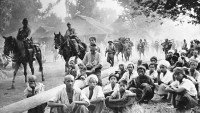
It was a relatively minor episode in a period marked by the killing of two African presidents, months of massacres in churches, schools and sports stadiums, a biblical exodus by much of the Hutu population, a cholera outbreak in refugee camps established in the neighbouring Democratic Republic of Congo (DRC), and a rebel takeover of the country. But it mattered a great deal to Beata Umubyeyi Mairesse, the author of this book, as she was one of the children evacuated in June 1994. At 15, she did not meet the criteria stipulated by the convoy’s organisers, so she and her mother hid under a tarpaulin sat upon by the smaller children as the trucks worked their painstaking way through a series of road blocks manned by Hutu militiamen hungry for fresh victims.

The sickness at the heart of boxing

More from Books

There is a lot of death in the latest, and potentially last, book on boxing by the South African journalist Donald McRae. In less than two years he loses his sister, both his parents and his mother-in-law. To cope with the trauma he returns to the sport that has sustained his life and work for 30 years. But when he reimmerses himself in boxing he does not like what he sees. He finds a sport where bouts are controlled by gangsters; where famous boxers dope and lie about it; where fights still have inadequate safety protocols; and where the centre of power has shifted from Las Vegas to Riyadh, lured by Mohammed bin Salman’s money. Each of these trends, McRae believes, knits boxing and death closer together. ‘I want boxing to sweep me away from real life,’ he confesses.

The agony of making music at Auschwitz

More from Books

Anita Lasker survived the Holocaust because, as a Berlin teenager, she had enjoyed her cello lessons. The Hungarian Lily Mathé’s violin performances had once impressed the man who became the Auschwitz concentration camp commandant. Alma Rosé, among Europe’s most talented musicians and the niece of Gustav Mahler, became the conductor who kept these young women and more than 40 others alive through ‘ferocious discipline’ and determination. In The Women’s Orchestra of Auschwitz, Anne Sebba recounts these intertwined stories with great sensitivity. She also explores the ethical questions that haunted the survivors who were once forced to play melodies in the darkest moments of the 20th century.

A picture of jealous rivalry: Madame Matisse, by Sophie Haydock, reviewed

More from Books

‘Your muse or your wife’ is quite the ultimatum to throw at an artist. But that was the choice Henri Matisse faced in 1939 when his wife of 30 years (you might know her as ‘Woman with a Hat’, 1905) had had enough of Lydia Delectorskaya (‘The Pink Nude’, 1935). It’s a dilemma which forms the crux of Sophie Haydock’s deliciously immersive novel about these two extraordinary women. A former journalist, Haydock is making it her mission to breathe life into women whose faces we know from famous artworks. Her gripping 2022 debut, The Flames, animated the tangled tales of the women who stripped naked for the troubled German artist Egon Schiele (including his sister and his sister-in-law).

The importance of honouring the enemy war dead

More from Books

There are several dozen graves from the second world war (and some from the first) in churchyards near my village on Salisbury Plain, but all of them British or Commonwealth ones. Nor have I seen any enemy graves elsewhere, although some 4,500 Germans died on British soil during the last world war, and a far smaller number in the Great War. Until 1962 they lay in many hundreds of cemeteries throughout Britain, Northern Ireland, the Isle of Man and the Channel Islands. But in 1959 the German equivalent of the Imperial (later Commonwealth) War Graves Commission (IWGC), the Volksbund Deutsche Kriegsgräberfürsorge (VDK), was given leave to rebury the dead of both wars collectively at Cannock Chase in Staffordshire, at what was to be the German Military Cemetery.

Controlling AI is the great challenge of our age

More from Books

In 1997 the world chess champion Garry Kasparov was beaten by an IBM computer system called Deep Blue. It had defied all expectations, exploring some 300 million possible moves in one second. The most that skilled chess players can contemplate is about 110 moves at any given time. It was a seminal moment in the advance of artificial intelligence – even if not fully understood, writes Richard Susskind in How to Think About AI. People did not wholly grasp the impact of the exponential power of computers, nor that new ways would be found to develop systems that could achieve human expert-level performance. Fast forward to 2016 and to AlphaGo, a machine designed to play the complex game Go, which has more possible moves than atoms in the observable universe.

The dogged women on the trail of Dr Crippen

Lead book review

On 18 November 1910, 300 women marched on the Houses of Parliament to demand the right to vote. Their protest was met with shameless brutality: punches, kicks, beatings and sexual assault from policemen and male bystanders. Three weeks earlier, a young woman named Ethel Le Neve had been tried for her part in the most sensational crime of the new century, the ‘London Cellar Murder’. The portrait of Le Neve presented by her barrister had been one of ‘perfect Edwardian feminine innocence’, docile, gentle, lacking in agency – a reassuring contrast to the strident, determined suffragettes, whose refusal to conform to societal expectations were to culminate in the attacks at Westminster. The suffragettes had their jaws broken; Le Neve walked free.

The adventures of the indomitable Dorothy Mills

More from Books

When Dorothy Mills disappeared to Haiti to research a travel book, the British press led with the headline: EARL’S DAUGHTER GOES TO SEE BABIES EATEN IN BUSH. Mills was never out of the news in the interwar years. She wrote nine novels as well as six travel books, all of which sold briskly, and in 1928 she was the only woman in the starry line-up at London’s Explorer’s Week (Ernest Shackleton’s skipper, Frank Worsley, spoke alongside her). She was born Dorothy Walpole, in 1889.Her father, Robert, became the fifth Earl of Orford when she was five. Her ancestors included Britain’s first prime minister, another Robert. The young Dolly travelled widely with her parents; her mother was one of the American heiresses who enriched the aristocracy in the 1890s.

The vagaries of laboratory experiments

More from Books

One usually likes to think that scientists know what they’re doing. Here’s something that might shake your confidence. In bio-medical research, scientists often use cell lines. These are in vitro cells, originally taken from a human or animal donor, which can be experimented on to help develop new drugs or treatments. The problem is that, according to one review, in ‘at least 5 per cent’ of studies, the scientists have totally mixed up where the cells came from. This means that in at least one in 20 studies that were sent off for peer review the scientists were completely confused about the most basic element of their research. They thought, for instance, they were doing research on lung cells when they actually had pancreatic ones.

The unfairytale life of two European princesses

More from Books

This hefty book is more about context – the turbulent years of mid-19th-century Europe – than it is about its two protagonists. Details of the many popular uprisings of the time, plus the jockeying for position of the main players and the battles and intrigues involved, are so packed into its pages that teasing out the stories of the two empresses is not always easy. The early married life of Empress Elisabeth of Austria, known as Sisi, sounds appalling. Her older sister had been groomed to marry the young Emperor Franz Joseph, but the moment he saw Sisi, then only 15, she was the one he wanted. It was impossible to turn him down. Much of the future of Bavaria (her parents’ kingdom), let alone that of her own family, depended on his goodwill.

The mystery of the missing man: Green Ink, by Stephen May, reviewed

More from Books

Stephen May used to write contemporary novels about men who ‘live outside big cities, lack self-confidence and rarely feature in contemporary fiction’, as he once put it, adding: ‘Even Nick Hornby’s characters are more sorted than mine.’ But a chance discovery of a Wikipedia page about the three weeks that a young Stalin spent in Edwardian London sent May’s imagination hurtling back through the decades. The result was Sell Us the Rope (2022), his sixth novel, which imagined what Koba, the Georgian then better known as Joseph Dzhugashvili, got up to in 1907 while attending the Fifth Congress of the Russian Social Democratic Labour party. May mixed the real with the fictional to great acclaim.

The comfort of curling up with a violent thriller

More from Books

Tsundokists of the world, unite! You have a new champion in Lucy Mangan, whose follow up to her entrancing memoir of childhood reading (Bookworm) is an unabashed paean to the pleasure of acquiring more books than you could ever possibly read in your life. That does not stop Mangan from trying, and this is a whirlwind tour through her voracious, encyclopaedic adult reading habit, one that not so much offers evidence of ‘how reading shapes our lives’, but how life shapes our reading. The ‘forced march’ of patriarchal school set texts in Mangan’s teens is relieved when she inherits a Maeve Binchy doorstopper and first encounters a book that is ‘unapologetically about women’.

Survival of the cruellest in 16th-century Constantinople

More from Books

The 16th-century Ottoman ruler Sultan Suleyman liked to impose himself on foreign monarchs from the start, always beginning official letters with the uncompromising assertion: ‘I am the great lord and conqueror of the whole world.’ In this sparkling account of his middle years, the second in an ambitious three-volume biography, Christopher de Bellaigue never actually describes Suleyman as ‘the magnificent’, his most widely known epithet. But he certainly conjures up his awesome presence at home and abroad in animated prose saturated with vivid colour and detail. So, in 1538, we encounter the sultan in his mid-forties, a swan-necked figure in a white lozenge-shaped turban, riding to war in the Balkans.

The world’s most exotic languages are vanishing in a puff of smoke

More from Books

It is one of academia’s horrible ironies that linguistics, the subject devoted to human communication, has managed to communicate nothing about its many startling and fundamental discoveries to the world outside its university departments. So any book such as this linguistic tour of some of the world’s exotic, hidden and endangered languages is to be welcomed with sobbing gratitude. Almost all the languages Lorna Gibb describes are staples of linguistics course books, but I’m assuming each will come as startling news to a general readership. One which was new to me was the sign language used by native north Americans throughout the Great Plains, and thanks to Gibb, I also now know how to interpret their smoke signals: two puffs = all is well; three puffs = help!

The Bloomsbury Group’s precarious paradise

Lead book review

The artist Vanessa Bell, née Stephen, the wife of Clive Bell, is enjoying the limelight this year as an exhibition of her work travels the country. Hot on its coat-tails comes Wendy Hitchmough’s beautifully illustrated new study of Bell’s life and art. As the former curator of the painter’s home at Charleston, Hitchmough writes with insider knowledge, supported by an armoury of scholarship: the bibliography alone stretches to 14 pages and the notes to 45. Somewhere within this carapace is a uniquely original and talented artist struggling to get out – a true radical whose story was one long, rolling sequence of experiments in leading as creative a life as possible within or without the constraints of her time.

The wonder of the human body

More from Books

Gabriel Weston is an extraordinary writer. An ENT surgeon who now prefers to carry out excisions of skin cancers, she has found a niche in exploring moral dilemmas in medicine. Her first book, Direct Red (2009), examined such clashes as a patient’s need for empathy and a surgeon’s requirement to be steely. A serious problem at the time was how the punishing schedules of junior doctors made it virtually impossible for them to give patients the attention and compassion they so often needed. Weston’s second book, Dirty Work (2013), was a novel – and no less ethically probing. Nancy, its female gynaecologist protagonist, takes on her department’s unpopular abortion lists, telling herself she is performing an essential feminist service.

A satire on the modern art market: The Violet Hour, by James Cahill, reviewed

More from Books

In James Cahill’s first novel, Tiepolo Blue, Don Lamb, a Cambridge art historian, expressed outrage when ‘Sick Bed’, a Tracey Emin-like installation, is erected in the college quad. It is tempting to imagine what Lamb would now make of the many artworks on display in The Violet Hour. Here, Cahill steps away from the rarefied world of academia and public galleries to expose the excesses of the international art market. At the centre of the book’s many strands is Thomas Haller, whose violet-coloured panels partially inspire the title. He is a world-renowned artist who, in the words of his erstwhile best friend and dealer, Lorna Bedford, has become ‘the moneyed ghost of his former self’.

Clouded memories: Ballerina, by Patrick Modiano, reviewed

More from Books

There are, broadly speaking, two types of artist: the explorer and the miner. The explorer keeps moving on, staking out new aesthetic or thematic terrain, while the miner keeps returning, digging deeper into the same earth each time. Patrick Modiano, the French Nobel prizewinner for literature in 2014, is an artist firmly of the second camp. Ballerina may be Modiano’s 32nd novel, but it feels more like the latest haunting chapter of the one long book that makes up his career. Blending noir, elegy, Paris and an obsession with memory, Modiano writes like Proust conducting a police line-up.

Nazis, killer dogs and weird sex: Empty Wigs, by Jonathan Meades, reviewed

More from Books

Jonathan Meades is, you might say, a baroque artist in a mannerist age. Whereas today’s younger and more widely feted writers think small – a Brooklyn sublet, a Camden Town love nest, the cracked mirror of the self – Meades goes big. And not just in physical terms (Empty Wigs tips the scales at nearly 3lb), but in scope. Where his contemporaries’ prose can be affectless and somehow skinless (a Paris Review interviewer said of Rachel Cusk, with apparent admiration, that her writing ‘feels contemporary, swift and “clean”’), Meades piles on the style, packing in metaphors, coinages and allusions until the crystals can’t take it, swooping between social classes, doing the police in different voices.

Liberty is a loaded word

More from Books

Just about everyone is for liberty, but we mean different things by it. Far-right libertarians want almost all constraints on their actions removed. They desire free markets, no unions, low taxes, free speech and the freedom to be very rich. The oppressed want freedom from tyranny: in extremis, they want to be free from jail and free to live without the threat of arbitrary arrest and torture. The moderately oppressed want more freedom than they have now, but within the context of a functioning democracy that is more equal, and more supportive, than the kind of society imagined by the right. They make a distinction between liberty and licence (complete freedom) of the kind that results in the pike dining at leisure on the minnows.

How Cold War Czechoslovakia became a haven for terrorists

More from Books

Cold War Prague hid its historic charms under a veil of grime and dilapidation. But, as we learn from this deeply researched and scholarly study, it was still a favoured destination for international terrorists, mostly Palestinians, after the 1968 Soviet invasion. They liked its hotels, its proximity to the West, its medical facilities, the tolerance and support of its security authorities and the quality of its light-arms manufacturing. Communist Czechoslovakia (CSSR) boasted relatively efficient security and intelligence services (generically referred to as the Stb). They were scrupulous record- keepers, and Stb archives, released after the Velvet Revolution with minimal expurgation, remain among the most complete of any former Warsaw Pact nation.

Butchered for feather beds: the brutal end of the great auk

More from Books

The great auk was a large seabird of the family Alcidae, a group which includes the razorbill, guillemot and puffin, breeding species of North Atlantic cliffs, islands and skerries. Before it was hunted to extinction in the 1840s, the great auk inhabited an ecological niche equivalent to that of penguins in the southern hemisphere. Flightless, and able to nest only on low-lying shorelines, it was nonetheless perfectly adapted to life at sea. Short, flipper-like wings enabled it to dive to prodigious depths for food; soft down and oily flesh kept it warm. Smartly attired in black and white, and with a massive bill, it stood nearly 3ft tall. The same traits that so suited the great auk to its oceanic life made it both conspicuous and vulnerable.