Henry Jeffreys

In defence of celebrity rosé

From our UK edition

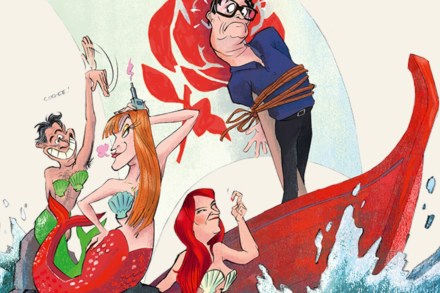
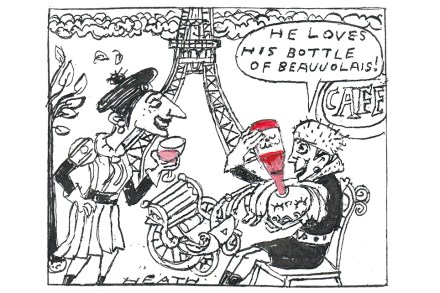
Alan Watkins, the late parliamentary sketch writer, told a story about his time on the Sunday Express in the 1960s. He was called into the office of his editor, Sir John Junor, thinking he was going to be told off for spending too much on expenses. Instead, Junor brought out a receipt from El Vino and said: ‘Only poofs drink rosé.’ How far we have come from those Neanderthal days. It’s not just Britain’s gay community knocking back the pink. Everyone’s at it. Jeremy Clarkson’s drink of choice isn’t beer, it’s rosé. As a nation we get through more than 100 million bottles each year. In fact, the British have enjoyed rosé for centuries. In the past, many wines would have been pink by default as all the grapes would be thrown in together.

How to be a good enough godfather

From our UK edition

Of all the inappropriate presents I've bought my godson over the years, the nadir was the Swiss Army knife I sent for his 11th birthday. I was pretty pleased when I ordered it: a genuine Victorinox, none of those Chinese knockoffs. He'll be removing stones from horses' hooves in no time, I thought to myself. But a week later he sent me a thank you note in unusually shaky handwriting saying the knife had been confiscated by his mother after he'd had it for only a day because he cut his hands to pieces. Had I ruined his chances of being a violinist or a heart surgeon?  It all started promisingly when I was asked to be a godfather in 2008.

In celebration of solo drinking

From our UK edition

‘Be not solitary; be not idle,’ wrote Robert Burton in The Anatomy of Melancholy. Now, 400 years later, one bar is taking his instruction to heart and banning solo drinkers. An Altrincham venue which goes by the gloriously 1990s nightclub name of Alibi will only allow groups in after 9 p.m. Owner Carl Peters said he introduced the policy after certain individuals had been ‘mithering other groups’ – ‘mithering’ being a northern word meaning to pester or make a fuss. Alibi also has a strict dress code: ‘No sportswear/trackies, no Stone Island, no ripped/frayed jeans, no baseball caps, no roadman vibes.’ I should point out to Spectator readers that a roadman isn't someone employed by the council to fix potholes, it's a young man with gangster pretensions.

Cheers to corkscrews!

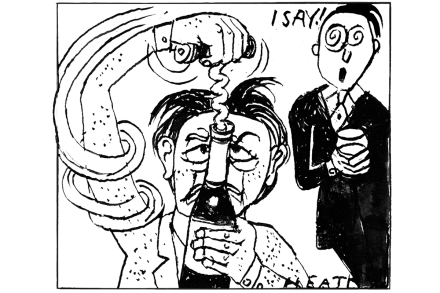
For the first 50 years of the corked bottle, there was no easy way to get into it. The combination of cork and a strong glass bottle came together around 1630, but the first mention of a device to open the bloody thing wasn’t until 1681. Cavalier get-togethers must have resembled the teenage parties I attended, with everyone desperately trying to open bottles using keys, pens, knives etc. Or using that technique where you bang the bottle against a wall with the heel of a shoe. Halcyon days. More likely the Cavaliers would have just taken the top off cleanly with a swift blow from a saber. Early devices for extracting corks were called “bottle screws.” According to wine writer Hugh Johnson, the word “corkscrew” was first used in 1720.

corkscrews

Beaujolais – a refuge for impecunious wine lovers

From our UK edition

With his three-piece suits, poodle hairdo and bizarrely bendy physique, Tom Gilbey looks like he was created in a secret laboratory beneath the streets of Turnham Green by the Wine Marketing Board. But I have it on good authority that he is a real person. Gilbey came to prominence last year as the self-styled ‘wine wanker’ who ran the London marathon, stopping every mile to taste a wine blind and guessing most of them right. Now we have the inevitable book; and while Gilbey isn’t an elegant prose stylist in the manner of Oz Clarke, Thirsty: 100 Great Wines and Stories (Square Peg, £20) is an enormously entertaining read. It’s part memoir, part guide to wine. The author comes from wine royalty.

Matthew Parris, Stephen J. Shaw, Henry Jeffreys, Tessa Dunlop and Angus Colwell

From our UK edition

31 min listen

On this week’s Spectator Out Loud: Matthew Parris reflects on the gay rights movement in the UK; faced with Britain’s demographic declines, Stephen J. Shaw argues that Britain needs to recover a sense of ‘futurehood’; Henry Jeffreys makes the case for disposing of wine lists; Tessa Dunlop reviews Valentine Low’s Power and the Palace: The Inside Story of the Monarchy and 10 Downing Street; and, Angus Colwell reviews a new podcast on David Bowie from BBC Sounds.  Produced and presented by Patrick Gibbons.

Labour’s Terminator, Silicon Valley’s ‘Antichrist’ obsession & can charity shops survive?

From our UK edition

37 min listen

First: who has the Home Secretary got in her sights? Political editor Tim Shipman profiles Shabana Mahmood in the Spectator’s cover article this week. Given Keir Starmer’s dismal approval ratings, politicos are consumed by gossip about who could be his heir-apparent – even more so, following Angela Rayner’s defenestration a few weeks ago. Mahmood may not be the most high-profile of the Starmer movement, but she is now talked about alongside Wes Streeting and Andy Burnham as a potential successor to Starmer. But – it all depends on what she can achieve at the Home Office. So, who does she have in her sights?

Hell is a wine list

From our UK edition

Wine lists give me the fear. I can still recall the prickle of adrenaline when my father handed me the leather-bound menu when I was in my early twenties because I had started working for a wine merchant after university. Should I play it safe or take a punt on something unusual that some people might hate? Perhaps it would be safest to pick the second cheapest. Their drinking pleasure was in my hands. Argh, the pressure. You’d think that after 15 years of writing professionally about wine this anxiety would have faded. It actually gets worse. The more I know, the more indecisive I become. Is the wine a bit too young? Was it a good vintage? Meanwhile the rest of the table is getting thirsty. One can ask the staff but in many places they’re just as clueless, if not more so.

Keith McNally’s memoir is strangely unappetizing

Harvey Weinstein has a memorable walk-on role in Keith McNally’s memoir I Regret Almost Everything. Taking a break from being New York’s most celebrated restaurateur, McNally wrote and directed a film called End of the Night that was screened at Cannes in 1990. Its auteur hoped that Weinstein, who distributed the previous year’s Palme D’Or-winning picture Sex, Lies, and Videotape, would warm to it. He was blunt: “I didn’t like your film and I’m not going to buy it.” As McNally swallows the shot, there’s a chaser. “But I’d still like to come to the after-party.” McNally admires Weinstein’s honesty, if little else. So I’m going to be straight, too. I didn’t enjoy I Regret Almost Everything. This is a shame, because the ingredients are promising.

McNally

The satisfaction of making wine the hard way

From our UK edition

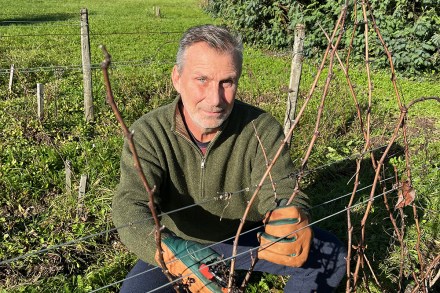
You can learn a lot about a winemaker by tasting his wine. In The Accidental Connoisseur, Lawrence Osborne wrote of one wine that smelt of ‘simmering insanity’, reflecting the angry Italian who made it. I didn’t have quite such an extreme reaction to Peter Hahn’s Clos de la Meslerie Vouvray, but I did deduce that he was idealistic, determined, romantic, perhaps a little dogmatic, and given to certain esoteric beliefs. Having now read his book Angels in the Cellar, I can say that my deductions were mostly right. Hahn is an American whose career as an investment banker came to an end when he suffered a breakdown in the back of a London taxi. He decided to give up the rat race and bought a neglected Vouvray domaine, where he moved with his family to live la belle vie.

Henry Jeffreys, Marcus Walker, Angus Colwell, Nicolas Farrell and Rory Sutherland

From our UK edition

29 min listen

On this week’s Spectator Out Loud: Henry Jeffreys looks at the potential impact of Trump’s tariffs on British drinkers (1:31); on the 400th anniversary of Charles I’s accession to the throne, Marcus Walker explains what modern Britain could learn from the cavalier monarch (7:10); Angus Colwell provides his notes on beef dripping (13:55); Nicolas Farrell reveals he refused to accept the local equivalent of an Oscar (16:40); and, Rory Sutherland makes the case for linking VAT to happiness… with 0% going to pubs, Indian restaurants and cheddar cheese (24:08).  Produced and presented by Patrick Gibbons.

Could Trump’s tariffs be good news for British wine-lovers?

From our UK edition

Professional Englishmen and women – doctors, accountants and even journalists – could once afford to drink first-growth claret like Château Latour on a regular basis. In 1972, when the Daily Telegraph’s Guide to the Pleasures of Wine was published, Pomerol was still an obscure corner of Bordeaux, known for offering ‘very good value’. Those days are long gone. Prices began to take off in the 1980s, with Auberon Waugh blaming ‘American millionaires looking to impress their guests’. The 1982 Bordeaux vintage was highly lauded by a then-unknown young lawyer called Robert Parker Jnr who would go on to become the most influential wine critic in the world. After this, anything Parker recommended became unaffordable to most British wine-lovers.

Is Trump going to kill off champagne?

From our UK edition

Well, it looks like it’s going to be war between the European Union and the US. A trade war that is, before you start digging a shelter in the backyard. In response to proposed EU 50 per cent tariffs on American whiskey, President Trump wrote on Truth Social, his own social media platform: ‘The European Union, one of the most hostile and abusive taxing and tariffing authorities in the World, which was formed for the sole purpose of taking advantage of the United States, has just put a nasty 50% Tariff on Whisky. If this Tariff is not removed immediately, the U.S. will shortly place a 200% Tariff on all WINES, CHAMPAGNES, & ALCOHOLIC PRODUCTS COMING OUT OF FRANCE AND OTHER E.U. REPRESENTED COUNTRIES. This will be great for the Wine and Champagne businesses in the U.S.

Is Indian whisky ready to take on Scotch?

From our UK edition

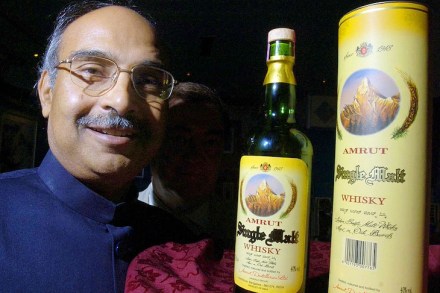
Indians drink a lot of Scotch whisky. In 2023 the country overtook France to become the largest market for Scotch in terms of volume, according to the Scotch Whisky Association. But could the world's largest whisky market be about to transfer its allegiance? Donald Trump is certainly hoping so. Last week, on Valentine’s Day no less, talks between the US President and Indian Prime Minister Narendra Modi led to the lowering of Indian tariffs on Bourbon from 150 to 100 per cent (Scotch whisky, despite some spirited lobbying by the British government, remains at 150 per cent). Yet despite this, the real rival for the affections of the Indian middle classes is not bourbon, but the country's fast improving domestic products.

Elon’s America, Welby’s legacy & celebrating Beaujolais Day

From our UK edition

45 min listen

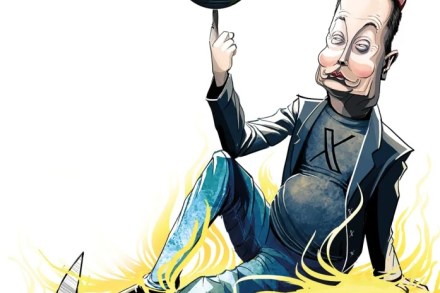
This week: welcome to Planet Elon. We knew that he would likely be a big part of Donald Trump’s second term, so it was unsurprising when this week Elon Musk was named – alongside entrepreneur Vivek Ramaswamy – as a co-leader of the new US Department of Government Efficiency, which will look at federal government waste. When Musk took over Twitter, he fired swathes of employees whose work was actively harming the company, so he’s in a perfect position to turn his sights on the bloated federal government. It is, writes Douglas Murray, a once-in-a-generation opportunity to strip a whole layer of rot from the body politic. But can he translate his success in the private sector to the public sector?

The thrill of the Beaujolais Run

From our UK edition

‘Le Beaujolais nouveau est arrivé!’ If that phrase means anything to you, you’re likely of a vintage that remembers pre-Clarkson Top Gear. Growing up in the 1980s, you couldn’t miss adverts for the Beaujolais Run – an annual race to be the first to bring the new wine back to England. People would rush over to Burgundy in their Aston Martins and Jaguars, fill up with Beaujolais and roar back home. The idea for a race across France was cooked up by Clement Freud and wine merchant Joseph Berkmann in 1970. It really took off in 1974 when the Sunday Times offered a prize to the first person to bring a case of wine back to the newspaper’s offices following its release at midnight on the third Thursday in November.

From public bar to cocktail bar: books for the discerning drinker

From our UK edition

One of the joys of getting older is the appreciation of the solitary pint. But what to do as you sip your hard-earned beer? Usually after a suitable period of contemplation I’ll start fiddling with my phone. Not Adrian Tierney-Jones; he writes books, and his latest, A Pub for All Seasons (Headline, £20), is a poetic meditation on the public house, its history and place in our culture with some memoir deftly thrown in. Most of all it’s an appreciation of what makes a pub great: the layers accumulated by decades – centuries, sometimes – of human interaction. ‘The perfect pub,’ he writes, ‘is a kind of metaphysical palimpsest which we should try to imagine as a constantly evolving space.

It’s time to stop the war on Malbec

From our UK edition

The German historian Johann Wilhelm von Archenholz wrote about British tastes in alcohol in the eighteenth century: ‘In London they liked everything that is powerful and heady.’ Not much has changed since then. Blame it on the weather, blame it on the food or blame it on the good times, the British have always liked their drink strong.  But for how much longer will we be able to cheerfully knock back the Malbec when a new duty system is implemented in February? Wines between 11.5 per cent and 14.5 per cent ABV will have their own bands per 0.1 increment of alcohol. Which means the tax on your favourite 14.5 per cent Argie Malbec will go up from £2.67 to £3.10. Before last year’s budget it would have been £2.23. Plus there’s VAT on top of that.

Paul Wood, Ross Clark, Andrew Lycett, Laura Gascoigne and Henry Jeffreys

From our UK edition

33 min listen

On this week’s Spectator Out Loud: as Lebanon reels from the exploding pagers, Paul Wood wonders what’s next for Israel and Hezbollah (1:24); Ross Clark examines Ireland’s low-tax project, following the news that they’re set to receive €13 billion… that they didn’t want (8:40); Reviewing Ben Macintyre’s new book, Andrew Lycett looks at the 1980 Iranian London embassy siege (15:29); Laura Gascoigne argues that Vincent Van Gogh would approve of the new exhibition of his works at the National Gallery (22:35); and Henry Jeffreys provides his notes on corkscrews (28:01).  Produced and presented by Patrick Gibbons.

Cheers to corkscrews!

From our UK edition

For the first 50 years of the corked bottle, there was no easy way to get into it. The combination of cork and a strong glass bottle came together around 1630 but the first mention of a device to open the bloody thing wasn’t until 1681. Cavalier get-togethers must have resembled the teenage parties I attended with everyone desperately trying to open the bottle using keys, pens, knives etc. Or using that technique where you bang the bottle against a wall with the heel of a shoe. Halcyon days. More likely they’d just take the top off cleanly with a swift blow from a sabre and a loud ‘Huzzah!’. Early devices for extracting corks were called ‘bottle screws’. According to Hugh Johnson, the word ‘corkscrew’ was first used in 1720.