Culture

Culture

The good, the bad and the ugly in books, exhibitions, cinema, TV, dance, music, podcasts and theatre.

Wedgwood Museum: At risk

Arts feature

We are fairly certain that the late Robert Maxwell never met the even later Josiah Wedgwood, but Cap’n Bob’s nefarious legacy is now being keenly felt by Wedgwood’s descendants. For it was in the aftermath of Maxwell’s plundering of the Mirror Group that the Pension Protection Fund was established to compensate pensioners in the wake of insolvency. And now this legislation is being used to asset-strip one of the great museums of England. On the southern edge of Stoke-on-Trent stands the Wedgwood Museum, dedicated to ‘The People Who Have Made Objects of Great Beauty from the Soils of Staffordshire’.

A look ahead | 18 December 2010

Exhibitions

The trend of fewer temporary exhibitions in our museums is becoming established, as the cost of mounting blockbusters escalates beyond even the generous reach of sponsorship. This is in sharp contrast to the commercial galleries, which still put on as many as 10 or 15 different shows a year in the hope of tempting clients to part with their cash. Taking a keen look at forthcoming exhibitions is always a mixed pleasure: the expected counterpointed with the novel, the obvious with the obscure. Thankfully, there are still enough exciting prospects in the public sector to raise the spirits and move us to make a note in the diary.

Intimations of infinity

Arts feature

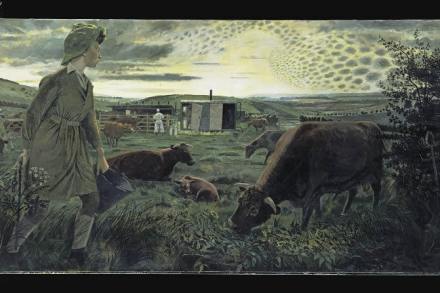
Andrew Lambirth finds a striking metaphor for the physical limitations of earthbound existence versus the infinite freedom of the spirit in Paul Nash’s painting ‘Winter Sea’ Paul Nash is one of the best-loved English painters of the last century, a great imaginative artist, always trying to discover the appropriate form for what he wanted to say. Nash was a philosopher-poet who expressed himself best (though he was a good writer) in visual terms and chose landscape painting as his primary vehicle. Although he died prematurely, in 1946 at the age of 57, his work stands easily above that of most of his contemporaries, and its originality and inventiveness have continued to inspire painters and beguile the public.

Culture notes

More from Arts

Hush: it’s secret When I go to a film, there are certain things I expect: the popcorn only affordable with a small loan; the endless standing up and sitting down as people push past, suddenly sure the film will look better from the row in front; these are a given. What I don’t expect is to be plunged into the film’s set, spending two hours wandering through the real-life version of the world on screen. But that’s what you get when you sign up to Secret Cinema. I booked a ticket to its latest screening, and arrived at the specified time and place without knowing what film I would actually be seeing.

Festival: City of music

Music

Lucerne is a city with powerful musical associations, the most celebrated being Wagner’s living there for the six years between 1866 and 1872, the most tranquil of his life, in Haus Triebschen, now a magnificent Wagner museum. Lucerne is a city with powerful musical associations, the most celebrated being Wagner’s living there for the six years between 1866 and 1872, the most tranquil of his life, in Haus Triebschen, now a magnificent Wagner museum. But he had visited before, most notably in 1859, when he finished Tristan und Isolde in the Hotel Schweizerhof; but also in 1850, a visit recorded with surprising sympathy by Stravinsky, a late convert to Wagner, when he visited Lucerne for the last time in 1969: ‘I went from Triebschen to the Schwann Hotel for tea.

All over the place

Theatre

Deceptively attractive. Romeo and Juliet tempts directors and leads them on while keeping all its false doors and secret pitfalls out of view. Rupert Goold’s RSC production is two fifths good and three fifths indifferent. A respectable score. This lovely, tricky and rather silly play isn’t the work of a genius but of a jobbing apprentice with a careless, or perhaps ambitious, sense of what could be managed on stage. Goold adds a spot of extra bother here and there, overusing the balcony, bunging Arabic music into the masque ball, and botching the costumes. Spectacular irrelevance seems to be his guiding principle. The street brawls are enlivened by whooshes of flame surging up from beneath the boards like an oil-rig blow-out.

The long march

Cinema

Peter Weir’s The Way Back tells the story of a group of escapees from a 1940 Siberian gulag who walked across Siberia, Mongolia, Tibet and the Himalayas to freedom in British India, a journey of 12 months and 4,000 miles, and a journey that will bring into sharp focus the domitability of your own crappy spirit, particularly if you always take the bus two stops up the hill, as I do. Peter Weir’s The Way Back tells the story of a group of escapees from a 1940 Siberian gulag who walked across Siberia, Mongolia, Tibet and the Himalayas to freedom in British India, a journey of 12 months and 4,000 miles, and a journey that will bring into sharp focus the domitability of your own crappy spirit, particularly if you always take the bus two stops up the hill, as I do.

A golden age

Music

Was there a golden age of English music a hundred years ago? From today’s vantage-point there probably was. Was there a golden age of English music a hundred years ago? From today’s vantage-point there probably was. The years 1910 and 1911 still excite the imagination as one contemplates the extraordinary richness of the new works that were being introduced to audiences in London and at festivals at that period. If you believed in the Zeitgeist, the spirit of the age, there was plenty to support you. The spirit was changing — ‘Rarely, rarely comest thou, spirit of delight’ was the ambiguous line by Shelley that Edward Elgar inscribed on the score of his Second Symphony.

Unsung poets

Radio

We might actually be glad of the time difference over in Australia this Christmas, so that we can switch on to Aggers and co. and listen in peace long after Aunt Maud has been safely tucked up with her mug of Horlicks and hot-water bottle. The Fourth Test in Melbourne promises to be the best present of the season, cheering up the nation and turning us all into Yes We Can people after decades of No Can Do. Who can remember a time when cricket has been so incredibly exciting, with England’s batters whacking the ball into triple figures, and wickets falling ball-on-ball not to the terrifying speed of the West Indians or the crafty spinning of those turncoat Aussies but to our own Broad, Swann and Anderson? It’s enough to turn me into an ardent member of the Barmy Army.

Top of the pops

Television

The most watched programme on British television this year was the special live edition of EastEnders, broadcast in February to mark the soap’s 25th anniversary. The most watched programme on British television this year was the special live edition of EastEnders, broadcast in February to mark the soap’s 25th anniversary. This was the one — I assume you’re keeping up — in which Bradley Branning plunged to his death and Stacey confessed that she had killed Archie. At the end, some 16.6 million people were watching, which is roughly 28 per cent of the population, still a fraction of the 50 per cent who watched the old Morecambe and Wise show on Christmas Day back in the 1970s. But television is no longer the glue that binds us.

Gardens: Beguiled by olive trees

More from Arts

Fashion may be Folly’s child, but that never stopped gardeners, when the urge was on them, from planting something à la mode. Fashion may be Folly’s child, but that never stopped gardeners, when the urge was on them, from planting something à la mode. That must be why olive trees (Olea europea), natives of the rocky dry soils of the eastern Mediterranean, are now so widely planted in British gardens. Prince Charles has them at Highgrove and they can be seen each year at Chelsea Flower Show so, hey, we all have to grow them, don’t we?

The road to ruins

More from Arts

Director Patrick Keiller made his name with London (1994) and Robinson in Space (1997), semi-documentaries recounting the peripatetic investigations into ‘the problem of England’ conducted by the unseen narrator and his fellow academic Robinson. The late Paul Scofield’s voiceover, rich in literary reference and understated satire, combined with meticulous shot composition to produce unclassifiable portraits of a country forever in decline from its literary and industrial pre-eminence. In the new film Robinson in Ruins, Vanessa Redgrave assumes Scofield’s role as narrator.

Exhibitions Round-up: lifting the heart

More from Arts

The run-up to Christmas is the perfect season for an exhibition of Andrew Logan’s joyful and extravagant art. The run-up to Christmas is the perfect season for an exhibition of Andrew Logan’s joyful and extravagant art. At Flowers (82 Kingsland Road, E2, until 31 December) is an installation of glittering sculptures which lightens the spirit and brings a song to the lips. Fashion meets fantasy in Logan’s signature mirror sculptures, his unique blend of resin, glass, fibreglass, paint and glitter. For the past 40 years, Logan (born 1945) has brought colour and light into people’s lives. He was a pioneer of the sensational long before the YBAs toddled into view; revealingly, Sir Norman Rosenthal, chief enabler of the YBAs, is a long-time admirer of Logan.

All the lonely people

Cinema

Whereas Sofia Coppola’s directorial breakthrough, Lost in Translation, featured two lonely souls rattling about in a Tokyo hotel, her latest film, Somewhere, features one lonely soul holed up in a Californian hotel, and isn’t half so good. Whereas Sofia Coppola’s directorial breakthrough, Lost in Translation, featured two lonely souls rattling about in a Tokyo hotel, her latest film, Somewhere, features one lonely soul holed up in a Californian hotel, and isn’t half so good. It’s not bad. It’s not hateful. It’s not evil. You won’t want to hunt it down and bring it to trial. But a second film about ennui suffers from ennui itself. And I’m not sure I can buy into the ‘emptiness of celebrity’ shtick any more.

Bring on the warmth

Music

Cold weather demands warm music. To which end I am delighted that Mojo, the monthly rock magazine for the more gnarled music fan, has chosen as its album of the year Queen of Denmark by John Grant. As we all know to our cost, albums adored by music magazines tend to be more rigorous and admirable than enjoyable, but this one is as warm and welcoming as a hot bath, a cup of mulled wine and an enormous cheque all rolled into one. Mr Grant, who is 41, gay, from Denver and very gloomy, is the former lead singer of a band called The Czars.

Interview: Semyon Bychkov: his own man

Opera

Semyon Bychkov has rather unspectacularly become one of the world’s most sought after conductors, and at present he is in London to conduct a series of performances of Wagner’s now least often staged canonical opera, Tannhäuser, at the Royal Opera House. Semyon Bychkov has rather unspectacularly become one of the world’s most sought after conductors, and at present he is in London to conduct a series of performances of Wagner’s now least often staged canonical opera, Tannhäuser, at the Royal Opera House.

Flawed curiosity

Theatre

His brain clouded with opium fumes, Jean Cocteau wrote Les Parents Terribles in just one week. It opens like a Greek tragedy crossed with a madcap sitcom. The ageing beauty Yvonne prances around her Bohemian apartment pining and weeping for her son, Michael, who has gone missing. When he turns up safe and sound, she throws herself into ecstasies of relief, leads him to the chaise-longue and showers his face and lips with kisses. He then breaks the news that he’s in love with a typist. She reacts like a cobra touched with a cattle prod. Spitting with anger she denounces the ‘lying hussy’, and vows never to let an intruder steal away her happiness and leave her to die neglected and unloved.

Speech impediment

Radio

It’s the juxtaposition of ‘u’ on ‘u’ that did for Jim. According to scientific study, a sequence of words with the same vowels in the same place can trip us up, as poor Jim Naughtie discovered on Monday morning. It’s the juxtaposition of ‘u’ on ‘u’ that did for Jim. According to scientific study, a sequence of words with the same vowels in the same place can trip us up, as poor Jim Naughtie discovered on Monday morning. If you missed the classic radio moment, he was trying to announce Jeremy Hunt, the culture minister, just before the eight o’clock news but didn’t quite get his name right, muddling up those initial letters.

Juggling statistics

Television

I love statistics. Possibly my favourite is the one from Bjorn Lomborg’s The Skeptical Environmentalist: the total number of birds killed in the Exxon Valdez disaster was the same as are killed each day in the US flying into plate-glass windows or the same as are killed in Britain every two days by cats. It’s good because you can use it in so many different ways: to annoy cat lovers; to amaze friends at dinner parties; and above all to bait those tortured souls for whom Exxon Valdez has become the ne plus ultra of the kind of Man Made Eco Armageddon that must never, at all costs, be allowed to happen again. Obviously, we’d all rather those little tweetie birdies didn’t die, but that’s not the point.

TV: Why I Love … Mastermind

I’m often told I should go on Mastermind. Although this isn’t a compliment (it’s actually a very polite, and very British, way of asking, ‘Can we talk about something else now?’), I still take it as one. Whenever someone mentions to me that I ought to audition for a spot in The Black Chair it tells me that, conversation skills aside, I’m at least on course to be the kind of person I’d like to be. If someone told me I should try out for The Weakest Link or, worse, The National Lottery: In It To Win It, I’d take it either as an insult or a suggestion that I really should engage in some sustained self-improvement.

Light relief

Exhibitions

The so-called Glasgow Boys had no manifesto, common background or style, apart from working in and around the city of Glasgow and sharing a belief in the importance of painting from direct observation and experience. They acknowledged the influence of the naturalism practised by the Barbizon and Hague schools in the later 19th century, and rejected narrative in painting and especially the sickly sentimentalism that bedevilled so much Victorian art. They were a loosely associated group of painters, sometimes called the Glasgow School but preferring to be known by the slightly more raffish title of the Glasgow Boys, who banded together principally to exhibit. This ploy worked and they achieved a degree of international recognition.

Broken hearts

More from Arts

In a bleak St Louis tenement, the Wingfields are buckling beneath the Depression and their mother’s old-fashioned aspirations. A framework of fire escapes and raised walkways provides convenient perches from which Tom (Leo Bill) can narrate and look on with foreboding as his lame sister is dressed and groomed for the long awaited ‘gentleman caller’. In a bleak St Louis tenement, the Wingfields are buckling beneath the Depression and their mother’s old-fashioned aspirations. A framework of fire escapes and raised walkways provides convenient perches from which Tom (Leo Bill) can narrate and look on with foreboding as his lame sister is dressed and groomed for the long awaited ‘gentleman caller’.

Incredible journey

Cinema

Monsters is a sci-fi alien film and is being promoted as a sci-fi alien film but it’s not really a sci-fi alien film as it’s a love story with a beautiful and unexpected ending. Monsters is a sci-fi alien film and is being promoted as a sci-fi alien film but it’s not really a sci-fi alien film as it’s a love story with a beautiful and unexpected ending. It just happens to be set in the future and happens to feature aliens, and is one of those films that was made for next to nothing — $15,000! — and yet has proved both a critical and box-office success. Fifteen thousand dollars! How is it possible? I spend that in Waitrose and still have nothing to put together as a meal for supper. How is that possible? I don’t know. It’s frightening.

Child abuse

Theatre

Christmas approaches. And kitchens and playrooms across the land resound with the joyous tinkle of little Josephs and Marys rehearsing their roles in the Nativity play. My four-year-old son, making his debut in a farmyard cameo, has just one line, ‘I’m a donkey and I’m very tired,’ which he repeats endlessly to the delight of his beaming dad. So I can only imagine the levels of pride surging through the families of Ciara Southwood and Madison Lygo as they prepared for the lead roles of Mimi and Janey in the Royal Court’s new play Kin, which is set in a girls’ prep school. The homes of these lucky ten-year-old actresses will have echoed with the play’s exquisitely turned dialogue. ‘Lazy shit,’ says Janey.

MacMillan’s loyalty

Music

In the first week of September, the Scottish composer James MacMillan sat in the ‘composition hut’ in the backyard of his Glasgow house, finishing the music he’d been commissioned to write for the Pope’s Mass at Westminster Cathedral. In the first week of September, the Scottish composer James MacMillan sat in the ‘composition hut’ in the backyard of his Glasgow house, finishing the music he’d been commissioned to write for the Pope’s Mass at Westminster Cathedral. ‘I’m enjoying it — oh, the triumphalism!’ he wrote on his blog. He wasn’t kidding. Two weeks later, as the small, frail figure of Benedict XVI processed into the cathedral, a fanfare sounded over his head.

Magnificent Mozart

Opera

The subtitle of Mozart’s Don Giovanni is ‘Il dissoluto punito’ (the rake punished), that of Rossini’s La Cenerentola is ‘La bontà in trionfo’ (goodness triumphant), while Monteverdi’s L’Incoronazione di Poppea might well be subtitled ‘Vice rewarded’. The subtitle of Mozart’s Don Giovanni is ‘Il dissoluto punito’ (the rake punished), that of Rossini’s La Cenerentola is ‘La bontà in trionfo’ (goodness triumphant), while Monteverdi’s L’Incoronazione di Poppea might well be subtitled ‘Vice rewarded’. They are the three operas that Glyndebourne is taking round the country this year, whether with moralistic intent I don’t know.