Culture

Culture

The good, the bad and the ugly in books, exhibitions, cinema, TV, dance, music, podcasts and theatre.

Never the same

More from Arts

Simon Starling’s art often involves some form of recycling — his controversial ‘Shedboatshed’ won the 2005 Turner Prize – and his ‘new’ exhibition at Camden Arts Centre (until 20 February) is no different. Simon Starling’s art often involves some form of recycling — his controversial ‘Shedboatshed’ won the 2005 Turner Prize – and his ‘new’ exhibition at Camden Arts Centre (until 20 February) is no different.

More real art, please

More from Arts

Although I am an admirer of Dulwich Picture Gallery, and like to support its generally rewarding exhibition programme, I will not be making the pilgrimage to see its latest show, Norman Rockwell’s America. Although I am an admirer of Dulwich Picture Gallery, and like to support its generally rewarding exhibition programme, I will not be making the pilgrimage to see its latest show, Norman Rockwell’s America. This is not just because it’s quite a hike to Dulwich for me, involving a bus, a train, another bus and another train (anything in excess of three hours from door to door), but also because I don’t think the trip will be worth it.

Going for gold

Theatre

There’s gold out there. The search for lost masterpieces beguiles many a theatrical impresario but with it comes the danger that the thrill of the chase may convert a spirit of honest exploration into an obtuse reverence for the quarry. There’s gold out there. The search for lost masterpieces beguiles many a theatrical impresario but with it comes the danger that the thrill of the chase may convert a spirit of honest exploration into an obtuse reverence for the quarry. The huntsman starts to believe that neglect proves excellence. Sturdy Beggars, an independent troupe who accept no public subsidy, are mounting a season of ‘forgotten gems’ from Eastern Europe.

Witch craft

Opera

Is Humperdinck’s Hänsel und Gretel an opera for children of all ages, or for grown-ups and for children, or mainly for grown-ups? I went to the Royal Opera’s revival of it just after Christmas, to a 12.30 matinée (there were several), which I took to be for the benefit of children, as well as possibly being an unusual piece of thoughtfulness about transport on the part of the management. Is Humperdinck’s Hänsel und Gretel an opera for children of all ages, or for grown-ups and for children, or mainly for grown-ups? I went to the Royal Opera’s revival of it just after Christmas, to a 12.

Cruel cuts

Radio

You might be forgiven for thinking that the cuts to broadcasting have already been implemented, with nothing but Mozart on Radio 3 and the Bible on Radio 4 on Sunday. Meanwhile, we’ve discovered that the actor who played the unfortunate Nigel Pargetter in The Archers, Graham Seed, has lost 75 per cent of his income, with only a few weeks’ warning — is he another silent victim of the national overspend? Switch over to the BBC’s World Service and the New Year diet becomes even more stringent. No drama for at least a month, so that between the briefings on world news and sport there are instead endless repeats of The Strand, Crossing Continents or The Forum with just one or two new half-hour documentaries per week. We should be asking questions.

Waste not, want not

Television

‘I want everyone to be as angry as I am,’ says Hugh Fearnley-Whittingstall, and I hope he succeeds for the thing that makes him so angry is one of the things that makes me most angry, too: the senseless eradication of the world’s fish stocks. ‘I want everyone to be as angry as I am,’ says Hugh Fearnley-Whittingstall, and I hope he succeeds for the thing that makes him so angry is one of the things that makes me most angry, too: the senseless eradication of the world’s fish stocks. All this week on Channel 4, HF-W has been campaigning in a series of programmes called Hugh’s Fish Fight. In the first episode he set the scene nicely by going out with a trawler into the fishing grounds 80 miles off the north Scottish coast.

The crash from an Austrian perspective

It’s not all politics at Westminster. There’s a pretty good think-tank scene too, with lectures on topics that you’re unlikely to read about in the newspapers. One took place today: the Adam Smith Institute hosted a lecture by Steven G. Horwitz, from St. Lawrence University, entitled “An Austrian perspective on the great recession of 2008-09”. As many CoffeeHousers will know, "Austrian" refers to von Mises, Hayek and the others whose analysis of bubbles and crises certainly seems to fit current events. My colleague Jonathan Jones was there, and took some notes – which I have moulded into a six-point briefing.  It’s not often we do a post based on a think-tank talk – we may do more, if CoffeeHousers find them useful.

Death watch

Exhibitions

Although I stopped watching TV some years ago, films are a continuing solace and pleasure. Among the Christmas treats was a previously unseen Jack Nicholson movie, entitled The Bucket List. The plot revolves around two very different Americans, Nicholson and Morgan Freeman, both of whom are suffering from cancer and are given a mere matter of months to live. The Bucket List is their wish list of things to do before they die, some of the more exotic of which the wealthy Nicholson enables them to achieve. The excellent Freeman, a poorer man but the greater philosopher, reminds Nicholson of a more important consideration: the two questions asked of Ancient Egyptians at the gates of Paradise. Have you found joy in your life? And, has your life brought joy to others?

Hit Liszt

Arts feature

Damian Thompson highlights the gems among the prolific and pilloried composer’s nine million notes The extraordinary thing about Franz Liszt is that he remains one of the most famous composers of the 19th century despite the fact that the overwhelming majority of his music is forgotten — and likely to stay forgotten. He wrote enough of it, that’s for sure. If you were to listen to his works one after another without interruption, it would take about a week. I’m basing that estimate on the fact that Leslie Howard’s 98 CDs of Liszt’s complete piano music, which are just about to be reissued by Hyperion, last for just over five days. That’s nine million notes spread over 12 miles of printed pages, in case you were wondering.

Whine merchants

Music

Some albums you love instantaneously, others you have to work at. And, just occasionally, an album comes along that you know that you will love if only you can hear it enough times. Except that you won’t. You will keep on playing it, and still you won’t really like it, and still you will keep on playing it. Mine at the moment is the one by Mumford & Sons, the amusingly posh raggle-taggle folk group (all called Oli and Ben), who enjoyed a wondrous 2010, selling loads of records and wowing festival audiences (all called Oli and Ben). If only they could write a decent tune, they might be quite good. Last week I was perilously close to throwing in the towel, and putting on an old Steely Dan record instead, when it suddenly occurred to me: it’s the voice.

Twin peaks

Theatre

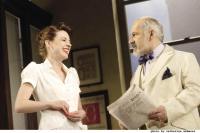
It’s that time of year. The great reckoning is upon us. Insurance is being renewed. Tax returns are being ferreted out. Roofing jobs are being appraised and budgeted for. And spouses are being trundled into central London for the annual session of dialysis at the theatre. It’s that time of year. The great reckoning is upon us. Insurance is being renewed. Tax returns are being ferreted out. Roofing jobs are being appraised and budgeted for. And spouses are being trundled into central London for the annual session of dialysis at the theatre. And here to meet them is Ayckbourn’s yuletide comedy Seasons Greetings, which features three hilariously miserable families bickering their way through the festival of ill-will. Ayckbourn is the Christmas blow-out of dramatists.

Production values

In the absence of any operas to attend, I’ve been reading the most recent defence of ‘director’s opera’, a book with the characteristic title Unsettling Opera, by the American academic David J. Levin. In the absence of any operas to attend, I’ve been reading the most recent defence of ‘director’s opera’, a book with the characteristic title Unsettling Opera, by the American academic David J. Levin. Anyone braving one of these books — there are plenty of them now — needs to have a high tolerance for jargon, indeed for deformed prose of many kinds. They tend to rehearse the same basic argument, in Levin’s case with close attention to a small number of operas and (usually) DVDs of some productions.

Single vision

Radio

There’s been much grumbling in the shires about Radio 3’s 12-day Mozart marathon. There’s been much grumbling in the shires about Radio 3’s 12-day Mozart marathon. Why burden us with so much baroque? Where do you go if you can’t abide all those notes? But actually there’s something wonderfully cleansing about knowing that what you’re going to hear at any time of day or night on the music station is bound to have a K number attached to it. It’s like going on a diet after too many mince pies and brandy butter.

Forgotten laughter

Television

The Radio Times now lists 72 channels, and that’s not all of them. The Radio Times now lists 72 channels, and that’s not all of them. No wonder television has to feed on itself, like a hungry tigress scoffing her cubs. In particular, it devours the past, so this week we had a Morecambe and Wise evening on BBC2, starting with the Christmas show from 1976, a third of a century ago. These shows got peak audiences of 28 million, inconceivable now, and just as French education ministers can allegedly tell you what every child in the country is studying at any moment, programme controllers could sigh with pleasure and know precisely what flickering image was in front of more than half the population. They riveted the nation, in Bagehot’s sense: they tied us together.

Direct observation

Exhibitions

Although he was the leading portrait painter of Regency England, Thomas Lawrence (1769–1830) has somehow slipped beneath the catch-net of modern public recognition. Although he was the leading portrait painter of Regency England, Thomas Lawrence (1769–1830) has somehow slipped beneath the catch-net of modern public recognition. He was the son of a Bristol innkeeper, who moved with his family to Devizes in 1773 to take over the Black Bear public house, and by 1780 young Lawrence was charming all and sundry with what Fanny Burney called ‘his astonishing skill in drawing’. His precocious talent came in handy when his father was declared bankrupt and Lawrence became the family breadwinner with his pencil profiles and pastels.

Turkish time travel

Arts feature

Harry Mount looks across the Dardanelles and sees yesterday’s weather today In Canakkale — the biggest town on the Dardanelles, where more than 130,000 British, Australians, New Zealanders and Turks were slaughtered in the 1915 campaign — Mark Wallinger, the 2007 Turner Prize winner, has dreamt up a clever little work about memory. On the Asian quayside, looking across to the Gallipoli killing fields on the European side of the straits, is an old shipping container, tricked out like a 1950s picture house; think Cinema Paradiso, and you get the idea. Using a 1950s-style sign, Wallinger has named it ‘Sinema Amnesia’ (Sinema is Turkish for cinema).

Lords of laughter

Features

What do the following comedians have in common? Morecambe and Wise, Ronnie Barker, Frankie Howerd, Bob Monkhouse, Peter Sellers. They’re all dead, yes. But something else. None of them was knighted. Instead they were all made OBE, an honour Michael Winner once charmingly described as ‘what you get if you clean the toilets well at King’s Cross station’. Still, they did better than Les Dawson, Tony Hancock, Tommy Cooper and Peter Cook. Those four got nothing. I find this curious. In most cases, at least. Hancock died a bit too young (suicide at 44), and accepting anything from the honours system would have turned Cook from satirist to court jester, in two ways a fool. But the rest?

Prime cut

More from Arts

The recent restoration of Fritz Lang’s Metropolis is now available for home viewing in three plush editions, in Eureka’s Masters of Cinema DVD series. The recent restoration of Fritz Lang’s Metropolis is now available for home viewing in three plush editions, in Eureka’s Masters of Cinema DVD series. Metropolis is the foundation of all subsequent science-fiction films. It is a movie of incalculable influence that deserves to be seen by all — and the chief attractions of this version are 25 minutes of footage unseen for 80 years, and long believed lost, as well as a recording of the original score. Premiered the year The Jazz Singer’s sound changed cinema, Metropolis was a peak of both silent film and German Expressionism.

Vapid Wagner

Opera

It is characteristic of Wagner’s operas, in their remarkable urgency and depth, that initially one thinks they are dealing with one or another opposition, for instance, Power versus Love in the Ring, only to find, as one gets further into them, that they are very much more complicated than that, and often that what seems to be their subject matter is not what actually is. It is characteristic of Wagner’s operas, in their remarkable urgency and depth, that initially one thinks they are dealing with one or another opposition, for instance, Power versus Love in the Ring, only to find, as one gets further into them, that they are very much more complicated than that, and often that what seems to be their subject matter is not what actually is.

Classy act

Theatre

Michael Grandage, boss of the Donmar, is a most unusual director. He has no ideas. His rivals go in for party-theme, concept-album, pop-video Shakespeare (provincial folksiness in metropolitan disguise), but Grandage just goes in for Shakespeare. He arrives with no prejudices or pieties, only solutions. He’s the bard’s delivery boy. His current production of King Lear sweeps the stage clean of the usual Ozzy Osbourne clutter and reduces the inventory to just three items, a map, a chair and a pillory for Kent. Nothing else. This daring austerity opens things up and allows the mysterious, grotesque, lurching and inscrutable play to do its best and worst, to charm, horrify, move and appal us. There is nothing Grandage won’t consider omitting.

Magical adventures

More from Arts

English National Ballet has a long history of Nutcrackers, each memorable in its own way. This one, created by ENB’s artistic director Wayne Eagling for the company’s 60th anniversary, is no exception. Contrary to today’s trends, Eagling has opted for a fairly traditional staging, steering away from the lure of modern readings, satirical reinterpretations and impenetrable psychological takes. For the seasoned viewer and newcomer alike, this Nutcracker has the same retro flavour that some illustrated books from 50 to 60 years ago possess, thanks also to Peter Farmer’s luscious sets and costumes. One of its greatest novelties is that the action takes place in this country and not in some fairy-tale German region, as is customary.

Weekly shockers

Television

Did you hear the one about Jordan’s disabled son? Unlikely, since you probably don’t watch Tramadol Nights (Channel 4), nor read the Mirror (‘Katie Price furious after Frankie Boyle joke about her disabled son’), nor the Guardian (‘Frankie Boyle’s Katie Price joke sparks Ofcom investigation’). Did you hear the one about Jordan’s disabled son? Unlikely, since you probably don’t watch Tramadol Nights (Channel 4), nor read the Mirror (‘Katie Price furious after Frankie Boyle joke about her disabled son’), nor the Guardian (‘Frankie Boyle’s Katie Price joke sparks Ofcom investigation’). Don’t worry, I’m not going to repeat it here. What kind of sicko do you think I am: Rod Liddle?

Everyday surprises

Radio

It’s so unnerving, knowing there are going to be two big surprises tomorrow night (2 January) on The Archers, but having no idea what’s in store. It’s so unnerving, knowing there are going to be two big surprises tomorrow night (2 January) on The Archers, but having no idea what’s in store. Experience warns me that it’s not going to be pleasant. But who’s for the chop? The press release says one half of the double-whammy will play out an existing storyline. That’s easy. I bet we’ll find out that Ian is the secret father of Helen’s baby. For the uninitiated, he’s gay but ages ago wanted to be a sperm donor. Meanwhile, Helen opted for IVF having given up on men — except for her pal Ian.

RIP: Captain Beefheart

It’s as John Updike once put it – they’re getting within the big fella’s range. Captain Beefheart died at the weekend, the latest in a long line of interesting people from the world of popular music to pop his clogs. In commemoration then, here is his somewhat uncompromising and not hugely tuneful “Dachau Blues”, from the album Trout Mask Replica, recorded with the incomparable Antennae Jimmy Semens and the Mascara Snake. He was an acquired taste, Beefheart, but I liked him so it seems only right to pay one’s respects. Incidentally, has anyone ever met a woman, anywhere on earth, who liked Beefheart’s music?

Sunday Morning Country: Steve Earle & Emmylou Harris

A great song from Mr Earle's terrific album Train A Coming which was also covered by Emmylou on Wrecking Ball. Here they are together performing Goodbye: UPDATE: This post is now, alas, dedicated to Julian FitzGerald, old friend from Trinity days and much missed by all who knew him.

Arts administration: Questions of privilege

Arts feature

The rights and wrongs of internships for those who are seeking a first job have been hotly debated in the press recently, and nowhere more so than with reference to young people who hope to make a career in arts and music administration. But the principles remain the same whatever the discipline: is it legal for an organisation to employ people who are usually given a stipulated job when they become an intern, and not to pay them; and is it acceptable that these opportunities tend to go to young people who are already rich enough (through parental support or earnings from a gap year many cannot afford to take in the first place) to underwrite the costs of living while earning nothing?