Culture

Culture

The good, the bad and the ugly in books, exhibitions, cinema, TV, dance, music, podcasts and theatre.

People like us | 3 March 2012

Cinema

This week A Separation, Asghar Farhadi’s deceptively simple domestic drama, added the Oscar for Best Foreign Language film to its trophy case. Its success abroad has been attributed largely to its universally recognisable premise; unlike much Iranian cinema, Farhadi’s film feels modern, offering an intimate snapshot of social divisions in present-day Tehran. Most Western audiences will spend the first five minutes, in which we see a husband and wife asking a judge for a divorce, marvelling at just how like us these people seem. The film’s style feels familiar, too. As in Ingmar Bergman’s Scenes from a Marriage (which Farhadi openly admits to imitating), the camera is close-up, inquisitive rather than didactic. Morality, even the truth, seems to be subjective here.

A break from posh

Exhibitions

The actor Ed Stoppard is kicking off the year in some nice period costumes. One of our brightest young actors, he’s back at 165 Eaton Place in the new BBC Upstairs Downstairs (reviewed on page 60) playing the diplomat Sir Hallam Holland. It’s got gas masks, the Munich Crisis, cocktails, a dead pet monkey, the odd conchie servant and, not least from Ed’s point of view, some great clothes. ‘In this series I get to wear jodhpurs and hacking jacket, naval uniform, black tie, white tie and a dressing-gown that would make Hugh Hefner green with envy. It will look sumptuous — more so than the last series.

The Picasso effect

Exhibitions

Pablo Picasso (1881–1973) cast a very long shadow over the 20th century, not least in England. Although he did not visit this country often, he apparently had a high regard for it, despite his somewhat sketchy knowledge of its contemporary painters. He once complained, ‘Why, when I ask about modern artists in England, am I always told about Duncan Grant?’ This remark is usually taken as a slight to Grant, though the two knew each other and maintained friendly relations.

Good as Gold

This is a bit of a non-blog really, so apologies for that. Just that if you get a chance to buy the magazine this week, turn to Tanya Gold’s restaurant review first. She’s done The Grand Hotel, Brighton and it’s the best bit of writing I’ve seen for a bit, here, there or anywhere. The Grand, she says, and hotels like it, are ‘made of nylon and ennui and could live, full-sized, in Ian McEwan’s head.’ The English Channel, meanwhile, is ‘a stretch of water so boring it looks more like paint…….(it) is a disgrace and it knows it, it doesn’t even try to be a sea.’ And there’s much more; she even mentions the food. Pathetic plugging one’s own mag on one’s own mag’s blogsite.

Retro rubbish

Theatre

Joy of joys. Huge, fat, inebriating doses of adulation have been squirted all over Josie Rourke’s first show as the châtelaine of the Donmar Warehouse. It’s a breakthrough production in many ways. You have to break through the treacly tides of critical approval. Then you have to break through the Donmar’s overenthusiastic heating system, which sends unwary play-goers to sleep long before their bedtimes. Finally you have to break through the script — The Recruiting Officer by George Farquhar, one of those neglected classics that everyone agrees is marvellous and no one bothers to read. Hardly surprising. We’re in Herefordshire in 1706.

Sturdy specimen

Opera

A few weeks ago I was speculating anxiously on the possibility that even the greatest masterpieces, in opera or other art forms, might be exhaustible, or that anyway I might not be able to find anything fresh in them, and therefore might succumb either to a state of mild boredom, or else, like some critics, irritably demand that every production ‘break new ground’, as if it is the job of directors and performers to cater primarily to jaded palates.

New world order | 25 February 2012

Radio

Not much fuss has been made about it. We might not have realised it was happening if news of the leaving bash with its tales of uninvited guests (former staff members) had not been gossiped about in the press. But from March the BBC World Service will no longer be broadcasting from Bush House, that once very grand but now rather shabby crescent-shaped building at the heart of the Aldwych in central London. Instead, all 27 of the specialist radio teams broadcasting in Arabic, Persian, Swahili, Russian, Urdu, Brazilian Portuguese, Mandarin, Tamil and Nepalese...will be moving in to swanky new studios in Portland Place, just north of Oxford Circus, as part of the transformation of Broadcasting House. It’s hard to imagine the BBC, let alone the World Service, without Bush House.

All eyes on Melvyn’s hair

Television

An American reporter once said to me that all television in his country was fundamentally about race, and all TV in this country was about class. There was some truth there, I thought, if exaggerated. Then in one week along comes a new Melvyn Bragg series about class and another attempt to revive Upstairs, Downstairs, whose original ended on ITV some 37 years ago. Melvyn Bragg on Class and Culture began at BBC2’s prime time on Friday. There are problems with documentaries about class. In this case, one difficulty is Melvyn’s hypnotic hair. When he’s indoors, it is thick and lustrous, as if a King Charles spaniel had settled on his head. Out of doors, in the wind, it looks like a haystack in a hurricane, or a game of pick-up-sticks gone lethally wrong.

The Wow factor

Music

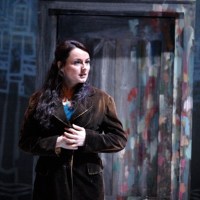
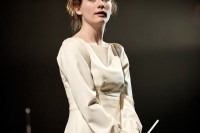
Next month, a formidable band of women will take to the stage at the Southbank Centre for the Women of the World Festival, now in its second year. The line-up includes veteran Annie Lennox, who will perform with rising stars Katy B, Jess Mills, and Brit Award winner Emeli Sandé as part of an eclectic menu of music, comedy, poetry, debates and workshops that cover topics ranging from domestic violence to vajazzling. But if Eighties icons and trends in personal grooming leave you cold, there is plenty more on offer. Top of my list is Irish actress Lisa Dwan’s (above) adaptation as a one-woman play of Beside the Sea, a French novella by Véronique Olmi (published in an award-winning English translation by Peirene Press).

A deafening silence

Music

One morning in 2007, the music critic Nick Coleman woke up to find that he was profoundly deaf in one ear. ‘The silence did not descend silently, however. It made a small sound. You might compare it to the sound of a kitten dropping on to a pillow.’ Within an hour this pffff had developed a pulse, and over the next few days it evolved into an unceasing clamour of clanks, zizzes and whistles. By now Coleman was in hospital and doctors were scratching their heads, as they usually do with tinnitus. I can remember the eyes of my doctor glazing over with boredom when I told him about my own tinnitus. When he heard that I wrote about music, and had been to far too many deafening gigs over the years, his disapproval hardened. A scribble on the pad, and I was on my way. Next!

British Sailors for British Ships!

Mary Wakefield, writing this week's Diary column for the magazine (remember: subscribe!), deplores the Art Fund's appeal for public subscribers to help purchase Yinka Shonibare's Victory in a bottle so it may be displayed at Greenwich: Every day, except when it’s raining, I cycle to work through Trafalgar Square and pause to gaze at the ship in a big plastic bottle on the fourth plinth. What makes it so horrid? The ship is a scale model of Nelson’s Victory with sails made of an African print and I’m told it symbolises the triumph of ethnic diversity over pallid, monocultural imperial Britain. But that doesn’t make it pretty. To each their own; Shonibare's work seems playful and even fun to me.

Displeasures of the flesh

Exhibitions

When Lucian Freud (1922–2011) was hailed as the Greatest Living Painter towards the end of his career, it was almost as a mark of respect for having survived so long and kept stubbornly painting in the way he wanted, without any quarter given to fads and fashions, in pursuit of truth to appearances, whatever that term may actually mean. This lifetime achievement award, though understandable (the English love a Grand Old Man), was misplaced, for Freud was not a great painter. He was often a striking image-maker, but from the overwhelming evidence of the knotted, gnarled and pelleted textures of his later paintings, the turgid accumulations of dry pigment, he disliked the medium of oil paint intensely.

A silent revival

Arts feature

Peter Hoskin says that thanks to the DVD and advances in film restoration there has never been a better time for movie fans Whatever happened to silent cinema? Oh, yes, that’s right, it was supplanted by the talkies in the late Twenties and early Thirties, until it suddenly came back to life in time for the Academy Awards next week. Never since the first Oscars were handed over in 1929 has a silent film looked more likely to win the Best Picture statuette. And even if The Artist doesn’t achieve what every bookie expects it to, then there’s always Martin Scorsese’s Hugo; not itself a silent film but — perhaps a first for a 3D kids’ film — it does revolve around the work of the early cinematic pioneer Georges Méliès.

Terribly long & awfully sentimental

Cinema

Unless I am Extremely Dim & Incredibly Thick, which is always a possibility — you think I don’t know? I do — this Stephen Daldry adaptation of Jonathan Safran Foer’s 2005 novel Extremely Loud & Incredibly Close just doesn’t seen to have any point, and is sentimental and banal as well as very, very long (or so it seemed). It may have worked as a book — I can’t say; I never read it — but as a film it’s a trial. Why has it been Oscar-nominated in the Best Picture category? No idea, although I would suggest it caters to America’s idea of itself as a nation that can triumph over anything, including 9/11, and to the notion that all scars can always be healed, which I’m thinking is patently trite nonsense.

The big push

Music

We are all just trying to make a living here, obviously. Musicians are no different. There are so many of them now, several generations of them, for the old ones never stop and new ones seem to appear every day. To make any impression at all, then, you need what sportsmen call ‘momentum’. That’s the mass of your talent multiplied by the velocity of hype. And so, each year, exciting young singer-songwriters are propelled into the public gaze, release records that aren’t quite as great as expected and are then mercilessly slagged off by everyone. This year it’s the turn of the young American singer Lana Del Rey, whose enigmatic ‘Video Games’ was a hit at the end of last year.

Callas versus Callas

Theatre

As a human, Maria Callas was a diva. As a musician, she was a divinity. In the early Seventies she came down from Olympus to share her wisdom with us mortals and gave a series of open classes at the Julliard in New York. These seminars inspired Terrence McNally to create a full-scale portrait of opera’s greatest star. The play opens as a biting slice of character comedy as Callas inflicts her brand of ‘coaching’ (i.e., character assassination) on three wannabe soloists. It’s amazing. She’s back. The legend walks the earth again in all her gorgeous and contradictory coloration. She’s exacting, brilliant, charming, shy, arrogant, needy, fragile, evasive, fiery, frigid, miserable, exuberant. She’s magnificently paranoid and heroically lonely.

Songbird in a gilded cage

Theatre

Sister Juana Inés de la Cruz is accounted the most considerable literary figure in 17th-century Latin America. I’m happy to take this on trust, remembering with great pleasure her comedy The House of Desires, a palpable hit when given in 2004 as part of the RSC’s still memorable festival of plays from the Spanish Golden Age. Sister Juana, born in 1651, was a favourite in the viceregal court in Mexico City. She shared the court’s delight in the cloak-and-dagger comedies of Calderón. But as a scholar and poet who expressed ‘abhorrence’ for matrimony, she had no option but to take the veil. Although this gave her the freedom to write, it didn’t allow her to leave the convent to see her play performed.

Character building | 18 February 2012

Radio

He writes about the stuff you’d rather not know, prefer not to think about, pretend to ignore. But it lives on with you in the mind. It won’t let you go. By his words, the sharp, brittle, spot-on dialogue, he forces you to recognise the limitations of your experience, your understanding. Roy Williams’s new trilogy of plays for Radio 4, The Interrogation, takes three predictable situations — a Premier League footballer rapes an underage girl, a white woman batters her racist husband to death with a brick, a black kid joins a gang and shoots dead a young mother — and fills in the details behind those black-and-white headlines. It’s not the story outline that matters, but the characterisation, the way the people speak, the language they use.

Eco-loons on the march

Television

Only this morning I got an email from an evidently very bright 17-year-old at a certain nameless public school. ‘I’m so sick of having to study “environmental ethics” for hours on end, being split into “study groups”, and making lovely colourful mind-maps for presentations; the syllabus is infantile, and I feel increasingly infantilised by my relativist, happy-clappy and downright incompetent teachers,’ he wrote. Amen, brother. I’m not sure who I feel sorrier for: the poor kids being force-fed this drivel; or the poor parents who probably imagined that for the price of £30,000 a year they’d bought the right not to have their beloved ones indoctrinated with all this specious eco-propaganda.

Unfinished business | 18 February 2012

Theatre

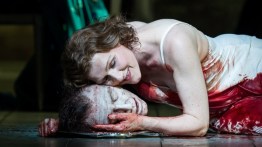
Absent Friends is the least technically adventurous of Alan Ayckbourn’s plays. Yet Jeremy Herrin’s revival (Harold Pinter Theatre, booking until 14 April) seems determined to display all its workings. The fact that the action unfolds in real time is thrust in our face with a big clock on the back wall, and an even bigger one on the curtain (lest we forget during the interval). Of the three couples who meet for a reunion, one is flattened into a caricature, with David Armand overplaying John’s fidgetiness, while Kara Tointon’s Evelyn (above) takes taciturnity to an exhibitionistic extreme. And then each awkward conversational pause is held just enough seconds too long for it to seem that the play is acting the actors, not the other way around.

Frankenstein’s family

Danny Boyle’s staged version of Frankenstein packed in the crowds to the National Theatre last year with its Olympian scale and throbbing orange sunsets. But if you were hoping for a more intimate invitation to the world of Mary Shelley’s monster, you might be better off popping down to the small but central Jermyn Street Theatre, for fringe company Primavera’s new production of Bloody Poetry. Howard Brenton’s 1984 play is unflinching in its depiction of the feckless ménage of poets that produced not only Frankenstein, but also Byron’s ‘Don Juan’ and Percy Shelley’s ‘Masque of Anarchy’, along with a traveling assortment of illegitimate children.

Memorable imagery

Exhibitions

The RWA galleries offer a superb setting for a sculptor, and Ivor Abrahams RA (born 1935) has taken full advantage of the beautiful top-lit space of the main rooms to present a lively retrospective look at his principal themes and achievements. The work ranges from the 1950s to the present day, and embraces a number of different media, from drawing, painting, collage and screenprinting to relief and fully three-dimensional objects. The scale also runs the gamut from hand-held to overwhelming (‘Head of the Stairs’ is three-metres high), while the variety of materials includes bronze, plastics, ceramic and flocking. This is the kind of work that cannot be judged from reproductions in books: it has to be seen and experienced to be fully understood and appreciated.

Our island story | 11 February 2012

Television

Desmond Shawe-Taylor, Surveyor of the Queen’s Pictures, on a radio programme that tells the history of the monarchy through 50 objects in the Royal Collection A History of the World in 100 Objects managed to squeeze the great paradigm shifts of anthropology into the interval between the roadworks sign and the all-clear, spiriting away traffic cones with remote customs and belief systems. What could follow something so confidently global if not an examination of our own strange customs and belief systems — some introspective anthropology?

Easy listening | 11 February 2012

Music

There is only one place these days where the music of Charles Villiers Stanford (1852–1924) sends its hearers into reliable ecstasy, and that is in choirs and places where they sing. Otherwise he is something of a bust. Despite having written seven symphonies, nine operas, 11 concertos (including three piano, two violin, a cello and a clarinet), eight string quartets and countless songs, piano pieces and other chamber works, he is now celebrated for a tiny fraction of his output. Stanford himself thought that to be renowned as a composer of Anglican Church music was not enough. He wanted to be measured alongside international (i.e., German) stars, and so went to Berlin to study with the leading teachers of the day, and in particular to meet Brahms.

Man about the House

Opera

They are lighting the candles at Covent Garden to honour one of the great singers of our age. Thomas Allen (as he was then) first appeared on the stage of the Royal Opera House in 1972, as Donald in Billy Budd, when Benjamin Britten was alive and his opera not nearly so highly thought of as it is today. This month he returns as a long-standing knight of the realm and, so far as our major house is concerned, a monarch to boot. He may have been born a commoner in County Durham 68 years ago but the baritone’s stellar international reputation granted him regal status many moons ago, particularly in the great Mozart roles.