Culture

Culture

The good, the bad and the ugly in books, exhibitions, cinema, TV, dance, music, podcasts and theatre.

The Good Life – how a 70s sitcom became a Conservative lodestar

Features

When the writers John Esmonde and Bob Larbey came up with the idea for The Good Life, they were looking for a vehicle for Richard Briers, who’d just turned 40. He was well established but not quite famous — the other three actors even less so. Felicity Kendal and Penelope Keith were cast on the strength of their performances in an Ayckbourn play. Paul Eddington was a ‘first eleven light-comedy actor’ (as Briers put it) but he was hardly a household name. In the opening credits, Briers’s name was above the title, the other three were below it. Briers’s Tom Good was the lead; Kendal was ensured a decent role as his wife, Barbara, but Jerry and Margo Leadbetter were initially conceived as supporting characters.

Moving heaven and earth

Theatre

Although I’ve some doubt — and this would be applauded by Galileo — whether in everyday life it matters very much to know whether the sun goes round the earth or vice versa, I don’t for one minute doubt that the great physicist’s conflict with Mother Church mattered profoundly and resonates to this day. To Brecht, writing Das Leben des Galilei in exile in 1938, shortly after the disastrous Chamberlain appeasement, his play asserted unprejudiced scientific inquiry not just against religious dogma but also the controls that fascism and profiteering have ever sought to impose upon it. He gets to this issue way ahead of Michael Frayn’s treatment in Copenhagen of the 1941 debate  between Werner Heisenberg and the Danish physicist Niels Bohr.

Sheer torture

Theatre

Ever been to a ‘promenade performance’? Barmy, really. The audience is conducted through a makeshift theatre space — often a disused ironworks — where the show is performed in disjointed snatches amid atmospheric clutter. Invariably hopeless as drama, promenade shows can be revealing as social anthropology. They lay bare a secret that lies at the heart of theatrical life: actors loathe play-goers. Without a paying audience, all theatre is simply am-dram. And actors have a morbid fear of slipping into the underclass of voluntary performance. So they covertly resent ticket-buying audiences who alone have the power to convert an unpaid show-off into a self-regarding thesp, with his agent and his Spotlight listing and his drink problem.

Missing | 21 February 2013

More from Books

What are so noticeably lacking in Mathew Brady’s interviews with the dead are the smells; likewise in Ambrose Bierce’s corpses their faces gnawed away by hogs near the Greenbrier, Cheat, Gauley; or the wounded roasted in gullies a foot deep in leaves at Shiloh, Spotsylvania; and you, reader, cannot supply what is left out.  So how much more eludes us? . . . the scent in the rain.

Bigmouth Strikes Again

Johnny Marr's at it again. ‘David Cameron is not allowed to like my music,’ he fumes. He revives his disgust for Cameron's love of The Smiths at least once every three months. God knows why he bothers. A bid to get his once famous name back in the papers? Or perhaps he likes to madden Tories? Ever since Cameron appeared on  Desert Island Discs, Tories have winced at the furious and occasionally bemused response from musicians name-checked by Dave. Marr was, as we know, most put out to find 'The Charming Man' on the list; and Paul Weller of The Jam was lost as to why Cameron liked 'Eton Rifles'. Weller memorably said: ‘Which part of it doesn't he get? It wasn't intended as a fucking jolly drinking song for the cadet corps.

Ice Age art at the British Museum: Geniuses of 40,000BC

Arts feature

The best way to approach any exhibition is with a clear and uncluttered mind, without expectations or prejudices. Of course this is often impossible, for all sorts of reasons, particularly when we have some familiarity with the subject on view. Inevitably we are besieged by images and opinions before we enter an exhibition of Manet or Picasso, but with Ice Age Art I was able to approach without any troubling preconceptions. I arrived at the British Museum in a state of pleasant anticipation, and within minutes I was entirely won over. The curator, Jill Cook, has given us an extraordinary glimpse of a long-distant age which yet feels incredibly fresh and relevant to us today.

The new seekers | 14 February 2013

Exhibitions

Over the past year or so, art world insiders have queued up to denounce the current state of the contemporary art world. Charles Saatchi started the ball rolling with a column at the end of 2011 in the Guardian. Breaking his self-imposed ban on interviews or writing, he launched a withering attack on an art world that, according to him, had descended to ‘the sport of the Eurotrashy, Hedge-fundy Hamptonites; of trendy oligarchs and oiligarchs; and of art dealers with masturbatory levels of self-regard’.

The comfort of strangers

Blink and you would have missed it, but Wednesday was World Radio Day, devoted to celebrating radio ‘as a medium’. You might think the BBC would welcome this Unesco initiative ‘to promote freedom of expression over the airwaves’ and ‘improve international co-operation between broadcasters’, but there’s nothing in Radio Times about it, and nothing on the various network websites. It’s as if radio has become such an established part of British life there’s no need to give it special treatment, to celebrate its existence as a way of ensuring its survival.

The Scarf

Poems

I saw Christine Lagarde outside The Wellcome Trust with a trolley case. She was wearing my scarf — the scarf I had when I was thirty two: a scarf with white dots on royal blue, or should I say French navy? — the very essence of what a scarf should be, which, in red, would be the scarf of the swagman or children’s book burglar but in blue remains jolly while suggesting tradition. Now, I admire Christine Lagarde and I support her policies. I believe the life of Christine Lagarde is something worth aiming for. I admire Christine Lagarde, but that is no reason to confer on her my scarf — the best scarf I ever had, the perfect scarf, which I have looked for ever since. You have taken a liberty, Christine Lagarde, guardian, lawmaker.

Schoenberg in shorts

Television

For anyone who missed The Sound and the Fury (Tuesday, BBC4) here is a reason — one of many — to catch it on your iPlayer: footage of a fierce, frowning and elderly Stravinsky, sitting in the empty stalls of the Théâtre des Champs Elysées and recalling the ‘near-riot’ which greeted the first performance of The Rite of Spring in 1913. ‘It was full — ’ (he gestured crossly around him) ‘ — of very noisy public. Very ’ostile public. I went up — when I heard all this noise — and I said, “Go to hell! Excuse me, Messieurs et Dames, and goodbye!

Double vision | 14 February 2013

Opera

This week has featured new productions at the Royal Opera and English National Opera of staples of the repertoire, both subjected to drastic rethinking. Tchaikovsky’s Eugene Onegin is the first production at the Royal Opera of the new Director of Opera, Kasper Holten, and on this showing I very much hope it will be the last. It has been reviewed coolly on the whole, but I haven’t read anyone being sufficiently abusive — adequately, that is, to the experience of sitting through a flawed but moving masterpiece that is systematically, though I’m sure involuntarily, slaughtered from the opening moments to the wretched close. This is an opera that Holten loves, and he has made clear that he learnt Russian to get to the heart of it.

Fatal flaw | 14 February 2013

Theatre

A new play about the banking crisis at the Bush. Writer, Clare Duffy, has spent a year or two badgering financiers and economists with questions about ‘the fundamentals’. ‘What is the value of money?’ she asks. ‘What do we want and need money to be?’ Her play has lots of zing and energy, and opens as a TV game show. The audience is divided into teams and individuals are hauled out of their seats and asked to engage in sporting contests with a big stash of 10,000 pound coins that gleam in coppery piles on the stage. Then the show becomes a drama. We’re in 2007. Two bankers, Queenie and Casino, hatch a scheme to short the American housing market. A tiny investment of £5 million will net billions, should the bubble go pop.

Mid-life crisis | 14 February 2013

Cinema

This is 40. Or perhaps I should say, is this 40? I haven’t yet reached that rounded age myself, so don’t have much of a frame of reference. But a quick spin around Wikipedia reveals that the film’s writer-director Judd Apatow (45) and its two stars, Leslie Mann (40) and Paul Rudd (43), all have the requisite number of years on them. They must know what they’re talking about, mustn’t they? Mann and Rudd play Debbie and Pete, a married couple who first appeared in one of the best comedies of the last decade, Apatow’s Knocked Up (2007). And their relationship is summed up by the film’s poster: Pete squats on the toilet, iPad in hand, while Debbie looks on askance through the bathroom mirror.

Painting the Fence

More from Books

For the first coat she started at the house end, he at the garden gate. They worked towards each other meeting fondly in the middle. For the second coat they began in the middle and worked outwards;  he abstracted, murmuring,  tweaking his phone with a painty forefinger. By the shrubbery he put down his brush and the garden gate groaned, clicked shut. Now the tin offers her its tedious advice For a perfect finish, apply a third coat. The days pass.  The paint hardens.

Medieval mystery

Arts feature

Medieval castles are generally dark and forbidding places that look as if they were built to prove the proposition that ‘form follows function’: the function was to be impregnable, and their high walls, crenelated and machicolated battlements, and slits for firing arrows instead of windows suggest that everything was subordinated to that dour defensive purpose. Castles are gloomy, intimidating buildings that sink the spirits. They were meant to intimidate and depress the population, and they succeeded. They still do. But we may have the wrong idea about castles. Recent research suggests that, in Italy at least, far from being solidly monochrome blocks, they may have been a riot of colour.

Finding beauty in junk

Exhibitions

Although Kurt Schwitters (1887–1948) did not invent the technique or theory of collage, he was one of the greatest practitioners of it, raising it in his work to the level of an independent art form. The Cubists may have made art out of collage first, but for them it was intricately allied with painting, whereas Schwitters made collages for their own sake. They are some of the finest things in this rich and varied exhibition, which focuses on his years in Britain (1940–8), though the full range of his work, including a fascinating selection of paintings and sculptures, is also indicated in this typically large Tate display. Viewing it is a potentially exhausting experience, so best to be selective in what you choose to study.

Peonies

More from Books

On an impulse, you could eat these flowers up the way they’re floating, stemlessly, side by side like scoops of ice cream in a crystal cup. White and softly drizzled with syrup (almost creeping down from the top) and shyly turning inward still, each closed bud leaks red along the seams and gleams like a hot sundae. What puzzles is how quickly these petals fan out, brown, flip, and fray along the edges. If only they’d stay put — if you could just keep peonies shut. Open, they frazzle.

Hall of mirrors

More from Arts

At first glance, Holy Motors is all about one astonishing performance — or several, depending on how you look at it. The performance in question is by Denis Lavant, who plays M. Oscar, a blank page of a man who scribbles over himself with make-up and wigs to portray a succession of different characters. At the film’s outset he is a Parisian businessman, leaving his home in a limousine to do battle with the markets. Soon after, he is an old beggar woman, a sex robot sheathed in rubber, a gangster, a father and more. We never really know why he does this beyond — in his own words — ‘the beauty of the act’. But then, look closer, and there’s more going on. Is it any coincidence that M.

What kind of film does ‘Hitchcock’ think it is?

Cinema

Hitchcock is one of those films which would have been much better off if it had taken a moment to sit down and decide on its own sensibility. Before a camera had even rolled, it should have pulled up a chair and asked itself: am I a film about Hitchcock’s marriage, or am I a film about his psyche, or am I a film about one of his films, or am I an inside-Hollywood comedy, starring Sir Anthony Hopkins lumbering about in a fat suit and perving at blondes? If it had asked itself, it might have settled on the one, and retained its focus, and told us something. But it didn’t, so it doesn’t, and it tells us nothing. It’s not awful. It’s just not much of anything; the kind of film you will walk away from with a ‘so what?’ and a shrug. ‘So what?

Blank canvas | 7 February 2013

Opera

I approach any production of Mozart’s last opera, La clemenza di Tito, in a state of acute trepidation: it’s not pleasant sitting bored through nearly three hours of one of your favourite two or three composers, one whom you regard as perhaps the most astonishing artist who ever lived. But that is how La clemenza di Tito has nearly always affected me — first, before it was revived in theatres, on a dodgy old Nixa recording, then, fairly often since, in various opera houses, its having now become a repertoire piece, something which was inconceivable only 40 years ago. Still, despite its canonisation, its defenders — its admirers still, significantly, regard themselves in that way — tend to strike one or another defiant or uneasy note.

English eccentrics

Theatre

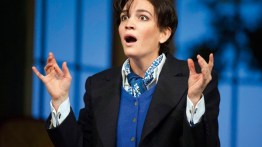
Quartermaine’s Terms is a period piece within a period piece. It’s set in that part of the early 1960s which was still effectively the 1950s. St John Quartermaine, a shy bumbler, is the oldest and most useless teacher at a Cambridge language school. All his colleagues are lovable freaks. There’s the Jesus-worshipping spinster shackled to her ailing mum. There’s the caravanning dad who takes calamitous holidays in rain-swept Norfolk. There’s the wannabe novelist ditched by his wife while writing a particularly heartfelt chapter about marital bliss. And there’s the boss, a fogeyish queen, who has no idea the school is heading for the buffers.

Making music

Music

Since the birth of the peer-to-peer file-sharing service Napster in the late 1990s, the record industry has been the unwilling poster child for entire businesses being overthrown by the march of technology. The major labels, once all-powerful, now stand Ozymandias-like, looking out over their barren empires; an ailing HMV, long ago diagnosed as terminal, is finally in its death throes; and it looks increasingly unlikely that music will ever be paid for again. An industry that’s resorted to The X Factor is an industry in trouble. Michael Breidenbruecker is the co-founder of the music streaming and recommendation service Last.fm, one of London’s big tech success stories. ‘When we started in 2000,’ he says, ‘there was no market.

Why can’t the British pop industry launch new acts that last?

Music

It’s all been happening in the pop world since I was last here. David Bowie released a new song, arguably his best in several decades. Wilko Johnson announced that he had terminal cancer, and a lot of men in their fifties wept for their own lost youth. HMV went belly up, and I ripped my £5 HMV voucher into shreds, hours before they decided they would honour the damn things after all. Is it my imagination, or have prices for CDs risen ever so slightly on Amazon these past few weeks? For them, I suppose, the job is done, and monopolistic practices can now creep in and grab hold of the market by the throat. A music lawyer I know is very pessimistic about the future of recorded music, not least because if there is no more money to be made, she won’t be making any either.

From Russia with love | 7 February 2013

More from Arts

If you want to know what’s so great about John Cranko’s choreography, look at the opening phrase of the final duet in Onegin (1965). The male dancer encircles the ballerina in an embrace that is not reciprocated, and then falls at her feet; she lunges forward to walk away from him, but her motion is counteracted by the downward and backward pull he performs while crouching on the stage behind her. It is sheer simplicity and sheer genius. The basic game of opposition and the use of gravity — at odds with ballet’s traditional aerial nature — encompass a unique range of emotions.

Small Chat

More from Books

I have no experience of small boys, I tell my son, driving him home. Well only you. He sits there pertly. They lose things, he chirrups. You must know that. Encouraged by this opening, I warm-up a mother’s inside info. So why did Jago kick Beastly? I quiz and, why did Ant fix his key-fob to his fly? His silence counts each snowflake; he is as secret as Switzerland. His strength gathers itself, cracks open his shoes, skitters through his jacket’s seams. Only his hands furl, last token of infancy, these he bunkers in his pockets.

Thoroughly modern Manet

Arts feature

There can’t really be many people who look at art with any regularity who continue to confuse Manet with Monet. But there are those who still think that Manet was an Impressionist, because so many of his friends and contemporaries were members of the group. In fact, Manet kept his distance and steadfastly refused to exhibit with them. His was an urban, studio-based art, not given to plein-air effects of atmosphere and local colour. He looked instead to the dazzling bravura of Franz Hals’s portraits, and the sombre and often majestic originality of Velázquez and Goya.

Ship’s Biscuit

More from Books

After Mother scarpered It was ship’s biscuit With shrapnel sparkles. It was hot spurts and gristle And cold snaps with a wet towel For stealing a puff from Dad’s fag Or sneaking a peek at his titty mags. But we buggers deserved no better. It was us that made her run off, With our bickers and our bungles. It was our bloody cheek. It was his bleeding knuckles.