Culture

Culture

The good, the bad and the ugly in books, exhibitions, cinema, TV, dance, music, podcasts and theatre.

Time Travel

More from Arts

Merrily We Roll Along (Menier Chocolate Factory, until 9 March) lets you escape the winter cold to a showbiz party in a Bel Air beach house. Still, despite its summery setting, Stephen Sondheim’s musical has a stock-taking feel that suits it to a run at the changing of the years. ‘How did you get to be here?’ the opening chorus asks Hollywood mega-success Franklin Shepard (played with charisma by Mark Umbers), who has alienated his friends and lost the will to live. George Furth’s book answers with a stepwise journey back in time from 1976, putting meticulous reverse engineering to touching effect. A wistful tune Franklin picks out on the piano turns out to be from his first hit — before he sold out.

‘My country first’

Radio

It’s not unusual for Kirsty Young’s castaways on Desert Island Discs to choose music that reminds them of people who are important to them. But Aung San Suu Kyi must surely have been the first politician-guest to ask her friends and family what she should take with her to that solitary isle, instead of carefully stage-managing her selection to present a particular view of herself. Who, for instance, would have expected to hear Tom Jones belting out ‘The Green Green Grass of Home’ on Sunday morning? But there he was, as cheesily sentimental as ever, chosen for Suu Kyi by her Burmese PA. She even confessed that she hadn’t listened to the song before the interview (which took place at her home in Naypyidaw) and said she had no idea whether she liked it or not.

Ordinary people | 31 January 2013

Television

There was little reason to be curious about David or Jackie Siegel at the beginning of Queen of Versailles (Monday, BBC4): he is the King of Timeshare and she is his Beauty Queen; they are building a palace in Florida, and modelling it on Versailles; it will be the biggest private home in America, when it is finished, and the Siegels will squeeze into it with their colossal fortune, their fleet of staff, their eight children and their bouquet of powder-puff dogs. ‘My husband deserves this house,’ says Jackie. ‘It’ll be like a lifetime achievement.’ There didn’t seem a whole lot more to find out. But then, after 30 minutes of screen time, came the crash: September 2008.

A Cirque to irk

Cinema

Just as Les Mis was soaringly monotonous, Cirque du Soleil: Worlds Away (3D) is soaringly pointless. No point to it whatsoever. I looked. I looked everywhere for a point, even under my cinema seat. (That’s how desperate I was.) But I came up empty-handed. It’s 90 minutes of sheer, total, utter pointlessness, as written and directed by Andrew Adamson (who directed the first two Shreks and the first two Chronicles of Narnia) and produced by James Cameron, who has made some good films, and Titanic. God knows what they were thinking of when they embarked on this. And boredom doesn’t even come near it. I experienced the sort of boredom that is also a seething rage spread thin. What am I doing here? When’s it going to end? Why did anyone imagine this was even a film?

Mauvais goût

More from Arts

It was dinner at a prize-winning hotel in Burgundy. I looked, stupefied, at an awkward arrangement of trapezoidal plates, unaccommodating to food and unergonomic to both eater and plongeur. There was a water glass of triangular section and silly cutlery that would bring even Philippe Starck’s most empurpled morphological fantasies into the arena of commonsense. I thought wistfully about the simple charm of the old Duralex glass. The timelessly perfect round-shouldered Burgundy bottle’s unaffected handsomeness only served to make its table-top companions look all the more ridiculous. Modern France is in a terrible state as far as design is concerned. Renault’s peerless record of ingenuity is gone: it has not produced a worthwhile innovation for nearly 20 years.

Unacceptable faces

Theatre

A play called Rutherford & Son gripped audiences in London 101 years ago. Set on Tyneside, it was the David Hare-style leftie hit of its season. It depicted the unacceptable face of capitalism, a face that belonged to John Rutherford, who rules the family glassworks by fear, hated by his workers and his children alike. It’s still a fresh, brutal-up-north story of a monstrous control freak devoted to work and money and nothing else. The show has a terrific twist at the end and it was an instant hit in London, went to New York and was widely translated. But it became a big news story when the unknown author, K.G. Sowerby, was revealed to be a woman. Women did not write plays back then.

Electricity

More from Books

It was a bolt from the blue, she said. You mean it was love at first sight? I asked. But no, she meant that they ran past the same tree in a storm and were flung to the ground side by side — an introduction of almost Biblical significance. Of course he helped her up and took her to the clubhouse and that was how it started, But now, she complained, the electricity’s off and we’re left lying down in the dark.

BBC Radio 2 Folk Awards: bottom of the class

You would think that asking for and receiving the names of the judges of a set of BBC awards would be a straightforward matter. The corporation’s own awards guidelines, available on its website, demand transparency. So it was surprising that when I asked who chose the winners of the BBC Radio 2 Folk Awards, thinking I’d write about them in my music blog, The Glamour Cave, I was told it was a secret. It was a more unpleasant surprise that a follow-up Freedom of Information request was denied on the grounds that the award ceremony, in the view of the BBC’s FoI department, was protected as 'journalism'. If an awards ceremony qualified as journalism, I was left wondering, then what could they possibly consider my blog to be? Did I want to know?

Gerald Scarfe, anti-Semitic? No.

So, that Gerald Scarfe cartoon, then. I don’t like it much, but then I like cartoons which make me laugh, (and especially so if they have animals in them). McLachlan, Honeysett, Rowson et al – and on a daily basis of course, Matt. I’m always at a bit of a loss with those big cartoons in the broadsheets which are attempting to tell me something very meaningful and make me stroke my chin. This one made me averse because it seemed to encapsulate the shrieking hysteria of the metro-left; translated into words, it says: ‘Netanyahu is building walls out of the blood of murdered Palestinian innocents!

Obsessed with Pinter

Arts feature

It’s the size of a Hackney bedsit but the ambience is cosily expensive. Sonia Friedman’s tiny office above the Duke of York’s Theatre in St Martin’s Lane has warm, pinkish lighting and elegant armchairs with thick, deep cushions. The dark wallpaper is obscured by framed posters of hit West End shows. Sprawled across the sofa there’s a touch of pure kitsch: a six-year-old poodle, snuffling and dozing, whose fluffy white forelegs are sheathed in the armlets of a scarlet tank top. His name is Teddy and he looks like the victim of a stag-night prank contentedly sleeping off his hangover. Opposite me sits Sonia Friedman — pretty, blonde, in her mid-40s — who occupies a formidable position as one of the West End’s leading producers.

Bring in the lawyers

Exhibitions

When collectors want to purchase an expensive work of art, they contact their lawyers to write up a contract with the dealer, spelling out pages of contingencies and indemnity clauses. ‘We have a steady stream of business writing agreements for collectors and galleries,’ said Jo Backer Laird, a Manhattan arts lawyer and a former general counsel at Christie’s. ‘We didn’t see much of this just ten years ago.

Seraphic misfit

Exhibitions

This year marks the 15th anniversary of the Estorick Collection and it is fitting that Giorgio Morandi (1890–1964), one of the most consistently popular of the museum’s artists, should inaugurate the celebrations. Although Morandi’s trademark still-life paintings of bottles and jars have been regularly shown in Britain (the last major show was at the Tate in 2001), the appetite for his work is unassuaged, perhaps because its delights are not revealed all at once. His work encourages repeated looking and gives something back each time, differently articulated. ‘The monk of the bottles’, as he was called, lived with his mother and three sisters in an apartment in Bologna, hardly travelling anywhere, and concentrating on working in his studio.

Alan Rusbridger’s new playmate

Steerpike is back in this week's magazine. As ever, here is your preview: 'While losses mount at the Guardian, the editor, Alan Rusbridger, has fallen in love. He keeps ordering the sub-editors to find space for articles about his new Fazioli piano. Cheeky responses have appeared on the website. ‘We always wondered how you filled your days and how you spent your fortune,’ wrote one indignant hack. ‘Now we know.’ Faziolis cost at least £50,000 and a friend at the Wigmore Hall tells me professionals won’t go near them. ‘They’re for loaded amateurs who think a pricy instrument will make up for clumsy fingerwork.

Word challenge

Radio

The first competition had 30,000 entries; the second more than 74,000. How many will be attracted to this year’s 500 Words challenge, launched by Chris Evans on his Radio 2 morning show on Monday? It’s open to any young person — under the age of 13 — to come up with a winning short story. To create a fiction that works as a vivid, compelling narrative in just 500 words, and no more, is no easy task. Shorter means crisper, sharper, edgier and more focused; no dead wood. That’s hard enough for a seasoned grown-up. The young writer must quickly learn how to stick to the point, to conjure up a scene or say what they want to say, in just over a page of single-spaced A4.

The hard sell

Television

`The older I get, the less tolerant I become of being treated by television like a child with Attention Deficit Hyperactivity Disorder. No offence meant to Dr Jago Cooper but, if I’m going to consider spending a valuable hour of my fast-diminishing lifespan watching a documentary about Lost Kingdoms of South America, the very last thing that’s going to persuade me is being importuned in the manner of those men with microphones at street markets trying to persuade me to buy an amazing labour-saving device I never knew I needed, the Radish-o-Chop.

Telling tales

Cinema

I cannot tell you about all the things Steven Spielberg can and cannot do. I cannot tell you, for example, if he can make decent goblets from Quality Street wrappers or funny teeth from orange peel, as I can, but what I am able to say is this: he knows how to tell a story; where to start it, where to finish it, what to do with all those fiddly bits in the middle. And although Lincoln is a film that pays fantastically close attention to politics — not a negative per se, but unless you are on top of your American history you may occasionally find yourself scratching your head — its narrative swoop largely takes the legislative detail in its stride, plus the star is Daniel Day-Lewis, which is always a thing. He is not so much an actor, more a shape shifter.

Orchestral tour de force

Opera

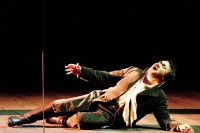
There is only one test that a performance of Verdi’s Otello has to pass: do you come out of the theatre drained, desperate at the suffering that human beings who love one another can nonetheless inflict, so that they torture or even kill the object of their love? Shakespeare’s play is about other things besides, indeed that may not be the major test of a production of it.

Seeing the light | 24 January 2013

Theatre

Meet Fenton. He’s a psycho. A year or so back he was banged up for murdering a preppy teenage girl in one of America’s less-enlightened southern states. Enter a campaigning congressman, John Daniels, who hopes to teach Fenton to read and write and to help him make something of his ruined life. The opening of Richard Vergette’s play is intriguing enough but a savage twist is on its way. Fenton rejects all the congressman’s overtures. Asked to recite the alphabet, he glares and grunts and spits out monosyllabic expletives. The only expressive medium for which he shows any talent is the flinging of furniture at high speed across the interrogation room.

Rediscovering Spotify

Music

All my life I’ve wanted to be able to write confidently about orchestral performances and I think I may have cracked it. So forgive me while I show off for a paragraph. In the last movement of Bruckner’s Seventh, Mariss Jansons and the Bavarian Radio Symphony Orchestra capture the jauntiness of the opening theme; there’s a twist of Haydn amid the grandeur. But it takes a long time for the brass and woodwind to settle down, and when Bruckner gathers his forces for a climax the conductor leans heavily on the gas pedal, as if he’s nearly missed a turning. No such problems with Karajan and the Berlin Philharmonic, where from the first bar the sheen of the violins tells you that every twist of the score has been mapped out, not to say ironed out, well in advance.

‘I was very naughty when young’: Michael Winner dies aged 77

Journalist and film director Michael Winner passed away today aged 77. He was a popular diarist in the pages of The Spectator, with his most recent offering appearing in January 2010. In that column, he described the filming of his TV series 'Michael Winner's Dining Stars', and mused about what might happen if it flopped: There’s a nasty Hollywood crew saying about artistes: ‘Bring on da puppets.’ That was largely the attitude of the production team. I’d have fired most of them. I know I’m not Leonardo di Caprio, Johnny Depp, Meryl Streep or anyone near the top of the star tree. But courtesy would have been appreciated. It was a great experience regardless. I loved the warmth, consideration, and sometimes confrontation, from people who hosted me for dinner.

Go with the flow

Arts feature

Last November Lutfur Rahman, the independent Mayor of Tower Hamlets, confirmed that the borough intended to sell a Henry Moore sculpture entitled ‘Draped Seated Woman’ (1958–9) that had been historically sited in the borough. Rahman’s reasoning was twofold: the sculpture was too expensive for the council to insure and the money raised from the work’s sale at auction, which could be up to £20 million, would ease the £100 million budget cut that Tower Hamlets is faced with over the next three years. The announcement elicited a strong protest from the arts lobby.

Real life | 17 January 2013

Real life

André Léon Marie Nicolas Rieu is a Dutch violinist, conductor and composer best known for creating the Johann Strauss Orchestra. So says Wikipedia. But I know better. André Rieu is a cunning hypnotist who has lulled my mother into a zombified trance from which I cannot waken her. His televised open-air concerts, which now take up an entire Sky channel, play constantly in her home. The rapt hysteria of the assembled thousands is reflected in my dear mother’s visage and I fear for her, I really do. The dangers of the genre known as ‘popular classical’ are already well documented. Richard Clayderman, Vanessa-Mae, Lang Lang, the Classic FM chart with its endless Air on a G String…I used to think, ‘If it gives people pleasure, why not?

My very own 1970s sex pest

The Wiki Man

To understand the Jimmy Savile affair, you had to be there. By ‘there’ I mean the late 1970s. At the time my school on the Welsh borders had its own very minor provincial sex-pest. I think every school did. Ours was known as ‘the 50p man’. Periodically he would approach a straggler on a cross--country run, or someone taking a walk (i.e. smoke) by the river, and expose himself, announcing, ‘If you touch this, I’ll give you this 50p.’ Even allowing for inflation, 50p was an offer you could easily refuse. So the schoolboy victim would scarper off, usually (perhaps not always) to relate the incident to general hilarity.

The making of a myth

More from Arts

When John Kelly was transported from Tipperary to Tasmania in 1841, for stealing pigs, he couldn’t have imagined that 170 years later there’d be an exhibition of paintings of one of his offspring at Dublin’s plush Museum of Modern Art (until 27 January). Yet here he is, Ned, the 19th-century Oz-born bushranger and cop-killer, as imagined by the Australian painter Sidney Nolan (1917–1992). Painted in the 1940s, Nolan’s Ned Kelly series deploys a childlike style to capture the criminal Kelly Gang’s 1880 shoot-out with police. In each painting Kelly wears his mysterious mask and hovers over the bloody action, more motif than man, as if observing his own canonisation into Oz legend.

Picking out the plums

Radio

‘How much did you say the TV licence cost?’ asks my American friend. ‘£145.50,’ I reply. ‘One hundred and forty-five pounds,’ she repeats, with astonishment. ‘And everyone has to pay it?’ ‘Yep. Every home with a TV.’ ‘That’s a lot of money.’ My friend is an economist, with the ability to be as precise about the US’s federal budget as I am about what I’ve just spent at the supermarket. She made me stop and think. If you multiply £145.50 by 26.4 million households, that is for sure a huge amount of money. Is it worth it? It’s the obvious question, to which the answer has to be yes, if the alternative is a commercially driven network, and especially when it comes to News.

Wodehouse to the rescue

Television

I knew this would happen: I’ve been watching season five of Mad Men on DVD and it’s spoiled me for normal telly. If you notice increased levels of toxicity — dissatisfaction and disgruntlement — in the following grumblings, then Mad Men is the reason.  Nothing pleases me so much, you see, and I am likely to remain crabby and sniffy until the effects of that 13-episode pleasure-binge wear off. Where to go from Madison Avenue in 1966? Which to choose of these bracing alternatives: the cuckoo-land of Mr Selfridge (Sunday, ITV), the dismal wastes of Utopia (Wednesday, Channel 4) or the company of those dashing, anxious, well-dressed Spies of Warsaw (Wednesday, BBC4)?