Culture

Culture

The good, the bad and the ugly in books, exhibitions, cinema, TV, dance, music, podcasts and theatre.

Bluestone 42: Dad’s Army it isn’t

Television

The thing that always used to bother me about M*A*S*H as a child was the lack of combat. You’d see the realistic film of choppers at the beginning and, obviously, the plotline would quite often include casualties coming in from recent scenes of action. But the exciting stuff always seemed to happen offstage, a bit like in Shakespeare where some character strides on and tells you what a terrible battle there’s just been and you’re going, ‘Wait a second. Did we just skip past the most exciting bit?’ This clearly isn’t going to be a problem, though, with BBC3’s new sitcom about a bomb disposal unit in Afghanistan, Bluestone 42 (Tuesday).

Mozart magic

Opera

It was some time since I’d been to a performance of Mozart’s greatest though not his deepest opera, Le Nozze di Figaro, one of the works of which I can’t imagine ever tiring. And it is, despite some heavy vocal demands, an opera which normally suits students at the music colleges well. There weren’t any obvious grave shortcomings in the first night’s performance of it at the Guildhall School of Music & Drama, but it annoyingly failed to achieve lift-off. Nerves may well have a lot to do with that: the playing of the Overture had enough problems of intonation among the winds, which later played beautifully, to suggest that.

Aversion therapy

Theatre

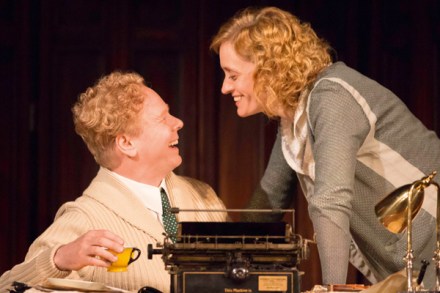
It’s been a while, I have to say, but last week I saw a show that thrilled me to the core. Trelawny of the Wells, the Donmar’s latest offering, is a tribute to the theatre written by actor-turned-writer Arthur Wing Pinero. A simple set-up. Gorgeous young luvvie, Rose Trelawny, has forsaken the greasepaint to marry a greaseball called Arthur Gower. He’s loaded. Rosie’s actor chums treat her to a farewell bash complete with antique gags, tuneless ditties, snatches from half-remembered dramas and long-winded orations consisting entirely of in-jokes. (You’ll have spotted that this is not the show that thrilled me to the core.

Transatlantic traffic

Theatre

There has been a lot of discussion recently, prompted by the start of President Obama’s second term, about the ‘Special Relationship’ between the United Kingdom and the United States. What seems to have been overlooked in the analysis of politics, economics and diplomatic relations is that the strongest and most culturally important link between the two countries is their shared passion for theatre. For all the razzle-dazzle of Broadway, the London of Elizabeth II remains, as it has since the rule of Elizabeth I, the world capital of the stage. Transferring from London to New York is a huge buzz for British actors, but it is a chance to sample the delights of Manhattan rather than a cultural pilgrimage.

If David Bowie really has returned to form, I’ll cry

Music

I haven’t heard the David Bowie album yet, but the Amazon order is in and Postie has been alerted as to the importance of the delivery. How often these days do any of us feel so excited about an imminent release? The ten-year gap between Bowie albums might have something to do with it, but the 30-year gap between decent Bowie albums is probably more relevant. And all this is down to the excellence of the single. Gary Kemp of Spandau Ballet wept the first time he heard ‘Where Are We Now?’, and I was blubbing well into the song’s third or fourth week on Radio 2.

Port na h-Abhainne

More from Books

We walked the cliff of Portnahaven listening to the grey seals sing on Orsay and Eilean Mhic Coinnich across the little harbour. Were they singing for the love of being here in this place, like us, far from griefs — and were they also singing, as we were, to each other?

David Inshaw: the great romantic

Arts feature

David Inshaw will celebrate his 70th birthday on 21 March, around the time of the spring equinox. On the eve of this grand climacteric, which will be marked by an exhibition of new and old work at the Fine Art Society, I went down to Devizes to interview him. He has lived for much of his life there, with brief interludes in Bristol, London, Cambridge and Wales. In Devizes he is surrounded by the countryside that has most inspired him — the Marlborough Downs and the open stretches of Salisbury Plain, the trees and hills of his beloved Wiltshire. Inshaw is a landscape and figure painter, known to many as a Ruralist (a group he co-founded in 1975 with his great friend Sir Peter Blake, and which he left in 1983).

Wandering eye

Exhibitions

‘When Matisse dies,’ declared Picasso, ‘Chagall will be the only painter left who understands what colour really is.’ Wandering around this splendid show you can see exactly what he meant. Chagall never used colour for cheap effect, but to convey meaning and emotion. The effect of seeing so many of his works together is almost overwhelming — a symphony hung upon a wall. But these aren’t the romantic paintings of Chagall’s later years, the visions of young lovers floating over seas of flowers. These are the urgent artworks of his youth, made at a time of immense upheaval. By focusing on these early years, to the virtual exclusion of his later work, this fascinating retrospective casts Marc Chagall in an entirely different light.

Foundling Hospital tokens

Exhibitions

‘Dear Sir, I am the unfortunate woman that lies under sentens of Death in Newgatt...’  So begins a letter of 1757 addressed to the powers that be at the Foundling Hospital in  London’s Bloomsbury. Written in a strong hand, it contains the poignant petition of a woman on death row, Margaret Larney, that her children, who have been admitted to the hospital separately, might ‘know one and other’. Even if the younger child hadn’t died shortly after admission, Margaret’s eloquent plea would certainly have been in vain. When an infant entered the hospital, its former identity was erased and siblings remained ignorant of their blood ties. But now, some 250 years later, Margaret is getting a second hearing.

Could Malcolm Tucker take on Alan Rusbridger?

Sad news has broken. If the online speculation is true, it appears that casting agents for the upcoming Guardian movie have overlooked Daniel Radcliffe for the part of Alan Rusbridger. Given that Harry Potter and AR are dopplegangers, Mr Steerpike reckons that the agents have missed a trick. For those who haven’t heard, the film will chart the paper's stormy relationship with Wikileaks. Benedict Cumberbatch is already getting to grips with the role of Julian Assange; the question now is, who will play Rusbridger? Incongruous rumours are circulating that the softly spoken editor will be portrayed by Scottish actor Peter Capaldi, aka Malcolm Tucker.

First Life of Pi, now Cloud Atlas. Why keep trying to film the unfilmable?

More from Arts

Whenever the possibility of a film version of a difficult or complex book is mooted, speculation mounts about how it will be done. Usually at this point some dull spark will pipe up that some novels are simply ‘unfilmable’ (though such reservations are sometimes shared by the authors of the novels in question: David Mitchell himself never believed that his novel Cloud Atlas could be turned into a movie: ‘My only film-related thought when I was writing the book was what a shame that no one would ever, ever film this,’ he said. ‘I was quite convinced it would never happen’).

Nick Robinson’s Battle for the Airwaves

Radio

Deep within the BBC’s inquiry into the Newsnight and Jimmy Savile affair is a comment by Jeremy Paxman so inflammatory as to demand its own investigation (lasting months and costing squillions). The trouble, he said, with BBC News is that it has become dominated by ‘radio people’. This was not, it seems, intended as a compliment. It’s as if, in Paxman’s view, the whole dreadful, dreary, demeaning muddle was the fault of those ‘radio people’, because according to Paxman they ‘belong to a different kind of culture’. You might think it’s of little importance that Paxman thinks himself cast from a different mould to, say, John Humphrys or Eddie Mair.

ITV’s Food Glorious Food is under the curse of Simon Cowell

Television

I sometimes worry that ITV — the middle child — doesn’t get enough of my attention and so this week I have decided to redress the balance: I devoted myself to episode one of Food Glorious Food (Wednesday, ITV). It’s a nine-part quest, hosted by Carol Vorderman, which aims to discover ‘Britain’s best-loved recipe’. O jubilate deo! This is how it goes: treasured family recipes are cooked up at regional events and tasted by one of four judges who choose a favourite and submit it to be tasted by the other three. The judges are Loyd Grossman (smooth), Anne Harrison (stern), Stacie Stewart (bubbly) or Tom Parker Bowles (apologetic).

Losing the plot | 28 February 2013

Theatre

Who got the most out of the credit crunch? Security guards, repossession firms, bailed-out banks and, of course, playwrights. Anders Lustgarten is the latest to cash in on five years of global misery with If You Don’t Let Us Dream, We Won’t Let You Sleep. The play, like the title, is effortful, disjointed and cumbersome. In the first half, a gang of fatcat bankers sets up a new financial instrument, Unity Bonds, which will generate profits from socially useful behaviour. This intriguing idea is sidelined in the second half. The action moves to a squatter camp where the banking system is about to be put on trial. Lustgarten assumes, no doubt correctly, that the audience is more in sympathy with anti-capitalists than with high finance.

Class prejudice is keeping talented children out of classical music

Music

Musicians have always had an uncertain social status in England, the traditional reactions varying from amused condescension to mild repulsion. The former was the old class-based judgment on men who had chosen to take up a profession which at best was associated with society women and at worst seemed menial; the latter directed towards brass players from rough backgrounds whose lips juggled pint pots with mouthpieces and not much else. The most respectable practitioners were probably organists, often referred to as ‘funny little men’, but taken seriously.

Le Nozze di Figaro

Opera

I went to two of the most familiar operas in the repertoire this week, one in HD from the New York Met, the other at the Royal Opera. Both were given in decent if not, with some exceptions, outstanding performances. The experiences led me to think again about the differences between seeing an opera onstage in a theatre and seeing one ‘live’ in the cinema. Our intermission hostess, Renée Fleming, repeated the usual formula about how there is no substitute for actually being present in the theatre where the opera is taking place, but I wonder what she would say if challenged on that point.

The new Design Museum: Prince Charles will prefer it. But should we?

More from Arts

Twenty-five years ago I went to St James’s Palace to ask the Prince of Wales if he would open the new Design Museum. Before us was the model of the building, an elegant, austere, uncompromised white box that was very much along Bauhaus lines. We knew that ‘modern’ no longer meant ‘of-the-moment’ but had become a period style label. Even at the time we acknowledged the layers of irony in this historicist gesture. The Prince, sounding pained, I recall, asked, ‘Mr Bayley, why has it got a flat roof?’ And that was the end of that. Next time it will be different. The Design Museum is moving from a creatively reused banana warehouse near Tower Bridge to a creatively reused Commonwealth Institute on the edge of Holland Park.

X5

More from Books

The bus slows at the dancing blue and ignis fatuus of yellow vest and chequered bodywork. There’s one car in the ditch and one with an L slewed across the featureless straight run from Cambridge. Our driver rolls down the glass – five or six hours, it’s as bad as it gets – and lets the swish and flip and grim theatricality as emergency vehicles keep arriving (cutting tools, the doors of an ambulance swung back) enter the overheated bus alongside cold rumour. Caxton Gibbet watches. So do the chicken bones of that restaurant we had booked for the day of the fire.

Morrissey’s solution for world peace

What is it with former members of The Smiths saying stupid things? Last week it was guitarist Johnny Marr and today it’s Morrissey: ‘If more men were homosexual, there would be no wars, because homosexual men would never kill other men, whereas heterosexual men love killing other men. They even get medals for it. Women don’t go to war to kill other women. Wars and armies and nuclear weapons are essentially heterosexual hobbies.’ Perhaps Mr Steerpike should award a weekly Big Mouth Strikes Again prize.

The dark side of Benjamin Britten

Arts feature

We are only two months into the Britten centenary year and already books, articles and talks (and, of course, performances) swell the flood of existing biographical studies and the six bulky volumes of diaries and letters. Dead for less than 40 years, Britten is as copiously documented as any English composer except Elgar. Have emails wiped out areas of research? I hope that some teenage composer, a latter-day Britten, is even now baring their musical soul writing candid and maybe scurrilous opinions on the current musical scene in a diary as the young Britten did from 1928. ‘The child is father to the man’ rings true in Britten’s case. Britten the man was  a Jekyll and Hyde, with Hyde perhaps too often gaining the upper hand.

In the thick of it

Exhibitions

Man Ray, born Michael Emmanuel Radnitzky (1890–1976) in Philadelphia, was a maker of images par excellence. He made sculptures, paintings and photographs, but the medium was always secondary to the image. After all, it is the reproduction of his marvellous painting ‘Observatory Time — The Lovers’, in which Lee Miller’s lips are emblazoned across the sky, that one remembers, or the reproduction of his object ‘Gift’, a flat iron with tacks stuck to its ironing face; not the originals. Perhaps the only sculpture one recalls as a three-dimensional presence is his ‘Indestructible Object’, a metronome with a photo of a woman’s eye attached to its swinging arm; and that’s chiefly because it moves.

The cult horror of The Room

More from Arts

The Room is an awful film. Plot lines are picked up and forgotten in seconds, stock footage is repeated continuously, actors and names change without explanation, doors are never closed and every photo frame contains a picture of a spoon. Even the second (absurd) sex scene is just a repeat with different music. But that is exactly its appeal — a film so bad it’s good. Scratch that, it’s so execrable that, to weirdos like me, it’s genius. I’m not alone: The Room has gathered a vast cult following. The Prince Charles cinema in Leicester Square has cottoned on and has frequent showings. They sell out every time. Earlier this month producer, director and star Tommy Wiseau came to entertain his nerdish legions.

Is radio succumbing to the greed of the internet?

Radio

‘Young people under 16 don’t want to listen to the radio unless there’s a picture to look at,’ said Annie Nightingale on the Today programme. It was Saturday morning and I was only half listening. But this woke me up sharpish. Nightingale was talking to Sarah Montague about the new ‘Harlem Shake’ craze on YouTube but she also enthused about the new Sunday-night Radio 1 show hosted by Dan and Phil, whose ‘visualised’ radio show I’ve already discussed. She’s right, of course; how can we expect young people brought up on the web, and glued to their iPhones and iPads, to be satisfied with listening to words or music or conversation without a screen to look at, filled with hectic moving images?

Only disconnect

Cinema

Cloud Atlas is part-sci-fi, part-thriller, part-romance, part-comedy, part-action flick, part-this, part-that and it all adds up to? A whole lot of not very much. Based on David Mitchell’s novel, this strains, laboriously, to capture that novel’s scope and complexity, but gets nowhere near, and takes three hours to get nowhere near. (If you are going to take three hours, you can’t get somewhere, at least? Is that too much to ask?) Its problem isn’t lack of ambition. This cost $100 million, had three directors and stars multiple A-listers in multiple roles in multiple storylines.

Spurned women

Opera

I saw three operas this week, all centrally concerned with spurned women. That’s not surprising, given the general subject matter of the art form, but it sometimes makes me wonder why we prefer to see, and more importantly to hear, love-tormented women more than men. The only major exception to spring to mind is Wagner’s Ring, which gets under way with a dwarf teased and rejected by three mermaids. But even Alberich spends much more time elaborating on his plans for world domination than on lamenting lost love; the Ring is quite a big exception, but one still wonders why it is female suffering from despised love rather than the male version of the same complaint that excites operatic composers and their listeners so much.

Mixed blessings | 21 February 2013

More from Arts

Last week, Sergei Polunin’s powerful entrance in Marguerite and Armand was saluted with a wave of electrically charged silence: not a cough, not a sound, all eyes glued to the stage. Whether viewers held their breath because they were waiting to see if the star who stormed out of the Royal Ballet still had it, or because they were genuinely impressed, is difficult to say. Personally, I was struck by that first appearance, as it confirmed that since leaving the company amid accusations, allegations and gossip Polunin has refined his already exceptional interpretative and technical skills. His charismatic Armand is the perfect reading of the role for today.