Culture

Culture

The good, the bad and the ugly in books, exhibitions, cinema, TV, dance, music, podcasts and theatre.

Is the Louvre suggesting that Germany is programmed for war and catastrophe?

Exhibitions

Curated by the Louvre as a tribute to mark the 50th anniversary of the Franco–German co-operation treaty signed in January 1963, De l’Allemagne 1800–1939: German thought and painting from Friedrich to Beckmann sounds like a harmless survey of German art. But it is stranger than that, less a measured look at German painting and more a very French attempt to interrogate the German soul, Nietzsche’s writings in hand. The exhibition opens dramatically with eight 12ft-high canvases by Anselm Kiefer. They were made especially for the show and provide the exhibition’s title, in turn taken from Madame de Staël’s famous book De l’Allemagne.

Museums in dire straits forced to sell treasure to raise funds

Exhibitions

It is a desperate state of affairs when museums and art galleries sell outstanding works of art in order to raise funds. It is even worse, perhaps, when they do so because they no longer want them. Next month, on 5 June, Sotheby’s New York is offering some 25 classical carpets on behalf of the Corcoran Gallery of Art in Washington DC, which includes what the auction house describes as ‘one of the most important and revered carpets in the world’. No one taking the trouble to contemplate the 17th-century Isfahan ‘Clark Sickle-Leaf Carpet’ (right) for more than a minute could fail to be entranced by it, or to recognise that this most beautiful and astonishingly complex of textiles is a remarkable work of art. That is, in one sense, precisely why it is being sold.

It’s not just older women. Where are the BBC’s black female presenters?

Harriet Harman missed something on this morning’s Radio 4 Today programme. Yes, the paucity older women appearing on British television remains a very relevant one, since the BBC axed Moira Stuart in 2007. Yet at the same time it single-handedly wiped out 100pc of its primetime black (African-Caribbean) female newsreader talent. That hole left by Stuart has never been filled and no-one has ever been able to explain why. Not even former Mark Thompson, the ex-BBC chief, when I asked him face-to-face that same year. As a teenage swot in Birmingham, I felt proud watching Moira reading the news. She inspired me. After years of faffing, I finally studied journalism in May 2003.  An ITV News traineeship and years in BBC regional news lead me to Sky News.

The stamp of quality – Terence Stamp at the BFI

More from Arts

If ever a director’s decision to cast an actor based solely on looks could be excused, it would be Pier Paolo Pasolini’s choice of Terence Stamp for the lead in 1968’s Theorem. As the mysterious, nameless, selfless houseguest of a well-off Milan family, Stamp (above) combines the insouciance of Malcolm McDowell in A Clockwork Orange with a passive saintliness appropriate to Pasolini’s satirical intent. Stamp didn’t even have to be able to speak Italian — his character barely talks, and everyone’s dubbed anyway. Somewhere between the profound and the Pythonesque, Theorem ticks all the boxes for a 1960s European art film: allegorical Christ figure exposes middle-class hypocrisy with his sexual magnetism and non-linear narrative.

The Fall, Culture Show Special — Not Like Any Other Love: The Smiths

Television

The serial killer on The Fall (BBC1, Monday) is no ordinary serial killer. He has a unique and terrifying modus operandi — or ‘signature’, as we serial-killer experts call it. What this serial killer does is to predate ruthlessly and single-mindedly on those young, attractive women unfortunate enough to be in the precise target-audience demographic of glossy-grimy five-part, prime-time BBC thrillers about serial killers. His thoroughness is chilling. First he checks out what they do for a living: architects and lawyers are ideal because then people at opinion-forming, BBC executive-frequented Islington dinner parties will definitely be talking about it, whereas they might not if it were just smelly prostitutes.

The Great Gatsby dazzles Deborah Ross

Cinema

OK, old sports, Baz Luhrmann’s version of F. Scott Fitzgerald’s The Great Gatsby, as produced by Jay-Z, and with Kanye West on the soundtrack, has already riled the purists, who are grumbling and railing and basically queuing up to say it sucks, it’s a travesty, nothing like the book, doesn’t even come close, but you know what? You can tell them all to go hang. This is fantastically enjoyable, and a blast. It is wild and rampant and thrilling. It’s the best film I’ve seen since the last best film I saw, whatever and whenever that was. So tell them to go hang plus, if you are in the mood, you may wish to add: ‘But has it stayed true to Fitzgerald’s vision of a Kanye West soundtrack?

Dance: Hansel and Gretel

More from Arts

As far as memory serves, in my 46 years of being both in and at the ballet I have encountered only seven ballet adaptations of the Grimm Brothers’ Hansel and Gretel. Alas, each was less memorable than the one before. Happily, the new version by the Royal Ballet’s first artist-in-residence, Liam Scarlett, which had its première last week, has dispensed with the dance numbers for cuddly forest animals and cute gingerbread men that turned the versions of his predecessors into laughable creations. Instead, he has opted to exploit the dark tones of the Grimms’ narrative — abandoned children, cannibalism, a hyperbolic excess of unhealthily sugary food, etc.

Opera: Wozzeck, Die Zauberflöte

Opera

At the close of the first night of Wozzeck at the Coliseum there was a longer dead silence than I can remember after any operatic performance I have been to, and when applause began it sounded reluctant. Everyone was stunned by the intensity and involvingness of the preceding 100 minutes, the work having been performed straight through, no interval. Virtually every element in the production contributed to this shattering effect, and any shortcomings would be easily corrigible and with one exception trifling.

The Jaguar F-Type is no E-Type

More from Arts

In 1951, Arthur Drexler, an influential curator at New York’s Museum of Modern Art, organised an exhibition called 8 Automobiles. Drexler, who used to wear a bow tie, was one of the people who helped make ‘design’ the credible subject it is today. The press release said it was the ‘first exhibition anywhere of automobiles selected for design’ — as, indeed, it was. Eight fine cars were presented on a dramatic fake roadway with huge photographic enlargements of details as a backdrop.

Spectator Play: what’s worth – or not worth – watching, listening to or going to this weekend

Mark Millar appears to be the typical Spectator reader until you discover – as Peter Hoskin did when he interviewed him for this week’s magazine - that he ‘spends most of his time on bizarre world in distant corners of the multiverse… surrounded by assassins dipped in blood’. Why? Because he’s a comic-book writer – and a comic-book writer who Hollywood loves. The first film adaptation of his work, Kick-Ass, made $100 million at the box office, and its sequel Kick-Ass 2 - which comes out in July and the trailer to which is below - is expected to do just as well. Not bad for a man whose first experience of shame was losing an inter-school debating competition to Michael Gove.

Comic-book writer Mark Millar interviewed

Arts feature

In purely demographic terms, Mark Millar isn’t too different from the rest of us. He’s a middle-aged, wiry-haired, churchgoing Scot with two kids. He subscribes to The Spectator, and enjoys his ‘weekly treat’ of reading the latest issue in the bath. So, unless you have excavated this copy from the yellowing stack in your dentist’s surgery, he could even be scanning these words at the same time as you — right now. But demographics, often inadequate, are practically useless when it comes to Millar. He may tick the box marked ‘Spectator reader’, but he actually spends most of his time on bizarro worlds in distant corners of the multiverse. He’s surrounded by assassins dipped in blood and sadists wrapped in capes.

Alexander Calder, Eilis O’Connell, Mary Newcomb

Exhibitions

Alexander Calder (1898–1976) needs no introduction. The master of the mobile — that poignant hanging arrangement of moving elements — he also invented the stabile (stationary) and the standing mobile. There was no one who could cut and shape sheet aluminium and suspend it from wire with quite the same wit, economy and shape invention. His imagery is primarily abstract and organises flat geometrical forms in contrasting planes through space: discs and triangles balance more biomorphic shapes and are linked by bent sprung wire into a multidirectional kinetic experience of colour and light. Calder mostly used black, white and red, supplemented with blue and yellow, his forms poised and counterweighted with supreme grace and the kind of intricacy that demands utter clarity.

Springtime of the Renaissance: Sculpture and the Arts in Florence, 1400–1460

Exhibitions

Sixty per cent of the best Renaissance art is said to be in Italy, and half of that is in Florence. So why bother going to Florence for a particular Renaissance sculpture exhibition when there’s huge amounts of the stuff on show in the city’s museums any day of the year? It’s true that some of the best Donatellos at the Palazzo Strozzi have taken only a short trip from the Bargello, ten minutes’ stroll away; ditto works from the Duomo Museum. But there’s lots more from museums around the world — from the Louvre, Berlin and the V&A — and from the rest of Italy, Naples in particular, that make this show a must, even for Firenze addicts. It’s even more of a must for anyone who’s a bit hazy about the Renaissance.

War Stories

Poems

The mental battle over Sunday roast: mum, my brother and myself trying our best to look interested, so he wouldn’t be wounded.

Tweet of the day, One to One

Radio

What will you miss most if your hearing begins to diminish? Those secretly overheard snippets of conversation on the bus? The throwaway comments of partner or child? A great Shakespearean in full flow on the stage of the National? High on my list would be the Dawn Chorus. Once it starts up again in full orchestral mode you know for sure that winter is on the wane and spring must come. That cacophony of trills and warbles is a convincing restatement of nature’s invincibility. We might be doing all we can to destroy the environment but the birds are still singing loud enough to wake you from the deepest sleep. To no longer hear it every morning would be a crushing blow, an absence of hope.

Will the internet save television?

Television

Forget The Apprentice. A ‘reality TV’ show where you have no say, and where you can only watch as Sir Alan Sugar does all the hiring and firing? That is so last decade. Forget, too, quaint programmes such as The X Factor, where you pick the contestants you like and the ones you don’t — a format that’s been kicking around since Eurovision. No, imagine if your power as a viewer extended way beyond deciding which participant stays and which goes: instead, you get to choose whether an entire TV series deserves to be born. ‘Out!’ you can say after watching a single episode of a wannabe series, and finding it wanting. ‘Cut! Next!’ Or, if you like a particular pilot episode, you could decree: ‘Fabulous.

Josie Rourke has a hit at last with The Weir, The Tempest: a karaoke version of all

Theatre

The Weir is the ultimate hit-from-nowhere. It was written in 1997 by the 26-year-old Conor McPherson. It opened at the Royal Court Upstairs and glided over to Broadway and then toured America. The script defies every rule of theatrical physics. It’s wordy and static, it’s entirely devoid of action or spectacle, and the atmosphere is mired in gloom. Four morose drinkers, stuck in a pub in the west of Ireland, try to impress a pretty incomer from Dublin by telling her ghost stories. Nothing else happens. The faint stirring of a romance between the Dublin girl and the handsome deadbeat behind the bar provides a tiny note of optimism at the end. And yet McPherson is a miracle-worker.

Benedict Cumberbatch is brilliant in Star Trek Into Darkness

Cinema

P.D. James is a figure of fun in my household. She used to be a regular pundit on Newsnight Review, the old BBC arts programme, and her film criticism was guided by her hearing. Every new film, she complained, was ‘terribly loud’. Why didn’t projectionists reduce the volume? We wondered if it had ever been thus with James. We replaced the baroness’s soft tones with the austere squawk of Dame Edith Evans and declared that Buster Keaton was ‘terribly loud’. But the great lady is on to something: an overbearing sound system can harm a film. Star Trek Into Darkness began and it was as if a choir of Hell’s Angels, on their way to the seaside to biff some unsuspecting day-trippers, had taken a detour via the Leicester Square Empire.

Joshua, Opera North, Don Carlo, Royal Opera House

Opera

Why stage a Handel oratorio, or anyone else’s for that matter? The recent urge to do it, with Bach’s Passions — even, I’m told, with Messiah — suggests a further incursion of TV into our lives, the inability to absorb anything that isn’t partly or primarily visual. At least Handel’s Joshua, which Charles Edwards directs and designs in a new Opera North production, is bellicose so there is a fair amount of action, though the most indelible parts of it are the choruses, some of them, strangely, sung with scores in hand, some not. The setting is post-second world war, yet another production with an excuse for dressing the characters in dowdy clothes suggestive of a Ken Loach movie.

Chic’s Nile Rodgers on Daft Punk’s new single

Music

Every new product, whatever it is, needs a bit of ‘buzz’, and indeed vast numbers of people around the world make a decent living trying to generate that ‘buzz’, while the rest of us spend much of our time trying to ignore it. Last week, though, much chatter was to be had in music-loving circles about the new single from Daft Punk, a French duo who make dance music and dress up as robots whenever they play live. I bought their 2001 album Discovery, which was awash with references to old soft-rock hits of the late 1970s, and was so influential you could hear blatant steals from it on countless chart hits from the subsequent decade.

Artists Open Houses: Brighton’s alternative to gallery going

Arts feature

I’m standing in a palatial flat in one of the most beautiful squares in Brighton, in a huge whitewashed room flooded with natural light. The lucky man who lives here, Ted Davis, is showing me around. His home isn’t usually open to the public, but this month anyone can wander in. Ted is a photographer — rather a good one, in fact. His perceptive portraits adorn these walls, alongside his still lifes of wilting flowers,  and for the next four weekends his splendid apartment in Palmeira Square will become a temporary exhibition space. It’s part of an annual festival here in Brighton called Artists Open Houses, in which hundreds of local artists like Ted transform their homes into pop-up galleries. ‘It’s like hosting a party,’ he tells me.

The two sides of painter Joan Eardley

More from Arts

There were two Joan Eardleys, according to a new biography of the Scottish painter by Christopher Andreae. There was ‘the tender and gentle Joan’, as revealed by her bosom friend Audrey Walker, and ‘the tough, cussing, swearing, bulldozing, indomitable creator of what may be masterpieces’. Both are reflected in the Portland Gallery’s new exhibition of drawings and paintings from the last 20 years of her short life (until 17 May). The tough Joan chose the challenging subject matter, dividing her time between the rotting tenements of unreconstructed Glasgow and the leaky fisherman’s cottages of Catterline, south of Aberdeen.

Radio: We are too gender blasé to want to listen to the sex-specific Men’s Hour/Woman’s Hour

Radio

Forty years ago, the idea of having an hour of BBC Radio devoted to men talking about themselves would have been so cutting-edge. Back in that dark age, you could still see City gents striding to work in pin-striped suits and bowler hats, whose buttoned-up appearance reflected (or so we have always been led to believe) their social behaviour. No self-respecting member of the male élite would have been happy to sit behind a mike chatting about their emotional problems. Now, though, after witnessing the extraordinary sight of wet cheeks on George Osborne, Andy Murray, and even Ken Livingstone, all the mystery of male difference has evaporated. We know, we’ve seen: they’re just like women, really.

TV: I would surely die if I watched more than five minutes of Ben Elton’s The Wright Way; Rupert Murdoch: Battle With Britain

Television

The controversial counterintuitive piece I was going to write concerned Ben Elton’s new sitcom The Wright Way (BBC1, Tuesday). You may have noticed it has been panned by all the critics, but the main focus has been on Elton’s shift from darling of the Eighties alternative comedy left to bourgeois sell-out. So what I was going to do was note that, whatever you think of Elton, he doesn’t half know how to capture the zeitgeist, and that this beautifully acted send-up of Elf n Safety gone mad starring the great David Haig is a bourgeois gem to rank with My Family and Outnumbered. But then I made the mistake of watching it. I lasted all of five minutes.

Deborah Ross is so NOT excited by Almodovar

Cinema

I was so excited about I’m So Excited but now I am just so disappointed. I love Pedro Almodóvar, usually. I would be his bitch any day, I’d have said, and although I’d probably still be his bitch, because you can’t hold one film against a person when they’ve made so many terrific ones, I may not be quite so wholehearted now I’ve been sold a pup. I thought this was going to be a ‘fun, screwball comedy’. I thought it was Almodóvar returning to his ‘wild comedy roots’. But it’s thin, banal, boring, unwitty and, if satirical, then poorly satirical, and poorly satire is no good to anyone. It won’t even put the kettle on. (Put the kettle on. ‘No. I’m poorly.

You can’t judge the RSC’s As You Like It with the crude star system

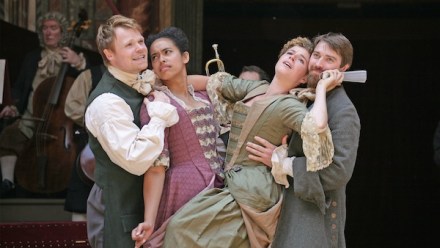
Theatre

Grumbler: I suppose I have to begin by asking whether, if you’ll forgive the obvious question, you actually did like it? Optimist: Equally obviously, your question is too simple. Remember The Spectator rates its readers’ intelligence, abjuring the crudity of the ‘stars out of five’ system beloved of its competitors. G: You could at least begin by telling me about the starring role, for isn’t the play all about Rosalind? Doesn’t it stand or fall on whether it’s ‘love at first sight’ for the audience as well as for the actors? How can any of today’s actors charm the birds from the trees as the likes of Vanessa Redgrave once did? O: Times change, theatre is ‘written on the wind’.