Culture

Culture

The good, the bad and the ugly in books, exhibitions, cinema, TV, dance, music, podcasts and theatre.

Adrian Lester is one of the great Othellos; Glory Dazed

Theatre

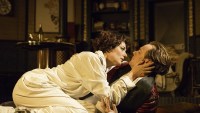
Amazing news at the National. Nicholas Hytner has invented a time machine that can bring Shakespeare to bumpkins who’ve never bothered to read him. His up-to-date Othello begins with Venice’s powerful élite dressed in two-piece suits, like Manchester Utd on tour, and striding around a war-room plotting military action against ‘the Turk’. In Act II, Othello and his task force are choppered out to Cyprus where a heavily fortified compound is ready and waiting for them. Crikey. Looks as though they conquered the enemy and built Camp Bastion in 24 hours flat. Fast work, chaps. Othello’s squadron boasts two strange new recruits.

Verdi’s Don Carlos is the tops

Opera

I go to about half a dozen operas a year, mainly by 19th-century Italian and French composers, plus some Mozart, bits of Handel, Richard Strauss and Britten and, most recently, Wagner. Having seen my first Don Carlos — the memorable Luchino Visconti production — more than 50 years ago, I thought then that it had all one could wish for in an opera, and it remains my favourite. Hearing the live broadcast from New York of the Met’s Don Carlos in March, I was reminded once again of the treats in store as the Nicholas Hytner production (which had its first outing in 2008) returns to Covent Garden this month. The seven performances at the Royal Opera House begin this weekend.

Interview with the musician Paul Lewis

Music

Being an English pianist must be a lonely calling at times. There is no native tradition like the ones that, say, German or Russian musicians are heir to, so many superb pianists have been unjustly overlooked. It used to be said of John Ogdon that, had he been born Ogdonski, in Minsk rather than Mansfield, his profile would have been greater. Perhaps; but would he have been a finer musician? If you were born in Huyton, the son of a docker, the odds against gaining international recognition are greater still. Yet, in his 42nd year, that is where Paul Lewis stands today as he approaches the final furlong of a three-year survey of Schubert.

Herring Way (15th Hole, 321 yards)

More from Books

Where the golf course curls along the sea’s granite edge and wholesome turf seeps around outcrops of dark rock, a modest drive is required to carry beyond a deep gully reaching into the heart of a succinct and slender fairway.  A poorly struck ball can leap between knobs of stone before, occasionally, being tossed just a short chip or long putt away from the wavering flag.  More normally, you will see its final despairing hop into the ravine, sacrificed to the tide or disappearing into camouflage among like-sized pebbles on the beach below. At one time or another, in a kind of ritual, most golfers reaching this high place will also pull out an older ball and tee up the wrong way, facing the lumbering swell.

An artistic rebirth: reopening the Rijksmuseum

Arts feature

Hallelujah! The minimalist fashion for dreary acres of white walls is coming to an end. During the long decade that the Rijksmuseum has been closed — it was only supposed to be shut for three years — the taste for colourless voids has come and, please God, is going. Jean-Michel Wilmotte, the designer behind the museum’s new interior decoration, is obsessively anti-white. It kills anything on show, he says — that’s why he’s gone for a series of hangings of blue-grey shades as the background for objects and paintings. Occasionally, the fine gauze over the windows gives the place a touch of sepulchral gloom, but that’s a minor gripe. The sombre colours work, lingering backstage, not swamping the pictures.

Why on earth paint portraits in the age of photography?

Exhibitions

‘Everybody faces rejection,’ the portrait artist Aaron Shikler said. He should know, having had three official White House portraits of former President Ronald Reagan rejected — one was too large, one was too casual and one ‘they just didn’t like it’. The commission finally was given to a different artist. Don’t feel too sorry for him. His posthumous portrait of President John F. Kennedy hangs in the White House along with those of First Ladies Jacqueline Kennedy and Nancy Reagan, and he has also painted likenesses of US senators, Supreme Court Justices, cabinet officers, socialites and people who just had a lot of money. Still, fame and past successes don’t make one immune from criticism.

Exhibition review: Looking at the View, Tate Britain

Exhibitions

Most of us like to look at a view, though not all are fortunate enough to live with one, in which case art can offer an alternative, a window on the world. Landscape is a great solace, and particularly refreshing for the tired urban spirit, but we want more than holiday snaps of foreign places briefly visited. We need the deeper exploration of art to feed hearts and minds, an investigation through the procedures of painting and drawing, a reordering of shapes and a fitting together, a showing again under other than a purely mimetic guise. With luck and application, through bearing witness to that process of recreating, we come to greater knowledge of our world and our place within it. As D.H.

Trading places | 25 April 2013

More from Arts

The Philippines: An Archipelago of Exchange at the Quai Branly Museum in Paris (until 24 July) brings together an impressive range of objects that demonstrate the fluidity of ideas and forms dispersed through exploration, trade and the blood of battle. The exhibition focuses on the fertile interactions between Filipino tribes and naval traders preceding the 16th-century Spanish colonisation. Housed under the canopy of Jean Nouvel’s extraordinary building, the display treads a fine line between fetishisation and objective examination. On entering, you are surrounded by semi-circles of carved wooden rice gods, expanding outwards like shockwaves; you leave through a dark chamber lined with funerary objects.

Television: The United States of Television; The Politician’s Husband

Television

There are two American Dreams — the one that happens in real life and is experienced by people such as Barack Obama, and the one that happens on screens, both silver and small, shared by millions across the world. BBC2’s The United States of Television: America in Primetime (Saturday) traces the history of the latter, focusing on the TV series shown during those magical hours when Americans sit down to dinner after a hard day’s work chasing the former. Only the fittest, finest programmes survive in this slot, where Nielsen ratings mercilessly track the tastes of 300 million people as they chow down and chill out.

Cinema: The Look of Love

Cinema

The Look of Love is the biopic of Paul Raymond and although it wants to be a tragedy — I could feel it straining at the leash to go in that direction — it never quite pulls it off, so to speak. Visually, it’s fantastic, with more retro kitsch than you can shake a stick at, should you wish to shake a stick at retro kitsch, and there are exceptional performances from Anna Friel and Imogen Poots, but it somehow lacks emotional heart, or any kind of poignancy. It’s entertaining, but glib and unaffecting, and so astonishingly uncritical it makes posing for porn mags or getting your kit off in some seedy Soho dive seem like the most fulfilling and joyful thing a woman can ever do, which I would dispute. A whole morning in John Lewis, that’s when a woman is happiest.

Theatre: Children of the Sun; The Arrest of Ai Wei Wei

Theatre

They’re back. Howard Davies and his translator Andrew Upton had a well-deserved hit in 2007 with Gorky’s Philistines at the Lyttelton. Children of the Sun, which Gorky wrote in jail in 1905, is a prophetic allegory that foretells the destruction of Russia’s weak, idle and pretentious upper classes. We’re in a country mansion where a mad professor, stuck in his laboratory, conducts daft experiments while rhapsodising about the redeeming power of science. He stands for the tsar, I think. Around him clusters a gang of artists and drifters who settle into a quadrangle of doomed eroticism. This one loves this one but that one loves this one who loves someone else, and so on. Each is too self-involved to respond to a romantic overture.

Opera: The Turn of the Screw – review; remembering Sir Colin Davis

Opera

The conducting career of Sir Colin Davis, who died a fortnight ago, more than that of most interpretative artists, had the aspect of a personal pilgrimage. Though I had no personal acquaintance with him, and don’t know much more about his life than can be gleaned from Wikipedia, I did attend his operatic performances from 1956 until 2011. In fact I realised recently, to my surprise, that he conducted far more of the operas I have been to than any other person. I first heard him and heard of him in 1956, when I attended a concert performance of Le Nozze di Figaro which he gave in Cambridge’s Guildhall with the Chelsea Opera Group, of which he was for about a decade the main conductor.

Are today’s composers up to the challenge of writing sublime music?

Music

When we describe music as ‘sublime’, what do we mean? For the Romans, sublimis signified greatness beyond measure. In the 18th century, Englishmen looked to The Spectator for clarification. Joseph Addison, in his Essay No. 339 of 1712, suggests that the sublime often achieves greatness without stirring up ‘pathetick’ human passions. The example he gives is Milton’s description, in Paradise Lost, of the Messiah looking down on his new Creation, ‘when every Part of Nature seem’d to rejoice in its Existence; when the Morning-Stars sang together, and all the Sons of God shouted for joy’. Whether a composition is sublime is essentially a matter of opinion.

After War

More from Books

‘The Firs’, ‘Hillcrest’, ‘Innisfree’ I An aerial view. A brochure maps it out And full possession guaranteed Within the year: time for the prefab plots to sprout Before the moves and backyards turn to seed. II Look, engines pushing upwards, shovels plough Until the hill is taken, then a kerb Whitewashed, colonial style, now caps the brow Once held by rosebay willow herb. III From smoke-black stations, city veterans Ascend and, armed with suitcases, meet packed Possessions dropped by green removal vans To walls in plaster, pale and cracked. IV But after decoration, ground is gained: Slit trenches, dug in by skeletal frames, Hold nothing but the memories retained By varnished pokerwork to post the names.

Provincials

More from Books

for Stuart Henson So Petrarch lived here? First saw Laura here, invented the sonnet and began a craze that turned to ‘tyranny’ (your word). These days they’re hardly de rigueur, but there’s the fear that if you can’t balance seven hundred years on fourteen lines and five rhymes, then the Muse will leave for Tony Harrison. There she goes. But you and I have learned by now to steer a steady course up Petrarch’s mountain track or — better metaphor — across the Rhône beside that Pont that keeps on reaching for a rhyme on its far bank. We know the knack of picking a wind, too: not one that’s blown infernos; one that gently tries the door.

Maria Miller tells the luvvies to take their easels off her lawn

Something had to give for Culture Secretary Maria Miller. She’s not had an easy time since the Leveson report and the subsequent battle over state regulation of the press. Harangued by all and sundry, she’s looking to make friends. In a speech at the British Museum this morning, Miller took the novel step of talking to the luvvies of the arts world as if they were grown-ups living in the real world. Her subject was budget cuts: ‘For honesty’s sake we must be clear about the grounds on which this argument must be had and the points that will get traction, not in the press, but with my colleagues – and with the country at large.’ Translation: Please stop giving beastly quotes about me to those nasty papers.

Spectator Play: what’s worth watching, listening to or going to this weekend

In a week where the news has been filled with stories about a certain ‘strong woman’, Kate Chisholm has found another strong woman to write about. In this week’s radio column, she argues that the radio presenter Sue MacGregor managed to be the only female presenter on the Today programme without the need to deepen her voice or worry about power dressing or pussy-bow blouses. Like Thatcher however, MacGregor ‘has always done things her way’, and her radio programme The Reunion is a prime example of this.

The future of opera

Arts feature

‘It’s an occult-mystery film opera.’ This is how Michel van der Aa describes his new opera, which opened last Friday at the Barbican (and is reviewed here). I had similar difficulties in describing the nature of many of the shows that I produced at Mica Moca, a performance and exhibition venue in Berlin. Over the course of five months, we produced more than 350 different shows of every genre you could think of and some I’d never heard of (check out Japanese free noise) and yet, by the end, I felt that what we’d actually produced was one huge opera. We’re living in very interesting and exciting times for the world of performance — when boundaries between art forms are breaking down and audience’s expectations are shifting.

Exhibitions: R.B. Kitaj: Obsessions The Art of Identity

Exhibitions

Nowadays, R.B. Kitaj (1932–2007) tends to be ignored by the critics in this country — like a bad smell in the corner of the room. It was not always thus: for years he was an admired, if somewhat controversial, presence, but then came his great retrospective at the Tate Gallery in 1994. A large proportion of the British critical fraternity united to condemn and vilify him, to ‘take him down a peg or two’, as if he were an unruly schoolboy too big for his boots, too clever for his own good. This chorus of complaint (some of which amounted to abuse) was deeply felt by Kitaj, and when his beloved second wife, Sandra Fisher, died suddenly in the midst of what he called his ‘Tate War’, he was heartbroken and his love for England all but extinguished.

Champion of the people

More from Arts

Welsh miners, Basque child refugees (above), Tyneside shipbuilders, Paul Robeson: In the Shadow of Tyranny at the Scottish National Portrait Gallery (until 16 May) offers a compelling portrait of Britain in the mid-20th century, as seen by an émigrée communist Austrian Jew, who also happened to be a Soviet espionage operative. Edith Tudor-Hart, who had fled her homeland in 1933 after marrying an English doctor, worked with spymaster Arnold Deutsch from 1926 onwards. As a photographer, her political sympathies were evident throughout her career, from early work documenting protest marches of ‘Red Vienna’ and its subsequent Nazification to representations of British inequality and deprivation.

Radio: Today; The Reunion

Radio

You could say that Sue MacGregor has done as much for women on radio as Margaret Thatcher did for women at Westminster. You might, though, want to add that MacGregor survived for 18 years as the only woman presenter on Today, Radio 4’s chief news and current affairs programme, without finding it necessary to deepen her voice to make it more masculine or worrying about what she should wear. She soon established herself as being as essential to the programme’s character and stature as her colleagues, the late Brian Redhead, Peter Hobday and John Humphrys. MacGregor has always done things her way — by adding a softer, gentler, yet not more pliable, touch to her interviewing technique.

Cinema: Love Is All You Need

Cinema

Love Is All You Need is a romantic comedy that isn’t romantic or comic or much of anything. It stars Pierce Brosnan as Philip, a widowed, all-work-no-play Englishman working in Denmark whose son is about to get married in Italy. Meanwhile, across town, the mother of the bride, Ida (Trine Dyrholm), a hairdresser who wears a wig because she’s lost all her own hair to chemotherapy, has just discovered her husband is playing away from home with pretty young Thilde from accounts. Films are always full of middle-aged men playing away from home with pretty young Thildes from accounts, but have you ever wandered into a company’s accounts department?

Opera: Der fliegende Holländer and Sunken Garden

Opera

Scottish Opera’s new production of The Flying Dutchman, performed in German but advertised in English, is almost a triumph, and very well worth going to see. I reflected, as I travelled by train back from Glasgow to Cambridge, changing only at Edinburgh, York, Peterborough and Ely, that this raw and in some ways crude opera, Wagner’s first to remain in the canon, benefits from the restrictions imposed by a budget as tight as Scottish Opera’s, though I can imagine the participants not entirely agreeing with me. The production, by Harry Fehr with designs by Tom Scutt, is simple and clear. The opera is relocated to Scotland, where Wagner originally set it, as the home of Gothick, and Daland becomes Donald, Erik becomes George; and the time is mid-20th century.

Upstairs, downstairs

Theatre

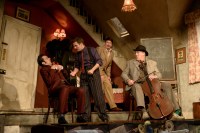
Never a dull moment at the Jermyn Street Theatre. It’s a titchy venue, the size of a gents’ loo, nestling beneath a cavernous flight of stairs in the nameless hinterland between druggy Soho and tarty Mayfair. The current proprietors, aiming for an air of scholastic amateurism, are on the hunt for ‘unknown and forgotten classics’. The theatre boasts a Resident Academic and an eccentric register of patrons including ‘Victoria Biggs, Euan Borland and the Duchess of Cambridge (pub)’. Currently it’s sifting the 1920s for treasure. Others have prospected here before. Ben Travers’s bourgeois farces no longer entertain us because middle-class morality has changed too much in the past 90 years. Frederick Lonsdale may stand a better chance.

Why David Bowie is still underrated

Arts feature

Is it just me, or is there quite a lot being written about David Bowie at the moment? Of course, there’s the fact that the V&A’s blockbuster exhibition has coincided with the totally unexpected appearance of his first album for ten years. (While putting the exhibition together, the curators could never have dreamed that on the day it opened, a new Bowie album would be number one in 40 countries.) Yet for some cynics on the internet — never hard to find — the recent outbreak of Bowie mania is a simple question of demographics: the media is now run by people who grew up with him, and apparently never get bored of banging on about it. Seeing ‘Starman’ on Top of the Pops!

Life and Death in Pompeii and Herculaneum

Exhibitions

The Reading Room is currently packed with Roman remains and with visitors attempting (or pretending) to look at them. The latest blockbuster at the BM (sponsored by Goldman Sachs) looks set to exceed all other oversubscribed sensationalist exhibitions, with more than 250 objects in a mazy but airy layout. When I first heard about this show, my main concern was how it could possibly compare or compete with the experience of visiting what’s actually left of the cities of Pompeii and Herculaneum in Italy. The principal attraction of this subject for those with some interest in the fine arts must be the famous wall-paintings, and how could these be transported to London? Yet, as is swiftly apparent on entering the display, there is enough here to make even the specialist excited.

Nicholas Hytner quits as head of National Theatre…in the wake of a Spectator profile

So, Nicholas Hytner is to step down as director of the National Theatre at the end of March 2015. How canny of Lloyd Evans to review his ten-year reign on the South Bank in The Spectator arts pages on 6 April, the week before his official announcement. Lloyd wrote: ‘Artistic freedom has been the hallmark of his ten-year stewardship….No one guessed how bold Hytner would be. He took the presiding spirit of the theatre, as embodied in its ponderous title, and chucked it in the Thames. Instead of running a museum of official art he created a showcase for his personal inclinations. The National Theatre of Hytner. An astonishing risk. 'And no one noticed how hazardous it was simply because he pulled it off with such aplomb…..