Tanya Harrod

Why do British galleries shun the humane, generous art of Ruskin Spear?

From our UK edition

Where do you see paintings by Ruskin Spear (1911–90)? In the salerooms mostly, because his work in public collections is rarely on display. Until the National Portrait Gallery closed for redevelopment it was, however, possible to study Spear’s splendid portrait of ‘Citizen James’ (Sid James) peering from a black and white TV screen, and his oil sketch of Harold Wilson wreathed in pipe smoke, the epitome of political cunning. Both were strikingly more convincing than their companion array of anodyne commissioned images. Like his beloved Sickert, Spear painted commissioned portraits but also took to making enigmatic ‘unofficial’ portraits based on press photographs — or, in the case of Sid James, a snap off the telly.

The V&A’s restructuring plans are baffling, disturbing and wrong

From our UK edition

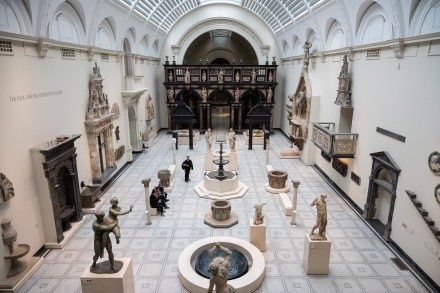
These are challenging times for all cultural institutions, not least for the Victoria & Albert Museum and for its director Tristram Hunt. The museum was riding high at the start of 2020 with strikingly successful exhibitions, record attendances and the ongoing realisation of the ambitious plans put in place by Martin Roth, Hunt’s predecessor – with branch museums in Shenzhen, in Dundee, and in East London, where a new museum will open together with a state-of-the-art Collections and Research Centre. But now, with a ten million pound deficit, no one can doubt that in response to the Covid-19 pandemic, staffing cuts will have to be made. The axe has already fallen on jobs in Retail, Conservation, and Collections Management.

Notes on a scandal | 1 March 2018

From our UK edition

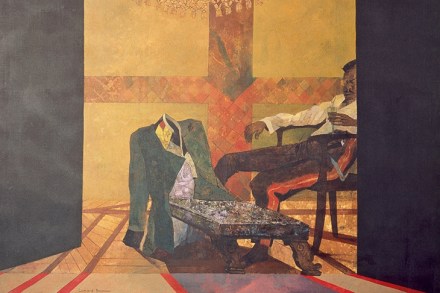
Leonard Rosoman is not a well-known artist these days. Many of us will, however, be subliminally familiar with his mural ‘Upstairs and Downstairs’ in the Grand Café at the Royal Academy, painted in 1986 when the artist was in his early seventies. Two worlds are portrayed with a degree of satire — dressy guests arriving for the private view of the Summer Exhibition and below, in sober grisaille, Royal Academy Schools students engaged on life drawing. ‘Upstairs and Downstairs’s wit and perspectival acuity notwithstanding, its status as a mural makes it easy to overlook, an extended splash of colour behind the Café’s lunch counter. Leonard Rosoman is worth rediscovering. He was a fine war artist and a brilliant illustrator.

Grain of truth

From our UK edition

We routinely feel emotional about materials — often subliminally. Which is why new substances and techniques for manufacturing have provoked vivid writing, particularly during the design-reform debates of the 19th century. Think of John Ruskin on the evils of cut as opposed to blown glass or his views on wrought iron as opposed to cast iron — the latter emblematic in his view of a ‘sophisticated, unkind, uncomfortable, unprincipled society’. For the designer Gottfried Semper man’s very inventiveness was a loss. We were losing our understanding of discrete materials. Then there was, and is, our perfectly justified anxieties about the plastics family, beautifully chronicled in Jeffrey Meikle’s American Plastic: A Cultural History.

Where’s the fun, Barbican? 

From our UK edition

Pop Art Design, curated by the Vitra Design Museum and currently at the Barbican, opens with Richard Hamilton’s 1956 ‘Just what makes today’s homes so different, so appealing?’. Made as a poster for the Whitechapel show This is Tomorrow, it’s a witty collage of consumer fantasies scissored out of magazines, reminding us that interest in popular culture among British artists operated as a humorous, semi-anthropological collegiate research project. In part, British Pop was a riposte to the lushness of American consumerism from a small island that had won the war but had lost the peace. Pop Art in the United States got under way later and many American Pop artists had had first-hand experience of commercial art.

Is the Louvre suggesting that Germany is programmed for war and catastrophe?

From our UK edition

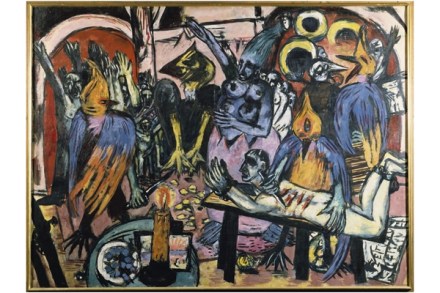
Curated by the Louvre as a tribute to mark the 50th anniversary of the Franco–German co-operation treaty signed in January 1963, De l’Allemagne 1800–1939: German thought and painting from Friedrich to Beckmann sounds like a harmless survey of German art. But it is stranger than that, less a measured look at German painting and more a very French attempt to interrogate the German soul, Nietzsche’s writings in hand. The exhibition opens dramatically with eight 12ft-high canvases by Anselm Kiefer. They were made especially for the show and provide the exhibition’s title, in turn taken from Madame de Staël’s famous book De l’Allemagne.

Shades of Gray | 21 March 2013

From our UK edition

The Anglo-Irish designer Eileen Gray keeps on being rediscovered but she remains a puzzle. The nub of the Gray ‘problem’, which her last large retrospective at the Design Museum in 2005 failed to answer, is this: how did the author of some of the most sensual, disturbing interior design and furniture of the 1910s and 1920s become an uncompromising modernist whose preferred materials were tubular steel, aluminium, plywood and celluloid? Of course artists do reinvent themselves — designers and architects more than most. Careers have odd trajectories that upset linear histories of art.

Weaving magic

From our UK edition

Tapestry, papal and princely, never quite went away. Today it satisfies a need for conspicuous displays of skill of the kind celebrated in the V&A’s recent show Power of Making. The surprise hit of last year’s Venice Biennale was Penelope’s Labour: Weaving Words and Images, an exhibition of weavings and tapestries old and new, while the reception of Grayson Perry’s six narrative hangings, ‘The Vanity of Small Differences’, confirms our current fascination with crafted art.

Inside No. 10

From our UK edition

We are standing in the wood-panelled anteroom to the state rooms at No. 10 Downing Street — myself, Mo Hussein, David Heaton and Janice Blackburn, the former curator of the Saatchi Gallery who has been putting examples of contemporary decorative art and design into No. 10 since last July. We gaze up at Michael Eden’s Wedgwood Tureen on a high mantelpiece above the fireplace. Eden used to make earthenware pots in deep Cumbria but now he designs with 3D software and his pieces are built layer by layer by a 3D printer. His Wedgwood Tureen is based on a classic Wedgwood shape, translated into a vivid red diagram of the original. It looks like a replication of a familiar object made by intelligent aliens. We are all quietly impressed.

Surprise tactics

From our UK edition

Suddenly the word craft has resonance. While not exactly on everyone’s lips, it has certainly won unexpected allies. Take the fashionable sociologist Richard Sennett. In his book Respect: the Formation of Character in an Age of Inequality (2003) Sennett seizes on what he calls ‘craftwork’ as a defence against a world dominated by audits and assessments in which comparatively few are singled out for recognition. By ‘getting the act right in itself...the craftsman can sustain his or her respect in an unequal world’. But the term is a slippery one. Craft is being embraced by the art world in the form of DIY of the homeliest kind.

For the people

From our UK edition

What is folk art? It is usually defined as being made by ‘the people’ as opposed to by academically trained artists. Its 19th-century admirers liked to emphasise that it was made for love, not money, and was therefore beyond vulgar commodification. It was heartening to think that in Sweden a young lover would carve a present for his wife-to-be while in return she would make and embroider him a linen shirt. As one Victorian collector explained, the results would be beautiful because ‘the Peasant, perfectly unconscious of any Art principles, does instinctively the right thing’. But England, dominated by getting and spending, posed problems, and it was acknowledged that English folk art was in short supply.

Subversive needles

From our UK edition

When Henry Moore wanted to make clear that he thought Eric Gill’s sculpture dull and unadventurous, he compared it to knitting. Times have changed, and knitting has become worryingly fashionable, hence the Crafts Council’s delightful exhibition Knit 2 Together. There is, however, a strange feeling of déjà vu about all this. Remember the barefoot California boy Kaffe Fassett, dubbed by Sir Roy Strong the ‘genius of the knitting needle’? There was a knitting renaissance back in the 1980s. Fassett had plenty of imitators with the result that a small knitwear business or an exciting yarn shop came to epitomise the brighter side of Mrs Thatcher’s enterprise culture. But fashion is fickle.