Culture

Culture

The good, the bad and the ugly in books, exhibitions, cinema, TV, dance, music, podcasts and theatre.

The splendour of the English carol

Music

The most celebrated Christmas carol, ‘Silent Night’, belongs to Austria. Father Joseph Mohr, the priest at Oberndorf, a small village near Salzburg, wrote it in 1818. Set to music by Franz Xaver Gruber, it was sung on Christmas Eve at the church of St Nicholas: Stille Nacht, heilige Nacht. It is the most celebrated carol for it captures the stillness of a winter night, the wonder of Christ’s birth, and the hope of all mankind for peace. But when it comes to the celebration of that birth nothing surpasses the English tradition. On Christmas Eve millions of people all over the world will tune in not to Oberndorf but to King’s College, Cambridge, where the choristers take us, as they have since 1918, through the Festival of Nine Lessons and Carols.

Ed Balls thrives in bourgeois version of ‘I’m a Celebrity’

Seeing the great and the good, from Edward Fox to Edward Balls, play Schumann on the piano in front of a packed house at King’s Place was rather like watching a live pitch for a bourgeois version of I’m a Celebrity Get Me Out of Here. Instead of reality stars (Joey Essex), or people from your distant youth (David Emanuel) doing utterly terrifying things such as eating bugs, this had thespians (Simon Russell Beale) and people from your distant youth (Fox) playing a Steinway grand in public. Which option was the more ghastly? I don’t know, but both were fascinating, since with both, you were utterly transfixed, simply thinking ‘Thank Christ it’s not me up there’.

Interview David Chipperfield: It is better to be fond of architecture than amazed by it

Arts feature

For a man who’s about to celebrate his 60th birthday, Sir David Chipperfield looks remarkably fresh-faced. His pale blue eyes are bright and piercing, his thick white hair is cut in a fashionable short crop. Clad in a dark polo neck, he looks almost boyish. This youthful vitality is reflected in his work. At an age when most of us tend to start slowing down, he’s busier than ever. His offices in London, Berlin, Milan and Shanghai employ more than 200 people. His current projects range from Paris to St Louis. I meet him in his groovy high-rise office overlooking Waterloo Station. He’s just flown in from Mexico City, where he’s built yet another new museum.

Daumier’s paintings show he is at heart a sculptor

Exhibitions

There hasn’t been a decent Daumier exhibition in this country for more than half a century, so art lovers have had to be content with the handful of pictures in national collections and books of reproductions. This works all right for the lithographs, which were after all made to be reproduced, and it is on his high status as a satirical printmaker that Daumier’s fame principally rests. And yet he is frequently lauded by artists who talk about him as a major draughtsman, sculptor and painter, not just as a political and social cartoonist, however fine. The chance to see a show of all aspects of his work is thus very welcome: how does the Academy acquit itself of the responsibility? The first thing that must be said is that there are rather too many lithographs on display.

The Passage

Poems

Here the homeless queue for motherly nuns to dish out meat and veg, for showers, clothes, central heating, company, conversation, medical attention, to use computers to apply for jobs, to borrow blankets against the cold, suits for interviews, an address for housing waiting lists: economic migrants, demobbed soldiers, the divorced, mad, alcoholic, unemployed, unlucky from Africa, Greece, Ireland, Manchester, shop doorways and Westminster Cathedral’s steps.

How I felt when I stepped inside the Hadron Collider

More from Arts

I have a new party piece. I can explain, with a degree of clarity and precision, how the Hadron Collider at Cern works and what it is looking for. I can’t claim credit for this feat of exposition myself; as any science teacher who had the misfortune to encounter me at school would testify. I owe everything to Collider: step inside the world’s greatest experiment, an exhibition at the Science Museum (until 6 May 2014). Collider shows how the contents of a cylinder of hydrogen and 27 kilometres of magnetic subterranean tubes are changing humanity’s understanding of life, the universe and everything. Why is gravity so weak that even you or I can defy its laws with our puny muscles? Are there more than three dimensions?

Are events in Last Tango in Halifax too bad to be true? 

Television

Does love run out when life runs out? Or does it intensify, touching and changing all around it? Two series now on our screens make a strong case for the latter —  one is about love striking in old age, the other about young lovers struck by Aids. Both pack a wallop. Since its Bafta-winning first series last year, Last Tango in Halifax (BBC1, Tuesdays) — about a widower and widow, Alan and Celia (wonderfully played by Derek Jacobi and Anne Reid), who reignite their teenage romance by getting engaged in their seventies — has been lauded for its celebration of love among the over-35s. But pensioner passion is not the only surprise this show offers — indeed, as the weeks go by, you realise that’s the least surprising thing about it.

A century before Miley Cyrus, it was male performers — like Nijinsky — who bared all 

Music

While the airwaves resonate with celebrations of Britten’s birth, I cannot help thinking that what was happening in Paris at that very moment was light-years away, not only from Lowestoft, but also from London. The cultural distance between the two metropolises can never have been greater than it was in 1913, and one can only imagine what Lowestoft was like then. The Britten family home, where Benjamin was born, is still standing, but it gives few clues to the life the family lived — inevitably restricted not only by location but also by lack of money. His father had once had the dream of becoming a gentleman farmer, but in the end had to settle for being a dentist. Cut to Paris, where the most glamorous if not notorious episode in the history of classical music was unfolding.

What it’s like to spend 90 minutes in the women’s loo of a thumping nightclub

Cinema

Powder Room is a small British film all about women and starring only women — boo-hoo, men; my heart bleeds for you all — yet it is almost entirely set in a nightclub, so whether you enjoy this film may depend on how willing you are to spend 90 minutes in such a club along with all that thumping music and the flashing lights and the scrabbling to get to the bar. As a rule, this is how I’d feel about such a prospect: I’d rather shoot myself in the head. However, I accept this doesn’t hold true for everyone and, from what I’ve learned over the years, I suspect it doesn’t hold true for most Spectator readers, who are out clubbing until all hours most nights of the week.

You can’t have Mojo and your money back

Theatre

In 1992 Quentin Tarentino gave us Reservoir Dogs. At a stroke he reinvented the gangster genre and turned it into a comedy of manners with a deadly undertow. This new mutation looked as if it might be easy to copy. Many tried. Among them was Jez Butterworth, whose 1995 play Mojo takes Tarantino’s zany-macabre format and moves it to Soho in the 1950s. Butterworth also leans heavily on Pinter. The play opens in the back-office of a nightclub. Two pilled-up criminals are exchanging streams of lairy London chit-chat. Their boss, Ezra, has discovered a teenage heart-throb named Silver Johnny but rival gangsters are keen to muscle in and grab a piece of the star’s income. The details are hard to follow because the jabbering thugs leap so fast from one topic to the next.

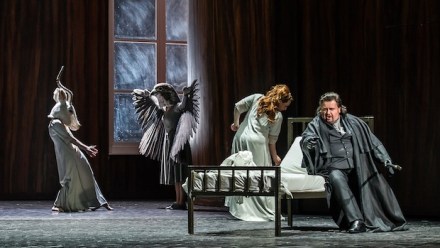
Should we watch the second act of Tristan und Isolde (without the first or the third)?

Opera

There aren’t many operas from which you can extract a single act and make a concert of it, in fact I can’t think of any except ones by Wagner. I’ve been to Act I of Die Walküre, Act III of Die Meistersinger¸ Act III of Parsifal at the Proms, Act II of Lohengrin, and several times to Act II of Tristan und Isolde. It’s not that Wagner’s acts tend to be longer than anyone else’s, they don’t: Handel’s often last as long, so do Rossini’s.

Bob Dylan falls foul of Europe’s neo-blasphemy laws

The French authorities are investigating Bob Dylan after some Croats were offended by something he said in an interview with Rolling Stone last year. The singer had said: ‘If you got a slave master or [Ku Klux] Klan in your blood, blacks can sense that. That stuff lingers to this day. Just like Jews can sense Nazi blood and the Serbs can sense Croatian blood.’ Dylan is the latest victim of Europe's neo-blasphemy laws, in which offending someone’s group identity is treated in the same way that offending God once was. When Christianity stops being sacred, everything becomes sacred; did GK Chesterton say that? Well it’s the sort of thing he might have said.

The Turner Prize lives the myth of constant renewal

Let’s imagine for a minute that the Turner Prize is cancelled next year. Would anyone care? A few members of the artistic elite and a handful of artists perhaps, but beyond that? I don’t think they would. There are plenty of other valuable art prizes out there, after all. And no one has really taken it seriously for a while now. Each year the same, tired debates come out about how ‘art can be whatever it wants to be’, which is true, but also happens to be the least controversial thing you can say. So it’s off. Cancelled. No more queues of people waiting to see a light switch turn on and off. No more unmade beds. And no more sullying Turner’s name for the sake of a prize which once awarded first spot to a man dressed as a bear. Would it matter?

How to think like Chekhov or Turgenev

Arts feature

I recently met an A-level English student who had never heard of Pontius Pilate. How is it possible to reach the age of 18 — to be applying to university to read English and European Literature — and never to have come across the man who asked the unanswerable question: what is truth? This student had completed a course in theatre studies, having read hardly any Shakespeare, nor any of his contemporaries, none of the Greeks — Sophocles, Aeschylus, Euripides — nothing from the Restoration, no Ibsen, no Shaw, and certainly no Schiller — though he had been given the role of Hippolytus in a school production of Phaedra’s Love, which had to be cancelled when the head teacher came across a copy of the script lying on the staffroom table. Phew!

In the National Gallery’s Vienna show, it’s Oscar Kokoschka who’s the real revelation

Exhibitions

The current exhibition in the Sainsbury Wing claims to be a portrait of Vienna in 1900, but in fact offers rather an interesting survey of portraits made there from the 1830s to 1918. The gallery layout has been usefully adapted to display the work thematically rather than chronologically, which is more dynamic but stylistically confusing. The only way to enjoy the show is to wander at will and pick out the paintings that appeal. There are some horrors here (I wouldn’t linger over Broncia Koller), but plenty of good things as well.

Love-making in Air

Poems

Black swifts in the sky ascend, soar and glide. They turn all about, seem not to collide. When feeling great joy they scream and they sing. They swoop and they love to mate on the wing. And we on our flight are feeling the same. We eye up the crowd and drink our champagne. With blankets above, seats set to recline, we touch and embrace. Mile-high we entwine. This freedom in air — it must be our right (despite paunches and fat) to like sex at a height.

Don’t flog a dead parrot – leave Monty Python in the past

Features

You can’t go home again, as the Americans say. It’s worth running that adage, taken from Thomas Wolfe’s unfinished novel of 1938, past those zealots who snapped up 20,000 tickets for Monty Python’s reunion at the O2 Arena in 43 seconds when they went on sale this week. Four more dates were immediately inked in, with more to follow, one feels certain, as Python fever covers the globe. What a horrible prospect. The Python team are not horrible. Goodness gracious, no. In four BBC series between 1969 and 1974 they were often outstandingly funny, in a way that nobody had been funny before.

Blackfish and the scandal of caged killer whales

More from Arts

If you were in a bathtub for 25 years, don’t you think you’d get a little bit psychotic? Well, yes, probably. But this is how captive killer whales live. Tilikum is no different from many of these. A 31-year-old orca who was scooped out of the North Atlantic in 1983, aged two, he has spent the remainder of his life in captivity. Over that time, he has grown to weigh five tons, and has been ‘involved’ in the deaths of three humans. He currently lives at SeaWorld in Orlando, and the documentary Blackfish tells his tale. Much of the video footage in the film speaks for itself; but the interviews that accompany it are equally gripping.

Why didn’t financial journalists blow the whistle on Paul Flowers? Robert Peston can’t tell you

Radio

As I listened to Robert Peston early last Friday fluffing on about the Revd Paul Flowers and the possible effect of his indiscretions on the future of the Co-operative Bank, I couldn’t help wondering why none of the financial journalists smelt a rat when Flowers took over as chairman of the once-dependable, now-fragile bank. The former Methodist minister, it is now emerging, has made a career out of duping those who employ him. He’s evidently a conman of considerable talent, but even so it’s incredible that none of the BBC’s keen-eyed investigators into the City and matters financial thought it worthwhile to check out Flowers once it was known that the bank was so surprisingly and shockingly in trouble.

Gary Bell is the real rudest man in Britain – and he’s on your side

Television

Gary Bell is the rudest man in Britain. I have known the bastard for years and no one —move over, lightweight Starkey — comes even close to matching his bluntness, his tastelessness, his heroic urge to offend at all costs regardless of how much collateral damage he causes his friends, his family or indeed his own reputation and career as a brilliant QC. But Gary has a dark secret: underneath that elephantine carapace of intellectual arrogance, gratuitous cruelty, and room-clearing crassness beats a heart so warm and tender it makes Princess Diana look like Hannibal Lecter. If a mate were in serious trouble, Gary would be the first to rush to the rescue. Well, wobble to the rescue because, as Gary would be the first to acknowledge, he is exceedingly fat.

Stuttgart Ballet – still John Cranko’s company

More from Arts

Stuttgart Ballet’s rapid ascent to fame is at the core of one of the most interesting chapters of ballet history. Between 1961 and 1973, the year of his untimely death, the South African Royal Ballet-trained choreographer John Cranko turned what had been a fairly standard ballet ensemble into a unique dance phenomenon. Although Stuttgart is still known as a ‘choreographer’s company’, his legacy was never artistically constraining. His successors took his powerful vision on board and broadened the repertoire in line with it. It was thus a pleasure to see the history of the company celebrated through the composite programme Made in Germany, in which past and present were seamlessly combined.

Trading Places at 30 – one of the funniest films of all time

Cinema

Next month marks the 30th anniversary of the release of what is, in my opinion, one of the funniest films of all time: Trading Places. Starring comedic demigods Eddie Murphy and Dan Ackroyd, together with Jamie Lee Curtis and Denholm Elliot, this 1983 critical and commercial success is an amusing and trenchant satire on race, class, money and the whole American dream.

Opera review: The Barbican’s Albert Herring was a perfect evening

Opera

Of this year’s three musical birthday boys, Wagner has fared, in England, surprisingly well, Verdi inexplicably badly, and Britten, as was to be expected, has received the royal treatment. No one could have predicted, though, that the culmination of the celebrations would be as glorious as it was: a single semi-staged performance at the Barbican of what, in my minority opinion, is his operatic masterpiece, Albert Herring. Surely after attending it, or hearing it on Radio 3, that might become a majority opinion.

Ben Miller interview: ‘Everyone was doing alternative comedy. I thought I’d distinguish myself by just telling jokes’

Theatre

Ben Miller is wolfing down a pizza. I meet the comedian in a Cambridge restaurant where he demolishes a Margherita shortly before racing off to appear on stage in The Duck House, a new farce about corrupt MPs. The show is set in 2009. Miller stars as a Labour backbencher who wants to jump ship and join the Conservatives. But first he has to convince a Tory bigwig that his expenses claims are entirely legitimate. He’s not helped by his dim-witted wife, his corrupt Russian cleaner, and his anarchist son, Seb, who has sublet the family flat in Kensington to a suicidal Goth. The writers Dan Patterson and Colin Swash wanted to stage the play just before the 2010 election. Miller believes this would have been premature.

Martin Shaw’s flaws make him perfect for Twelve Angry Men

Theatre

Strange actor, Martin Shaw. He’s got all the right equipment for major stardom: a handsome and complicated face, a languid sexiness, a decent physique and a magnificent throbbing voice. He sounds like a lion feeling peckish in mid-afternoon. At top volume, his growl could dislodge chimney pots. And yet he’s just a steady-eddy TV performer who does the odd stint in the West End. Why isn’t he Patrick Stewart or Anthony Hopkins? Perhaps his rhythm is too slow. Certainly, he lacks pep or sparkle, or a sense of mystery. You know what he’s going to do next because he’s just done it. And even then it wasn’t much. Warmth, innocence and fun are outside his range but these defects make him a great choice to play the central role in Twelve Angry Men.

We’ve got to hold on…

Hats off to the Duke of Cambridge for joining Jon Bon Jovi and Taylor Swift on stage at Kensington Palace last night for a sing-along of 'Livin' On A Prayer'. The Winter Whites Gala was raising money for Centrepoint homeless charity. It's the taking part that counts.