Culture

Culture

The good, the bad and the ugly in books, exhibitions, cinema, TV, dance, music, podcasts and theatre.

Can the Scots really be as small-minded, mistrustful and chippy as Spoiling suggests?

Theatre

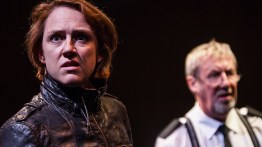
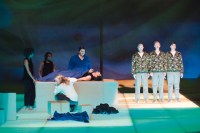
Referendum fever reaches Stratford East. Spoiling, by John McCann, takes us into the corridors of power in Holyrood shortly after a triumphant Yes vote. We meet a foul-mouthed bruiser named Fiona whose strident views and vivid language have propelled her into the public eye during the referendum battle. Her reward is Scotland’s foreign ministry. The most obvious and striking thing about Fiona is her personal ghastliness. A coarse, petulant show-off, over-endowed with self-belief, she has no wit, geniality or political intelligence. Asked how she feels about the birth of Scotland’s liberty, she rasps out her reply like a seagull with tonsilitis. ‘Rebirth!’ Her mistrust of Westminster is deeply engrained.

Ignore the simplistic politics, Pride will make you laugh and cry

Cinema

1984 and all that. Which side were you on? The side of Margaret Thatcher, her hairdo and person standing rigid against a rising tide of industrial activism and British declinism? Or the side of the miners, socking it to the Tory scum and their jackbooted adjutant, Johnny Law? There’s no doubting which side this new movie Pride is on. It’s about a curious episode in community relations when a group of gay people from London decided to fundraise and rabble-rouse on behalf of the striking miners in Wales. It starts with a shot of a red banner — ‘Thatcher Out!’ — hanging from a council-block window. And it ends with a discussion of which phrase will work best on a placard: ‘Screw you, Thatcher!’ or ‘Fuck you, Thatcher!’ They go with the former.

The secret to a long and happy pop career? Don’t die

Music

As everybody in the world except me seems to have seen Kate Bush’s live shows — against all apparent arithmetical sense — these have been gloomy weeks in the primary Berkmann residence. Even the mother of my children managed to acquire a last-minute freebie, even though she only really likes the first two or three albums and Bush didn’t play those. Admittedly, I would have had more chance of getting tickets if I had applied for some, but no sensible English male turns down the chance to sulk like the teenager he most certainly was when he stuck the poster that came free with Lionheart on his bedroom wall. No doubt everyone under 40 thinks we have all gone mad. If so, it’s a madness that was seeded a long time ago.

Warhol’s ‘time capsules’ contain everything from toenails to previously unseen paintings worth millions

Radio

‘I don’t know what I think,’ says Lenny Henry, echoing what many of us who were listening were probably also puzzling over. ‘Part of me thinks it’s art by the sheer fact that an artist has decided that something like this should happen for the amusement and intrigue of his fans...’ Henry was at the museum in Pittsburgh dedicated to the life and work of Andy Warhol. Among the collection, now displayed on seven floors of an old warehouse converted into a glittering catacomb of Sixties and Seventies style, are 610 boxes, dated and sealed by Warhol and designated by him as ‘time capsules’.

Russell Brand is duller than even the grimmest political interview

Columns

I have just spent a few moments in bed with the popular comedian Russell Brand and I have to say that I enjoyed it hugely. We did not have full penetrative sex, sadly, and when I say ‘in bed with’ I mean it sort of figuratively, or vicariously. What happened is that I watched Russell’s latest address to the world, which he delivers regularly from his bedroom — complete with those by now familiar mangled, high-camp estuarial vowels, tortuously pretentious grammar and infantile, uninformed narcissistic political opinions.

A Theatre Supper

Poems

I don’t know why it’s become important to me: the idea of a theatre supper at home? Maybe it’s a methodology for life that after decades of practice we can make it what we wish it to be: modest yet appetising, practical yet with an element of excitement pending? After so many supermarket visits made on foot or online, when the whole scene palls, and there are queues at the local eatery and we feel we are just jades pecking at the window… then our new-found theatre supper gives us a clue via an authentic half-bottle and Jansson’s Temptation. We might actually go to the theatre this time. Or not. But at least we’d be homely, sitting in the kitchen, dazed by our handiwork, speculating on our next project.

Left

More from Books

Who is there left that you can talk to? Days go by. ‘Friendless, deserted’ (The Beggar’s Opera?) — left in the lurch (what lurch?) — you languish. Time to make plans to die? You box up some age-stained letters, set aside more stuff, but your heart’s not in it. Tomorrow will be soon enough. Another of your thoughtless friends falls off the perch. Those language-teachers, those sergeant-majors, those not-quite-wives — how old they must all be now! And those types at school: grumbling, frowning, living their boxed-up lives — Mr Cartwright-Brown would be a hundred and thirty-nine. All gone... Time to wait out our world’s decline? (Wait even longer and watch the planet cool...?) Be serious. It’s not a dress rehearsal, OK...

Out of Reach

More from Books

Think of a hand-slip, a spun summit bothered by mist, the whirr and thrum of dark metals, a stranded face minding a gap which widens, widens, leaves one candle to burn in silence, late summer wings to char on glass, unspoken words to spell their spells forwards, backwards — fine fruit to hang in armouries of thorn for the devil to spit on.

Strictly Come Dancing review: seriously, who are the 11 million people who enjoy this stuff?

There's a Radio 4 programme, presented by the smug moraliser Marcus Brigstocke, called I've Never Seen Star Wars, which gets famous people to do things they've never done before, like watch Star Wars. I'm not famous, but before last night I'd never seen Strictly. The very idea of it bored me. I don't like ballroom dancing, I don't like sequins or kitsch or seventies nostalgia, I don't like programmes starring celebrities I've never heard of doing silly things because they desperately need the money. I don't get the semi-ironic personality cult around 'Brucie', a man without any obvious charm or talent, apart from being the only 20th-century light entertainer who's not dead or behind bars. I do however quite like his replacement Claudia Winklemann.

Pizza, choc-ice and Leonardos – the treasures of Turin

Arts feature

To most non-Italians Turin spells Fabbrica Italiana Automobili Torino (Fiat). But this subalpine city has a longer history than the internal combustion engine. It may be twinned with Detroit, but its cavalcade of equestrian monuments testifies to an older sort of horsepower — the sort harnessed by the condottieri of the House of Savoy to turn their little Duchy into a major player on the European stage and, for four brief years from 1861 to 1865, into the capital of the Kingdom of Italy. So while Detroit has the Detroit Institute of Arts, Turin has 55,000 sqm of royal museums, currently undergoing unification into a single complex called the ‘Polo Reale’.

The Bloomsbury painters bore me

Exhibitions

Virginia Woolf (1882–1941) claimed that nothing has really happened until it has been recorded, so this new exhibition at the NPG devoted to her life can only now be said to have happened — for here I am recording it. Of course it is a truism that an exhibition only exists while it is on. Afterwards it remains in (some of) the memories of those people who visited it, and in photographic records or a catalogue of the exhibits.

Joan Rivers (1933 – 2014) was the best

Joan Rivers has died from complications resulting from throat surgery. She was 81. For many, she was the best. The funniest, sharpest, most mischievous comic we will ever know. And though she'd hate us for saying it, she was also a true feminist pioneer. Well before it had been settled whether women should be doing stand-up at all, she was not only doing it but shaping it - and subtly shaping society too. Her early routines, like the following 1967 set from the Ed Sullivan show about how crappy the female experience could be, were laying the ground for political feminism: But her radicalism was restless. And when the political tides turned, so did she.

Radio 4 deserts the British bird. Shame on them!

Radio

A strange coincidence on Saturday night to come back from the cinema, having seen a film about a woman fighting to save her job while suffering from depression and thoughts of putting an end to it all, only to switch on the radio and hear from people who have had suicidal thoughts themselves or who have suffered the peculiar, awful grief of losing someone to suicide. The film was affecting and sensitively done, but after listening to In Memoriam: Conversations on a Bench (Radio 4) I realised how different the impact of radio can be. It was not that the film had in any way glamorised depression, or turned us as viewers into voyeurs revelling in someone else’s misfortune.

Before I Go to Sleep prefers creepy car parks to feelings

Cinema

Before I Go To Sleep is Rowan Joffe’s adaptation of S.J. Watson’s bestselling thriller of 2011, but whereas the book was smart, gripping, ingeniously plotted and had psychological depth — who are we, when we can’t remember who we are? — this is a disappointment on so many levels. It’s not as if it’s even set in Crouch End, north London, any more. According to my press notes, Crouch End was not deemed sufficiently ‘cinematic’, which has to be upsetting, if you live in Crouch End, as I do, and have always said to people, ‘Come on over. You’ll love it. It’s just so very cinematic round here’, but there you are. I suppose I’ll learn to live with it, as uncinematically as I can.

Mariinsky’s Les Troyens — a bad night for Berlioz and Edinburgh

Opera

I wonder whether grand opéra really takes war as seriously as this year’s Edinburgh Festival wanted it to. These vast works, written to exploit and reflect the power, resources and tastes of mid-19th-century Paris, tended to favour history and its battles for the scenic opportunities they afforded rather than for the lessons they taught. It was the cross-cultural love stories in the foreground that were the dramatic focus; whatever the context, the obligatory ballet always had to be shoehorned in. Berlioz provided a work that ostensibly fitted the formula with his Troyens, fashioned from Virgil’s Aeneid during the 1850s, painstakingly, obsessively and with minimal reward. It was rejected by the Paris Opera and for many decades performed only in truncated, bisected versions.

Enough ‘themes’ at festivals

Music

One might have expected the streets of Edinburgh, especially at festival time, to bear some evidence of the political struggle currently engulfing our nation, but in fact there was none at all. Apparently, the arguments for and against independence have to be traded on the doorstep and not in the street, which, to those visitors who anticipated fireworks, almost amounted to a vacuum. However, it meant that the streets could be made over to the customary bewildering number of stand-ups, advertisements, students handing out leaflets (they come at you these days on roller-skates, pirouetting as they approach), and thespians of every type.

Even near the front line, there were flowers on the ward

More from Arts

It’s the tub of bright red geraniums at the heart of the picture that startles. How did anyone have time (or energy) to water these bright, hopeful flowers amid the chaos of a field hospital in early 1915? ‘Tents with Stores and Flower Tub’ is one of ten paintings by Victor Tardieu in the Florence Nightingale Museum’s latest exhibition, dedicated to the pioneering work of the first world war nurses. Tardieu, a French artist who went to the front as an officer in an ambulance unit, created a vivid record of the makeshift camp in Bourbourg set up by volunteer nurses led by the indomitable Millicent, Duchess of Sutherland (portrayed above), who bought her own ambulance, filled it with bandages and took it across the Channel.

The Indian lady at the chemist

More from Books

I trust her look the shadow round her eyes her level stare explaining paracetamol these ones are strong take them at night she looks straight at me she is not very tall either inside deeper than skin confidence blooms more fragile and more certain than the hug of a friend.

Here’s why we should save the Wedgwood Museum

A public appeal has been launched to save the Wedgwood Museum pottery collection, which is being sold to pay off the ceramics firm's pension bill. The museum entered administration in 2010 after the firm collapsed and its £134m pension debts were transferred to the museum trust. The Art Fund said it had raised about £13m to buy it, but that a further £2.7m was needed by 30 November in order to save the collection.  Here's why we need to save this museum: We are fairly certain that the late Robert Maxwell never met the even later Josiah Wedgwood, but Cap’n Bob’s nefarious legacy is now being keenly felt by Wedgwood’s descendants.

The false paradise of Metroland | 29 August 2014

Gaily into Ruislip Gardens runs the red electric train… Near the end of the Metropolitan Line, where London dwindles into woods and meadows, stands a Tudor manor house, built within the moat of a motte-and-bailey castle. Now a quaint museum, charting the history of the farms that once surrounded it, this modest landmark shares its name with the local Tube station, Ruislip Manor. A century after they built it, the railway that runs through here still feels out of place. There are fields on one side, suburban semis on the other. Welcome to Metroland, the bizarre no-man’s-land between town and country, created by the Metropolitan Railway, which celebrates its 150th birthday this year.

Will we learn to love our ugly houses?

What are the root causes of Britain’s housing crisis? The Philosophers’ Mail – which has copied the format of MailOnline but I suspect is not aiming at quite the same demographic – recently offered an alternative to the usual explanations. That most people are opposed not to building more houses, but to building ugly houses, and that this accounts for most of what we dismiss as a nimbyism that prevents much-needed development. As they put it: 'Most of the large housing developments built in the South East of England in the last 25 years share one common and (in this context) generally undiscussed feature: they are very ugly. Or, to be more precise, they are far uglier than the countryside they have replaced.

The enigma of Werner Herzog

Arts feature

Strange things happen to Werner Herzog — almost as strange as the things that happen in his haunting, hypnotic films. In 1971, while making a movie in Peru, he was bumped off a flight that subsequently crashed into the jungle. Years later, he made a moving film about that disaster’s sole survivor. In 2006, while filming an interview with the BBC in Los Angeles, he was shot in the belly by some nutter with a small calibre rifle. Most film-makers would have been turned to jelly by this terrifying interruption; Herzog simply laughed it off, cheerfully dropping his trousers to reveal a bleeding bullet wound, and a natty pair of Paisley boxer shorts. ‘He has become a catalyst for extraordinary events,’ says his British producer Andre Singer.

My First Love

Poems

I made the mistake of getting in touch with him twenty years after – invited him to stay. He was almost alcoholic, had lost his front teeth, told endless anecdotes and, worst of all, was allergic to my dog. You’d think that’d be a cure or antidote to all those years of unrequited love spent yearning and longing, that I could forget that time — was I seventeen? — when he asked me to go with him to the States, could forget that moment years later when, at long long last he proposed, could forget that because I was young and fearful and he was wild, arty and penniless, I kept saying no. Less easy to forget how, ever since, I’ve wondered...

A wooden UFO lands in Yorkshire Sculpture Park

More from Arts

The New York-based sculptor Ursula von Rydingsvard comes from a long line of Polish and Ukrainian peasant farmers. She was born in Germany in 1942 on a forced labour farm to which her parents had been transported by the Nazis. Her early memories are of a wooden world — of huts, fences, domestic utensils and tools — on the farm and in postwar refugee camps.

Who needs drugs when you have Radio 3?

Radio

I’m willing to bet it’s only on the BBC’s Radio 3 that you’ll find yourself listening to a programme quite like Words and Music (Sunday evenings). You might want to disagree. Surely, it’s just a few bits of music stuck together with some poems and other readings on a random theme dreamt up by the production team? How easy must that be to pull off? Seventy-five minutes (or sometimes even longer) of dirt-cheap radio, quick to make, very few overheads, involving just a few hours per programme of research (nowadays so easy on Google) and a dead-simple edit job splicing everything together. But name another station anywhere that could make it work week-by-week with quite the same style, panache and sheer brio of the team at Radio 3.

BBC2’s Hotel India: slums? What slums?

Television

Viewers who like their TV journalism hard-hitting should probably avoid Hotel India, a new BBC2 series about the Taj Mahal Palace in Mumbai. The tone of Wednesday’s episode was set immediately when the narrator introduced us to ‘one of the oldest and grandest hotels in the world’, where ‘no detail is too small or demand too great’, and there’s ‘an army of staff dedicated to flawless service’. To prove it, head of housekeeping Indrani then strode fearsomely down a corridor like a more elegant version of Hattie Jacques’s matron in the Carry On films.