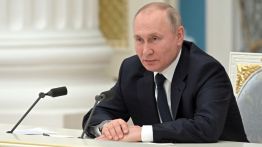
Vladimir putin

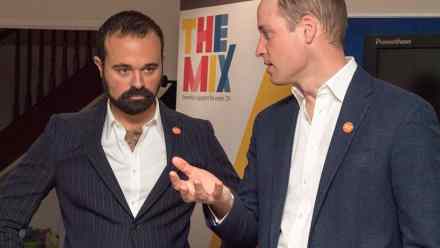
Now Lebedev turns on Putin

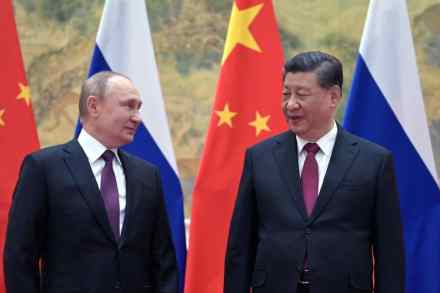
Looks like this war isn't going terribly well for Vladimir Putin. The Russian dictator now finds himself something of an international pariah, with barely half-a-dozen countries lining up behind him. By contrast, the charmless Kremlin autocrat seems to have done what no-one thought possible: unite Europe in opposition, drag Germany from its Ostpolitik slumber and even force neutral Sweden to dispatch thousands of missile launchers to his foes. Well done Vlad. It's not just in the international arena where Putin finds himself unloved: there's clearly cracks in the previously unshakeable support which he enjoyed from the plutocratic oligarchs his regime has helped enrich.

And now the dumbest takes about Ukraine

From our US edition

If hot takes brought peace, mankind would never know war again. At least, that’s the impression one is left with after spending time on Twitter during Russia’s horrific invasion of Ukraine. Some social media users seem to operate under the understanding that they are legally required to put their first — and often worst — opinions immediately onto the internet for all to see. Many of these tweets reflect the understandable human tendency to grasp at an explanation for terrible events. Laurie Garrett, a Pulitzer Prize-winning writer who is considered an oracle of sorts on the coronavirus pandemic, put forth an interesting theory. “It’s been suggested that #Putin isn’t thinking properly, perhaps due to long #COVID19,” she wrote.

takes

Germany has rejected Merkel’s military legacy

‘We are witnessing a turning point… the world is not the same anymore,’ said German Chancellor Olaf Scholz yesterday in a speech that will be remembered as the country’s biggest military shift since 1945. Staring down the barrel of Putin’s gun, Scholz announced a massive and immediate cash injection for Germany’s armed forces as well as a long-term commitment to higher defence spending. Russia’s unprovoked attack on Ukraine has pulled Germany out of decades of complacency and misguided pacifism. Foreign minister Annalena Baerbock seemed genuinely shocked at the discrepancy between Putin’s words during her visit to Moscow last month and his actions in Ukraine. She has said she feels betrayed: ‘stone-cold lied to.

Has Putin resurrected the West?

I think Putin will have been surprised. I mean: I was surprised. Weren’t you? Not, necessarily, that Ukraine should have been resisting as valiantly as it is; nor even that Russia’s supposedly unstoppable war machine should have found itself out of petrol on a chilly highway from which the road signs have been removed. But surprised by the sheer force and volume and unanimity of the international cry of: no, this will not stand. That is one thing, even amid the unspeakable human cost of the war in Ukraine, to feel encouraged by. If this invasion does, as many have said, mark the beginning of a new order in European security and great power politics, isn’t it a sign that it could be a stronger, better, less complacent one?

Yes, Russia could use nuclear weapons

From our US edition

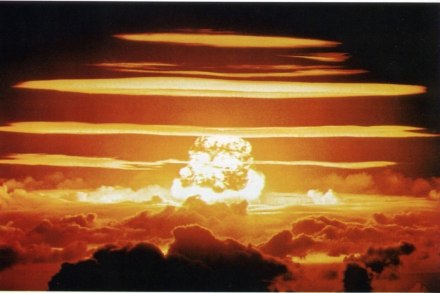
“Nuclear war is part of our strategic culture. Yes, we would start one if our homeland, our way of life, was threatened, absolutely. Why wouldn't we?” That’s what a retired Russian diplomat told me on the sidelines of a track-two dialogue between US, Russian and Chinese experts back in 2012. And to be honest, for several years, I didn’t believe him. I took his comments as bragging, atomic machismo, if you will. The context of the conversation was a response to a question to my Russian colleague on the subject of Moscow’s nuclear weapons doctrine and thinking. Russia for several years has believed in the concept of escalating nuclear tensions to deescalate tensions, or what defense scholars call “escalate to deescalate.

Biden’s confusion over sanctions

From our US edition

Russia’s military aggression against Ukraine requires a swift and effective Western response. But according to neoconservative and liberal internationalist pundits like columnist Walter Russell Mead, the invasion marks nothing less than an assault on the “world order” akin to Nazi aggression at the opening of World War II. “Not since Hitler attacked the Soviet Union in 1941 has a European leader committed an act of aggression as brutal or as nakedly cynical as Mr. Putin’s unprovoked attack on Ukraine,” Mead writes in the Wall Street Journal.

A new Europe is emerging from this crisis

With every hour that Kiev holds out, the geopolitics of Europe changes more. Germany, which so values its prohibition on sending weapons into warzones, has just announced that it is sending 1,000 anti-tank weapons and 500 Stinger missiles to support the Ukrainian forces. I expect that defence spending will rise considerably in the coming years Germany is also allowing other Nato members to export arms with German-made parts to Ukraine — which will make a material difference to the supplies that the Ukrainian government receives. Yesterday evening, it was announced that Russian banks are going to be cut off from Swift.

No, China isn’t about to invade Taiwan

From our US edition

I have a medal for winning the Cold War. And I'm not alone — they were awarded to all members of the military and federal civilian employees who served during the Cold War. That included me, at the tail end, with the State Department. Ironically, my so-called Cold War service was in Taiwan. I probably should return the thing; the Cold War is far from over. Part of the Cold War's real conclusion is playing out in Ukraine in real time. Is Taiwan, another hanging chad from that era, next? Is President Xi watching a weakened America giving in to the Russians and seeing his chance to seize Taiwan? Nope. Taiwan is not Ukraine is not Taiwan. The two places only exist next to each other in articles like this one because both are the results of American policy.

Europe’s ‘green’ transition put it at Russia’s mercy

From our US edition

Germany’s “halt” on the certification of the Nord Stream 2 pipeline on Tuesday is a classic case of too little, too late — a fact made all the more painfully clear in light of Russia’s invasion of Ukraine. Oil and gas still flow through Nord Stream 1 and many other Russian pipelines to Europe, and the continent has no choice but to keep importing the fossil fuels that finance Vladimir Putin’s offensive. We all saw this coming. Europe’s supposed “green” energy transition disregarded energy security and common sense, and Ukraine is now paying the price. The world will never tackle climate change if it's in a constant state of geopolitical energy insecurity, relying on authoritarian regimes like Russia and China to meet its basic needs.

To hurt Putin, go for oil and gas – not Swift

Both the British and the Americans have been explicit that it is the Europeans who are blocking Russia being cut from Swift. Removing Russia would be a sound step, but it is far less important than a western agreement not to buy Russian oil and gas would be. Sadly, though, there is little chance of this happening — too many countries are dependent on Russian gas — which means $700 million a day will continue to flow into Moscow, strengthening the Kremlin’s belief that it can ride out whatever sanctions are imposed on it. Depressing as this may be, there are things the UK can do using domestic law that would inflict pain on the Putin circle.

What happened to Tough Guy Joe Biden?

From our US edition

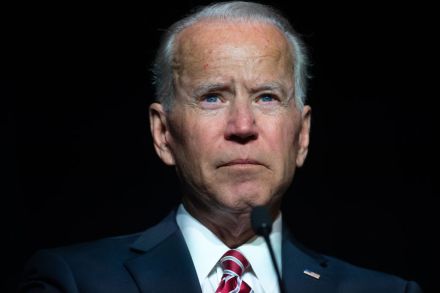
If you watched President Joe Biden’s press conference on Thursday afternoon, you wouldn’t know you were looking at the same man who allegedly looked Vladimir Putin in the eyes and told him he had no soul. Hell, based on Biden’s weak performance you might start to question whether or not he actually confronted and defeated a straight-razor-carrying bad dude named Corn Pop outside of a Delaware swimming pool in 1962. The president seemed to want to follow the theme of his last press conference: “Saying the Quiet Part Loud.” Who can forget the recent two-hour presser in which Biden essentially green-lit a “minor incursion” by Russia into Ukraine.

biden

The stakes for Europe are even higher than in 1938

From our US edition

Any analysis of the Ukraine situation risks lagging behind the news. As of the time this article was published, Russia had conquered the former Chernobyl nuclear power plant. Its forces are only about sixty miles away from Ukraine’s capital, Kyiv, which has already experienced shelling. Russians have also attempted to capture Antonov International Airport, just fifteen minutes away from the capital’s ring road. Meanwhile, European leaders are resorting to the usual responses: “concerned,” “strongly condemning." There is even a Twitter account mocking the EU’s approach to all major crises, called “Is EU Concerned?” The response to the invasion of Ukraine is not spared from similar mockery. Here in Europe, it feels like 1938 all over again.

Boris Johnson needs even tougher sanctions to deter Putin

Boris Johnson has just outlined a series of further sanctions on Russia. They are considerably more substantial than the ones he announced earlier this week. They exclude Russian banks from the UK financial system, bar Russian firms from raising capital in London and will see the UK join the US’s technology sanctions on Russia. However, Russia will not be cut off from the Swift payments system — it is clear that the UK has, sadly, lost the argument on that for now. This does raise the question of what, if not the unprovoked invasion of a sovereign country, would be enough to lead to Russia being cut off from Swift.

Eating donuts in Poland as the bombs fall

From our US edition

Tarnowskie Góry, Poland  There was something faintly obscene about lining up outside the bakery to celebrate Fat Thursday. Granted, it made no difference to Ukrainians whether I ate donuts or scrambled eggs for breakfast. But I had a brief sense of how fortunate it is to live in a peaceful society. Ukraine is not so lucky. Missiles have been falling throughout the night and day, and Russian soldiers have occupied key positions, right up to the outskirts of Kyiv. Some of us expected Putin to occupy Donbas and leave Western Ukraine alone. That has been proved entirely, tragically mistaken. After such a long, mysterious military build-up, the speed and scale of the Russian offensive has been stunning.

poland

Let Russia choke on Ukraine

From our US edition

At least for the moment, it looks like Russian president Vladimir Putin is intent on conquering Ukraine, a nation he's never believed has the right to exist. While the fog of war always limits accurate real-time military analysis, it seems for now that Russia has committed to annexing at least large sections of Ukraine and is winning the day militarily with ease. Of course, the media has predictably gone into overdrive, warning of World War Three, gas prices that will stay high for years and perhaps even Putin attacking NATO and nuclear war. But let’s put away the hysterics for a moment and think about the here and now. Russia’s goal in Ukraine has always been clear and does not involve war on NATO or even conquering Ukraine in its entirety.

ukraine

Boris Johnson promises more sanctions

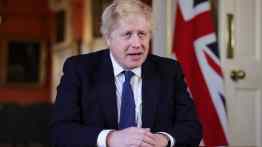
Following Vladimir Putin's decision to launch a full-scale invasion of Ukraine, Boris Johnson has addressed the nation. Speaking from 10 Downing Street, the Prime Minister spoke of his regret that 'our worst fears have now come true' and Russia had 'unleashed war in our European continent'. Johnson said he had spoken with the Ukrainian president to reiterate the UK's ongoing support. A vast invasion is underway — by land, by sea, and by air. And this is not, in the infamous phrase, some faraway country of which we know little. We have Ukrainian friends in this country; neighbours, co-workers: Ukraine is a country that for decades has enjoyed freedom and democracy and the right to choose its own destiny.

Biden’s weak words on the Russian invasion

From our US edition

Vladimir Putin has invaded Ukraine, a chilling moment that cries out for a tough response. Thankfully, the president of the United States has deployed his usual silver tongue. "The world will hold Russia accountable," Joe Biden said last night. "I will be monitoring the situation from the White House this evening and will continue to get regular updates from my national security team." Cue Cockburn nearly collapsing from the sheer rhetorical power of that statement. It's a wonder the Russian tanks didn't screech into reverse and roll back over the border. Cockburn understands this is a dangerous situation that calls for delicacy and forethought. But were such bland bromides really the best the leader of the free world could do?

Two reasons Putin thinks he can weather sanctions

The nature of the Russian attack on Ukraine, striking across the country and not just concentrating on the territory claimed by the so-called breakaway republics, shows Vladimir Putin’s confidence that he can weather whatever sanctions the West imposes. This is not an assault designed to sit in any kind of grey area, but an unambiguous invasion — which the West has always made clear would bring forth the maximum set of sanctions. This is not an assault designed to sit in any kind of grey area Putin’s confidence is driven by two things. First, as I say in the magazine this week, Russia has been preparing to face expanded sanctions since the annexation of Crimea in 2014.

rape

Was Russia’s ‘rape’ of Ukraine inevitable?

From our US edition

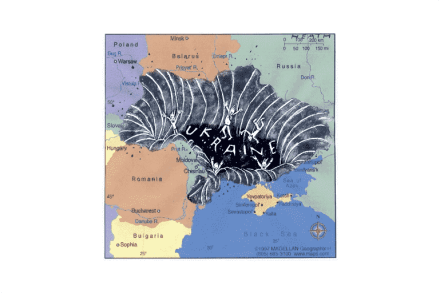
In a press conference earlier this month, Vladimir Putin noted that the Ukrainian government does not like the Minsk agreement and then added: "Like it or not, it's your duty, my beauty." The saying has well-known sexual connotations: Putin appeared to be quoting from “Sleeping Beauty in a Coffin” by the Soviet-era punk rock group Red Mold: “Sleeping beauty in a coffin, I crept up and fucked her. Like it, or dislike it, sleep my beauty.” Although the Kremlin press representative claimed that Putin referred to an old folkloric expression, reference to Ukraine as an object of necrophilia and rape is clear.