Vladimir putin

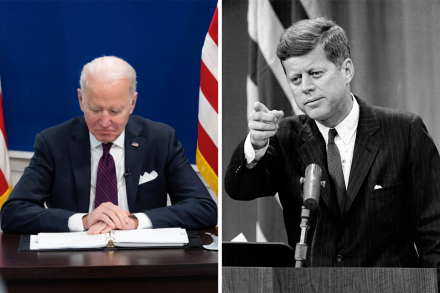
Joe Biden is no Jack Kennedy

From our US edition

As the Ukraine situation heats up, you can already picture the insider account Vice President Kamala Harris will publish one day in her 2025 bestseller Thirty-One Days in February. But then, as any survivor of the Cuban Missile Crisis is bound to tell President Joe Biden, “I knew Jack Kennedy, Jack Kennedy was a friend of mine, and you, Joe Biden, are no Jack Kennedy.” One of the clichés if not the myths about the Cuban Missile Crisis was that President Kennedy and Soviet leader Nikita Khrushchev were playing chicken and Khrushchev “blinked." Under threat of potential nuclear war, he then decided to withdraw the Soviet nuclear missiles from Cuba. We now know that what really happened was more complicated than the initial reports made it appear.

Why we shouldn’t ban Russia Today

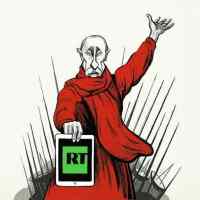
Nadine Dorries, the Culture Secretary, has written to Ofcom urging it to keep the situation with Russia Today ‘very carefully under review' given events in Ukraine. At PMQs, Keir Starmer called for the government to ask Ofcom to review RT’s license.  But if RT lost its broadcast license in the UK, then Putin would use this as an excuse to kick out the BBC and other British broadcasters. Just look at how Russia closed the Moscow office of Deutsche Welle, the German public service broadcaster, and ended the accreditation of its journalists after a German-language version of RT was taken off air in Germany. The least-worst option would be for guests to refuse to go on RT given the credulous way in which it reports Kremlin propaganda.

Has Putin outplayed Macron in Africa?

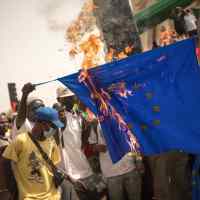
While the world is focused on Ukraine, Emmanuel Macron has withdrawn all French forces from Mali. Last weekend, thousands of soldiers were flown out of the former French colony after nine years of fighting Islamist insurgents in the Sahel. Malian protesters bid the French soldiers farewell by shouting ‘Shit to France’ at the departing planes. Following a military coup in May, Mali’s ‘interim President’ Colonel Assimi Goïta began to tire of the French and their calls for free elections. There were also lingering doubts over France’s motivation, stoked by a Russian disinformation campaign. So Goïta began looking for allies who could provide him with muscle to fight the Islamist insurgency without any lectures about democracy.

Would Trump have prevented the crisis in Ukraine?

‘I know Vladimir Putin very well,’ said Donald Trump yesterday, speaking of the Ukraine crisis, ‘he would have never done during the Trump administration what he is doing now.’ As with a lot of Trump utterances, that statement is at once arrogant, preposterous — and probably true. Maybe it is a coincidence — or Trump’s often-cited luck — that the last major crisis over Ukraine was back in 2014, after Viktor Yanukovych was ousted and Putin annexed Crimea. Or perhaps not. Putin, as a slightly comic alpha male authoritarian, saw in Trump something he recognised Back then Barack Obama led the free world and, busy as he was, he offloaded the knotty Ukraine problem on to his Vice President Joe Biden, which I wrote about here yesterday.

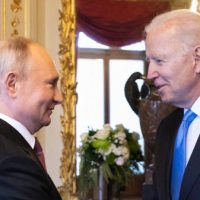
U.S. President Joe Biden and Russian President Vladimir Putin (Getty Images)

Biden exploits the Russia conflict for political gain

From our US edition

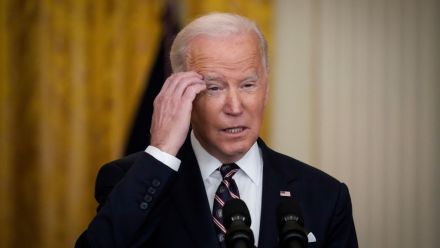
President Joe Biden is preparing to buck responsibility no matter the outcome of the brewing conflict between Russia and Ukraine. Biden's statements about Russia have been anything but cohesive. One day he is giving up the game by stating publicly that he has no appetite for war and would allow a "minor incursion"; the next he's focusing exclusively on diplomatic channels; the next he's warning of force if Putin makes another move. All the while, White House officials have planted news stories and touted vague "intelligence" warning of an imminent Russian invasion. The message is this: war with Russia is inevitable, unless it isn't, in which case Biden gets all the credit. So who gets the blame if Putin does invade Ukraine and the US responds with military force?

Putin’s next move

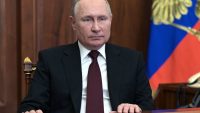
Budapest Russian troops, many apparently without insignia, began advancing into the disputed Donbas region yesterday. The question now is how much further they will go. The Donbas rebels claim an area three times the size of the territory they currently hold, which is roughly equivalent to the area of Devon. If Moscow were to try to take control of the larger territory, it would mean overrunning the Ukrainian frontlines. It is unlikely that Kiev’s military can mount a serious defence if the Kremlin orders a full-scale attack. The call to advance came in the form of a belligerent speech by Putin to the Russian people. In it, he strongly suggested that his aim was to reintegrate the country of 45 million into the motherland.

Sanctions won’t stop Putin

The Lithuanian prime minister, Ingrida Šimonyte, put it well yesterday: 'the way we respond will define us for the generations to come'. The invasion of Ukraine started last night with Vladimir Putin’s order to send troops into eastern Ukraine. He had earlier recognised the breakaway provinces of Donetsk and Luhansk, which together constitute the Donbas region, as independent republics. The two self-proclaimed states declared their independence — something neither Kiev nor any other third country save Russia has yet recognised — following 2014 following the Maidan revolution. The US, UK and EU say they will announce fresh sanctions as early as today. What we know is that the technicalities have been drawn up.

Diplomacy is Ukraine’s last hope

From our US edition

Amid a pile of Russian disinformation, a mass evacuation of civilians from the self-proclaimed separatist republic and reports that Russian commanders are preparing to execute an invasion order, diplomacy (or at least the hope of it) reared its beautiful head late Sunday night. After a frantic series of calls orchestrated by French president Emmanuel Macron, the White House released a statement confirming President Biden’s openness to a direct meeting with Russian president Vladimir Putin. Whether or not the leader-to-leader discussions happen, however, won’t be fully up to Biden or Macron. It takes two to tango, as the hackneyed phrase goes. And right now, Moscow has been habitually cryptic about its intentions.

ukraine

Is a Russian invasion now imminent?

Tensions on the Ukraine border are continuing to increase. Worryingly, Russian state media has gone from mocking Washington’s warnings of an invasion to ramping up the various pretexts that the Kremlin is trying to create for one. The leaders of the two self-proclaimed breakaway republics in the Donbas have been on Russian TV today asking for Russia to recognise them and offer military assistance. Moscow is also claiming that it has killed five Ukraine troops who supposedly crossed into its territory.  The Biden administration remains convinced that an attack on Ukraine is coming in the near future.

How the Ukraine crisis ends

Vladimir Putin does not think in the way the West does. Of course sanctions will hurt. But so what? He may be wrong in his strategic calculations, but he is not, as Boris Johnson claimed over the weekend, irrational. Putin is an old-school strategist. This is one of the reasons that sanctions will not have the desired impact. An import ban on Russian gas would definitely hurt the Russian economy, but that seems highly unlikely. Italian President Mario Draghi said on Friday that we should not touch gas. It is now the guy who sits in Moscow, rather than Draghi, who is willing to do ‘whatever it takes’. An import ban on the latest iPhones does not have the same deterrent effect as a continental gas shortage. Don’t fool yourself about the impact of sanctions.

Time to retire the ‘Munich’ analogy?

From our US edition

The Ukraine crisis signaled to Western officials and pundits to once again begin recycling the historical analogy of the 1938 Munich Agreement, which handed Nazi Germany parts of Czechoslovakia in a failed bid to head off major conflict in Europe. This was expected. Such comparisons are usually followed by the predictable warnings about the danger of Western “appeasement.” Hence British defense secretary Ben Wallace has recently compared Western diplomatic efforts to head off a Russian invasion of Ukraine to the appeasement of Nazi Germany ahead of World War Two, suggesting that unnamed Western countries were not being tough enough with Moscow.

Why Glenn Greenwald backs Putin

From our US edition

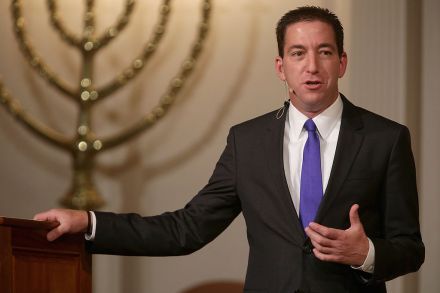
Few things are sure in life: death, taxes and Glenn Greenwald advocating whatever position happens to be in the interests of Vladimir Putin. The self-styled civil libertarian rose to prominence during the George W. Bush administration for his withering attacks on American counterterrorism policies. Later, he won a Pulitzer Prize for his role in facilitating Edward Snowden’s leak of government documents. Always a rancorous figure who bristled at attempts to place him in a partisan box, Greenwald started to upset his confederates on the left and develop a fan base on the right during the Trump years. Greenwald was one of the most vocal critics of the narrative positing that the new American president was a pawn of the Russian one.

Greenwald

How western journalists became Putin propagandists

Why does Vladimir Putin need Russia Today and Sputnik News when the western media are doing such a great job on his behalf? Throughout his two decades in power, Putin has yearned for international respect. Failing that, he’ll settle for fear. And what more satisfying outcome could there be for a serial sabre-rattler like Putin to have his bluff finally taken seriously? For weeks, British papers and TV have been filled with images of scary Russian tanks, warships and artillery blasting away — mostly provided, if you check the photo credits, by Russia’s Ministry of Defence. Since November, the US and British governments have been issuing increasingly strident warnings that Putin is preparing an imminent and massive attack on Ukraine.

What would Thatcher have said about Putin?

When Sir Tony Brenton writes a letter to the Times, as he frequently does, it always says at the bottom that he was British ambassador to Moscow. The uninformed reader could be forgiven for thinking the sub-editors have got it back to front and he was actually the Russian ambassador to London. Sir Tony’s message in every letter is ‘It’s all Britain’s fault’. In his latest, his particular target was the Foreign Secretary, Liz Truss, after her visit to Moscow. He said she ‘might usefully recall Margaret Thatcher’s wise message to Mikhail Gorbachev sent in 1985 as perestroika began to take off: “We know that you have as much right to feel secure as we do.

As with Iraq, so with Russia

From our US edition

Against the backdrop of the Ukraine crisis, we have been bombarded with many historical analogies. Leading the list are the 1961 Berlin standoff and the 1962 Cuban Missile crisis. And then there is that all-time favorite, the 1938 Munich Agreement. Those crises should certainly not be regarded as ancient history. But then why go back 60 or 80 years when you can walk down memory lane? Like, say, when an American president was trying to rally the public and mobilize international support in the name of using military force against an alleged bloodthirsty dictator who was supposedly threatening Western geostrategic interests and challenging its liberal democratic values?

ukraine

NATO won’t bleed for Ukraine

From our US edition

Ask three different people whether Russian President Vladimir Putin will approve an invasion of Ukraine, and you are likely to get three different answers. Yes, a Russian land, air, and sea blitz is inevitable and will come in fairly short order, likely without warning. Yes, a Russian invasion is possible, but could still be averted with some shrewd diplomacy. Or, no, surely Putin understands an invasion would be a disaster for his legacy and his country’s economy. In the midst of all of this comes wild speculation about what Putin is thinking at any given moment, how the weather may factor into his calculations, and what the Russian government’s end goal really is. What can be said for certain, however, is that diplomacy has picked up significantly over the past week.

Is this Biden’s Munich moment?

From our US edition

When it is 1938 in Washington, it is already past midnight in Moscow. The clock is ticking and the map of Europe is being redrawn, but this is not a Munich moment. We are now past that, and past the time when the leader of a Western democracy might have the honesty to admit to his public, as Neville Chamberlain did in 1938, that he doesn’t want to fight a war over “a quarrel in a faraway country between people of which we know little.” The shadow of Munich shames and intimidates the leaders of the Western democracies, and not without reason. But if there is a Munich moment in the latest Ukraine crisis, then it happened nearly seven years ago — in 2015, when the Obama administration backed the Minsk II accords and the dismemberment of Ukraine.

energy munich

Why does Germany look so weak on Russia?

From our US edition

A recent survey of Germans done by Forsa, amongst the most reputable polling institutions in that country, shows that at least in one way, the Cold War has not quite ended. A majority of West German respondents (52 percent) blame Russia for escalating the conflict with Ukraine, while a plurality of East German participants (43 percent) blame the United States. All respondents, meanwhile, plead for peace in the region and expressed fear of a looming war between Europe and Russia. The political repercussions here are very real. The generation born in the late 1960s, having been completely educated in the East German communist dictatorship, currently constitutes the most significant single voting block in the East.

The unthinkable horror of a Russia-Ukraine war

From our US edition

In the coming days, if intelligence assessments are accurate, the world will watch the unfolding of a bloody war between Russia and Ukraine. It will make history for all the wrong reasons, as the largest armed conflict since World War Two. And while Moscow would almost certainly defeat Kyiv on the battlefield, the real story will be the horror unleashed by the first modern war fought between nations of real consequence in decades. Such a war would showcase military modernizations that, while well-known, will still shock most Americans and change our perception that war in the twenty-first century is anything but cost-free. Worst of all, there's chance that a Russia-Ukraine war might not be contained to just those two countries, sucking in America in the process.