Vladimir putin

How close is Russia to collapse?

Russia is now as closed off to the world as the Soviet Union was before Mikhail Gorbachev made his first tentative steps towards glasnost more than 40 years ago. Pretty much all the progress that post-Soviet Russia had made towards becoming a 'normal' country has been reversed within the space of two weeks. Vladimir Putin’s presumed legacy – of stability, predictability and hugely improved living standards for the vast majority of Russians – is vanishing before their eyes. In recent days, Netflix and TikTok have joined what had already become a mass western boycott of Russia. American Express followed Barclaycard and Mastercard in leaving the Russian market.

Vladimir Putin, deep statist

From our US edition

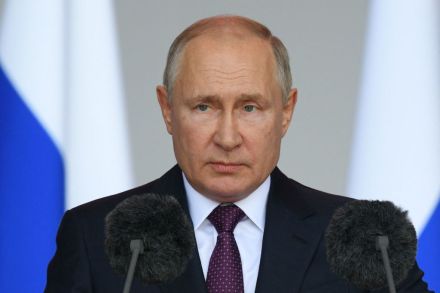
Vladimir Putin's brutality in Ukraine is only going to get worse. The Ukrainians have fought valiantly, far better than anyone expected, but then that only means the Russians will have to up the slaughter in the coming days. As for Putin, he's reportedly fuming over his army's setbacks, threatening reprisals, while hunkering down in — I'm not making this up — his "mountain lair" deep in the Urals. If that makes Putin sound like a Bond villain, then that's just one of the many images of him that's emerged in recent days (the most popular is Putin as Hitler). The seemingly insane nature of his Ukraine invasion has left observers grasping for a reference point. Is Putin addled by cabin fever? Under the sway of extremists? Mentally ill? Who is this Vladimir Putin anyway?

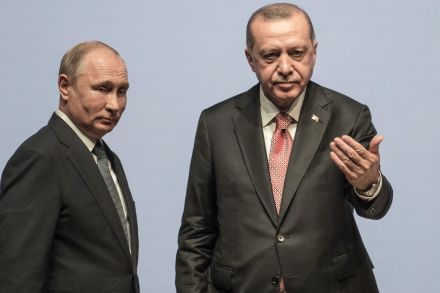
What Erdogan is thinking about Ukraine

From our US edition

Turkey’s twentieth-century experience was very different from that of most European countries. During World War One, the late Ottoman Empire joined forces with Germany, a decision the sultans not only came to regret but that ultimately led to the fall of their monarchy. The Turkish War of Independence followed, touched off by Mustafa Kemal Atatürk, who transformed the Ottoman Empire into the secular Turkish Republic that still exists today. During World War Two, Turkey remained neutral, because of its previous experiences with joining a German military campaign, but also because it was in dire economic shape. In 1952, Turkey joined NATO, and has since been an ally of the West.

Putin will escalate

From our US edition

“I can’t tell you how this ends. All I can tell you is that I just hope millions of people don’t die, or that both Ukraine and Russia aren’t both destroyed in some way thanks to this war.” Those words, spoken to me on an encrypted smartphone app yesterday, are from a Ukrainian commander actively fighting Russian soldiers that I have known for years thanks to wargames I helped organize that brought together national experts, military officials, and policymakers from around the world.

Rise of the dimwit vodka dumpers

From our US edition

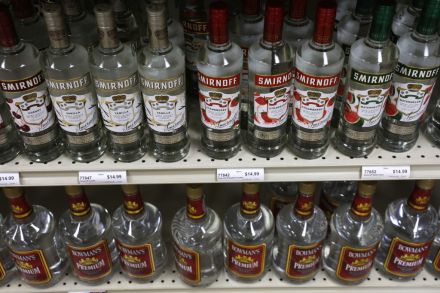
Passive news absorbers across the nation haven’t been able to avoid this thing they heard about some guy named Poutine, who’s, like, Russia’s Orange Man, invading Ukraine, which is, like, a peaceful society of hunter-gatherers and supermodels who live harmoniously with nature, talk to animals, and invented Democracy. This is a super important, really bad thing. The Crane people have been forced to take up arms and defend their way of life. Now, Americans across social media are also stepping up to let you Cranes know they’re paying attention, they care, and they’re ready to strike back at the invaders. Yellow and blue are this season’s black square.

Do Russians support Putin’s war?

Everyone is calling the conflict in Ukraine Putin’s war and insisting that it has nothing to do with the Russians themselves. The nightmare would end – they tell us – if only Vladimir Putin were to disappear in a coup. They used to say the same thing not only about Adolf Hitler but also Benito Mussolini. Yet both the Fuhrer and the Duce would have been as powerless as the speakers at Hyde Park Corner if they had not enjoyed the willing consent of a critical mass of Germans and Italians.

The downfall of Russia’s oligarchs

The normal justification for sanctioning oligarchs is that doing so will cost them money, causing them to put pressure on Vladimir Putin so he stops killing Ukrainians. But this rests on the untested assumption that they are able to put pressure on him, and that is where the plan is currently falling down. Oligarchs are not what they used to be. Our idea of the Russian oligarch was born in the 1990s, when a tiny group of men emerged from the wreckage of the Soviet economy, using their nous to seize anything with real value.

Lindsey Graham unites the world

From our US edition

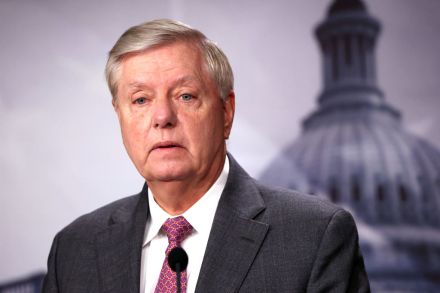
It was a beautiful moment of bipartisan unity when, left and right, American and European, young and old, united to call Lindsey Graham a moron. The South Carolina senator made headlines Thursday night after appearing on Sean Hannity’s show on Fox. He openly called for Vladimir Putin to be assassinated: How does this end? Somebody in Russia has to step up to the plate. Is there a Brutus in Russia? Is there more successful Col. Stauffenberg in the Russian military? The only way this ends, my friend, is for somebody in Russia to take this guy out! You would be doing your country a great service and the world a great service. Graham doubled down on his insanely dangerous comments on Twitter right after. Best to put this kind of stupidity in writing, in case there was any confusion.

lindsey graham

Putin’s Stalinist playbook

From our US edition

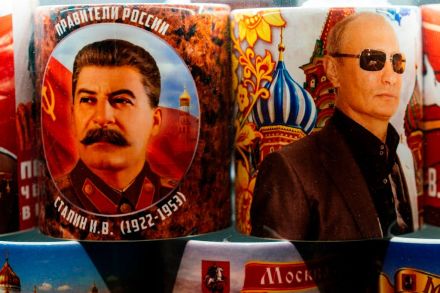
Vladimir Putin's actions have shocked many Western observers over the past few days. But his moves bear all the hallmarks of one of his predecessors: Joseph Stalin. Last Monday, the Russian Duma passed a direct appeal to Putin to recognize the Russian-controlled separatist states of Donetsk and Luhansk. The Russian president first said he would not immediately recognize the so-called republics. The reason for this was he wanted it to appear that when he finally did recognize them as independent republics, he was simply reacting to popular pressure from below. This is straight out of the Stalin playbook.

stalin

America’s long history of sitting out Russian invasions

From our US edition

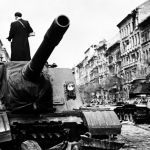
By now, my colleagues in the media may have convinced you that Russia’s invasion of Ukraine has been a “transformative” event, a challenge by a reactionary dictator to the “liberal international order,” if not an end to one historical epoch and the beginning of a new one. The world has turned upside down, nothing will again be the same, blah, blah, blah. When millennials make such apocalyptic observations, I can understand. Like Founding Father Thomas Paine, they assume that each day marks the “birthday of a new world.” But what about baby boomers like New York Times columnist Tom Friedman, who were in high school in 1956 during the so-called Hungarian Revolution, which was very much like what is happening in Ukraine today?

georgia

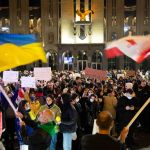
Pro-Ukraine citizens clash with authorities in Georgia

From our US edition

Tbilisi, Georgia After one week of fighting, Russia's invasion of Ukraine has already caused far-reaching geopolitical consequences, most of which point to gross miscalculation from the Kremlin. Following an arguably hesitant start, the Western world has united to provide Ukraine with lethal and non-lethal aid, as well as economic and humanitarian support. In addition, despite Putin ostensibly launching his war to prevent Ukraine from becoming a NATO member and curtail the alliance's easterly expansion, Kyiv's relations with the West have ironically become closer. Both Sweden and Finland appear to be closer than ever to considering joining NATO.

Putin understands America’s moral decay

From our US edition

Last October, Vladimir Putin aired a speech to the Russian nation chiding the United States for its moral decay. He observed an America “blotting out whole pages” of its history, pursuing “reverse discrimination against the majority in the interests of minorities,” and renouncing time-honored values in an effort at “public renewal.” “It’s their right, but we are asking them to steer clear of our home,” he warned. “We have a different viewpoint.” This iteration of family values and conservative critique went barely noticed by the American press at the time.

Putin

No-fly zones won’t work, but what about aid to Ukraine?

Vladimir Putin's forces are encircling the cities of Kharkiv, Kherson and Mariupol, and a 40 mile-long convoy of Russian armoured vehicles is north of Kiev on the seventh day of fighting in Ukraine. The coming days are likely to see greater barbarity from the Russian President after he failed to get his way in the first few days of the invasion. Those days are also likely to stretch into weeks as Putin lays siege to these cities until they are his. The debate about what the West should be doing to needs to widen out So far the political debate in the West has been dominated by a noisy argument about a no-fly zone: something all leaders have repeatedly ruled out on the grounds that it would lead to direct combat between Nato and Russia.

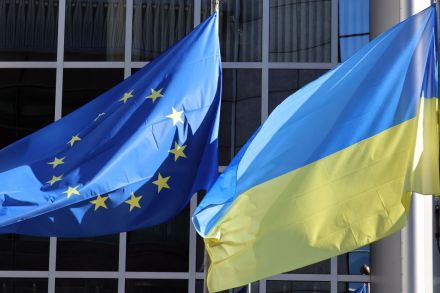
Putin is making the EU great again

From our US edition

The Europeans have been jolted awake from their deep Pax Americana slumber, when the continent was largely content to eat the spoils of economic prosperity and allow the United States to do the heavy lifting on all things security. And we have Vladimir Putin to thank for it. Russia’s nearly week-long invasion of Ukraine has shocked the conscience of many who believed Europe would never return to the dark days of large-scale land warfare.

Boris rules out a no-fly zone over Ukraine

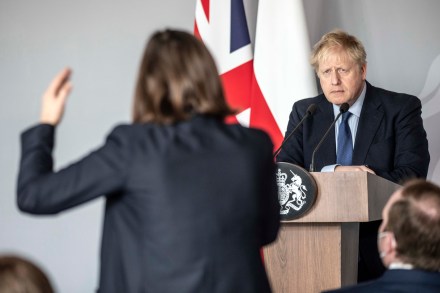
What can the UK do to ensure that Vladimir Putin fails in Ukraine? The Prime Minister has just given a press conference in Poland with his counterpart Mateusz Morawiecki where he repeated his assertion that 'Putin will fail' and that the West 'will succeed in protecting and preserving a sovereign, independent and democratic Ukraine'. The Russian president, he said, had underestimated the resolve of Ukraine and its allies.

taiwan

What does Ukraine really mean for Taiwan?

From our US edition

No one should think that Vladimir Putin’s invasion of Ukraine means that Xi Jinping will decide to use force against Taiwan anytime soon, if ever. China is not Russia, nor Taiwan Ukraine. Yet neither should policymakers presume that Beijing will not be influenced by what happens on the other end of Eurasia. Washington must consider whether and how Putin’s aggression has raised the stakes in defending Taiwan from the People’s Republic of China. At the least, US strategists will seriously have to assess whether a global environment in which norms of international behavior are regressing may serve to spur Beijing to military action that once seemed unlikely.

Putin’s endgame is preserving ‘his’ Russia

From our US edition

Vladimir Putin’s war in Ukraine does not appear to be going well, and the Russian economy is about to experience the full force of Western sanctions. American social media is already in a celebratory mood. But caution is in order — it’s never smart to underestimate your opponent. Putin was expecting sanctions, and he and his war planners could not have discounted Ukrainian resistance, even if they underestimated its intensity. Maybe they did expect the invasion to be a cakewalk and are taken aback by how difficult it’s proved to be in just these first few days. But as of now the invasion still seems to be on its timetable, and its military objectives are achievable. Russians are surrounding Kyiv.

Liz Truss is having a good war

Liz Truss gave a striking statement in the Commons this afternoon on the action the government was taking to respond to the Russian invasion of Ukraine. It contrasted to the approach taken by some of her colleagues, because it contained a number of admissions about the impact of this action. For the first time, the Foreign Secretary stated that Britain would 'have to undergo some economic hardship as a result of our sanctions'. This has been implicit over the past few days, but Truss was the first to say it clearly. She added that 'our hardships are nothing compared to those endured by the people of Ukraine', and also warned that the war could last months or years.

‘Staying Switzerland’ on Ukraine is impossible

The striking thing about the financial sanctions on Russia is not their severity, but just how many countries are joining in the effort. Switzerland has today announced that it will adopt the EU sanctions on Russia, particularly significant because it has been the biggest recipient of private transfers by Russians in recent years. The fact that such a traditionally neutral country is imposing sanctions will deepen the wedge between Putin and the rest of the ruling elite. Meanwhile in Asia, Japan, South Korea and Singapore have signed on to the economic measures on Russia.

Viktor Orbán has played a perfect game with Putin

On 3 April Hungarians will have their ninth set of free parliamentary elections since the collapse of the communist dictatorship in 1989. The winner is likely to be Viktor Orbán and his Fidesz-KDNP coalition, which is leading in five of the six major polls. Russia’s invasion of Ukraine will not change that dynamic even though the opposition leader, Péter Márki-Zay has called Orbán a ‘traitor’ for his long-standing friendship with Vladimir Putin. Ever since Viktor Orbán began his second stint as Hungary’s prime minister in 2010, he has repeatedly played the provocateur within the EU, tweaking the eurocrats’ noses with his cultural conservatism and hostility to mass immigration.