Russia

Ukraine’s most wanted – an interview with Dmitry Firtash

If you’ve heard of Dmitry Firtash, the odds are you’ll have the impression of a deeply controversial man. He was arrested in Austria in 2014 at the US government’s request on charges of ‘conspiracy to bribe’ in India. A warrant was then issued for his arrest in Spain. Last year, Firtash was sanctioned by Ukraine over claims that he was selling titanium products to the Russian military. In America, he has been called ‘Ukraine’s most wanted’. In Britain, he gave £4 million to Cambridge University and spent much more on other projects, and has since been held up as a classic example of an oligarch buying his way into our establishment.

The three stumbling blocks to a Ukraine peace deal

A month in, and the war in Ukraine looks very different to how anyone expected. On the first day of the invasion, western intelligence sources believed that Kyiv would fall to Russian forces within 72 hours, underestimating the Ukrainians’ ability to defend their territory and overestimating the Russian military’s capabilities. Among Vladimir Putin’s many errors was his underestimation of western unity. He did not predict the severity of the sanctions against Russia or that his act of aggression would snap Europe (most notably Germany) out of its complacency over defence spending. In some ways, Putin, by going for a full-on invasion, made it easier for the West to adopt a unified position.

How much of a litre of fuel is now tax?

Common knowledge Tensions in the visit of the Duke and Duchess of Cambridge to Jamaica led some to speculate that the Commonwealth might not long survive the present Queen’s reign. Who came up with the idea of naming the successor organisation to the British Empire after a term first used by Oliver Cromwell? – Lord Rosebery is recorded as referring to a ‘Commonwealth of nations’ in 1884, a decade before he became prime minister. – The term was first used officially in the Commonwealth of Australia Constitution Act 1900, which established a federation of British colonies. – The idea of a British Commonwealth first surfaced at the 1926 Imperial Conference. – The word ‘British’ was dropped in 1949.

Ukraine is witnessing the future of drone warfare

Russian forces have reportedly been ordered to watch last year’s state-funded propaganda film Sky. The Kremlin-funded drama follows the lives of Russian airmen in Syria, where an estimated 18,000 people are believed to have died in Moscow's bombings. With jets soaring through the sky and explosive special effects, it tells the story of Oleg Peshkov, a pilot shot down by a Turkish fighter plane. When Hollywood makes its own action flicks about the war in Ukraine, directors may settle for a different kind of hero. Instead of strapping military men jumping into cockpits, it is becoming increasingly clear that Kyiv owes much of the credit for its fierce defence to drones.

bioweapon labs

Secret bioweapon labs are Putin’s MacGuffin 

From our US edition

Some commentators have already noted the strange homology between Russia’s evocation of “secret bioweapon labs” in Ukraine and the US evocation of Saddam Hussein’s weapons of mass destruction, which in both cases were used to justify military attack. It’s not that the US was unsure if Saddam had WMDs; they positively knew he did not have them, which is why they risked a ground offensive in Iraq, rather than sticking to air bombing. The nonexistent Iraqi weapons of mass destruction perfectly fulfill the role of a “MacGuffin” in Alfred Hitchcock’s films. A MacGuffin is “an object, event, or character in a film or story that serves to set and keep the plot in motion despite usually lacking intrinsic importance,” per Merriam-Webster.

Don’t let Russia end the old world order

From our US edition

While most Americans believe that the Russian invasion of Ukraine is morally wrong, there is in some corners a pervasive sense of annoyance with the conflict. The real enemy, some say, is China, and they believe that America should not focus on the last vestiges of 20th-century conflicts at the expense of losing focus on those of the 21st. They see NATO and the rest of the Cold War infrastructure as representative of a dying world. Instead of propping up this order, they argue, America should be hard at work building a new order to take on China. The goal of a new American-led, anti-China world order is a necessary one. The currently existing old order is ill-fitted to combat China, which indeed will be America’s main 21st-century enemy.

Who poisoned Roman Abramovich?

Russia is now 33 days into a war it expected would last 72 hours. Given the relative failure of the invasion, it is surprising anyone in the Russian security establishment has much time to spare for side projects. Yet, yesterday’s news that the Russian oligarch Roman Abramovich was poisoned during informal peace negotiations with the Ukrainians would suggest otherwise. While details are murky, according to the investigative journalism collective Bellingcat, billionaire Abramovich was engaged in shadow negotiations in the Ukrainian capital, Kyiv, earlier this month when he and his two Ukrainian interlocutors fell ill. The men later received medical treatment in Istanbul. Since the story broke, there has been a heady mix of clarifications, confirmations and counter-accusations.

The rouble’s astonishing recovery

The tank columns are stalled; one or two towns captured from the Ukrainians have been retaken. Russia’s war effort has been going nowhere fast for the past fortnight – unless you count the constant pounding and destruction of apartment blocks a form of progress. But then is the economic war being waged against Russia making any greater progress? True, Muscovites can no longer get a Big Mac, and western-made luxury goods have disappeared from the shelves. Yet look at the dollar’s march against the rouble and it is starting to look like a convoy of Russian armoured vehicles. For the first few days, the rouble sank inexorably as sanctions kicked in. On the day before Putin marched in on Ukraine, a rouble was worth $0.012.

Has Biden lost his mind on Ukraine?

From our US edition

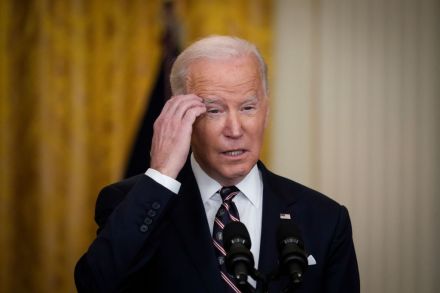
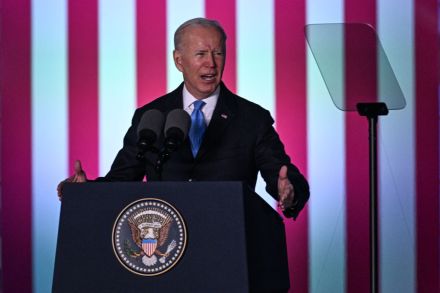
Has Joe Biden gone loco over Ukraine? In Warsaw, Biden proclaimed of Russian president Vladimir Putin, “For God’s sake, this man cannot remain in power.” Biden also called Putin a "butcher." Then, in a meeting with the Polish president, Biden said the US regards NATO’s Article 5 as a “sacred commitment.” Biden called Warsaw a “sacred place” in the history of Europe and in “humankind’s unending search for freedom.” Biden went on to describe the conflict in Ukraine as "a battle between democracy and autocracy, between liberty and repression, between a rules-based order and one governed by brute force.

biden ukraine
biden

Biden’s ad-libs are making the world less safe

From our US edition

Joe Biden, by his own admission, is a man who sometimes goes off script. Whereas some presidents seek to bottle up their emotions and remain reserved for the cameras, Biden wears his emotions on his sleeves. The president proved that yet again during his visit to Poland over the weekend, where he let loose on Russian president Vladimir Putin at the conclusion of a speech: “For God’s sake, this man cannot remain in power.” Many in the West would privately agree with Biden’s assessment.

regime change

Why Biden’s slip-up is so revealing

From our US edition

The White House might have issued the fastest correction of a sitting US president’s remarks in history this weekend. But it doesn’t matter one bit. The bottom line is Joe Biden — and most of the civilized world — wants to see Vladimir Putin out of power in Russia. More to the point: they want to see his regime changed and him most likely Gaddafi'd for his sins. And, to be frank, who can blame them? There is just one problem: getting rid of Vlad means World War Three. And I can tell you from gaming out such a conflict countless times in simulators, such a conflict leaves tens of millions of people dead. But let’s step back for a moment. I'm going to cut the president a little bit slack for saying out loud what we are all thinking.

Germany’s progressives have a Putin problem

Eighty-nine years ago this week, the German Social Democrats in the Reichstag cast the only votes opposing Adolf Hitler’s dictatorial power grab, the Enabling Act. Today’s SPD members often cite that moment as the proudest in their party’s 146-year history. With a memory like that, there is something awkward about the current SPD Chancellor’s position. Olaf Scholz is now having to come to terms with decades of SPD appeasement towards the dictator in Moscow. Before Putin’s invasion, Russian doves could be found across the German political spectrum, but Scholz's now-ruling SPD has an especially long and developed history of Kremlin cosiness.

Could Biden gaffe us into world war three?

‘I want your point of view, Joe,’ Barack Obama once told his vice-president Joe Biden. ‘I just want it in ten-minute increments, not 60-minute increments.’ Obama understood Biden’s biggest flaw – his mouth runs away with him. He’s a verbal firebomb always threatening to go off. Last night, oops Biden did it again. As he rounded off his fiery speech in Poland against Vladimir Putin and autocracy, he concluded: ‘For God’s sake, this man cannot remain in power.’ The onset of senility had reduced the dangerousness of Biden’s loquacity The White House, in what is now a familiar routine, issued a quick clarification. The President was not demanding ‘regime change’ in Moscow.

No more dithering over Ukraine

From our US edition

The extraordinary skill, courage and effectiveness of Ukraine’s fighting forces have given the US and NATO an extraordinary opportunity to reestablish military deterrence in Europe and show the Kremlin that unprovoked military aggression will be repelled and ultimately defeated. But President Biden and NATO leaders are dithering. They are simply not acting with the urgency needed to fully support Ukraine’s military. It’s the same failure they displayed for the year prior to the invasion, when Putin was building up tens of thousands of troops along Ukraine’s border. Even now, the US and NATO are hesitating to provide the full complement of essential weapons to Ukraine, including air-defense systems, MIG fighters and a lot more drones, anti-tank and anti-ship weapons.

ukraine
warsaw

Biden’s Warsaw speech was both baffling and moving

From our US edition

Poland “Biden fell asleep.” Perhaps a thousand jokesters posted this and similar jibes in the livestream comments as we waited for the president to speak from Warsaw. Thousands of Poles, and doubtless many Ukrainian refugees, were gathered around the Royal Castle in the center of the Polish capital to wait. Biden trotted out — old but amiable and very much awake. In fact, after spending two days meeting refugees, Ukrainian representatives and Polish politicians, he looked surprisingly sprightly. God help me for saying this but I have a soft spot for the president.

Why Russian tactics won’t win the war

As the Russian invasion of Ukraine enters its second month, the war has settled into a largely attritional struggle – and the picture is very different across the various fronts. Russian forces have been forced on to the defensive in many areas. The Russian ministry of defence has announced that the ‘first phase’ of the invasion is over, to be replaced with a more limited focus on Donbas in the east of Ukraine. The reason for this is simple: Ukrainian forces have not only stopped the Russian advances around Kyiv in the north and Mykolaiv in the south-west but have begun to regain towns and cut key Russian supply routes.

Is Putin’s war spreading?

Yerevan, Armenia ‘This is our land,’ Anna says, looking out over her roadside flower shop. ‘Lenin promised it to us.’ Her father was born across the mountains in Russia, one of around 100,000 displaced Armenians only able to return home after world war two. ‘But thanks to Lenin, we have our own country. A free country – at least for now.’ As the fighting in Ukraine stretches into its first month, another conflict between two former Soviet states might not be far away. Last year, a brief but bloody war broke out between Armenia and Azerbaijan over the breakaway region of Nagorno-Karabakh, which had been autonomously governed by ethnic Armenians over the past three decades.

Was Biden’s chemical weapons threat a gaffe?

Did Joe Biden mean to threaten Russia with a chemical weapons attack? That seemed to be what he implied at yesterday’s Nato summit when he said Russia using chemical weapons in Ukraine ‘would trigger a response in kind’ from the US. To respond ‘in kind’ means to respond in the same way – i.e. by firing chemical weapons back at Russia. Given that the US committed to destroying its remaining stockpiles of those munitions when it signed the Chemical Weapons Convention in 1993, it would seem very unlikely that this is what Biden meant. Or indeed, that he would have any chemical weapons to unleash in the first place. There is something to be said for ambiguity.

A state of virtual war

From our US edition

My husband came into the living room the other day as I was sitting on the couch, scrolling on my computer — doomscrolling to be more accurate. “What are you doing?” he asked. “Are you watching... war?” We laughed at the absurdity of the comment but he wasn’t wrong. That’s exactly what we had been doing for days. Watching war on social media. Needless to say, it was a challenge to focus on this piece. As the conflict escalated rapidly in Ukraine, I couldn’t tear myself away from the drama as it unfolded on Twitter. Putin seemed backed into a corner, desperate and using many of the same barbaric tactics he used in Syria. Bombing hospitals. Bombing kindergartens. Killing civilians.

war
cyberattack

How bad could a Russian cyberattack be?

From our US edition

When I have designed wargames around a NATO-Russia conflict, I often left out cyberattacks for a simple reason: it was just too complicated. Too many unknowns make an accurate simulation impossible. The number of targets, scale of the attack, damage done, how the attack could be carried out and its ramifications were beyond calculation for a mere simulation on the scale I was running using just consumer-based computer technology. Honestly, nuclear war seemed easier to think about, and that says a lot. But that should give us pause. Our world is basically a giant computer now, with cloud-based networks controlling virtually every aspect of our lives, from sewage and water treatment plants, to our electrical grid, to our smart homes, and on and on we go.