Military

There will be blood – the vital work of field transfusion units

Most conventional World War Two military histories focus on weapons, materiel and even the manpower needed for a decisive victory over Hitler and the Axis powers. Little has been written about blood as a strategic resource. However, a pioneering service of specially trained medics who worked dangerously close to the front lines, pumping blood into the veins of battle casualties, not only saved lives but contributed significantly to winning the war. They did this by returning men to the front line and boosting morale by persuading them that, if wounded, they had the maximum chance of life.


blood

What Britain taught us

From our US edition

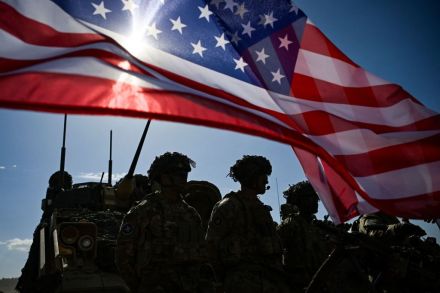
Being in Britain around the Fourth of July is always an odd experience for an American. It was especially awkward to be at the Alliance for Responsible Citizenship in London a week before the 250th anniversary of US independence. ARC is a British organization whose massive annual conference – about 4,000 people this year – is styled as a kind of counter-Davos, an international gathering of center-right types including a heavy representation of Americans. Given the timing, various speeches by gracious British hosts praising their American guests’ homeland – and by Americans themselves praising the principles of their revolution against the British two and a half centuries ago – were to be expected. But that didn’t diminish the cognitive dissonance.

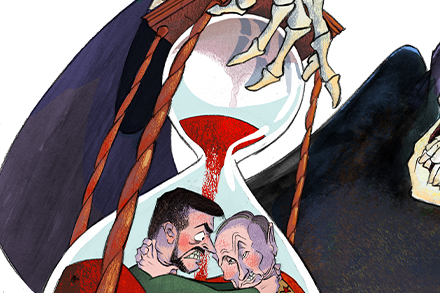
Forever war: will Zelensky and Putin be brought to an exhausted peace?

Volodymyr Zelensky stood proudly on the steps of 10 Downing Street earlier this month, flanked by Sir Keir Starmer and the leaders of France and Germany, ready to discuss Europe’s latest package of support for Ukraine’s ongoing war effort. Though the conflict has now lasted longer than World War One, Zelensky is in some ways in the most heroic period of his presidency. Ukraine not only continues to stand firm against intense Russian assaults but also seems to be regaining a strategic advantage with its long-range drone strikes. Europe has stepped up to replace US funding and diplomacy and the fall of Hungary’s Viktor Orbán has unlocked a €90 billion loan package. Yet it is also the most sordid period of Zelensky’s presidency.

war

How warfare became welfare

From our US edition

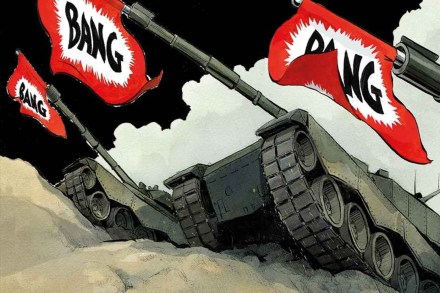
As tensions with Iran once again push the US toward the possibility of further involvement in Middle Eastern conflicts, a novel brand of anti-interventionism has swept American politics. After two decades of costly wars in Iraq and Afghanistan, both the populist right and progressive left have grown more willing to question the assumptions underpinning American military engagement abroad. Politicians as ideologically diverse as Thomas Massie and Alexandria Ocasio-Cortez now openly criticize interventionist foreign policy, while public fatigue with the post-9/11 wars has become increasingly visible across the political spectrum. Yet even as Americans tire of foreign interventions, cuts to the defense budget are politically untouchable. Wars end, defense spending does not.

US military

Inside the Killhouse: where Ukraine’s revolutionary military robots are developed

From our US edition

The Ukrainian unmanned ground vehicle rolled up to a small bunker hidden in a thicket in Kharkiv oblast then stopped. Another remote-controlled vehicle had just detonated its 66lbs of explosives at the Russian bunker’s entrance, which was still smoldering. And before that a kamikaze drone had dived inside and exploded. The operator was about to detonate his explosives when two Russian soldiers pushed a sign through the bunker’s shattered roof saying they were surrendering. They were directed to Ukrainian lines by a drone and taken into custody as POWs. So ended the world’s first fully robotic assault on an enemy position. The remotely operated vehicle in this attack is called a Targan (“cockroach” in Ukrainian) and looks like a miniature flatbed without the cab.

killhouse

Trump believes Britain has betrayed the SAS

From our US edition

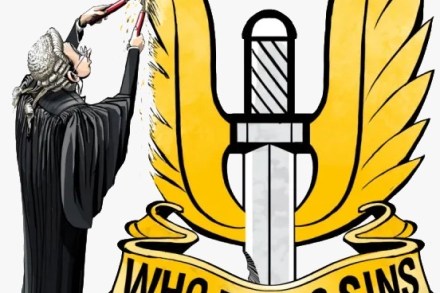
The Special Air Service, Special Boat Service and other elements of UK Special Forces are held in the highest regard by the Pentagon and by US special operators. British and American special forces have forged a bond of trust over decades with joint high-risk operations and combined training. A recent visit to Washington made clear that the American leadership on both sides of the political divide, and within the military and intelligence services, believe the current British government has broken that alliance. America views the SAS and SBS as equal to its own tier one special forces operators in Delta Force and SEAL Team Six. The eight saber squadrons of the SAS and SBS contribute a significant amount of the special forces’ manpower relied upon by both countries.

SAS

The age of the aircraft carrier is over

From our US edition

Ever since World War Two, America’s aircraft carrier fleets have served as imposing instruments of imperial power, roaming the oceans to cow recalcitrant nations into obedience. Favored by the Trump administration for this purpose, current experience indicates their day is done thanks to the proliferation of anti-ship missiles and the increasing ubiquity of drones. In America’s last Middle Eastern war but two, against the Yemeni Houthis in 2025, the carrier USS Harry S.Truman, complete with its attendant escorts, was driven into retreat, leaving antagonists in control of the Red Sea. On one occasion, the carrier’s desperate maneuver to avoid a Houthi drone caused an $80 million Hornet jet fighter to slide off the deck and topple into the sea.

How prepared is Britain for war? – with Gen Sir Nick Carter

35 min listen

General Sir Nick Carter, former chief of the defence staff, joins Tim Shipman to discuss Britain's military preparedness – or rather, lack thereof. While a friendlier US presence at the Munich Security Conference may have provided some relief, the military threats to the UK and to Europe presented are still stark. So what choices need to be addressed to ensure that Britain is equipped to deal with these threats? Is the government doing enough to address the awareness gap with the public? And how could AI change warfare? Produced by Patrick Gibbons.

How prepared is Britain for war? – with Gen Sir Nick Carter

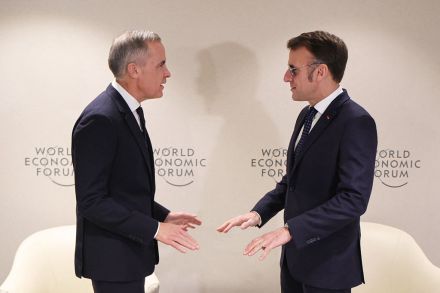
Davos and the showy ruthlessness of the new ‘far center’ 

From our US edition

There has always been a section of the establishment which thinks that the solution to populism lies in a great straightening-out of the populace. Populism is happening because people are bored, they say, so conscript them, get them off their phones, give them things to do – especially the young. It is only through collective struggle and sacrifice, it’s thought, that liberal democracy may find coherence and purpose again after 30 years of supposed ennui.  This part of the liberal center is happy enough to wave the flag. Indeed its main tactic is to accuse its opponents of national treason. It affects to agree with the populists that a new age of expediency has now opened, and that the establishment must now meet it with a ruthlessness of its own.

Carney Macron far center

Could military service become morally untenable for Catholics?

From our US edition

During his lengthy interview with the New York Times, President Trump was asked if there was anything that could check his power on the world stage. “Yeah, there is one thing,” he said. “My own morality. My own mind.” What are we to make of Trump’s morality? That’s between him and God, I suppose, and perhaps only the all-knowing could parse his mind. But it’s fair to wonder where morality factors into Trump’s foreign policy, and whether America’s moral justification of force has only ever been a convenient pretext for acting in our own interest.  At the World Economic Forum in Davos today, Trump said he “won’t use force” to take Greenland.

Pope

The five Haldanean principles that could reshape Britain

If Reform get into government, there is one man they seem likely to turn to for guidance. He is an obscure figure, unknown to many, yet has acolytes across the political spectrum – from Dominic Cummings to Gordon Brown. His name is Richard Burdon Haldane and he died almost a century ago. It was recently reported in this magazine that Danny Kruger had been seen carrying ‘a well-thumbed copy’ of the most recent biography of Haldane. I wrote that book. In it, I describe how Haldane reshaped Britain in the early 20th century – and how, should others choose to follow his example, he might help to transform it again today.

Q&A: A Labour rebellion is coming – can Starmer survive?

30 min listen

This week: Michael and Maddie look ahead to a turbulent political year, asking who will rise, who will fall – and whether Keir Starmer can survive the mounting unrest within his own parliamentary party. With Labour backbenchers showing an increasing willingness to defy the leadership, is a full-blown rebellion inevitable? They also discuss the government’s controversial decision to welcome Alaa Abdel-Fattah back to Britain, and ask what the episode reveals about two-tier politics, herd mentality in Westminster, and a Prime Minister more comfortable in the role of human rights lawyer than national leader. And finally: should Britain bring back national service?

European countries are expanding their militaries. Why aren’t we?

Following America’s extraordinary raid on Venezuela last week, Donald Trump has pointed to Greenland, which belongs to the Kingdom of Denmark, as the territory he plans to turn his attention to next, staking a claim he has made repeatedly since his return to the White House. Trump said this week that America needs Greenland ‘for national security. Right now’. He told reporters he is ‘very serious’ in his intent. The US President might be claiming Greenland in the name of peace and stability, but there is every chance his neo-imperial attempts to see off the threat from China and Russia will backfire. Will his actions herald the return to a land-grabbing, power--flaunting global order like that of the 19th century?

Trump says the US has captured Venezuela’s Maduro

Donald Trump's undeclared war in Venezuela against the Marxist regime of President Nicolas Maduro has erupted into the open. Trump says the US has captured Venezuela's leader and his wife. In a statement on Truth Social, Trump wrote: The United States of America has successfully carried out a large scale strike against Venezuela and its leader, President Nicolas Maduro, who has been, along with his wife, captured and flown out of the Country. This operation was done in conjunction with U.S. Law Enforcement. Details to follow. There will be a News Conference today at 11 A.M., at Mar-a-Lago. Thank you for your attention to this matter! President DONALD J. TRUMP.

Labour’s dereliction of duty over defence

Last week, our political editor, Tim Shipman, revealed a recent meeting between Air Chief Marshal Sir Richard Knighton, the Chief of the Defence Staff, and the three heads of the services to discuss the defence investment plan. This plan governs the day-to-day armed forces’ budgets and follows the recent Strategic Defence and Security Review (SDSR), which sets our military aims as a nation. The chiefs agreed to write an unprecedented letter to John Healey, the Defence Secretary, explaining that the SDSR couldn’t be delivered without the requisite funding. That money was not forthcoming in the Budget, so they are forced to contemplate a bleak alternative: immediate cuts to both our forces and ambitions. These looming defence cuts could not come at a worse time.

The unbearable wokeness of the Canadian military

From our US edition

“I think the question that needs to be asked is: what kind of military does Canada even want?” Dallas Alexander has been all country-star cool until I ask about his former employer. Now his voice takes on a more earnest tone. We’ve talked about the song the veteran-turned-singer considers his best – “Child of this Land,” a ballad about growing up in the remote Fishing Lake Métis Settlement in northern Alberta – and we’ve discussed which is the fan favorite: same, he says, or maybe the more upbeat “Can’t Blame My Bloodline.” To my mild surprise he doesn’t mention “Adios Amigo.” The song, with its catchy (and ominous) refrain, references the record-breaking sniper shot taken by Alexander’s team in 2017.

Dallas Alexander (Dallas Alexander) canada

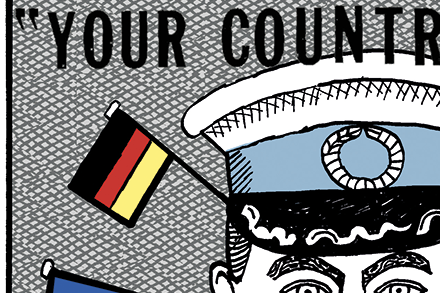
Is Germany ready for military service?

It’s finally crunch time for Boris Pistorius’s plan to reintroduce military service in Germany. Following a delay of several months thanks to the country’s snap federal election campaign at the start of the year, the defense minister’s new "Modernization of Military Service" draft law is currently being debated in Berlin. Under Pistorius’s proposals, all 18-year-olds will be asked to complete a questionnaire that will gauge their willingness and ability to carry out military service. For men, the quiz will be compulsory; for "other genders" – including women – it will be optional. Those who declare themselves willing to serve will be invited for a formal assessment for recruitment into the armed forces, while anyone refusing to fill out the questionnaire could face a fine.

military

Why the Army needs the cavalry

From our US edition

A generation ago, I was an officer in the US Army National Guard and later in the Army Reserve. I did absolutely nothing important, and never saw any places more exotic than Fort McCoy, Wisconsin, and Camp Atterbury, Indiana. I then spent a dozen years working for the Army as a civilian employee. I had already decided before these events to devote my academic career to the study of the Army. I loved (and still do love) it in an abstract and historical sense. However, only after my personal association with it did I realize how profoundly shortsighted it was. I observed this myopia daily and marveled at its immensity. Veterans may remember the adage that there is “the right way, the wrong way and the Army way.” The Army way is usually just plain dumb.

Army

The ‘Great Spiritizing’ of the top brass  

From our US edition

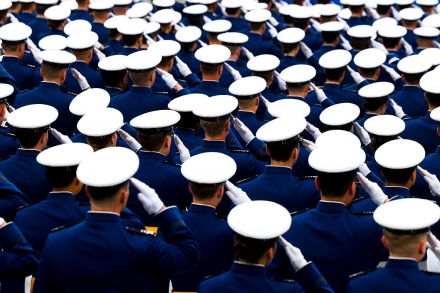
“Today we end the War on Warriors,” Secretary of War Pete Hegseth, author of the book The War On Warriors, tweeted this morning. Today was the day that Hegseth really became Secretary of War, addressing, along with President Trump, a full gathering of top military brass in Quantico, Virginia.  “This is only an esprit de corps,” the President said, as he set sail from the White House for the event. “Do you know what that is, an esprit de corps? This is only a spirit. These are our generals, our admirals, our leaders, and it's a good thing, a thing like this has never been done before, because they came from all over the world. And there's a little bit of expense, not much, but there's a little expense to that. We don't like to waste it.

Hegseth

MDMA should be licensed for veterans with PTSD

‘Stuff starts to get real, real quick,’ recalls former US Marine, Tyler Flanigan. An Iraqi sniper had just shot out the tyres of his truck and a key member of his team had been killed. ‘We were sitting ducks.’ ‘I couldn’t easily name a single day in Iraq that I wasn't shot at or didn’t have something explode next to me,’ says his fellow US Marine veteran, Nigel McCourry. Combat experience is hard to forget. Civilian life offers daily triggers that throw you back down ‘IED alley’, reliving the flailing feeling of being blown up and the horror of gathering friends’ body parts in bags. These former US Marines discussed their trauma in the documentary Dead Dog on the Left.