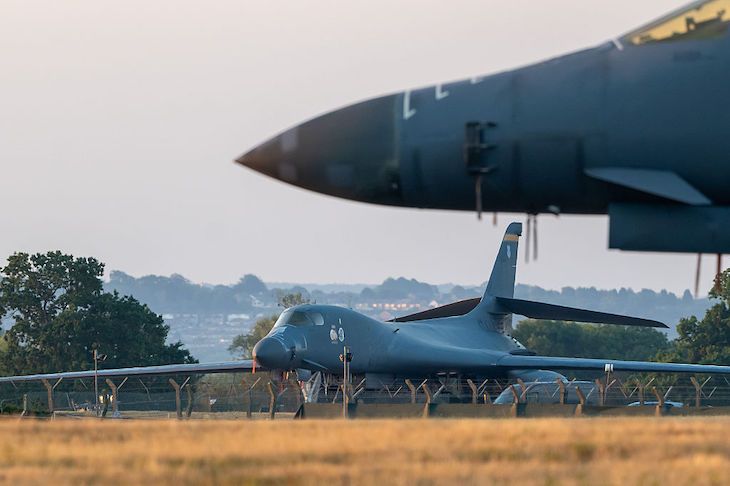
The hasty withdrawal by the United States of its 12 B1 Bombers from Royal Air Force base Fairford, without explanation by the Pentagon, has fueled much speculation. The most obvious conclusion is that there is an ongoing security threat to the airbase in Gloucestershire, even after the foiling of last week’s attack, if that is what it was.
The lesson for the UK from the sudden departure of the US bombers should be clear: we are now primarily responsible for own defense and security
The US, while initially pleased with what they said was a good British reaction to that incident on September 27, seemed as bemused as many others as to why five men, who were initially arrested on suspicion of terror offenses, were subsequently released on bail.
The sequence of events is certainly bizarre: an alleged terror attack foiled by one of Gloucestershire’s redoubtable farming ladies; the arrest of five suspects, then their release on bail; the news that one of the suspects had dialed the police an hour before officers intercepted them; and the subsequent arrest and release on bail of a further suspect, a UK-Iranian national. None of this really makes much sense, even after the British Prime Minister pointed the finger at Iran. The US administration now regards the UK, with some justification, as no longer a wholly reliable ally.
The security threat to Fairford, regardless of what happened last week, is real. In July, according to the BBC, Iran warned that “any base used for aggression against Iranian territory constitutes a legitimate target for our forces.” Fairford would certainly fit that bill. It is possible that another Iranian, or Iranian-inspired, plot has been detected involving the airbase. This would explain the rapid and unannounced departure of the bombers and the fact that the air-to-air refuelers, necessary for them to make their way across the Atlantic, had not been scrambled.
The B1s were brought over from their home base in the United States earlier this year to support the American campaign against Iran. Their presence attracted plenty of attention. Former prime minister Keir Starmer initially refused to allow the US to use Fairford for strikes on Iran. Starmer was eventually cajoled into allowing Fairford’s use for “defensive” operations by the US. The Iranians seem not to have been persuaded that the bombs being dropped on them by these B1s were “defensive.”
But whether or not a new threat from Iran led to the bombers’ departure, there is a wider context to what has unfolded at Fairford. The US, from the beginning of the second Trump presidency in January 2025, has been insisting that its allies need to look after themselves. They have suggested withdrawing troops from Europe, insisted that the Europeans provide any post-ceasefire security forces in Ukraine, and have been reluctant to provide any form of security guarantee to Taiwan. Allies are unhappy with the policies but the change in America’s position is clear.
In the Middle East, we have seen this trend accelerated by the evident vulnerability of both US bases and the infrastructure of their host countries.
A Pentagon report, the details of which emerged last week in the Christian Science Monitor, found that “Iranian strikes damaged and destroyed hundreds of buildings and structures at US bases in Kuwait, Bahrain, Qatar, UAE, Saudi Arabia, Iraq, Oman and Jordan, during the conflict.” General David Petraeus, who commanded US Central Command from its forward base at Al Udeid in Qatar, has stated publicly that US bases in the region are “no longer viable.” Rather ruefully he reported that his “beautiful” headquarters, now has “a few holes in the roof.”
The damage and potential destruction of host nations’ critical infrastructure, not just oil and gas, but water supplies too, will also be weighing on the White House. Those countries, while they may fear and loathe Iran, will also be calculating that the defensive protection offered by a US presence is no longer effective, and is even a potential liability. They are readjusting accordingly.
That is one of the driving forces behind the Muslim NATO initiative; Saudi Arabia, Turkey, Pakistan and other countries are now understandably looking to their own security. The US is withdrawing to its home hemisphere while bases across thew Middle East find themselves in range of Iranian missiles and drones. The Pentagon is keen to emphasize that it retains its Conventional Prompt Strike, which allows the US to strike anywhere in the world in under 60 minutes. Secure bases outside the US – including Diego Garcia – make for easier sustained operations. As if to emphasize the importance of such locations, the US will soon have three carrier strike groups in the Middle East.
But the lesson of the sudden departure of the US bombers should be clear: Britain and its European allies are now responsible for their own defense; its alliances, within NATO, with the US, in AUKUS, and with others, carry real obligations and are not an excuse to palm-off responsibilities. Britain also has a genuine internal security problem with Iranian-inspired disruptors, and possible terrorists. The United Kingdom has seen the forces of its closest ally leave its territory because the country is unable to properly defend itself.





Comments