

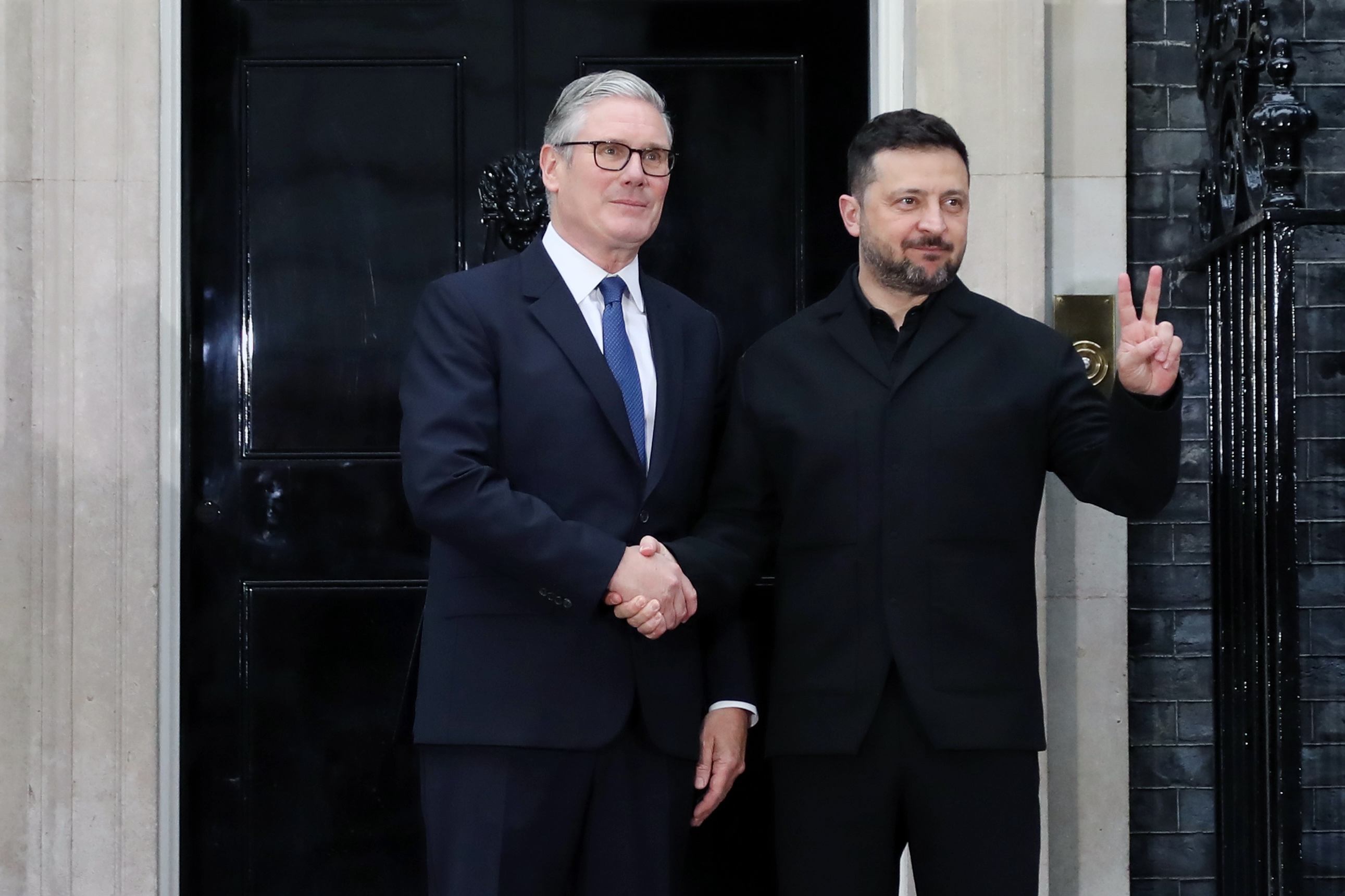
Volodymyr Zelensky stood proudly on the steps of 10 Downing Street earlier this month, flanked by Sir Keir Starmer and the leaders of France and Germany, ready to discuss Europe’s latest package of support for Ukraine’s ongoing war effort. Though the conflict has now lasted longer than World War One, Zelensky is in some ways in the most heroic period of his presidency. Ukraine not only continues to stand firm against intense Russian assaults but also seems to be regaining a strategic advantage with its long-range drone strikes. Europe has stepped up to replace US funding and diplomacy and the fall of Hungary’s Viktor Orbán has unlocked a €90 billion loan package.
Yet it is also the most sordid period of Zelensky’s presidency. Ukraine’s independent anti-corruption agency, NABU, has revealed evidence of shocking, large-scale war-profiteering in Zelensky’s inner circle. In April it was reported that NABU had intercepted evidence that came uncomfortably close to linking Zelensky himself to a luxury villa built with the proceeds of embezzlement. Andriy Yermak, Zelensky’s long-time business partner and latterly his all-powerful chief of staff, has been formally arrested (he says the charges are “unfounded”). Several key former Zelensky business partners, as well as prominent members of his Servant of the People party, have escaped corruption charges by fleeing abroad, leading to accusations that they were tipped off by powerful friends.
Ukraine will produce a staggering seven million military drones this year
Polls show Ukrainians’ deep distrust of the government. In a survey last month by the Kyiv International Institute of Sociology – Ukraine’s most reputable polling organization – 54 percent named corruption in state authorities as the greatest threat to the development of Ukraine, while only 39 percent named Russian military aggression. Some 59 percent believed that Zelensky was personally responsible for corruption. And that was before the latest revelations about four luxury villas near Kyiv built using allegedly stolen money by Timur Mindich – a business partner of Zelensky’s wanted for involvement in a $100 million embezzlement scheme that skimmed money off funds intended to fortify energy infrastructure against Russian attack. According to conversations recorded by NABU, one villa was for Mindich himself, another for Yermak, the third for the former deputy prime minister Oleksiy Chernyshov, while the fourth appears to have been for someone whom Mindich refers to as “Vova,” short for Volodymyr, who “spoke with him before Shabbat.” The investigation continues (Zelensky is not a subject of it).
“After reading and listening through the transcripts, any normal person feels like a patient with nausea and bloating whose every exit has been stitched shut,” says Inna Vedernikova, political editor at the news website ZN.UA. “The only thing that can help is freeing the country’s body of its toxic government. But to change the government, you need elections. To hold elections, you need to end the war. And the date the war ends depends on Putin and, partly, on Zelensky.”
In addition to “Mindichgate” revelations, news recently broke of another massive fraud at Energoatom, Ukraine’s atomic energy agency, where officials allegedly stole nearly $3.86 million by using a shell company to inflate prices. “The war serves as the perfect shield for this kind of institutionalized looting,” says Iuliia Mendel, Zelensky’s former press secretary. “Same old story. The grift continues. The Ukrainian people keep dying.” It is especially frustrating for many Ukrainians that not a single official has yet been jailed as a result of this year’s anti-corruption campaign.
Yet even as corruption scandals rage in Kyiv, new-generation drones are changing the strategic shape of the war. Ukraine will produce a staggering seven million military drones of various sizes this year – up from just 3,000 annually in 2022 and roughly 70 times more than US military contractors currently produce. Some are piloted via unjammable fiber-optic cables, others carry a Starlink satellite terminal on board, while the newest generation are (terrifyingly) autonomous and select their targets according to AI software.
Optimists hail Ukraine’s latest long-range drone success as a turning point in the war. Yet advances on the ground are measured in single-figure handfuls of square miles. The drone-haunted “kill zone” on both sides of the front line is now 60 miles deep, making serious advances suicidally dangerous and rendering expensive western tanks and armored vehicles largely irrelevant.
Vladimir Putin is in trouble, too – though in a different way. At St. Petersburg’s International Economic Forum earlier this month, he addressed a motley audience of browbeaten Russian businesspeople, weirdo western fellow travelers and a delegation from the Taliban. Putin’s theme was Russia’s economic resilience and its “path to a stable future” – even as smoke continued to rise from burned-out oil and gas terminals in the same city struck by Ukrainian drones.
For the first time in four and a half years the war is coming home to many Russians, who had hitherto largely ignored it. The new long-range Ukrainian drones have accomplished what no amount of expensive western Tomahawk cruise missiles and HIMARS rocket artillery could ever have achieved, in the form of crippling daily strikes on critical Russian energy infrastructure, airfields, ammunition dumps and arms factories thousands of miles from the war zone.

Russia’s size – 12 times Ukraine’s economy and four times its population – has become a liability as Ukrainian drone bombardiers select thinly defended deep-strike targets. Key roads in Russian-occupied Ukraine have been brought under Ukrainian fire control, leading to the rationing of food and gasoline in Crimea. And while Russia’s economy is by no means close to collapse, the economic picture of stagnation, debt and inflation is so grim that its Central Bank governor Elvira Nabiullina – whose fiscal wizardry has been a major factor in Russia’s resilience so far – made excuses and dodged the St. Petersburg Forum altogether.
What both Russia and Ukraine have in common is a crisis in military recruitment, each dangerous in a different way. Putin has so far fought his war entirely with “volunteers” – mostly desperate men from the provinces attracted by enormous signing bounties equal to a year’s wages and the offer of debt cancellation – as well as recruits from Russia’s prisons. Apart from a single attempt to mobilize military reservists in September 2022 – which sparked protests, arson attacks on recruitment offices and a mass flight of military-age men – so far the Kremlin has been wary of forcibly recruiting men into the meat grinder. But even with its 140 million-strong population, Russia is finding it increasingly difficult to recruit new soldiers. According to fresh figures from BBC Monitoring and independent Russian news outlet Mediazona, more than 352,000 Russians have been killed in action. The British Ministry of Defence puts the real death toll at closer to half a million. Either way, the numbers are staggering – more than one in 100 of Russia’s 35 million men of military age have died for Putin’s folly. Or put another way, Russia has lost the entire army strength with which it began the war three times over.
According to the Ukrainians, the Russians are now losing 30,000 men a month – more than they can recruit. The Russian Ministry of Defense is busy hiring men from Africa, Asia and South America, but so far those numbers are in the hundreds, not thousands. A contingent of North Korean regular soldiers decorated for their service in Ukraine appeared at this year’s scaled-down May 9 Victory Day celebrations in Moscow. But Russian military blogging channels are full of rumors that the Kremlin may be preparing a fresh wave of mobilization, with graduating students – who do compulsory military training as part of their schooling and graduate as reserve officers – forced to register at local military recruitment stations. Such a move would mark not only the Kremlin’s desperation but also a reckless abandonment of caution that could finally break Russians’ apathetic acquiescence in a war that has been so far fought largely by “expendable” cannon fodder from the bottom rung of society.
Ukraine’s military losses remain a closely guarded military secret. But what is no secret to Ukrainian men of military age is that the state’s recruiting officers will stop at nothing to press-gang new recruits. Videos on social media show vans of officers grabbing men from the counters of fast-food outlets, from inside factories and in parks while they are walking their dogs. Often these operations involve desperate fights, with passers-by frequently intervening to attack the would-be recruiters. Forced recruitment – known as “busification” – has become a major source of discontent, especially as evidence emerges of large-scale, systematic extortion of cash in exchange for release back into civilian society, often after brutal beatings.
Russia is finding it increasingly difficult to recruit new soldiers
Unsurprisingly, these press-ganged victims make unenthusiastic soldiers. Before the figures were classified last December, Ukrainian prosecutors opened 311,000 cases for desertion and absence without leave since the beginning of the war – more than half of them since the start of last year. For most Ukrainians, who face the daily nightmare of air raids and electricity cuts, frustration with the war is growing. A recent poll showed that 61 percent of Ukrainians would approve a ceasefire along the current front line if European troops were deployed in Ukraine to help repel a future invasion – a strikingly similar number to the 60 percent of Russians who favor talks, according to the Levada Center. Zelensky, long trusted as a hero who united his country in the face of overwhelming aggression and who successfully rallied a reluctant West to Ukraine’s aid, is now seen by many as an obstacle to peace rather than a pragmatic leader ready to cut losses and make a deal. Polls put his former army chief General Valery Zaluzhny at 64 percent to Zelensky’s 36 percent in a future election.
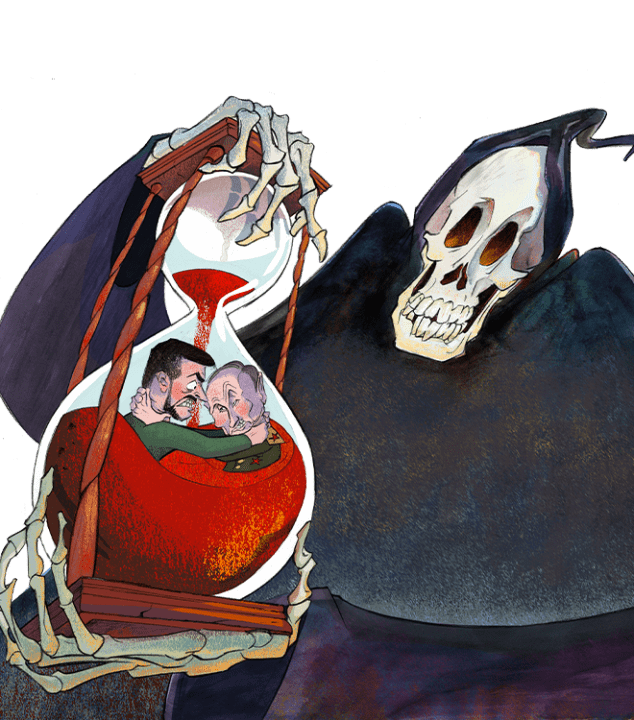
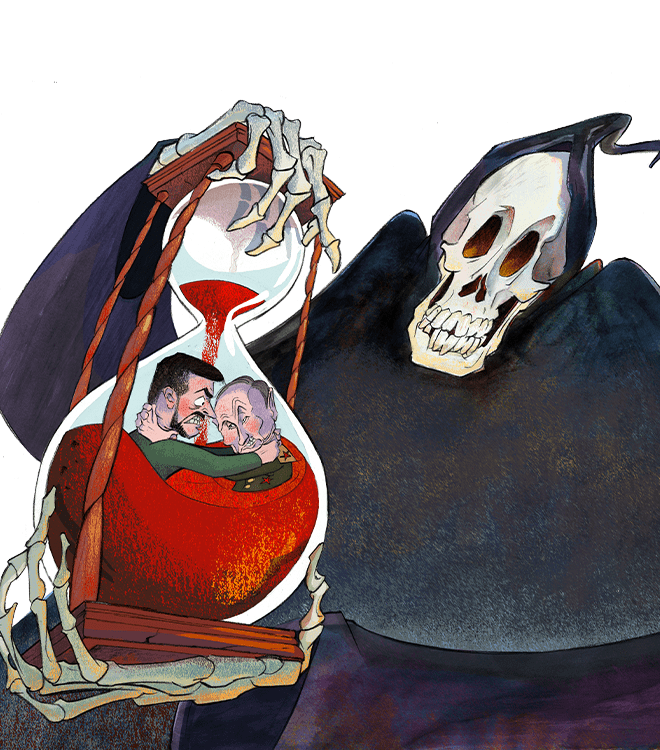
Putin has publicly rejected Zelensky’s recent offer of face-to-face peace talks. Yet the Kremlin-connected billionaire Roman Abramovich secretly flew to Kyiv earlier this month, apparently to open a back channel for negotiation. Yet even as both leaders vow to fight on, Russia’s economy crumbles and Ukraine’s political consensus is fracturing fast. On both sides, ordinary people are wearying of war. Slowly, the makings of an exhausted peace are forming.





Comments