Art

Which great French novelist was also a crossword-setter?

One could have endless fun setting quiz questions about Georges Perec. Which French novelist had a scientific paper, ‘Experimental demonstration of the Tomatotropic organisation in the Soprano (Cantatrix sopranico L)’ included in a scientific festschrift at the Centre National de la Recherche Scientifique? (The article charted the ‘yelling reaction’ — YR —of singers pelted with ‘Tomato rungisia vulgaris’.) And which French novelist wrote the world’s longest palindrome (5,566 letters)? Perec would have enjoyed being the subject of a quiz, though, to do him full justice, the questions ought to have been cryptic: he was a crossword-setter as well as a novelist. His works are notoriously structured around puzzles and linguistically

To call this offering a book is an abuse of language

I picked up this book with real enthusiasm. Who cannot be entranced by those 20 years after the second world war when New York supplanted Paris as the cultural capital of the world? One thinks of the Beats, of Dylan and Greenwich Village, of Sontag and Trilling. Well think again, for none of the above feature in this book at all. Indeed the first thing to be said is that to call this offering from Thames & Hudson a book is a real abuse of language. It has covers and inside those covers one finds text and image but the three essays that cover visual art, architecture and design and

The pop artist whose transgressions went too far – for the PC art world

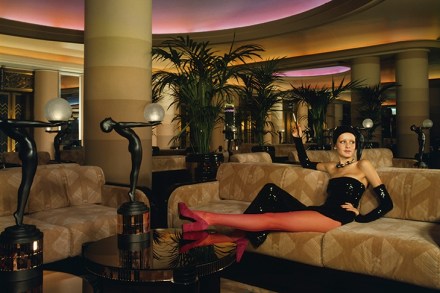
Allen Jones (born 1937) has been demonised. In 1969 he made a group of three sculptures of scantily-clad female figures. They were slightly larger than life and arranged in positions that enabled them (with the addition of a glass top or padded seat) to be turned into a table, a chair and a hat stand. These super-mannequins were highly modelled, wigged and leather-booted, and unavoidably realistic. When first exhibited in 1970 they provoked outrage among the feminist community. Jones’s 1978 retrospective of graphic art at the ICA caused a near riot even though the sculptures weren’t shown. In 1986, when the chair went on display, it had acid thrown over

Frieze Art Fair: where great refinement meets harrowing vulgarity

If you wanted to find a middle-aged man in a bright orange suit, matching tie and sneakers, Frieze is a good place to start looking. I found one. Or maybe he was a limited edition existing in several reproductions. Certainly, he was frequently spotted: conspiratorial of aspect, he was stooped and crouched over a mobile with body language saying ‘serious business’. I overheard: ‘Ah, Corinna. Va bene? How are prices in Zurigo?’ Long before you reach Frieze’s vast tented sites in Regent’s Park there are signs of danger. Extraordinary shoes and statement hair and rucked-up skinny trousers start appearing in a fall-out zone about half a mile away from the

Frieze Week Diary: Will my marbles be the first to go, or my liver?

This diary first appeared on Apollo Magazine’s website. Monday, 13 October There was something weird in the London air, and it wasn’t the rain. E-mails from PRs were hitting my inbox like the salvo from a battery of Gatling guns, and I’d already bumped into one art critic on the point of nervous collapse. ‘Just. Don’t,’ she shot at me when I asked her about all the launch parties I wasn’t invited to. So here we were: on the verge of Frieze, waiting for the ice to break. By the end of tomorrow, art dealers, PRs and journalists would be running screaming through the streets of central London, from Regent’s Park to the river.

The best of Frieze Art Fair was free

Frieze and its ever-multiplying layers – some fantastically rich, others disappointingly dry – has expanded into a millefeuille so dense that you wonder whether organisers Matthew Slotover and Amanda Sharp have ever heard of museum fatigue. Today, 30 to 45 minutes is apparently the concentration cap – the point at which you can no longer bring yourself to give a shit yet keep walking past the frames. Knowing this, the majority of London’s public might feel they had been spared the ordeal of entering the tents in Regent’s Park, where half an hour will get you through almost nothing of the fair. By some freak of programming the best of the works

Postcard from Ukraine – meet the artists in exile from the People’s Republic of Donetsk

It was Orthodox Trinity Sunday when Luba Michailova received word that separatists would soon occupy the premises of the Donetsk art centre she founded. She was in Kiev at the time, and recalls now that her first response was religious: ‘Any difficulties in life you get, it’s for your good, and for testing you.’ The following morning, at 8 o’clock, several staff were at work cleaning when 15 men in balaclavas appeared, firing Kalashnikovs into the air. Michailova tells me, ‘So when it happened, I knew it would happen, but I never thought it would be so painful.’ Donetsk now is in the hands of the masked separatists who brought

Tate Modern’s latest show feels like it’s from another planet

‘Some day we shall no longer need pictures: we shall just be happy.’ — Sigmar Polke and Gerhard Richter, 1966 Who says Germans have no sense of humour? OK, so their writers tend to be a pretty gloomy bunch — but like loads of other German artists, from Otto Dix to Georg Baselitz, Sigmar Polke’s paintings are illuminated by a dry, mordant wit. It’s encapsulated in an early doodle called ‘Mona Lisa’ (1963), which hangs near the entrance to this hugely enjoyable retrospective — the first comprehensive survey of his eclectic, eccentric work. ‘Original value $1,000,000,’ reads the handwritten caption. ‘Now only 99c, including frame.’ That Polke’s pictures now sell

Bored bores boring – critics love the Dull Men’s calendar

The Telegraph has a nice photo gallery featuring the specimens of the 2015 Dull Men of Great Britain calendar, which our own Dot Wordsworth plans to give her husband for Christmas: ‘I had thought that dull, in reference to people, was a metaphor from dull in the sense of ‘unshiny’. ‘Dieu de batailles!’ as the Constable of France in Henry V exclaims of the English, ‘where have they this mettle?/ Is not their climate foggy, raw and dull?’ But I was quite wrong, as so often. It started off (in the form dol) meaning ‘foolish’. In English almost as old as you could care to have it, the author of The

Have scientists really found proof of life after death?

When I finally reached the hospital, my grandma had already lost consciousness. As soon as I saw her, I could tell she wouldn’t wake up again. We all stood around and waited, and hoped it wouldn’t take too long. I sat on the bed and held her hand. Thankfully, it only took an hour or so. Eventually, the nurse came in and checked her pulse and told us she was dead. Except she wasn’t. Not exactly. The nurse was right – her heart had stopped – but from the way she held my hand, I could tell she was still there. I didn’t say anything. I knew she’d be gone

Effie Gray can effie off

Effie Gray, which has been written by Emma Thompson and recounts the doomed marriage of Victorian art critic John Ruskin to his teenage bride (he refused to consummate it), has a blissful cast. It stars Dakota Fanning, Ms Thompson herself, plus Julie Walters, David Suchet, Greg Wise, James Fox, Derek Jacobi and Robbie Coltrane. So it is period drama heaven, in this respect. It’s a cast you could watch all day, whatever, which is handy, as this is probably quite dull otherwise. It is adequate. It does the job. It gets us from A to B. But it feels as if it is missing something crucial, and I don’t just

Liechtenstein is utterly ridiculous – but that’s a big part of its appeal

It’s official: Europe’s least visited country is unloved little Liechtenstein. Last year, a mere 60,000 tourists travelled to this absurd Alpine principality. For discerning Spectator readers, this is great news. Liechtenstein is charming, its absurdities are enchanting, and it boasts one of the most stylish (and least crowded) modern art museums in Europe. Nothing spoils a sightseeing trip so much as lots of other sightseers. Spend a weekend in Liechtenstein – only two hours by train from Zurich – and you and your significant other should have the entire country (virtually) to yourselves. Liechtenstein is utterly ridiculous, but that’s a big part of its appeal. One of the smallest countries

Picasso’s dealer

When she was four, Anne Sinclair had her portrait painted by Marie Laurencin. It is a charming picture, a little dark-brown-haired girl with a white bow, very blue eyes and a white and pink striped blouse, and it was commissioned by Sinclair’s grandfather, Paul Rosenberg, one of the handful of most influential Parisian art dealers of the 1920s and 1930s. More interested in politics than family history, Sinclair — for 13 years the host of the prestigious French weekly television news show 7 sur 7 — waited until she turned 60 to explore the trunks of papers in her mother’s attic. What she found was a remarkable archive of letters,

Tate Britain’s Turner show reveals an old master – though the Spectator didn’t think so at the time

Juvenilia is the work produced during an artist’s youth. It would seem logical to think, therefore, that an artist’s output during their old age would be classified as ‘senilia’. Yet no such word exists. But how else to classify the three blockbuster exhibitions this year that deal with Matisse, Turner and Rembrandt’s late work? These titans produced some of their finest art during old age. The exuberance of Matisse’s cut-outs are all the more astonishing given that they were produced not in the first bloom of life but rather in the dying embers of it. Rembrandt’s late works — on display at the National Gallery from October and discussed by

‘Likes’, lacquered cherry pies and Anselm Kiefer: the weird world of post-internet art

In the mid-1990s the art world got excited about internet art (or ‘net.art’, as those involved styled it). This new way of making art would harness the world wide web, take the form of exciting online projects, bypass traditional galleries and be accessible to all with a dial-up connection. ‘Net.artists’ were self-styled radicals particularly fond of that most modernist of tropes, the manifesto, which they distributed via electronic mailing lists or electronic bulletin boards. These artists adopted funky, web-style names such as ‘Irational.org’ and ‘VNS Matrix’ and showed their work online at similarly funkily named websites like Rhizome, Suck and Echo. But there was, alas, a gap in the Matrix,

Why everyone loves Rembrandt

Talking of Rembrandt’s ‘The Jewish Bride’ to a friend, Vincent van Gogh went — characteristically — over the top. ‘I should be happy to give ten years of my life,’ he exclaimed, ‘if I could go on sitting here in front of this picture for a fortnight, with only a crust of dry bread for food.’ Without undergoing such rigours, visitors to Rembrandt: the Late Works at the National Gallery next month will be able to see the picture that drove Vincent to such a paroxysm of enthusiasm, along with many other masterpieces from the artist’s last years. It may be that in recent decades other 17th-century masters — Caravaggio

This former head of the Metropolitan finds Rembrandt boring

Surely only a double-act of the stature of Philippe de Montebello, the director of the Metropolitan Museum of Art from 1977 to 2008 but also a colossus of the art world more generally, and Martin Gayford, the eminent critic who has doubled as the recording angel of the pensées of Lucian Freud and David Hockney, could have sold the idea of producing a record of conversations about looking at works of art to a publisher. As Gayford succinctly puts it: Philippe and I had embarked on a joint project: to meet in various places as opportunities presented themselves in the course of our travels. Our idea was to make a

By all means protest against Exhibit B, but do not withdraw it

Having met with an equal mix of critical acclaim and revulsion at the Edinburgh Festival, Brett Bailey’s Exhibit B – based on the ‘human zoos’ and ethnographic displays of the late 19th century – opens today at the Barbican. I have not seen it yet, but as someone with coloured South African heritage – well aware of the European brutality during the ‘Scramble for Africa’ – I have little desire to. To some, Exhibit B will be racist and needlessly provocative. To others, it will be thought-provoking and poignant. The show ostensibly uses stark, racist imagery to make an anti-racist statement. Is Exhibit B offensive? The 19,000-odd people who have signed the e-petition to have

The Imperial War Museum finds a deadly place to display first world war masterpieces

The Imperial War Museum has reopened after a major refit and looks pretty dapper, even though it was overrun by hordes when I visited (it was still the school holidays). There’s a new and effective restaurant, inevitably, but also a new sense of spaciousness. I am not concerned here with weapons of mass destruction, merely with the record of the damage they inflict. They keep the art up on the third floor of the museum, and currently have a major display devoted to the first world war, which they claim is the largest of its type for nearly a century. It’s full of expected names, shown in some detail. But