Art

The painter as poser

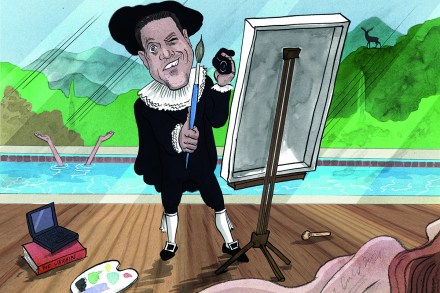
Bernard Buffet was no one’s idea of a great painter. Except, that is, Pierre Bergé and Nick Foulkes. Bergé was Buffet’s original backer and boyfriend, later performing identical roles for Yves Saint-Laurent, turning the sensitive designer into a global ‘luxury brand’ and turning himself into one of France’s richest men with pistonnage to spare. Foulkes is the accomplished writer on style who, in this new book, aims to rehabilitate an artistic reputation which he feels has been dissed by the narrow prejudices of the art-historical establishment. To a degree, this is true. Because Buffet’s scratchy and splashy paintings are (mawkishly) ‘figurative’, he never satisfied the criteria of ‘relevance’ and ‘progress’

High life | 31 December 2015

This is going to be one hell of a year, hell being the operative word. It will be the year the greatest Greek writer since Homer turns 80 (but we’ll keep quiet about that for the moment). Our world is so stuck in reverse that a woman who was stabbed in Miami during the Art Basel shindig, and was bleeding and begging for help, was mistaken for an artwork and ignored. The woman survived but will art? Conceptual art must be the biggest con since Bernie Madoff and then some. And speaking of con artists, I’ve never had any respect for Mark Zuckerberg, someone who is reputed to have copied

Biblical art, like Christianity, is always renewing itself

This sign adorns a local church in Harlesden. I suppose it could be called a Pop Annunciation. Who says religious art is stuck in the past? Then again, it is a perennial – and fascinating – question in Christian art: how much contemporary life to include in biblical scenes. For centuries artists have shocked the public by including ordinary-looking young beauties as Mary, ordinary working blokes as shepherds or apostles. Caravaggio is a good example, but even before him nativity scenes were transposed to Tuscan landscapes. In fact the first realistic landscapes in Western art were posing as biblical backdrops. The shock was rehashed by the Pre-Rapahelites, whose sacred scenes featured

Giving Turner Prize to Assemble is like giving Booker to Thomas Piketty

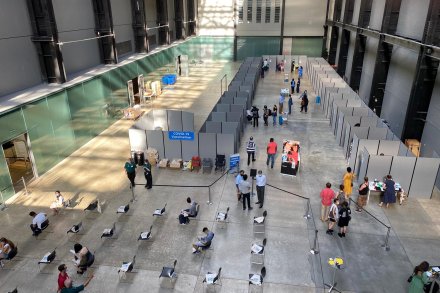
Within the first ten minutes of last night’s televised Turner Prize ceremony, someone had twice declared that the award was a ‘concept’. I must say, this was news to me: I’d always believed it was an award for contemporary art that existed to create a buzz around young artists who otherwise couldn’t get arrested. More often than not, one of the nominees is chosen to manufacture a bit of controversy – hardly the most noble objective, but it can make for a good half hour of telly. Kim Gordon forgetting what year we were in aside, what we got instead was in no sense good TV, but then that’s not

Dear Mary | 19 November 2015

Q. I work in the London art market. Often, when I run into a fellow dealer and ask how they are in a friendly way, I get a reply along the lines of ‘It’s been totally mad. I’ve just come back from New York and I’m about to go to Hong Kong, then it’s Dubai the week after that…’ Clearly these people imagine that rushing around the world suggests that they are incredibly successful, when paradoxically all this exertion shows that unfortunately the opposite is the case. I usually say ‘Gosh you must be busy!’ but am beginning to feel that it would be kinder not to pretend to buy

Approachable abstraction

Fifteen million pounds and a hefty slice of architectural vision have transformed the Whitworth from a fusty Victorian art temple into a sumptuous and thoroughly modern gallery. The space inside now channels the visitor from one gallery to another through split levels and along wide, glass-walled extensions. The great barrel-vaulted spaces at the gallery’s core are now flooded with light from the opening up of the building into the park around it. The redevelopment has embraced the landscape surrounding the gallery and thinned the barrier between inside and out. The transformation is impressive; the sense of space remarkable. The ground floor currently houses a huge assortment of exhibits including, among

Samuel Palmer: from long-haired mystic to High Church Tory

In his youth, Samuel Palmer (1805–1881) painted like a Romantic poet. The moonlit field of ‘The Harvest Moon’ (1831–32) glows with uncanny significance; for Palmer, as for Tolstoy’s Lieven, the bowed forms of the peasants at the harvest are shadows of divinity. Palmer aged like a Romantic poet too. The long-haired mystic became a High Church Tory: like Coleridge, but without the drinking. ‘The Past for Poets, the Present for Pigs,’ was Palmer’s opinion of England after the Reform Act. But did the poetry of Palmer’s seven-year sojourn in the ‘Valley of Vision’ at Shoreham, Kent also decline into prosaic commerce and pastoral nostalgia? In Samuel Palmer: Shadows on the

Picasso was a much better sculptor than a painter

If you’re anywhere near New York soon, don’t miss the exhibition of Picasso’s sculptures at the Museum of Modern Art. It has restored my love of the great magician. As a teenager I had eyes for no one else. He was the obvious god of modern art. Almost all previous art looked boring, and not much subsequent art spoke to me. I suppose I liked the posturing maleness (I also liked The Rolling Stones). But then his paintings gradually lost some of their force (at around the time that Stones songs began to sound dull after the first ten seconds of Dionysian excitement). At Tate Modern’s Matisse Picasso show in

Assemble’s Turner Prize entry is positive, genuine and ego-free. They’ll never win

Here are some fur coats reclaiming the design canon for the sisterhood. They are draped over the back of tubular steel chairs. In this daring arrangement, they subvert the established patriarchy by partially obscuring the ‘autograph design object’ of the chair, something that represents the historic subsuming of all female creativity under male dominance. While this will be obvious enough, it must be appreciated in the greater context of the work which ‘extrudes novelty from recognisability via subtle acts of transformation’ and in doing so ‘displaces the certainty with which we appoint function and value to objects’. I read this in the catalogue, an essential companion to Nicole Wermers’ ‘Untitled

Hitler’s émigrés

Next week Frank Auerbach will be honoured by the British art establishment with a one-man show at Tate Britain. It’s a fitting tribute for an artist who’s widely (and quite rightly) regarded as Britain’s greatest living painter. Yet although Auerbach has spent almost all his life in Britain, what’s striking about his paintings is how Germanic they seem. Born in Berlin in 1931, Auerbach was only seven when he came to England (his parents subsequently perished in the Holocaust). By rights, he should stand alongside British artists such as Peter Blake and David Hockney, yet his work feels far closer to German painters like Georg Baselitz or Anselm Kiefer. Auerbach

High life | 1 October 2015

If cheating is the cancer of sport, losing has to be its halitosis. I stunk out the joint in Amsterdam last week, and even managed to be thrown (a first) for my troubles. Winners, for some strange reason, never have an excuse. Losers tend to. Mine is that my opponent was born after the war, whereas I was in an age group that was born before it. The rules are that one fights opponents within five years of one’s birthday, either way. My opponents were double that, but I should have registered an objection before the matches began. Some did and stayed out. I did not. I arrogantly thought I

No, Radio 3, not everyone can be an artist

Radio 3 on Saturday had interesting, if over-long programmes about the effect of music on the mind. In one of them, people were discussing musical education. All the panellists agreed with the proposition that ‘everyone is musical’. Later in the day, I attended an exhibition opening at the De La Warr Pavilion, Bexhill, at which Peter Bazalgette, the chairman of the Arts Council, spoke. ‘Everyone is an artist,’ he said. Two things struck me about these propositions. The first is that they are now the orthodoxy in the arts: no teacher in the state system or anyone working in the subsidised arts could publicly deny them and expect to get

Special effects | 1 October 2015

Maybe what we love about radio is the way that most of its programming allows us the luxury of staying content with ourselves, of realising that it’s OK to be no more, or less, than average. There’s no spangle, no sparkle on the wireless; nothing to make us feel we should be aspiring to live in a fake and fantastical world of gilded lives, to be uber-rich, super-tanned, ultra-happy. On the contrary, you could say most radio is a celebration of Ms or Mr Average. Think of all those short stories, plays, features and real-time, real-voice recordings which take us right inside (too far inside, some might say) the banality

See no evil

When I was at university, Reggie Kray was my penpal. I wrote to him in 1991, asking for an interview for The Word, an Oxford student newspaper. Kray was unavoidably detained at Her Majesty’s pleasure. But he sent me a prompt, polite letter back. ‘Thanks for your letter,’ he wrote. ‘I will see you as soon as possible. We only get three visitors a month. Could you send me a copy of The Word?’ I sent him a copy — but I never did get to be among his three monthly visitors before his death in 2000, at the age of 66. Still, I’m ashamed to say, I was thrilled

Come rain or shine

‘Pray don’t talk to me about the weather, Mr Worthing,’ pleads Gwendolen in The Importance of Being Earnest. ‘Whenever people talk to me about the weather, I always feel quite certain that they mean something else. And that makes me quite nervous.’ Weatherland would make Gwendolen very nervous indeed. Our observations of the sky, Alexandra Harris reveals in this extended outlook, have always meant something else. Weatherland is a literary biography of the climate. Beginning with the Fall (in the Biblical rather than the autumnal sense) and ending with Alice Oswald, Harris condenses 2,000 years of weather ‘as it is recreated in the human imagination’. It is the weather-consciousness of

The bitterness of Bacon

When Michael Peppiatt met Francis Bacon in 1963 to interview him for a student magazine, the artist was already well-established, and perhaps even establishment. He had been the subject of retrospectives at the Tate and the Guggenheim, and the Marlborough Gallery had paid off several decades’ worth of gambling debts. No longer an authentically marginal figure, ‘mythologising his life’ was ‘at the very centre of his existence and painting’; and for 29 years Peppiatt became his scribe, drinking partner, estate agent, confidante, gatekeeper and admirer, and the recipient of lavish dinners, drinks, flats, paintings and acquaintances. Alienated from his own family, Peppiatt grew up in Bacon’s world and only belatedly

The only art is Essex

When I went to visit Edward Bawden he vigorously denied that there were any modern painters in Essex. That may not have been true then — this was in the 1980s — or even now. What is indisputable, however, is that there have been plenty of artists in the county. They are the subject of two small but delightfully jam-packed exhibitions at the Fry Art Gallery, Saffron Walden. Bawden (1903–1989) is at the heart of both of them, even if the second point he made to me — equally emphatically — was that he called himself a designer rather than an artist (‘out of self-defence, mainly’). That distinction, and the

Ai Weiwei

In September, the Royal Academy of Arts will present a solo exhibition of works by the Chinese artist Ai Weiwei. This follows his installation of porcelain sunflower seeds in Tate Modern’s Turbine Hall, a solo show at Blenheim Palace and two solo exhibitions at the Lisson Gallery (which represents him). Peculiarly, the Royal Academy’s press release claims that Ai’s work has not been seen extensively in Britain, which might suggest that its press team doesn’t get out much. He has certainly been exhibited here more than other key Chinese contemporary artists such as Zeng Fanzhi, Yang Fudong or Gu Wenda. Ai transcends the art world, particularly since his arrest by

Seeking closure | 13 August 2015

A while ago, David Hockney mused on a proposal to tax the works of art stored in artists’ studios. ‘You’d only have to say they weren’t finished, and you are the only one who could say if they were,’ he suggested. ‘There’d be nothing they could do.’ This is the state of affairs examined in Unfinished, a thought-provoking little exhibition at the Courtauld Gallery. Once upon a time, it was as clear whether a painter had completed a picture as it was whether the gardener had thoroughly mowed the lawn. Indisputably, Perino del Vaga downed tools for some reason halfway through his ‘Holy Family with Saint John the Baptist’ (1528–37).

The lives of the artists — and other mysteries

Benjamin Wood’s first novel, The Bellwether Revivals, was published in 2012, picked up good reviews, was shortlisted for the Costa First Novel Award and the Commonwealth Book Prize and has become a bestseller in France — a promising start to a literary career, in other words. Wood’s new novel The Ecliptic is both an attempt to consolidate the success of his debut and also a meditation, among other things, on how to sustain such a career over decades while producing original and important art. On an island off the coast of Istanbul lies Portmantle, a remote community for painters, writers and musicians. The settlement provides a respite from the burden