Art

The problems at Tate Britain go beyond the director

Last week, Tate Britain was one of six museums across the UK to be nominated for the Art Fund’s Museum of the Year award, an annual prize in which the winner receives the not inconsiderable sum of £100,000. A couple of weeks earlier, Waldemar Januszczak, the Sunday Times’s ‘cor blimey’ art critic (don’t get me wrong, he has a winning shoot-from-the-hip style) was calling for the head of Penelope Curtis, Tate Britain’s director since 2010. Despite approving of the chronological rehang of the permanent collection which she oversaw last year – in fact, he proclaimed it a ‘miracle’ – Januszczak still insisted Curtis must go. He gave his reasons: she puts

A fresh perspective on reassuringly familiar artists

This exhibition examines a loosely knit community of artists and their interaction over a decade at the beginning of the last century. It is centred around the marriage of Ben and Winifred Nicholson (which began to split up in 1931), involves their crucial joint-friendship with Christopher Wood and a fruitful exhibiting relationship with William Staite Murray, topped off by the all-pervading influence of a true original, Alfred Wallis, Cornish fisherman, marine-stores dealer and compulsive painter. The intellectual and artistic meeting of these individuals was a formative impulse in the development of Modernism in England; and it could be said — with some justification — that they brought out the best

When Aachen was the centre of Europe – and Charlemagne ruled the known world

A UNESCO World Heritage Site since 1978, Aachen (Aix-la-Chapelle) will this summer become the focus of European attention. From June to September, the Aachen Palatinate, Europe’s best surviving Carolingian palace complex, plays host to three inter-related exhibitions commemorating the 1200th anniversary of the death of Charlemagne. The exhibition entitled Charlemagne. Power. Art. Treasures. occupies three separate parts of the former palace complex: the town hall, the Centre Charlemagne (a new visitor centre on the site of the original inner palace courtyard) and the Cathedral Treasury. Charlemagne, king of the Franks from 768-814, was crowned Holy Roman Emperor by the Pope in 800 and hailed the ‘father of Europe’ by a

Morally, can we justify giving Luis Suárez a Player of the Year award?

One of football’s many beauties is in encouraging us to forsake unfortunate strictures of accepted behaviour; as long as it’s at the game, we can sing, swear, cuddle strangers, and even care about stuff without fear of ridicule. And, perhaps best of all, we’re entitled to rejoice in the dastardly; it’s entirely justifiable to drool over the respective oeuvres of Roy Keane, Thierry Henry and Sergio Busquets, if they so tickle you. The game can also serve as a masking agent for off-pitch indiscretions, and remind people that personal matters are precisely that. Kenny Dalglish somehow wore links to the Clerkenwell crime syndicate, and though plenty of people dislike Wayne Rooney,

The mathematical revolution behind ‘the greatest picture in the world’

It seems odd to enter a room dominated by what Aldous Huxley famously called ‘the greatest picture in the world’ to find not another soul there. Looking down from an end wall of the mediaeval civic hall in the quiet little Tuscan town of Borgo San Sepolcro, Piero della Francesca’s ‘Resurrection’ is an image of astonishing power, showing a stern-faced risen Christ stepping out of his tomb in the dawn light of the first Easter morning like an unstoppable force of nature, exuding supernatural authority as he turns the leaves on the trees behind him from wintry death to the new life of spring. This is a painting like no

Wonders written on the wall

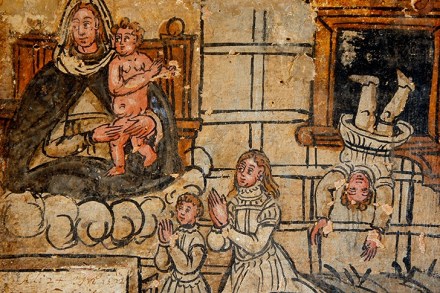
‘Take away, utterly extinct and destroy all shrines … pictures, paintings and all other monuments of feigned miracles, pilgrimages, idolatry and superstition so that there remain no memory of the same in walls, glass windows…’. These were the instructions handed down to churches in the reign of Edward VI, the death-knell for medieval church wall paintings following the wholesale destruction of the monasteries in his father’s time. That any church art survived this state-sponsored barbarism some five centuries ago seems extraordinary, and its rarity makes it all the more precious. This is no more than a pocket guide to the shadowy and often elusive fragments of secular and scared art

Sajid Javid’s first task is to recognise that the price of a cultural asset lies in its value as art

The suggestion, made by the poet Michael Rosen and others, that Sajid Javid is not sufficiently cultured to be Culture Secretary is as ludicrous as it is pompous. The secretary of state does not write poetry – even bad poetry. He decides how best to make the arts flourish, both as a source of spiritual value and revenue. Therein is a challenge – one that his predecessors have failed to meet. The nadir of Maria Miller’s lamentable ministerial career was not her recent non-apology or even the episode which saw her advisor appear to threaten a newspaper. No, it was the speech on culture in the age of austerity she gave last summer.

This beautiful new history of Kew Gardens needs a bit of weeding

Edward Bawden’s Kew Gardens is a beautiful book. Lovers of early 20th-century British art will find it hard to stop gazing at the painted board cover under the dustjacket. It is so sheenily brilliant that you want to frame it and hang it on the wall at once. Every page, including the endpaper plans of Kew, is visually perfect, and the book is an agreeable size. Peyton Skipwith, formerly of the Fine Art Society, and Brian Webb, the designer, have collaborated on beautiful books before; their track record is impeccable. Published by the V&A, their latest work is an utterly desirable object. Having had the privilege of being on a

A tipple and a scribble with Gerald Scarfe

Mr Steerpike longs for the day that he has a bar named after him, so he went to doff his cap to Gerald Scarfe at Scarfe’s Bar last night. Cartoonist Scarfe has spent the last four months decorating the bar at the Rosewood Hotel in Holborn. Politicos or royal junkies will love it: Farage, Brown, Cameron, Clegg and the first cartoon of wee baby George are all in evidence. ‘If the Prince of Wales can have a pub named after him, why shouldn’t I have a bar?’ says Scarfe, who treated me to a whistle-stop tour of his work. ‘There won’t be enough time to paint Maria Miller [before she

Eggcellent openings in Westminster

Westminster City Council is advertising the role (offered by the Westminster Adult Education Service) of tutor in ‘Ukrainian egg decoration’ – at £25 an hour. Anyone who thinks that the job would be a walk in the Royal Parks should think again. The advert says: ‘As well as being enthusiastic and motivated you need to have a teaching qualification (minimum PTTLS)’. Mr S better put his tiny ornate paintbrush away. He would have applied for the equally well remunerated ‘hula-hooper’ tutor too, were it not for the equally restrictive qualification barrier. Tristram Hunt must be so proud that teaching qualifications are being taken so seriously.

Julian Cooper’s rock profiles

Like most ambitious artists, Julian Cooper has been pulled this way and that by seemingly conflicting influences. The son and grandson of Lake District landscape painters — his mother was a sculptor — he fell among abstractionists at his London art college, Goldsmith’s, in the late 1960s. But when I first saw his work in the early 1980s, he had emerged as a flagrant figurative painter, with a series of large canvases depicting scenes from Malcolm Lowry’s novel Under the Volcano. There was no subterfuge about these works; they went straight back to Manet and Degas, not as imitations but developments. Whether from heredity or early practice at his father’s

Alain de Botton: We need art to help us to live and to die

The world’s big national museums are deeply glamorous places. We keep quiet in their hallowed halls, we wander the galleries in reverence, we look at a caption here and there, but, sometimes, if we’re honest, deep in our hearts, we may be asking ourselves what we’re doing there. Art enjoys unparalleled prestige in the modern world, but the reasons for this are rarely explained in plain terms. Just why does art matter? When people want to praise art museums, they sometimes remark that they are our ‘new cathedrals’. This seems an extremely accurate analogy, because for hundreds of years, cathedrals were, just like museums, by far the most significant places

Caught between a New Age rock and a theory junkie hard place

Siri Hustvedt’s new novel isn’t exactly an easy read — but the casual bookshop browser should be reassured that it’s nowhere near as punishing as the opening pages might suggest. In the ‘editor’s introduction’ we’re told that what follows is an anthology of writings by and about the late artist Harriet Burden — known to friends as Harry — with her own contributions taken from a series of notebooks labelled by letters of the alphabet: Notebook H, on Edmund Husserl, has pages on Husserl’s idea about ‘the intersubjective constitution of objectivity’ and the consequences of such an idea on the natural sciences… Q is devoted to quantum theory and its

Why Alain de Botton is a moron

It’s become too easy of late to be rude about Alain de Botton. His banal aphoristic “insights” and homilies on Twitter, his efforts to turn the media away from “meanness” (news should provide moral uplift and teach us how to be better people), his plea for museums to emulate churches by replacing their “bland captions” with a set of moral “commands”, thereby using the art in their collections to make us “good and wise and kind”, have all begun to pall somewhat. When did the playful essayist become so cloyingly dumb? And please, before I say another word, do let’s stop calling him a philosopher. He’s a businessman and a

The Picasso muse who became an artist

With her long blonde hair tied in a ponytail, Sylvette David is familiar from many of Picasso’s paintings. She met the artist in the South of France as a teenager and became one of his models – his muse but never his mistress — during the spring of 1954 (Picasso’s relationship with Françoise Gilot had ended and he hadn’t yet met Jacqueline Roque). A collection of drawings, paintings, metal sculptures and ceramics documenting their relationship can now be seen in the Kunsthalle Bremen’s exhibition Sylvette, Sylvette, Sylvette: Picasso and the Model (until 22 June). And in London, the Francis Kyle Gallery, 9 Maddox Street, W1, is showing some of Sylvette’s

France’s cultural excess is immoral (but I still love it)

For a committed, if unsuccessful, capitalist, I enjoy French culture an embarrassing amount – every last state-funded drop of it. Give me five-act operas with cast lists the size of a small Chinese city, give me obscenely expensive works of public art, give me inhumane concrete estates, give me unintelligible modernist music and I’ll be drooling with pleasure all night. In fact, I’m seeing a five-act French opera with a cast list the size of a small Chinese city tonight in Bordeaux. That’s the kind of disgusting thing I like to do. In my defence, I am aware that what I am doing is immoral and what is being created should be

Four artists you ought to know — and a famous one you can know better

In this round-up of exhibitions in London’s commercial galleries, I feature three shows of little-known but mature contemporary British artists. There is a great deal of interesting and worthwhile art being made out there, but not enough of it comes to public attention. Most museums won’t show it, and there are only a handful of commercial gallerists who are prepared to back quality over proven popularity. In such a world, the quieter talents tend to get overlooked, so it is a particular pleasure to be able to draw your attention to the subtle small paintings of Liam Hanley (born 1933). Hanley paints in oil and draws in pencil on linen

Anything you can smash, I can smash better

Art is under attack. Another week, another expensive poke in the eye. Last Sunday, Miami artist Maximo Caminero destroyed a $1 million vase by Ai Weiwei in protest at the museum ignoring the work of local artists. Before this, there was Wlodzimierz Umaniec’s defacement of a Tate Modern Mark Rothko in the cause of ‘Yellowism’, which saw the  Pole jailed for two years. Then came the story of the kids caught clambering over a $10 million Donald Judd. It’s hard not to smile. The irony of it all is too delicious. An art form that has for 100 years demanded that practitioners shaft society’s norms is, in turn, having its

A spirit to warm Bruegel’s ‘Hunters in the Snow’

The ostensible subject matter is misleading, as is any conflation with his lesser relatives’ wassailing peasants and roistering village squares. But Pieter Bruegel the Elder’s work is profoundly serious. It has a formidable intellectual content, a Shakespearian emotional range: a sardonic and stoical view of the human condition. There are paintings — ‘The Triumph of Death’, ‘The Blind Leading the Blind’ — which descend from Hieronymus Bosch. There is also the marvellous ‘Fall of Icarus’. According to recent scholarship, the version we have is not a Bruegel, but a later copy. That is plausible; it looks later. Yet the composition is classic Bruegel. He would be drawn to any legend expressing

Take a look at John Maynard Keynes’s armchair

Discoveries: Art, Science and Exploration at Two Temple Place (until 27 April) is like a giant cabinet of curiosities. Maps, gizmos and memorabilia are spread across two floors of this glorious high-Victorian building on the Embankment. There are drawings from doomed polar expeditions, bones and teeth of fish from the Woodwardian Collection (see above), early botanical diagrams, hoards of medieval gold, the loot of empire (the Sufi snakes-and-ladders board in ebony and mother-of-pearl is memorable) and John Maynard Keynes’s armchair. The exhibits are drawn from the eight museums of the University of Cambridge. Much is made of the fact that this is the first time the university’s museums have collaborated