Notes on...

Why criminals love a tunnel

What is it about a tunnel that excites us so? Last week’s story about the secret one in a New York synagogue fascinated the world, despite (or perhaps because of) the fact that no one knew why the thing had been built in the first place. Police attempted to close it, and indeed fill it with cement, leading to fights with a group of young men trying to defend the tunnel, which went under the street and led to at least one other nearby building. Maybe it’s the word ‘secret’. Of course that explains our interest in Tom, Dick and Harry, the three tunnels dug during the Great Escape.

Lesson one of ferret racing: don’t pick them up

The British are fond of ferrets. There is a portrait of Queen Elizabeth I at Hatfield House holding one on a collar and lead. For Yorkshire miners in the 1970s, tales of ‘ferret-legging’ – an endurance test whereby two of the rodents were put down competitors’ trousers – were legendary. (The world record is held by Frank Bartlett, a retired headmaster, who managed to endure the bites and scratches for five hours, 30 minutes.) So it feels a little odd that ferret racing was invented in the United States. Rather than being conceived in the backroom of some raucous Jacobean tavern, it was a Friday night distraction for rednecks laying oil and gas pipes through the North American wilderness.

Why it’s time to bring back wassailing

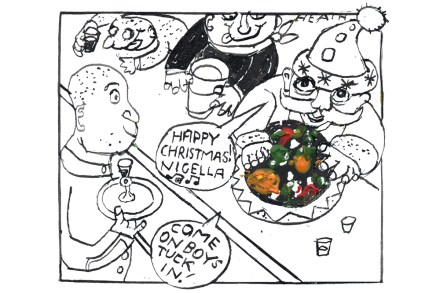
Before the Industrial Revolution shrank Christmas celebrations to two days, many workers across rural England might have spared a minute or two over Christmastide to bring out the family wassail bowl. Wassailing – sometimes in houses, sometimes in apple orchards – was a ceremonial toast to the health of friends, family and neighbours, or a ritualised routing of the bad spirits that lurk among fruit trees. Orchard wassailing, intended to guarantee bumper crops in the year ahead, was a rambunctious affair of gunshots, the banging together of trays and buckets and the blowing of cow horns (to scare away evil spirits), singing, drinking and bonfires.

‘Sex trafficking, cannibalism and murder’: St Nicholas wasn’t always so jolly

For a heartwarming Christmas tale, look no further than the medieval legend of St Nicholas – a story of sex-trafficking, cannibalism and murder. The historical Nicholas is a hazy figure whose scant biography was embroidered in the Middle Ages. The 12th-century Norman poet Wace wrote a colourful account of his life. It opens with the story that has informed the modern Santa Claus. Nicholas, we are told, took pity on a man who had once been wealthy but had fallen into poverty. The man had three daughters. Things were desperate – the man concluded that the girls had to be sold into sexual slavery. Nicholas visited the man’s house on three consecutive nights and each night threw gold in through an open window.

The slow death of Christmas cake

Wouldn’t you just know it? Christmas cake, as in dense fruitcake covered with marzipan and usually tooth-destroying royal icing, is being displaced by chocolate cake. Almost half of a sample of 2,000 people surveyed by Ocado said they’d prefer chocolate to fruitcake. The trend is represented by Nigella Lawson, who is making something called a Winter Wonderland chocolate and raspberry cake instead. ‘Much as I happen to love a slice of dense, damp Christmas cake, especially when eaten with a crumbly slice of good, strong, sharp cheese, I am surrounded by those who abominate dried fruit in all its seasonal manifestations,’ she writes. ‘If no one in your family likes dried fruit, there’s no point having a Christmas cake gathering dust.

The biggest music feuds of all time

Sad news from the Hall and Oates camp, where ‘I Can’t Go For That’ has become ‘I Can’t Go Within A Specified Distance of You’, Daryl Hall having taken out a restraining order on John Oates. Actually, we don’t know whether a distance is specified, as the details of the order remain secret. But we do know that Hall last year called Oates ‘my business partner… not my creative partner… We’ve always been very separate, and that’s a really important thing for me’. Such discord is in the finest traditions of pop. The most famous feud was in the most famous band, or rather after it: John Lennon reacted to Paul McCartney’s solo song ‘Too Many People’ (a dig at Lennon’s preach-iness) with ‘How Do You Sleep?

Should you ever eat wild salmon?

When I say ‘Scottish salmon’ what do you see? I bet it’s a muscular 20-pounder flashing up a river, or a silver grilse leaping out of the water for the sheer joy of it. I bet it’s not a flabby beast, covered in sea lice, possibly half-choked by micro-jellyfish in its gills, living in waters so polluted that the seabed beneath, contaminated by salmon poo, is lifeless. Fish kept in cages in comparatively calm loch waters do not get the exercise they need to firm up their flesh. They look good, pink and pretty, but their raw flesh is so soft you can spread it like butter. Fish kept in open sea cages and swimming against rough seas will have firmer flesh, but these farms are perhaps worse: when seals or storms tear open the cages, thousands of salmon escape.

In defence of Rickshaws

London rickshaws, or pedicabs, are always described as a scourge. They’re too bright and they’re too loud, the charge sheet reads: they block up the road and rip people off. Last week, the government announced in the King’s Speech that Transport for London will be given powers to license them. Drivers will have their fares regulated, their backgrounds checked and their driving abilities probed. At the moment, it’s a Wild West. If you buy a pedicab – congratulations, you’re a pedicab driver. You can now take German families over Westminster Bridge and play ‘Despacito’ as loud as a jet engine. I went out over the weekend to speak to some of London’s pedicab drivers about their trade, and whether they were worried it’s going to die.

In defence of foie gras

Apoll shows that nine out of ten Brits want to ban the import of foie gras. Crumbs! Haven’t they got anything more important to worry about? The Times says about 200 tons are imported from Europe every year. I only wish some would come my way. Though the same article says Waitrose stocks this greatest of all delicacies, I can’t remember seeing it in our local branch. The trouble is that the campaign against these large, buttery duck livers (goose liver is rare) is based on Yahoo-worthy ignorance and antique disinformation, such as the fading photographs that used to circulate of webbed feet nailed to the shed floor.

How Vegemite took over the world

Vegemite is 100 years old. The first yeast paste, Marmite, was introduced in the UK in 1902, named after the French cooking pot; New Zealand Marmite, currently a quite different product, emerged in 1919. The mite suffix had nothing to do with might, but the association was irresistible, and Vegemite was created in Australia in 1923, to take up an apparently indelible, salty place in its nation’s dreams. The economic logic of producing and selling yeast pastes was compelling. The German chemist Justus von Liebig had discovered that waste yeast from brewing could be turned into an edible paste. If people could be made to like it – strange to say, some people still don’t – a by-product could be utilised and fortunes could be made.

Are Ouija boards really that scary?

The name is the only clue you need. The French and German words for ‘yes’ show that the board will always tell you what you want to hear. Mind you, Elijah Bond and Charles Kennard, who invented the Ouija board for their novelty games company, claimed that Bond’s sister-in-law, a spiritualist, was given the name by the board itself at a séance in 1890, and that it meant ‘good luck’. Clearly the person on the other side wasn’t much of a linguist. Another explanation comes from the US comedian Brett Erlich: ‘“Ouija” is short for “we just push this thing around and make it say what we want to”.

What could be more Shakespearean than a ghost?

In the final series of the Netflix programme The Crown, Princess Diana will appear as a ghost. We are told that her apparitions will be ‘thoughtful and sensitive’ – which is rather disappointing for anyone hoping for her to have a recurring role, like Marty Hopkirk in Randall and Hopkirk (Deceased), perhaps wearing that white dress she wore to the British Fashion Awards. Yet this has not stopped the ‘friends of the King’ from saying that the programme has lost all the credibility it had in its earlier years. It is true that, in the first series, The Crown was more like Shakespeare than soap opera, with actors trained at the RSC delivering grand speeches about the nature of monarchy. But what could be more Shakespearean than a ghost?

Why are we superstitious about Friday the 13th?

Uzeste contains 387 people and a dead pope. The tiny French village is one of the less glamorous papal resting places, where the earthly remnants of the unfortunate Clement V await the General Resurrection. How much of Clement is left is hard to tell. As his body lay in state after he died in 1314, the church was struck by lightning, causing a fire that consumed his corpse. The medieval mind assumed that this was an earthly metaphor for the eternal flames that consumed Clement in Hell. Many identify this unfortunate pontiff as the first victim of the Curse of de Molay. Clement, a particularly craven occupant of the see of Peter, had moved the papacy to Avignon on the orders of the French king Philip IV, who then proceeded to co-opt him into his campaign against the Templar Order.

The joy of ‘ugly’ Birkenstocks

Fifteen years ago, when I was a teenager, wearing Birkenstocks meant you were flatfooted or you had no interest in attention from men. While the rest of us clip-clopped around in heels, it was only a brave few who would choose the flat sandal. Your geography teacher might wear them, or your mum when she took out the bins, but no one fashionable would be caught dead in a pair. Television and films encouraged the prejudice. Carrie Bradshaw taught us that you should never stoop so low as flats as she spent every dollar on Manolo Blahniks. And it’s not a coincidence that in Clueless, Travis, whom Cher describes as being from a group ‘no respectable girl actually dates’, has the surname Birkenstock.

The cult of the gilet

Last summer I attended a reunion at my prep school. The occasion was the leaving of a much-loved master. I thought that the appropriate thing to wear would be a tweed jacket in honour of prep-school masters everywhere. I found myself woefully overdressed. Pretty much all of my contemporaries were wearing gilets. It was a similar story this year at the Fortnum & Mason awards, the Oscars of the British food and drink scene. I wore a suit, but it seemed as if every other guest was casually sporting a gilet. When I was growing up the only people who wore gilets were fishermen, farmers and Michael J. Fox in Back to the Future. Furthermore, they weren’t called gilets, they were called body warmers or sleeveless coats.

The senseless ban on snus

As the government considers banning disposable vapes because they are thought to appeal to children, it is worth reflecting on the strange saga of the EU’s ban on snus, a Swedish smokeless tobacco product that delivers nicotine into the body via a small pouch placed under the lip. The story begins when Edwina Currie was health minister in 1988. She announced a ban on oral tobacco in response to a panic about Skoal Bandits, an American brand of snus with a masked cowboy on its logo which was presumed to appeal to children. The product itself was assumed to cause mouth cancer. In 1990, the EEC got involved. It argued that unilateral prohibition by a member state was a threat to the internal market and banned snus across the bloc.

The greatest – and strangest – prison breaks in history

Poor old Daniel Khalife. He must have thought his exit from HMP Wandsworth, hidden underneath a delivery van, would win ‘Most Creative Prison Escape of the Week’. But actually that title had already been nabbed by Danelo Cavalcante, who stood in a narrow external passageway at Pennsylvania’s Chester County prison, leaned forward so his hands were on the wall facing him, then placed his feet on the wall behind and ‘crab-walked’ upwards, his body parallel to the ground. Khalife’s escape isn’t even the most inventive in Wandsworth’s history. His van was a normal one – the removals vehicle parked outside the prison by the team helping Ronnie Biggs in 1965 had a sliding panel cut into the roof and a platform lift inside, which the team extended to reach the top of the wall.

The pride of pouring perfect concrete

In the summer of 2020 I was awarded a degree in history from Bristol University – the culmination of three years’ work, late nights and great expense – but it is my concrete pump operator licence which sits above the mantelpiece. My father considers my ability to pump concrete at a rate of one cubic metre per minute to be far more impressive than my knowledge of Henry VII’s foreign policy. At university I worked as a pump operator for my father’s piling company, making me a very unglamorous nepo baby. I helped bore the foundations for constructions all over the country.

‘A year of fish fingers’: how motherhood put me off frozen food

It’s 100 years since the American inventor Clarence Birdseye, with an investment of $7 for an electric fan, a few pails of brine and some blocks of ice, started developing his system of packing fresh food into cardboard boxes and freezing it at high speed, thus ushering in the frozen food era. If you go into your nearest branch of Iceland, you’ll see that the era is still in full swing.  In the colourful and far from morgue-like aisles, cheerful, sensible couples are filling their trolleys for the week, tempted by the dazzling food photography and the ‘tanginess’ of everything. This is wall-to-wall packaging seduction. ‘Oumph! Mexican spiced fajitas’, shouts the frozen ‘Oumph!’ brand.

Luis Rubiales and the weirdness of a kiss

A kiss is just a kiss, no? But when it’s Jenni Hermoso, the forward of the victorious Spanish women’s football team, on the receiving end, and the president of the Spanish football federation, Luis Rubiales, doing the kissing, and it’s during the official post-match ceremony in front of an interested global audience… it’s different.  Immediately afterwards, Miss Hermoso declared that she ‘didn’t like it’. Rubiales was defiant. ‘It was a kiss between two friends celebrating something,’ he declared, calling his critics ‘idiots and stupid people’. He may have had in mind the minister of equality in Spain’s caretaker government, Irene Montero, who described the kiss as ‘a form of sexual violence’. Yes, well, it just shows you how fraught kissing is.