Fergus Butler-Gallie

The Reverend Fergus Butler-Gallie is is a Priest and writer. His latest book is Twelve Churches: An unlikely history of the buildings that made Christianity.

Is politics becoming more religious? With Tom Holland & Jonathan Sumption

From our UK edition

39 min listen

Is British politics becoming more religious? Madeline Grant certainly thinks so, arguing – in the Spectator’s cover article – that the next election could be the most religious for decades. Issues like immigration and Islam, assisted dying – and even the establishment of the Church of England are likely to play a role. The current Labour government's ‘most telling divide’, Madeline writes, is between MPs – like Shabana Mahmood and Wes Streeting – who understand religion – and 'those who don’t’. For the Edition’s Easter special, host Lara Prendergast is joined by vicar – and Madeline’s husband – The Rev’d Fergus Butler-Gallie, former Supreme Court justice Jonathan Sumption and the historian and broadcaster Tom Holland.
Prince William resets faith – as Sarah Mullally enthroned

From our UK edition

37 min listen

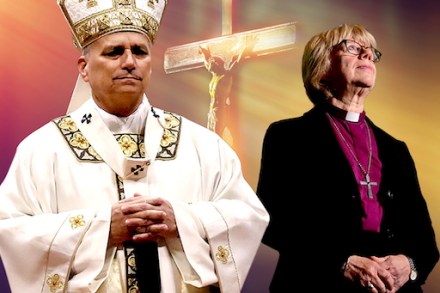
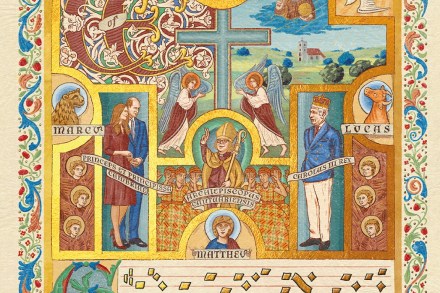
Dame Sarah Mullally has been enthroned as the Archbishop of Canterbury, the first female head of the Church of England. Prince William attended as the representative of the Monarch and – as heir to the throne – the person who will one day become Supreme Governor of the Church. His attendance came a few days after an interview appeared in The Times where Prince William seemed to be pressing 'reset' on his relationship with faith. Friend of Holy Smoke, The Daily Mail’s Robert Hardman – author of the forthcoming biography Elizabeth II. In Private. In Public.

Prince William resets faith – as Sarah Mullally enthroned

You can judge a private school by how it cares for its chapel

From our UK edition

I can still just about recall the exact angle of rotation required of the metal hymn-book casings in the Tonbridge School chapel to produce a piercing scraping sound – perfect for putting any preacher off his stride. God, as St Paul tells us, is not mocked, and as I ascended the pulpit when I returned 12 years later as the school’s assistant chaplain, I heard the old familiar scrape once more, now deployed to distract me. Chapel was the central experience of our school years, the place we remember most clearly In many ways it was comforting. Generations of pupils praying and singing in the same space and inevitably learning the same techniques to distract or annoy. They are teenagers after all.

How transformative has 2025 been for Christianity?

From our UK edition

21 min listen

Anglican author The Rev'd Fergus Butler-Gallie, Catholic priest Fr Alexander Lucie-Smith and Evangelical commentator Fleur Meston join Damian Thompson to reflect on 2025. They discuss Pope Leo XIV's leadership so far, the choice of Dame Sarah Mullally as Archbishop of Canterbury and why Christianity has been coopted by the far right. Plus, was the 'quiet revival' of Church-going the start of a trend – or just a blip? Produced by Patrick Gibbons.

Best of Notes on…

From our UK edition

29 min listen

The Best of Notes on... gathers the funniest, sharpest and most wonderfully random pieces from The Spectator’s beloved miscellany column. For more than a decade, these short, sharp essays have uncovered the intrigue in the everyday and the delight in digression. To purchase the book, go to spectator.co.uk/shop On this special episode of Spectator Out Loud, you can hear from: William Moore on jeans; Laura Freeman on Brits in Paris; Justin Marozzi on boxer shorts; Mark Mason on coming second; Michael Simmons on doner kebabs; Fergus Butler-Gallie on Friday the 13th; Hannah Tomes on rude place names; and, Margaret Mitchell on lobsters. Produced and presented by Patrick Gibbons, with an introduction from William Moore.

Which are the ‘Twelve Churches’ that made Christianity?

From our UK edition

40 min listen

What links the Church of the Nativity in Bethlehem and St Peter's in Rome with the 16th Street Baptist Church in Birmingham, Alabama, and Canaanland in Ota, Nigeria? These are just some of the churches that Anglican priest and writer the Revd Fergus Butler-Gallie highlights in his new book Twelve Churches: An Unlikely History of the Buildings that made Christianity. The Anglican priest and writer joins Damian Thompson on Holy Smoke to explain how each Church not only tells a story but also raises a surprising dilemma for modern believers. Fergus aims to tell the history of the Churches 'warts and all' and argues that, from Turkey to Britain, today’s Christians must be prepared to defend their religious spaces.

Kemi Badenoch’s God Delusion

From our UK edition

18 min listen

Conservative leader Kemi Badenoch has given a wide-ranging interview to the BBC’s Amol Rajan in which she touched upon her Nigerian upbringing, her feeling of identity and she even revealed she called out a peer for cheating at school. But perhaps her most interesting comments came when she revealed how she lost her belief in God. The Reverend Fergus Butler-Gallie, author of Twelve Churches, and Tim Shipman join Oscar Edmondson to discuss Kemi’s comments. Is it credible to call yourself a ‘cultural Christian’? And, with both an atheist Prime Minister and agnostic Leader of the Opposition, is the decline of religion in politics inevitable?

Has Kemi Badenoch really thought about the problem of evil?

From our UK edition

The problem of evil has stumped some of the greatest thinkers in the history of human philosophy and theology. It was, however, a cinch for Kemi Badenoch. In an interview designed to make the sometimes aloof Leader of the Opposition seem more relatable, Mrs Badenoch described how the case of Josef Fritzl made her ‘reject God’. She referred to the loss of faith as being ‘like a candle being blown out’ when she realised that while her prayers – for, inter alia, longer hair and good exam grades – appeared to have been answered, the prayers of the imprisoned Elisabeth Fritzl were not.

Keir’s peer purge, how to pick an archbishop & is AI ruining sport?

From our UK edition

44 min listen

This week: Peerless – the purge of the hereditary peers For this week’s cover, Charles Moore declares that the hereditary principle in Parliament is dead. Even though he lacks ‘a New Model Army’ to enforce the chamber’s full abolition, Keir Starmer is removing the hereditary peers. In doing so, he creates more room, reduces the Conservatives’ numerical advantage, and improves ‘the sex and ethnic balance’. But 86 hard-working and dutiful peers ‘lacking worldly ambition or partisan passions’ will be lost. Also in the magazine, Sophia Falkner, researcher at The Spectator, sets out exactly what we stand to lose by profiling some of the most capable hereditary peers in the House. She warns that Labour’s purge is ripping the heart out of the Lords.

Why should the hunt for the next Archbishop of Canterbury be ‘inclusive’?

From our UK edition

On 21 July 1828, the urbane aristocrat Charles Manners-Sutton, 89th Archbishop of Canterbury, died. Just two and a half weeks later, on 8 August, the mild-mannered linguistic scholar William Howley was elected as his successor. The efficiency of this process is in marked contrast to the current search to find the next successor to Manners-Sutton and Howley. Justin Welby announced he was vacating the throne of St Augustine on 12 November last year; it took until 28 May even to assemble the committee who will discuss the names of his potential successor. It will be a miracle if we know the name of the new Primate of All England by the autumn.

The sad decline of the Scottish Kirk

From our UK edition

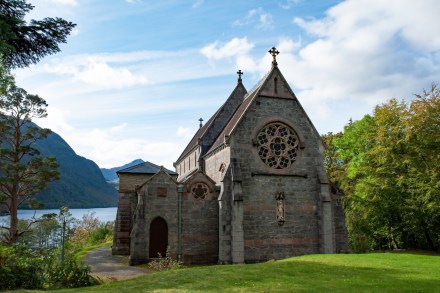
My memory is that October is cold in Sutherland in the Highlands of Scotland. Come to think of it, my memory is that June can be cold too. Nature might well abhor a vacuum, but whether anything can convincingly fill the one left by the Kirk’s role in Scottish life remains to be seen As a child, I was taken there a few times in half-terms by my Grandmother, to go and look at faded headstones with my surname on them. I suppose she thought it important to show me my windswept origins. Pictures show a little boy and a formidable woman in closely wrapped raincoats standing by grey stone and mossy clad churches. It all felt like a very alien aesthetic to the Romney Marsh where I had grown up and so I often struggled to describe it all in the holiday diaries which school made us keep.

Easter special: assisted dying, ‘bunny ebola’ & how do you eat your creme egg?

From our UK edition

34 min listen

This week: should the assisted dying bill be killed off?Six months after Kim Leadbeater MP launched the Terminally Ill Adults (End of Life) Bill, a group of Labour MPs have pronounced it ‘irredeemably flawed and not fit to become law’. They say the most basic aspects of the bill – having gone through its committee stage – do not hold up to scrutiny. Dan Hitchens agrees, writing in the magazine this week that ‘it’s hard to summarise the committee’s proceedings except with a kind of Homeric catalogue of rejected amendments’ accompanied by a ‘series of disconcerting public statements’.  With a third reading vote approaching, what could it tell us about the country we live in?

Spare us from performative piety

From our UK edition

Lent did not, I confess, start well. Cheltenham fell in its first week, and the Gold Cup is hardly the place for the rigours of Lenten discipline to begin. Some might say it is hardly the place for a clergyman at all. Peter Hitchens once commented on my clerical collar – stiff, crisp, linen – and said that if he saw a man wearing such a get-up at a racecourse he would assume he was an illegal bookmaker in disguise. Still, I recall that one of the most successful owner-breeders of all time was a clergyman. The vicar of Ashby de la Launde, the Revd J.W. King, won the Oaks, 1,000 Guineas and St Leger with his horse, Apology. There were, as the Bible tells us, giants in the earth in those days.

The tin ear of Justin Welby

From our UK edition

29 min listen

The former Archbishop of Canterbury, Justin Welby, is back in the news following his interview this week with the BBC's Laura Kuenssberg. The interview – his first since he resigned last November – was clearly Welby's attempt to draw a line under the abuse scandal that cost him his job.  The 2024 Makin report concluded that the Church of England missed many opportunities to investigate the late John Smyth, one of the most prolific abusers associated with the Anglican Church. However, the biggest headline from the interview was that Welby would 'forgive' John Smyth were he alive today. Albeit unintentionally, the former Archbishop of Canterbury ended up cementing his reputation as an inflexible micro-manager with a tin ear for the views of abuse survivors and his own clergy.

Why is the C of E selling off Dick Whittington’s burial place?

From our UK edition

The Church of England is flogging off Dick Whittington. No, this isn’t an innuendo or a twist from a pantomime, but reality. The burial place of the mayor and cat enthusiast, St Michael Paternoster Royal, is being sold off as an office. The people behind this act are the Diocese of London, who bought you the Martin Sargeant scandal, which saw a church official jailed for five years after he managed to defraud the London Diocesan Fund of £5 million undetected. The Diocese of London is now a byword for the worst excesses of the culture which is slowly killing the Church The Diocese of London is now, in Church of England circles, a byword for the worst excesses of the culture which is slowly killing the Church.

An incisive memoir of life in the cloisters

Bishop Fulton J. Sheen, the immaculately Brylcreemed megastar of the golden age of Catholic television and radio evangelism in the United States, famously hated hearing the confessions of nuns. Doing so, Sheen is reported to have said, was “like being stoned to death with popcorn.” Despite this, Sheen — at one point broadcasting to over 30 million Americans — found himself hearing a lot of nuns’ confessions in his later career. He was reduced to this, alongside what was rather euphemistically referred to as his “international cassette tape ministry,” having fallen foul of the archbishop of New York, the doughty Cardinal Spellman.

Cloistered

The problem with climate protesting clergy

From our UK edition

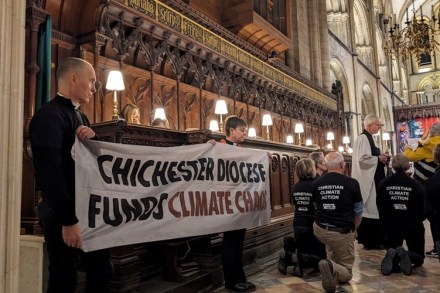
Received wisdom suggests that you would not expect a vicar to disrupt Divine Worship. Now, anybody who’s worked with the clergy up close will know that in this case, as in so many areas, received wisdom is wrong. Still, there was shock in news outlets and on social media this week when a gaggle of Christians, including clerics, disrupted Evensong at Chichester in the name of climate action.  Those clergy involved think they’re the children of the revolution when actually they’re the Primrose League Their general propensity for mischief aside, there should be absolutely no surprise at all that clergy were involved in this very particular protest. Clerics are predominately older and predominately middle class.

Why are we superstitious about Friday the 13th?

From our UK edition

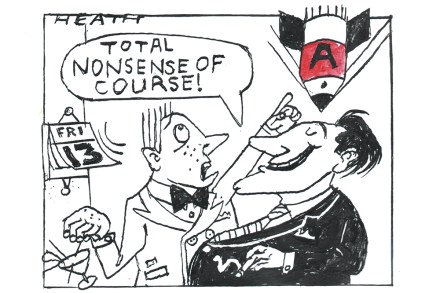
Uzeste contains 387 people and a dead pope. The tiny French village is one of the less glamorous papal resting places, where the earthly remnants of the unfortunate Clement V await the General Resurrection. How much of Clement is left is hard to tell. As his body lay in state after he died in 1314, the church was struck by lightning, causing a fire that consumed his corpse. The medieval mind assumed that this was an earthly metaphor for the eternal flames that consumed Clement in Hell. Many identify this unfortunate pontiff as the first victim of the Curse of de Molay. Clement, a particularly craven occupant of the see of Peter, had moved the papacy to Avignon on the orders of the French king Philip IV, who then proceeded to co-opt him into his campaign against the Templar Order.

What makes a novel funny?

What makes a novel funny? As well as being too enormous a question to tackle properly here, such an enterprise would, I suspect, require so clinical an approach to reading comic fiction as to remove entirely any possible joy or amusement. As the old saying goes, deconstructing a joke is like dissecting a frog: nobody laughs, and the frog dies. However, the question came to me again recently, as I reread John Kennedy Toole’s A Confederacy of Dunces. I howled with laughter from the initial farcical scene outside a department store, through Ignatius J.

funny novel

Did Jesus visit Cornwall?

From our UK edition

I remember the ephemera at the back of St Barnabas. The church stands in Oxford’s suburb of Jericho, near the University Press. It had proper church clutter: stumps of candles, dogeared pamphlets and reminders of long gone diocesan initiatives. St Barnabas – a beautiful Italianate monstrosity, plonked by the high Victorians, with their classic tact, amid a cluster of crabby little houses, once slums but now worth millions – is good at collecting this stuff. In the sacristy is a vestment made from the coronation hangings of Tsar Nicholas II, smuggled out of Petrograd at the revolution; now the double-headed eagle peeps through the incense, delighting porters, dons and motor workers alike on high days and holidays.