Notes on...

Cheers to corkscrews!

For the first 50 years of the corked bottle, there was no easy way to get into it. The combination of cork and a strong glass bottle came together around 1630 but the first mention of a device to open the bloody thing wasn’t until 1681. Cavalier get-togethers must have resembled the teenage parties I attended with everyone desperately trying to open the bottle using keys, pens, knives etc. Or using that technique where you bang the bottle against a wall with the heel of a shoe. Halcyon days. More likely they’d just take the top off cleanly with a swift blow from a sabre and a loud ‘Huzzah!’. Early devices for extracting corks were called ‘bottle screws’. According to Hugh Johnson, the word ‘corkscrew’ was first used in 1720.
How to roll the perfect cigarette

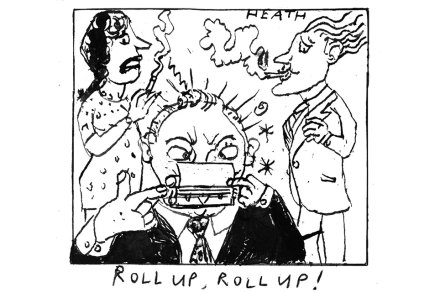
I recently estimated that, in my smoking life so far and at the age of 29, I have rolled 87,600 cigarettes. The calculation went as follows. Roughly 30 a day for the past six years, maybe 15 a day for four years before that. I attempted to make a reduction for eight months I spent in China, where the most beautiful straights could be bought for the equivalent of 40p per pack. But my mathematical faculties are almost as weak as my pulmonary ones, so I decided to balance those Chinese cigarettes with the thousands of rollies I’ve been asked to construct for friends, acquaintances and strangers. Apart from that brief and illicit fling with Chinese yen, I’ve been a roll-up man from the start.

Bring back the briefcase!

The final straw was seeing Jeremy Hunt wearing one shortly before the summer recess – and not just when riding his bicycle. He was actually walking down the street with the thing strapped to his back. Yes, of course, it is practical, but the now ubiquitous mini-backpack is so hideous that it belongs in the same category of naffness as men who wear flip-flops outside their own home or when not staying in a rented villa on the Costas. Once the preserve of hippies in the 1960s or gap-year students in the 1980s, these far smaller versions of backpacks (or what used to be known as rucksacks) have infiltrated modern Britain with hardly a nod in direction of style or decorum.

The unappetising truth about tasting menus

The tasting menu has fallen from fashion, and this is good. They are a curio – a window to the chef’s soul – and they have always incited more pity in me than awe. They draw the chef’s subconscious on the plate, and it isn’t always palatable; or, rather, it is too complex for joy. In their own words, they are unhappy. In The Devil in the Kitchen, Marco Pierre White writes that he was haunted by the loss of his mother, and his kitchen was an attempt to recover her. ‘I suppose,’ he wrote, ‘I was trying to kill myself but sacrificing your health for your career was all the rage.’ Bernard Loiseau (three Michelin stars) killed himself in 2003. Anthony Bourdain killed himself in 2018.

A connoisseur’s guide to collecting matchboxes

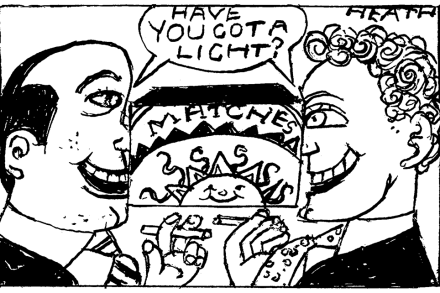
We’d been told it would be a ‘brat’ summer, characterised by its inventor, the singer Charli XCX, as ‘a pack of cigs, a Bic lighter and a strappy white top with no bra’. It hasn’t worked out like that for me, so I was glad to discover a counter-culture valuing matches over throwaway lighters. Young people, so the Wall Street Journal tells us, are collecting matchbooks and matchboxes and sharing their collecting habit on TikTok. I suppose it’s better than swapping pictures of their burgers. Once things are collected (as anything can be), exclusive rules put half the world in the wrong. To the ‘phillumenists’ of the British Matchbox Label and Bookmatch Society (founded 1945) a great crime is ‘Neighbouring a skillet’.

How bus travel lost its magic 

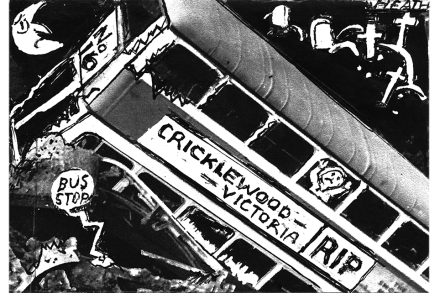
At the former Chiswick Works in west London, I recently celebrated the Routemaster’s 70th birthday. I owe my existence to this majestic mode of transport. My mum was a conductress on a Routemaster – the No. 16 – which cut a merry swathe from Cricklewood to Victoria, right through the centre of London. My dad, like a lot of young Irishmen, had arrived in London in the 1950s to help rebuild a city still recovering from the second world war. Every morning, he’d catch the first bus from his digs off the Edgware Road to various building sites. One morning he got chatting to the young clippie, and married her a few months later. ‘Open the front door,’ he’d say to me years later, ‘and the whole world’s outside.

Love it or loathe it, ragwort is winning 

White, lacy cow parsley frothing along the roadside is a familiar sight during the British summer. But 2024 is the first year I can remember when it’s been superseded by the retina-scorching yellow of ragwort. Whether you consider common ragwort (Senecio jacobaea) the ‘yellow peril’ or a precious wildflower crucial to biodiversity depends on whether you’re in the horse owner/farmer camp or a conservationist. ‘It’s the worst I’ve ever seen,’ I keep hearing from farmers and fellow horse-owners. For the first time I’ve had to pull it up from our small acreage; enough to fill a feed sack. In Appleshaw in Hampshire, villagers organised a community ragwort pull, getting an entire trailer’s worth in just over an hour.

Venn diagrams are the perfect tool for a politician

‘I just love Venn diagrams,’ Kamala Harris said in 2022. ‘It’s just something about those three circles, the analysis about where there is the intersection, right?’ Venn diagrams have graduated from school textbooks to a genre of internet meme. After Joe Biden announced he wouldn’t seek a second presidential term, Harris’s team tweeted a picture of some circles, labelled ‘Biden HQ’ and ‘Harris HQ’, overlapping to ‘hold Trump accountable’. Harris’s love of Venn diagrams might seem odd until you realise that they’re the perfect tool for a politician: they make complex issues look simple. They are often found in educational materials for young children, elucidating similarities and differences between things like animals or fruit.

The joy of party bags

The perfect, unpretentious, well-constructed party bag was given to guests leaving a recent Hatchards party. It contained a wedge of farmhouse cheddar and box of cheese biscuits from Paxton & Whitfield, a bottle of good white wine and an elegant hardback copy of Lucky Jim. The next evening, I tucked into all of these simultaneously, feeling spoilt, and meditating on how much nicer they were than some of the tat my children used to bring home from birthday parties in white polythene bags: a slice of synthetic birthday cake oozing its jam on to tadpole-sized balloons (which wouldn’t inflate, however hard you blew) and a polystyrene aeroplane whose wing broke off on assembly. To come home from a children’s birthday party without a party bag these days is almost unthinkable.

Are you a Gail’s or a Wimpy voter?

Liberal Democrat activists were reportedly told to ‘get out the Gail’s vote’, targeting people who visit the over-priced artisanal cafés. There are 131 Gail’s in the UK and around half are in Lib Dem marginals. If you’ve never come across one, think spinach, feta and filo pastry for £6, sold by a stressed Spanish girl in Twickenham. As I squirted more special sauce on to my plate, I witnessed the true meaning of Wimpy (est. 1954) I mentioned the Lib Dems’ Gail’s strategy to a Reform adviser. He laughed. ‘Oh, we tended to go after places with a Wimpy Bar at the election.’ I can confirm that Nigel Farage’s seat of Clacton-on-Sea has a Wimpy on the same road as his campaign HQ and there is another in Thurrock.

The cult of the water bottle

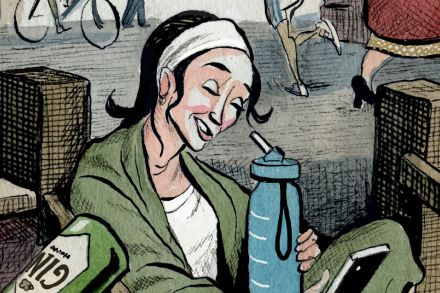
The water bottle is no longer just a water bottle. It is a status symbol. It is an extension of oneself. It is the source of good skin. It can hold 2.2 litres of water and keep it cool for 11 hours. It can be personalised, stylised and bastardised. It is Gen Z’s version of a purse dog, only heavier and less likely to destroy your handbag. Everyone has a reusable water bottle: 79 per cent of Gen Z carry one. Jordan Pickford used one as a cheat sheet in England’s game against Switzerland on Saturday, which is the most functional use of a water bottle I’ve seen in recent years. Only anti-environmentalists and people whose urine is the colour of a sailor’s tooth are yet to buy one – at least that’s what TikTok keeps telling me.

Gins in tins – the Yummy Mummy’s ruin

I’m writing this in my car, laptop on knees and a delicious can of Tanqueray Flor de Sevilla gin and tonic in the drinks holder, while my sons are at cricket practice. It’s an inclement evening, but were it a sunny summer’s day, the Yummy Mummies would be sprawled around the boundary in their Veja trainers and prairie dresses, pastel-coloured tins in hand, cackling and catching up like some Gen X version of Hogarth’s ‘Gin Lane’. Gins in tins are the acceptable form of ‘mother’s ruin’. First came Gordon’s G&T in a tin, followed by its pink gin, and now the chiller aisle contains more temptation than the Haribo shelves do for my children. Bombay Sapphire, Tanqueray, Sipsmith and multiple artisan brands have got in on the act.

My garden decor advice for Boris Johnson

Boris Johnson has three lifesize, carved wooden elephants in his garden, given to him by his wife for his 60th birthday. But here’s a warning for them both, for when they return from Sardinia to join their elephants again: garden sculptures are horribly addictive. Once you have one, you want more – and most of the good ones are ridiculously expensive unless, like my husband and me, you improvise. My husband John, who used to be a fashion designer and manufacturer, has taken to making iron sculptures, although he’s too modest to call himself a sculptor. I draw stuff, he says, and Sked (Malcolm Sked, the local blacksmith) makes them.

How to bet like a politician

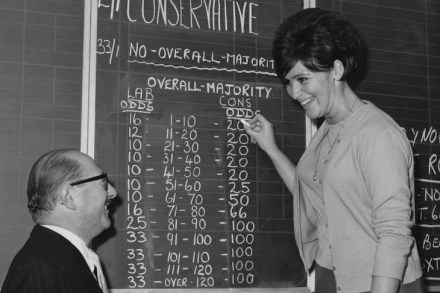
If you’re going to fleece a bookies, it would be wise to ask a friend to place the bet on your behalf, or do it with cash down the local Coral. Craig Williams didn’t. The Gambling Commission is investigating the Prime Minister’s parliamentary private secretary after he placed a bet on the date of the election – three days before his boss called it. Williams’s online bet was flagged as suspicious, which, in his words, has resulted in ‘some routine inquiries’. What’s worse, he only put £100 on at 5/1. It barely seems worth it. Political betting is not big business. Only £426,000 has been placed on the outcome of the next general election through Betfair Exchange, while around £300 million is put on the Grand National each year.

Madrí wouldn’t fool a true Spaniard

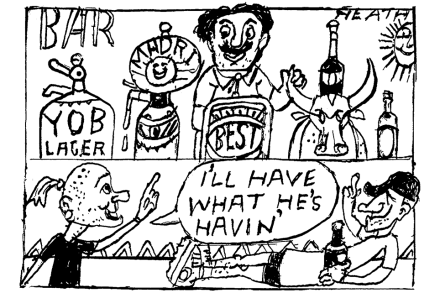
Four years ago, Madrí didn’t exist. Today, the faux Spanish lager is sold in a quarter of British pubs, which makes it one of the fastest-growing beers of all time. ‘Madrí’ is the historic name for Madrid, which is peculiar for a beer brewed in Tadcaster – or Tada as the Anglo-Saxon mead-drinkers called it. Madrí has never been brewed in Spain, let alone Madrid. Yet it shares the same sanguine-red label of the real Spanish lagers, such as Estrella Galicia, Mahou (pronounced Mao) and Estrella Damm, which allows it to blend in with them on pub bars and supermarket shelves. ‘People think they are drinking a Spanish beer but it’s not,’ says Aitor de Artaza, international head of Estrella Galicia. He accuses Madrí of ‘lacking transparency’.

What war graves teach us about peace

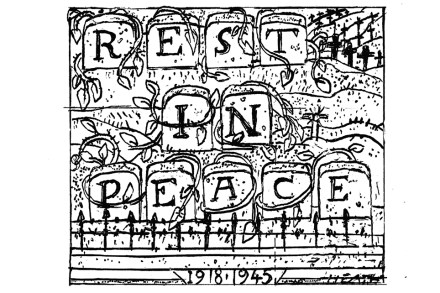
Hugh Jones was 29 when he was killed in action. On Wednesday, the eve of the 80th anniversary of D-Day, his grave at Bayeux – and those of 22,000 Commonwealth war dead in cemeteries across Normandy – was illuminated in a vigil to these silent witnesses to the pity of war. All Commonwealth war cemeteries share a powerful aesthetic. There are more than 2,000 across 134 countries, and in each, lines of soldiers’ graves evoke a battalion on parade. In life, officers and soldiers may have been divided by religion, rank or class but they are unseparated in death. They sit, Kipling wrote, on ‘fair and level ground… Where high and low are one’. It is difficult to imagine today how revolutionary these cemeteries were when they were built.

Assassination attempts, executions and volleyball: a history of Horse Guards

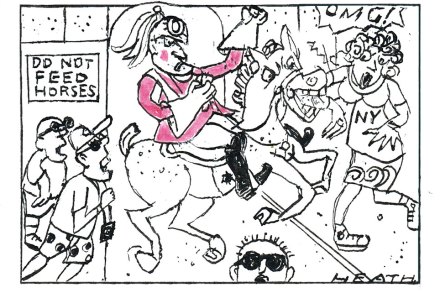
Will they never learn? The signs are very clear: ‘Beware! Horses may kick or bite.’ Yet last week a woman became the latest tourist to get a shock at Horse Guards, when the animal she was fussing suddenly turned its head and bit her arm. She was unhurt, but you can see why the animals occasionally lose their rag. They’re there to protect the monarch, after all. Sending a gentle message once in a while can’t do any harm. This small patch on Whitehall is where the King’s Life Guard do their thing because it’s still classed as the official entrance to Buckingham Palace. The building also used to house the office of the commander-in-chief of the British Army.

The unbeatable glory of a doner kebab

Ionce shared a bed with a doner kebab. I’d hungrily joined a 3 a.m. queue for much needed post-pub sustenance, only to pass out as soon as I sat down on my bed to eat it. It was a vinegary and leathery bedfellow to wake up to, but I’ve felt ever since that spending a full night with a doner qualifies me as an expert. I can tell you that any major city’s kebab purveyors can be ranked by the number of pints you need to have drunk before you feel like tucking in. Think of this number like the zones on the London Tube map. At the smart end there’s the zone one kebab: restaurant-grade and easily enjoyed as part of a full sit-down meal. At the other end there’s zone six: a last resort on the way home from a six-pint (or more) pub session.

All boys should own a Swiss Army knife

Last week, Carl Elsener of Victorinox, makers of the Swiss Army knife (all other manufacturers must refer to their products as ‘Swiss-style knives’), announced that the company is working to develop a knife without any blades in anticipation of modern legislation and safety-conscious consumers. A cutting-edge Swiss Army knife will no longer have a cutting edge. I’m glad this proposal didn’t come out before Christmas: 2023 was the year my wife finally agreed our son could have a knife of his own. She has friends who won’t let their children wash up knives in case they injure themselves, but let them watch YouTube unsupervised.

Tom Cruise and the art of falconry

Last week, the Hollywood team making the latest Mission Impossible film was desperate to clear Trafalgar Square of its superabundant pigeons for a scene involving its star, Tom Cruise. But it was not an ultrasonic laser in Ethan Hunt’s high-tech kitbag that did the trick. What you apparently need to rid central London of its pesky birds is an artform dating back 3,000 years. The producers had to resort to falconers to get the job done. These devotees of an ancient art, who have also performed sterling service recently for administrators at St Paul’s Cathedral and the Palace of Westminster, let loose a ‘cast’ of red-tailed hawks, complete with bells and jesses, and sent the pigeons packing.