Notes on...

In praise of Boris’s nemesis: the great crested newt

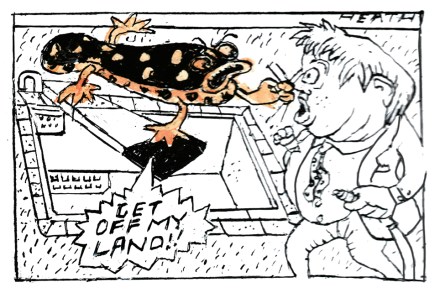
Britain is not blessed with an abundance of amphibians. There are just seven native varieties. The loss of ponds – whether in gardens, farmland or in areas earmarked for development – has seen a dramatic decline in habitat for one of the seven in particular, the great crested newt (or GCN for short). Its rarity means it is protected by law, making it an offence to kill, injure or capture one, or damage its habitat. That is why for construction firms, road builders and, most recently, Boris Johnson, no newts is good news. The discovery of GCNs at Johnson’s Oxfordshire pile meant planning permission for a swimming pool was refused.

My morning spin class with Rishi Sunak

It was 7.31 a.m. and I was late for my Notting Hill spin class. That meant the lights weren’t on when I entered the studio and scrambled to find my bike. Bleary-eyed, I noticed a man waving at me as I approached Bike 49. It was Rishi Sunak, on the bike next to mine. ‘I promise I booked this one,’ I said, so he didn’t think I was stalking him. The instructor started to shout motivational phrases at us and blast out Britney Spears and Dua Lipa. For the next 45 minutes, Rishi and I sweated it out side-by-side. This week an LA TikToker had a similarly surreal experience when she rocked up at the Santa Barbara SoulCycle studio for an early morning Taylor Swift-themed ride, only to find it filled with security.

Gloves, tea strainers and a game of Monopoly… how the Great Train Robbery unfolded

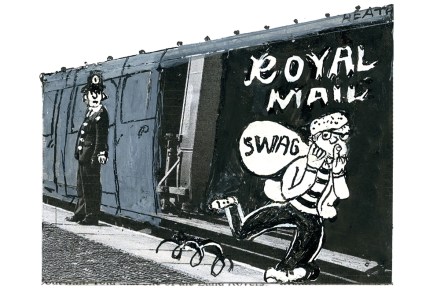
We don’t know if the two teenagers who attempted a train robbery in Scotland this week knew that it was the 60th anniversary of the most famous one in British history. Given their failure – nothing was stolen and the charges include ‘malicious mischief’ – it seems unlikely. Either way, the train robbery of August 1963 remains secure in its title of ‘Great’. Why did it fascinate us so much in the first place? Partly it was the zeitgeist timing (that year also saw Profumo, Beatlemania and JFK’s assassination); partly the amount stolen (£2.5 million, worth more than £40 million today); and partly the narrative of ‘plucky underdogs vs the police and banks’ – the last of whom were insured, except the Midland, which disdained the idea and so lost £500,000.

Who’s afraid of giant hogweed?

Giant hogweed is a troublesome and expansive species. But it is not, as the tabloids inevitably describe it every summer, ‘Britain’s most dangerous plant’. Many garden favourites – yew, laburnum, castor-oil plant (the source of ricin), for example – can actually kill you. The answer to living with these difficult but beautiful organisms isn’t knee-jerk eradication, but learning what they are and how they live... and then keeping a respectful distance.  Back in the early 1970s, meandering round the wastelands near Heathrow, I came across a giant hogweed wrapped round with ‘Keep Out’ tape. I wasn’t sure if it was a genuine security warning, or a jokey art installation.

The pleasures of pebble-spotting

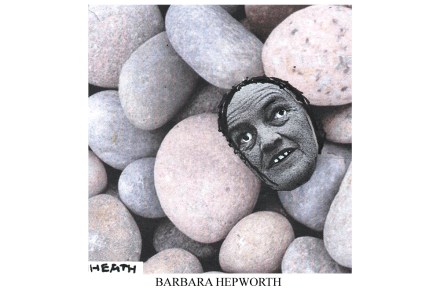
P-p-pick up a pebble. Feel its weight in your palm. Roll it over under your thumb. Any good? Not sure? Shuck it back on the shingle. Plenty of fish in the sea and more pebbles still on the shore. In The Pebbles on the Beach: A Spotter’s Guide, Clarence Ellis, pebble-spotter par excellence, opens with the words: ‘Most people collect something or other: stamps, butterflies, beetles, moths, dried and pressed wildflowers, old snuffboxes, china dogs and so forth. A few eccentrics even collect bus tickets! But collectors of pebbles are rare.’ We are not talking about the common or garden or indeed communal garden collector of pebbles – the sort with a wheelbarrow and a trowel. A true pebble-spotter does not make off with cartloads to resurface the driveway.

What’s the point of confetti?

All things considered, probably the least of George Osborne’s concerns on the occasion of his second marriage was being showered with orange confetti by a woman apparently sympathetic to the Just Stop Oil protestors. Bingo: a whole new form of protest came into being. What is the whole confetti thing about anyway? You used to be able to tell if there’d been a wedding at a church by the amount of pastel-coloured horseshoe and bell shapes ground into the pavement outside. It was sold in boxes decorated with wedding motifs. Nowadays, no eco-chic guest would throw paper confetti; dried flower petals are the way to go, available in tasteful cones and a useful way of recycling dead flowers. (Really, the protestor should just have thrown marigolds.

Open and shut case: the evolution of windows

Upstairs rooms in new houses are likely to be darker because building regulations now demand they should be at least 3ft 6in from the floor. Given the stingy heights of rooms these days, this reduces the glazed area. The regulators are worried about window safety. ‘Is there a plague of people falling out of them?’ asks Nicholas Boys Smith of the Create Streets pressure group. He answers himself: ‘Of course not.’ There are two ideas of a window, if the history of words were to be believed. The English language sides with the notion of a vent: ‘wind-eye’ in origin. It’s not only for Anglo-Saxon sparrows flying into mead-halls; the Spanish call it a ventana, a ventilating aperture.

The disappointing truth about Aperol spritz

I’m in Tuscany, where the piazzas glow orange at dusk, not only from the sunsets but also from the profusion of Aperol spritz. The bright orange drink has exploded in popularity in the past five years. Everyone’s drinking it: young women, middle-aged couples, groups of wrinkly tanned men, all sucking from straws sticking out of vast wine glasses loaded with ice cubes that give the illusion that there’s more liquid than there is in the famous 3-2-1 formula: three parts prosecco (equating to just one-tenth of a bottle), two parts Aperol and one part soda water, plus the obligatory orange slice. At the trendiest bar in Lucca I scoured the menu for the two drinks I used most to associate with Italy: Martini Rosso and the bellini. They weren’t there.

Boozy lunches are back

The financial crash of 2008 didn’t kill the boozy lunch outright, but it took the wind out of its sails. Ever more Americanised work styles further deflated the tradition, before Covid stamped on it. But the boozy lunch is back. It’s certainly surprising. After all, we are in the middle of a cost-of-living squeeze and a hospitality staffing crisis so severe that it has driven many restaurants to bankruptcy. But try meeting a friend for lunch in Farringdon, Soho or Mayfair and you wouldn’t know it. You must elbow your way in, wait for a harried but upbeat maître’d and thank your lucky stars you have a booking – if you do, that is. If not, there’s always Pret. As a special treat, I met my father recently at the smart Italian restaurant Luca in Clerkenwell.

Why I hate the new Pride flag

If you needed more proof that gay men aren’t in control of things any more – at least where the activist set is concerned – look no further than the evolution of the LGBTQ+ Pride flag. If, as Oscar Wilde once wrote, ‘Fashion is a form of ugliness so intolerable that we have to alter it every six months’, then the new Pride flag is somewhere between a prisoner of war and Frankenstein’s monster: a tortured and overburdened horror; a stitched-together crime against nature.  What was wrong with the old rainbow flag? Rainbows are happy and beautiful. Everyone loves a rainbow. And that, precisely, was the problem. You can’t strike fear into the hearts of your enemies with a rainbow. Big Gay needed something more militant.

The beauty of passport stamps

As a travel writer, I can get blasé about many aspects of travel: the free five-handed massage, the private plunge-pool out the back, those odd bits of overchilled orangey cheddar in an average Biz Class lounge. But one slightly childish thing that always pleases me is stamps in my passport. They should be emotionally meaningless: they are, after all, tiny and potentially annoying examples of frontier bureaucracy, ways and means by which a nation keeps tabs on you. And yet the other day I was going through the airport at Ibiza and getting my Spanish exit stamp – a Brexit benefit or drawback depending on how you feel – and the nice passport lady flicked through my passport, seeking a rare empty page, and said: ‘Wow, you have a lot of stamps.

Why I was evicted from a lesbian squat

Since my squatting experience back in the 1980s, the practice has gone somewhat out of fashion. Squatting laws in the UK have become much stricter, and eviction by police and landlords is easier. Spanish squatters have it relatively good at the moment, with criminal gangs targeting second homes in Spain, claiming to be homeless and using their young children to make eviction far more difficult. I recall my time squatting in a large, ramshackle terraced house in Surrey Docks, south London, when I first moved to London from Yorkshire. I was in my early twenties, claiming benefits, doing political activism, with no bank account or savings and I urgently needed somewhere to live. The squat had been advertised in the window of the radical bookstore in Brixton. ‘Lesbian? Feminist?

Meghan Markle and myths around mermaids

Disney’s latest remake of The Little Mermaid, out this week, has, it seems, a message for the royal family. When the prince wants to know the name of the mermaid, played by Halle Bailey, he tries to guess. ‘Diana?’ Nope. ‘Catherine?’ She pulls a face. Cue royal watchers identifying a snub of Kate, the Princess of Wales. Disney’s 1990 take on The Little Mermaid wasn’t quite the story that Hans Christian Andersen wrote – not having much to say about the mermaid’s quest for an immortal soul – but it did find one fan. As Meghan Markle observed in her interview with Oprah Winfrey: ‘Who as an adult really watches The Little Mermaid? But it came on… and I went “Oh my God, she falls in love with the prince and because of that loses her voice.”’ If only.

The sex appeal of lobsters

The night before I moved a pet lobster into my flat, I ate agnolotti all’ aragosta for dinner. It was possible that my soon-to-be companion, Snips McGee – who I inherited from a friend – would outlive me (the oldest lobster on record was estimated to be 140 years old) and I wanted one last plate of lobster ravioli, hold the moral hang-ups. The French author Gérard de Nerval also owned a pet lobster, which he took for walks on a blue silk leash. ‘They are peaceful, serious creatures,’ he said. ‘They know the secrets of the sea, they don’t bark, and they don’t gnaw upon one’s monadic privacy like dogs do.’ How I wish that were true. My Snips didn’t bark, but it was hard to find monadic or any other kind of privacy with an infant-sized cockroach by my bed.

In defence of rats

I n the ranks of unloved animals, rats are  surely king – so reviled that other pest species are often referred to as variations of the rat archetype: pigeons are ‘rats with wings’, grey squirrels are ‘tree rats’. There was also a recent flurry of stories about Britain facing an ‘invasion’ of ‘300 million monstrous super-rats capable of gnawing on steel and chewing through concrete’. Yet how reliable were these stories? The 300 million figure is from Steven Belmain, a Greenwich University professor, who was simply giving his estimate of the rat population. (Probably an underestimate, he says, but there has never been a proper survey.) Nor is there any evidence that our rats are changing in size or nature.

The mystical power of the coronation spoon

A spoon may seem too homely for grand ceremony. It might even, in this sceptical and utilitarian age, seem slightly ridiculous. This prompts the question of how, or whether, we value ancient traditions and ceremonies whose original meanings and power are largely lost to us. And if we do value them, why? This particular spoon, undeniably, is a very special one: doubtless the world’s most important spoon, and certainly one of the most beautiful examples of that humble genus: silver-gilt, finely engraved with acanthus scrolls, decorated with pearls, and with its bowl strangely divided into two. It dates from the 12th century, and may have been used ever since Richard the Lionheart. It is the oldest piece of the coronation regalia.

I’m grey – and proud

In the wake of new research by New York University’s Grossman School of Medicine, scientists think a treatment for stopping our hair going grey – and even reversing it – may soon be possible. Their optimism is based on early positive experiments with mice, which is great news if you’re a mouse, but what if you’re a man over 60 and totally grey like me? Yes, women go grey too – but it’s different for them. The ones I know don’t make a big existential drama out of it the way men like me do. Women simply dye their hair or just let it go grey. Men panic and turn to desperate measures like concealing highlights, expensive anti-grey shampoos, exotic toners and total dye jobs. And usually with tragic results.

We are losing the war to save red squirrels

Two years ago I watched a red squirrel climbing a pine tree at my home in Northumberland. I fear it may be the last time I have that thrill. Twenty years ago they were everywhere in our woods and regular visitors to my bird table. Then in 2003 we saw the first grey squirrel. Almost at once the reds became scarcer and today there are few left. Volunteers work hard to cull the greys, killing around 600 a year, and occasionally this works well enough for a brief revival of the reds. But we are losing the war.  It’s a strange fact of biogeography that Europe has only one species of true tree-climbing squirrel. There are others in the Caucasus and Siberia, and there are several ground squirrels, but the exquisite Nutkin is our continent’s unique tree squirrel.

The colourful history of the green man

All hail our pagan King! The time has come to lay down your crosses and take up the bough of oak. Britain is to return to the old ways – at least if you are to believe the conspiracy theorists, who were distressed to see, on the bottom of the coronation invitation sent out last week, the face of a green man staring back at them. His eyes are bright, his mouth exudes fronds of ivy – the green man calls to us. Depending on your particular view of the world, his inclusion is either an affront to Christian decency or a jolly salute to our monarch’s peculiarities. The green man is a playfully sinister envoy of the otherworldly. His face, either made entirely of leaves or a fleshy human screaming forth foliage, is carved into hundreds of parish churches.

The beauty of the Easter lily

The Easter lily, or Lilium longiflorum, grows from a bulb buried underground to bear white, trumpeting flowers which face outwards and smell divine. One doesn’t need to be an expert in semiotics to see why it came to be associated with the resurrection. In Christian tradition, lilies were said to have grown in the garden of Gethsemane at the spot where Jesus prayed on the eve of his crucifixion. The Easter lily is sometimes known as ‘the white-robed apostle of hope’.  A few stems of lilies tied with ribbon are  always a lovely present whatever the occasion, but it is true that some associate these flowers more with death than life. In depictions of the Annunciation, the angel Gabriel sometimes arrives clutching a spray of lilies.