More from Books

Kim Philby’s library

Kim Philby was the only man in history to have been made both an Officer of the Order of the British Empire and a Hero of the Soviet Union. After his defection to Moscow in 1963, aged 51, he admitted missing some friends, some condiments (Colman’s mustard and Lea & Perrins Worcestershire sauce) and English cricket — though he continued avidly to follow the scores. He was also a keen reader, though access to books in English through the British Council and USIS libraries in Moscow was denied him. Instead — and unusually — he was able to order books through the post and to pay for them with American dollars sent via a Russian bank. I recently found seven typed letters, addressed from Postbox 509, Main Post Office, Moscow, and signed H.A.R. Philby.

Bookends | 6 August 2011

Of all the great cultural shifts of recent years, the rise to respectability of American comics may be the strangest. Once, Superman, Batperson and the like were just lowbrow trash for kids, but while some of us were looking in the opposite direction they acquired legendary status and became the cornerstones of Western civilisation. Now every other new film features a superhero, backed up by astounding special effects and a marketing budget that could start a small war. Excellent timing, then, for British comics author Grant Morrison to produce Supergods: Our World in the Age of the Superhero (Jonathan Cape, £17.99), a hefty and authoritative overview of the genre.

Bookends: Corpses in the coal hole

Ruth Rendell has probably pulled more surprises on her readers than any other crime writer. But the one she produces with her latest novel is a little unusual even by her standards. Set in the present, The Vault (Hutchinson, £18.99) deals with the discovery of four corpses in the disused coal hole of a Georgian cottage in St John’s Wood. The main investigator is Rendell’s long-running series hero, Chief Inspector Wexford, now retired and living part-time in Hampstead. Called in, a little implausibly, as a police adviser, he copes with what are in effect two murder cases, with different timescales, victims, motives — and killers. He and his wife Dora also find the time to sort out a potentially lethal phase in the love life of their feckless middle-aged daughter.

Life & Letters | 30 July 2011

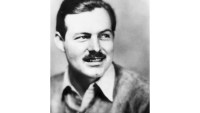
There was a photograph the other day of a Hemingway lookalike competition in Key West, Florida. Bizarre? Perhaps not. It’s 50 years since he put the barrel of a shotgun in his mouth and blew his head off, but he remains the most famous and widely recognised American writer of the 20th century, indeed of all time. Sadly, however, the lookalikes all take after the bearded bust-up Papa of his last miserable years, not the handsome young author of the great short stories where every word does its work and there are never too many of them. That Hemingway created an American type — lean, rangy, debonair — last example, Gregory Peck as the journalist in Roman Holiday. There was a photograph the other day of a Hemingway lookalike competition in Key West, Florida.

Mutiny, mayhem and murder

Nothing more gladdens this reader’s heart than a book that opens up an interesting and underexplored historical byway. Well, perhaps one thing: a book that opens up a historical byway that turns out to be a complete catastrophe. On that count, A Merciless Place more than delivers. Here is one of the great colonial cock-ups. It all started with a question that resonates to this day. When your jails are overcrowded academies of crime, and the respectable public lives in fear of what it imagines to be a violent criminal underclass, what do you do with your surplus convicts? Ken Clarke not yet having been thought of, conventional opinion in the 18th century was: ship them overseas and let them be somebody else’s problem. Yes, it hurt. Yes, it worked.

Losing the rat race

This is a book for anyone whose blood ever ran chill on reading the most sinister recipe in fiction, Samuel Whiskers’ instructions on how to cook Tom Kitten: ‘Anna Maria, make me a kitten dumpling roly-poly pudding for my dinner, make it properly with breadcrumbs.’ With or without breadcrumbs, or indeed butter and flour as Anna Maria preferred, rats will eat anything, dead or alive, from kittens to albatrosses. This is a book for anyone whose blood ever ran chill on reading the most sinister recipe in fiction, Samuel Whiskers’ instructions on how to cook Tom Kitten: ‘Anna Maria, make me a kitten dumpling roly-poly pudding for my dinner, make it properly with breadcrumbs.

Don’t blur the lines

Did you know that on the Central Line’s maiden journey to Shepherd’s Bush, one of the passengers was Mark Twain? Or that The Picture of Dorian Gray and The Sign of Four were both commissioned by the same publisher at the same London dinner? Or that Harrods dropped the apostrophe from its name in 1921, a full 19 years before Selfridges followed suit? My guess is that you probably didn’t — which is where Walk the Lines comes in. Did you know that on the Central Line’s maiden journey to Shepherd’s Bush, one of the passengers was Mark Twain? Or that The Picture of Dorian Gray and The Sign of Four were both commissioned by the same publisher at the same London dinner?

A choice of first novels | 30 July 2011

As L.P. Hartley noted, the past is a foreign country: they do things differently there. And no more so than during the two world wars, a fact that has provided a rich seam for several debut novelists to mine this summer. In Mark Douglas-Home’s puzzler The Sea Detective (Sandstone Press, £17.99), the tidal pull of a long-gone drama creates a psychological undertow for its hero Cal McGill. As the novel opens, Cal is on the run after covertly planting arctic flowers in Scottish ministers’ gardens as a subtle protest against the administration’s environmental policy. Cal is an oceanographer, skilled in the mapping of briny mysteries, logging sinister flotsam and jetsam through analysis of currents and shipping routes.

Appetites and resentments

According to Richard M. Cook, who is Alfred Kazin’s biographer as well as the editor of his journals, the nearly 600 pages of entries assembled in this book represent only one sixth of the total mass Kazin deposited in the archives of the New York Public Library. According to Richard M. Cook, who is Alfred Kazin’s biographer as well as the editor of his journals, the nearly 600 pages of entries assembled in this book represent only one sixth of the total mass Kazin deposited in the archives of the New York Public Library.

What was it like at the time?

At midday on Thursday, 8 June 1933 — Erik Larson is very keen on his times — the newly elected President Franklin D. Roosevelt had a call put through to the history department at the University of Chicago. At midday on Thursday, 8 June 1933 — Erik Larson is very keen on his times — the newly elected President Franklin D. Roosevelt had a call put through to the history department at the University of Chicago. Since taking office in early March Roosevelt had been trying to fill the post of ambassador to Berlin, and with none of the usual suspects prepared to take on the job and Congress on the point of adjourning for the summer recess, time was fast running out.

Portrait of a marriage

In her foreword to Elizabeth Jenkins’s 1954 classic, The Tortoise and the Hare, Hilary Mantel reminds us of the unaccountability of love Apart from a war, what could be more interesting than a marriage? A love affair, though it is one of the central concerns of fiction, is a self-limiting tactical skirmish, but a marriage is a long campaign, a grand game of strategy involving setbacks, bluffs and regroupings — a campaign pursued, sometimes, until the parties have forgotten the value of the territory they are fighting over, or have abandoned their first objectives in favour of secret ones.

Bookends: A friend of mine

A friend of mine was throttled by Pete Postlethwaite once. It was outside a TV studio, people were smoking and Postlethwaite was only demonstrating some bit of business he had done while playing Macbeth, but even so, very few of us can claim to have been strangled by someone Steven Spielberg once called ‘the best actor in the world’. Postlethwaite died in January, to a vast and unexpected surge of public grief. Now arrives an autobiography, A Spectacle of Dust (Weidenfeld & Nicolson, £20), written during illness, incomplete at death, finished by other hands. But there’s no doubt it’s the real thing. Postlethwaite was an unusually open, emotional actor, both strong and vulnerable, never terribly bothered about being liked.

The revised version

The narrator of Julian Barnes’s novella has failed disastrously to understand his first love. David Sexton admires this skilful story, but finds something missing Julian Barnes once said that the only time he had ever threatened to throw a guest out of his house was not because the churl had disparaged his food or insulted his wife but because he had disputed the greatness of Ford Madox Ford’s novel The Good Soldier.

Strategies for survival

This is an account of the multiplicity of ways in which men ‘stole back time from their captors through creativity’ in the prisoner-of-war camps of Europe and the Far East. This is an account of the multiplicity of ways in which men ‘stole back time from their captors through creativity’ in the prisoner-of-war camps of Europe and the Far East.

Talking about regeneration

Iain Sinclair, the London novelist and poet, is always on the move. From the industrial sumplands of Woolwich to the jagged riversides of Gravesend, he rakes unfrequented zones for literary signs and symbols, locations of forgotten films and other arcana. His previous book, Hackney, That Rose-Red Empire, revealed that Joseph Conrad had been a patient in the German Hospital in Dalston. Whenever I drive past that hospital (now converted into private flats), it resonates with the presence of the Congo-sick Polish author. Typically, Sinclair explores London on foot, gathering all kinds of off-piste detail as he does so.

Recent crime fiction | 23 July 2011

John Lawton’s Inspector Troy series constantly surprises. John Lawton’s Inspector Troy series constantly surprises. A Lily of the Field (Grove Press, £16.99), the seventh novel, has a plot stretching from Austria in 1934 to Wormwood Scrubs in 1949, via Los Alamos and Paris. Fiction rubs shoulders with fact. There are big themes — including the Holocaust, the atomic bomb and Cold War espionage — but they are linked to individual lives, beautifully and economically described. Meret is a cellist whom we meet as a schoolgirl in prewar Vienna, and her career provides the thread that binds together the various strands of the novel. Like all the characters, she is caught up in a world changing beyond recognition; and, as their world changes, so do they.

Poetry in paint

At the age of just 21, Samuel Palmer produced one of British art’s greatest self-portraits. At the age of just 21, Samuel Palmer produced one of British art’s greatest self-portraits. Although he is wearing the clothes of the period (1826), the face that surmounts the casually fastened soft high collar is both Romantic and modern, instantly and thrillingly bridging the gap between his century and our own. As Rachel Campbell-Johnston notes in her welcome biography, Palmer’s hair is unbrushed and he seems not to have bothered to shave: ‘It’s hardly the image you would expect from an upcoming artist at that time. He does not strike the pose of the ambitious young professional; make a bid for new clients by parading palette and brush’.

The last place on earth

Colin Thubron has called Siberia ‘the ultimate unearthly abroad’, the ‘place from which you will not return’. Colin Thubron has called Siberia ‘the ultimate unearthly abroad’, the ‘place from which you will not return’. Many millions have not — Dostoevsky and Solzhenitsyn were lucky — but these days quite a few do, and most of them seem to write books about it. The latest is Jacek Hugo-Bader, a Polish journalist who, as a 50th birthday present to himself, travelled from Moscow to Vladivostok in an old lazhi (‘tramp’, a Soviet jeep), driving 12,968 kilometres in 55 days, at an average speed of 43.8 kmph.