More from Books

On the way to the forum

In 150 BC, Cato the Elder arrived in the Senate House in Rome with an eye-catching basket of figs. This redoubtable statesman — often referred to as ‘censorius’, an epithet I have coveted since my childhood — was famous, apart from his censoriousness, for his conviction that the most important thing for Rome at any

Life & Letters: A PM’s summer reading

One of the weaknesses of many political biographies is that they are so often all about politics. The authors either forget that politicians are people, and sometimes interesting people, or they assume that their private life is of neither interest nor importance. So the book becomes a record of what the politician did rather than

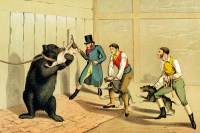
Not quite cricket

To the French, Albion’s expertise in perfidy will come as no surprise. But centuries of warfare have given them time to learn. With their experience only dating back to 1914, the Germans clearly found it difficult to grasp during the second world war that nowhere is the truth more expertly and instinctively spun than in

Where dreams take shape

The question of what artists actually get up to in their studios has always intrigued the rest of us — that mysterious alchemical process of transforming base materials into gold, or at least into something marketable in the present volatile art world. Today’s studio might as likely be a laptop as laboratory, factory, hangar or

Prophetic times

The subject here is colossal, covering a substantial stretch of the later Roman empire, the last years of the Persian empire, the conversion of the Arabs, the spread of Christianity and what happened to Judaism. The time span runs, effectively, from the death of Jesus to the moment in the eighth century when the Abbasids

A polished fragment

One evening nearly 40 years ago the world’s press descended on Patrick White in Sydney: they rampaged outside his house, pounded its doors, shouted through windows, camped on the lawn. The reason for this hullabaloo was that White had beaten Saul Bellow in the race for the Nobel Prize for Literature of 1973. Yet in

Going ethnic

Tyler Cowen, a professor of economics at George Mason University, has been keenly interested in food for years. Besides being a blogger, scholar and the youngest chess champion in the history of New Jersey, he is also the author of an online dining guide to the Washington DC area and an opinionated foodie. This is

A fine and private painter

Prunella Clough was a modest and self-effacing artist who nevertheless produced some of the most consistently original and innovative British art of the second half of the 20th century. She was by no means reclusive, enjoying an extensive social and teaching life, but she deliberately kept a low profile, being famously guarded with biographical details.

Searching for a saviour

The central themes of Russian history have remained constant for over a millennium.  Russia’s vast spaces and lack of any natural borders have always made her inhabitants terrified of invasion. And to protect the country against invaders, and to preserve its unity, Russia’s rulers seem always to have felt it necessary to assert their authority

Special providence …

When Ed Smith became a full-time professional cricketer for Kent in 1999 the county side was preparing for the new millennium by shedding anything that smacked of old-fashioned amateurism. Professionalism was to be a state of mind. Players were henceforth required to sign up to a new code of conduct. This Core Covenant consisted mainly

… in the fall of a sparrow

Set in Romania in the 1950s, this is the story of two people, Augustin and Safta, who are both very different and yet very closely linked. Safta is the daughter of the big house, while Augustin is the deaf mute illegitimate son of the cook. Safta’s mother, high-minded, overly religious since the death of a

Pawns in the game

The authors of this book have attempted a difficult thing: to ‘write about something that could never be known’. Here is a terrific and scary story about a group of American, British and European trekkers kidnapped by jihadists in Kashmir in July 1995 and slaughtered in December. Their wives were allowed to go free, and

A gruesome sort

Everybody knows that the heart pumps blood around the body, and that a man called William Harvey somehow discovered this fact. Before Harvey, people thought that blood moved around the body in a sluggish fashion. But then Harvey — who was born 14 years after Shakespeare — noticed that, actually, blood shoots out of the

Speeding along the highway

Back in the Sixties, if you wanted a fruitful, freakout-free LSD experience, you might have called on Mrs Aldous Huxley in Los Angeles, where she lived as a beatifically attuned Buddhist adept until her death in 2007. Aldous Huxley, her husband, had emigrated to America 70 years earlier in search of spiritual solace and the

What was it all for?

What happens to a novelist who becomes the conscience of a nation? Nadine Gordimer, who is now 89 and whose writing career began in the 1940s, has represented the progressive white intelligentsia of South Africa through a large corpus of fiction and essays, exploring personal and political morality with passionate lucidity through the apartheid years

Bookends: Terribly Tudor

History publishers like a gimmick, so I assumed Suzannah Lipscomb’s A Visitor’s Companion to Tudor England (Ebury, £12.99) must be a cheeky rip-off of Ian Mortimer’s Time Traveller’s Guide series. Not so. In fact this is a rich, meticulously plotted field guide to the surviving architectural treasures of Tudor England: the houses, fortresses, palaces and

Who are the losers now?

Keith Lowe’s horrifying book is a survey of the physical and moral breakdown of Europe in the closing months of the second world war and its immediate aftermath. It is a complex story and he tells it, on the whole, very well. Though the first world war took the lives of more uniformed young men,