Sophia Waugh

Sophia Waugh teaches English at a secondary school in Somerset.

What the Cass Review means for schools

From our UK edition

When the Cass Review was published in April, many of us working in schools heaved a sigh of relief. For many teachers the muddle surrounding the position of transgender children and those working with them caused serious concern. A maths teacher in Swindon was sacked for addressing a student as ‘she’ and writing her ‘dead name’ on the board, even though she/he was asking to be entered into a girls’ maths challenge. Most teachers are in the job to impart knowledge, to encourage thinking and to play a part in guiding a child towards adulthood. We are not there to judge, mock or belittle. But we found ourselves increasingly confused. How much should – or could – we tell the parents?

Out in the cold

From our UK edition

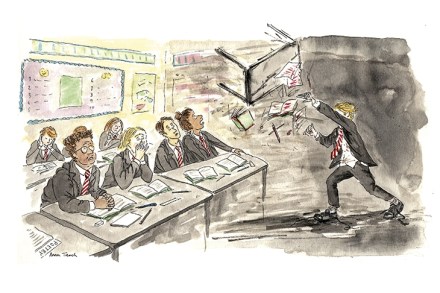
Children have a right to an education. This has been written into English law since the Forster Education Act of 1870, which began the process of making education compulsory for children aged between five and 13, and no one in their right mind would oppose that statement. So when the number of permanent exclusions from schools is on the rise, the reasons behind this should be examined carefully. A child excluded from school is not accessing education, and therefore their rights have been violated. But is it really that simple? A breakdown of the groups most often excluded does not bring up many surprises. In nearly half the cases, exclusions are for persistent disruption. Sex and drugs, bullying and racism come much further down the line.

English Cooking: Discover the true value of pie

From our UK edition

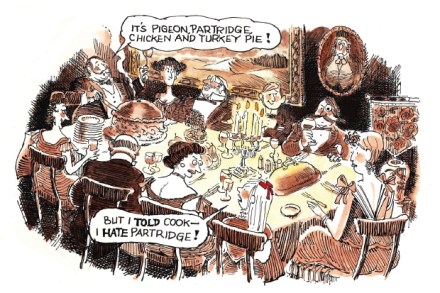
We all know what we think of as the great English Christmas lunch/dinner — turkey (originally from America) or goose (a worldwide bird, first domesticated in Ancient Egypt), Brussels sprouts (from Rome via Belgium), potatoes (also from the Americas). So, in fact, there is no such thing as a great English feast. Or is there? While the poor had little choice of food, the English traditionally knew how to feast. Christmas, which took over from the Roman pagan festival of Saturnalia, has for centuries been the year’s best excuse for eating, drinking, dancing, and showing off – showing off not just in silly tinsel hats, but in what you spread before your guests on the table. The stuffed bird is a key centrepiece of any English feast.

State secrets

From our UK edition

So much of the divide between state and private schools is a matter of mere perception — the perceptions of the teachers, the parents and the children. When, years ago, I announced that I would be sending my children to state schools, my colleagues (journalists on a national newspaper) turned on me as a pack of hounds, baying their disgust at what they called my willingness to ‘experiment’ on my own children. Move over Mengele, here comes Waugh. There are of course differences between the two types of education — but how many of them really matter? For my (yes, state-educated) children, many of the differences they saw between their various friends were nothing to do with education at all.

State schools are ‘character building’ too

From our UK edition

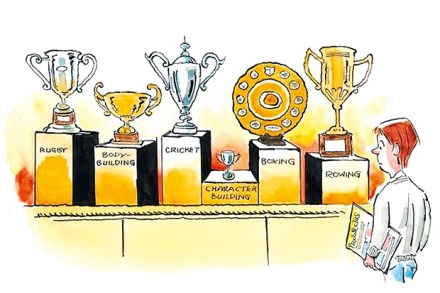
In tough times, we have to be persuaded to buy the non-essentials in life. While no one would deny an education is essential, many parents are beginning to question whether paying tens of thousands of pounds for a clutch of GCSEs is really worth it. Therefore public schools are having to come up with ever more selling points to draw in the punters. Anthony Seldon, the never willingly underquoted Master of Wellington College, has a new reason to encourage you to send your children to his school. He claims that his establishment, and others like it, can offer to teach your children ‘character’ in a way that no state school can. What is ‘character’ anyway? Can it really be taught by a bunch of soldiers coming in and telling you about their time in Afghanistan?

Stories about storytelling: Kirsty Gunn’s preoccupation with words is utterly entrancing

From our UK edition

Although entitled Infidelities this collection of short stories could as well be called Choices, because that is what really preoccupies Kirsty Gunn’s characters. Divided into three sections, ‘Going Out’, ‘Staying Out’ and ‘Never Coming Home’, the stories are more linked by style and writing than by any theme. Gunn’s style is clear, unaffected and poetic without being pretentious; her descriptions of nature — for instance the sky at the beginning of ‘The Wolf on the Road’ — are at times almost painfully beautiful. One stylistic technique she favours is not always as successful as her descriptive writing; often in a story she will slip from a narrative voice to an authorial one, from the past to the present.

God, aliens and a novel with a mission

From our UK edition

They say never work with children and animals. They could just as well say don’t write about aliens and God. A raft of readers hate sci-fi, and probably more sheer away at the very idea of a novel about a missionary. And yet… And yet The Book of Strange New Things works. It is in many ways extraordinary; its narrative drive, its lack of sentimentality, its occasional (emotional) brutality, its humour (albeit rare) all add up to a novel which is both intelligent, thought-provoking and as readable as a potboiler. Peter, ex-junkie, loving husband, cat-lover, sets off on a journey. The novel opens with his farewell to his wife, and we gather that he will be gone a while and that he might be in danger.

An utterly charming, totally bonkers short novel

From our UK edition

This utterly charming, totally bonkers short novel is something from another age. There are elements of A Handful of Dust (the young girl trapped reading Dickens), of Rebecca (the undervalued companion of a cantankerous employer), of fable and fairy tale and even of Restoration comedy. Victoria, young, pretty, big-bosomed, is the companion of a blind man of letters who lives in considerable style in a house in Italy. Her mother is drunk, her employer eats only eggs and dislikes women. Escape she must, and she does so via a vapid young man who falls swiftly in love with her, marries her and conveniently dies. Enter Lettice, a mother-in-law direct from Hades.

Young people aren’t driven by fun, but by fear

From our UK edition

Family legend has it that when I arrived in Durham, a fresh-faced ingénue from deepest Somerset, I called home. ‘This is the life,’ I said, after a bare 24 hours in the frozen north, and they hardly heard from me again. I would have expected my first daughter to have a similar experience, but by the time she set off for university I had already learned how very different the new generation is from ours. I arrived from a girls’ grammar school, having chosen a university as far from my (much-loved) home as I feasibly could, determined to have Fun. I threw myself into the whole thing. I stayed up night after night drinking nasty wine and talking rubbish and I doubt there was a single pub or college bar that I didn’t try out.

Auberon Waugh’s way with wine

From our UK edition

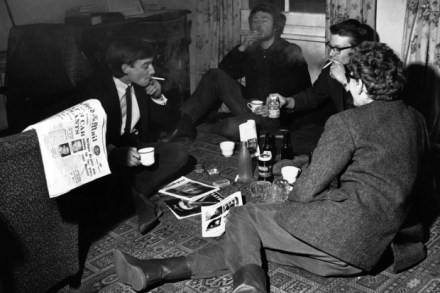
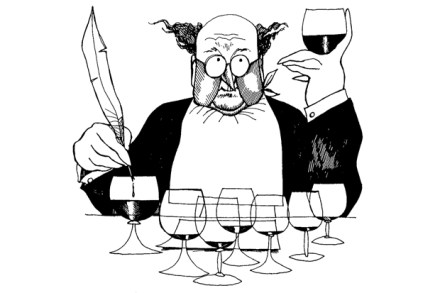
The cellars at Combe Florey, the house in Somerset in which I grew up, were a place of mystery and fear. You walked down wide, shallow stone steps to a large door on which my father had stuck a postcard which read ‘I know who you are’ when, in a fit of paranoia, he decided that a neighbour was stealing his wine. Once through the door, there were more steps down until you found yourself in a large, cool, faintly musty-smelling room. Bats, furious at the disturbance, swooped around you until they sulkily returned to their lair in some dark corner. Off each wall were more cellars: in one, a large red boiler rumbled and groaned, a ridiculously grand chandelier hung, totally out of place, and a portrait of Queen Charlotte leered out at you.

A ladykiller at large

From our UK edition

Ever since Sergeant Cuff appeared in The Moonstone in 1868, we English have loved our detectives. Moody Scandinavian fiction might come and go, but Peter Wimsey, Poirot, Marple and of course Sherlock Holmes continue to delight us. In Simon Serailler, Susan Hill has created a detective that ranks alongside all these greats. Like Cuff, he has his passion (drawing), like Wimsey he has a personal story, which is built up in each successive novel (this is the seventh in the series). A Question of Identity continues the tale of Serailler’s usually doomed love affairs, his ambivalent relationship with his father, his widowed sister’s single motherhood, and his care for her childen.

From Luxor to Heston services

From our UK edition

This wonderful book is not a history of food in 100 recipes at all; it is a history of the world in 100 recipes, as seen through the medium of what we ate and how we cooked it. William Sitwell’s erudite work never drags and should not be seen as a collection of recipes (although these are clearly chosen with modern-day cooking in mind) but as a window into the appetites and ways of life of our ancestors. We begin in Ancient Egypt, with a way of making bread extrapolated from pictures on the walls of a woman’s tomb in Luxor. This is one of the joys of the book; the recipes are not just retrieved from cookery books (the domstic kind, as we know them, did not really take off until the 18th century) but from many other sources, among them literature, the Bible and paintings.

Family get together 

From our UK edition

Mark Haddon is in what must sometimes seem like the unenviable position of having written a first (adult) novel which was, and continues to be, a smash hit. Drawing in part on his own experiences of working with the autistic, The Curious Incident of the Dog in the Night Time has become one of those books that anyone who claims to be a reader must know. His second novel, A Spot of Bother, did not receive the same acclaim, perhaps partly because the subject was a man in mid-life crisis who convinces himself he is dying. It too was wonderful, though — funny, perceptive and moving. His latest book, The Red House, is in the same mode as the second.

… in the fall of a sparrow

From our UK edition

Set in Romania in the 1950s, this is the story of two people, Augustin and Safta, who are both very different and yet very closely linked. Safta is the daughter of the big house, while Augustin is the deaf mute illegitimate son of the cook. Safta’s mother, high-minded, overly religious since the death of a baby, disappointed in her marriage, takes Augustin into the schoolroom until it becomes clear that while the boy has an impressive artistic talent he can learn nothing, and so he is returned to the stables. War comes, the house is dismantled, Safta, mourning her lost love, leaves the countryside and becomes a nurse and Augustin is left with the remaining servants and the dogs.

Losing my bottle

From our UK edition

Why does Waitrose think I can’t be trusted with Chablis? I was refused alcohol in Waitrose the other day. Not because of my age, nor because I don’t look my age. Nor, I hasten to add, because I was drunk. I was buying supper in Waitrose — two chickens, two bottles of chablis, some green beans — and when the woman on the till reached the wine she shook her head, folded her arms, and told me she could not serve me. At first I thought it was some silly joke. My children laughed along merrily. ‘Ooh, mum, she thinks you’re 17.’ But the children were the problem. When you shop with small children they’re a nightmare because they’re asking for sweets and whining.

Bookends: Getting it perfect

From our UK edition

There is an old joke which says that if you are lost in the desert, start making a salad dressing as someone will pop out of a sand dune and tell you that you are making it the wrong way. This, in essence, is what Felicity Cloake does in her recipe book Perfect (Fig Tree, £18.99). And the idea is a good one. Cloake has done all the hard work — read all the top cookery writers, tried out their versions, and then picked the best, or ‘Perfect’ one. So you have 68 ‘perfect’ recipes. The title is meant to be comforting, or encouraging, but it could be a little dangerous.

Bookends: Getting it perfect | 7 October 2011

From our UK edition

Sophia Waugh has written the Bookends column in this week's issue of the magazine. Here it is for readers of this blog. There is an old joke which says that if you are lost in the desert, start making a salad dressing as someone will pop out of a sand dune and tell you that you are making it the wrong way. This, in essence, is what Felicity Cloake does in her recipe book Perfect. And the idea is a good one. Cloake has done all the hard work — read all the top cookery writers, tried out their versions, and then picked the best, or ‘Perfect’ one. So you have 68 ‘perfect’ recipes. The title is meant to be comforting, or encouraging, but it could be a little dangerous.

Just the one regret

From our UK edition

Is he a monster, saint, genius or lunatic? In this massive book Naim Attallah attempts to lay to rest the gossip, slander and misconceptions that have dogged him for much of his life, while also coming clean about his own mistakes and failures. I have to declare an interest. I was, in the 1980s, one of ‘Naim’s girls’; I am very fond of him indeed, and for several years my father, Auberon Waugh, edited the magazine he once owned, the Literary Review. ‘Naim’s girls’ were a part of London’s social scene and provided Private Eye with one of many reasons to mock ‘Naim Attallah-Disgusting’. We were young, pretty, had ‘names’ and we loved parties. We were not paid very much but we certainly enjoyed ourselves.