More from Books

The imitable Jeeves

For as long as I can remember — I take neither pleasure nor pride in the admission — I have been one of those people who feels an irresistible curling of the lip at reviews of the ‘I laughed till I cried’ variety. Something about that hackneyed claim, invariably trumpeted in bold letters outside West End theatres, inspires absolute scepticism. No longer. At two memorable moments in Jeeves and the Wedding Bells I did indeed laugh until I cried. To readers unfamiliar with his role as a team captain on Radio 4’s The Write Stuff, the literary quiz which culminates each week with a pastiche of an author’s style, Sebastian Faulks, still best known for his novels Birdsong and Charlotte Gray, may appear an unlikely candidate for donning the mantle of P.G.

Carlos Acosta, the great dancer, should be a full-time novelist

Carlos Acosta, the greatest dancer of his generation, grew up in Havana as the youngest of 11 black children. Money was tight, but Carlos won a place at ballet school, and before long he was enthralling audiences at Covent Garden as a half Jagger, half Nureyev figure with a twist of the moon-walking Jackson in the mix. Now Acosta is about to leap into the world of literature with a debut novel, Pig’s Foot, written over a period of four years during rehearsal breaks. For all its manifest debt to Latin American so-called ‘magic realists’ (Marquez, Borges, Vargas Llosa), the novel stands triumphantly on its own. In pages of salty-sweetprose, it traces five generations of a black family through Cuba’s tumultuous recent history.

Why did Penelope Fitzgerald start writing so late? 

‘Experiences aren’t given us to be “got over”, otherwise they would hardly be experiences.’ The opening sentence of the first draft of The Bookshop, published in 1978 when Penelope Fitzgerald was 62, didn’t survive in the finished version, but its author had found her voice, and, in a way, her subject. She had learnt how to look back. She had begun publishing only four years earlier, with a life of Edward Burne-Jones. There followed a thriller, written to amuse her husband as he lay dying, and a second biography, The Knox Brothers. This was about her father, ‘Evoe’ Knox, editor of Punch and author of light verse, and his three brothers, two of whom became priests in different denominations.

Why Jeremy Paxman’s Great War deserves a place on your bookshelf

The Great War involved the civilian population like no previous conflict. ‘Men, women and children, factory, workshop and army — are organised in one complete unity of social resistance, to defend themselves both by offence and by ordinary defence,’ said Ramsay MacDonald. Geoffrey Studdert Kennedy, the popular army padre nicknamed ‘Woodbine Willie’, declared ‘There are no non-combatants.’ This premise underpins both these books. While Kate Adie specifically addresses ‘the legacy of women in World War One’, Jeremy Paxman discusses more generally the state of the embattled nation, its press, its political, industrial and social life, its assumptions and priorities. The strengths and weaknesses of both offerings are surprisingly similar.

Village life can be gripping

Black Sheep opens biblically, with a mining village named Mount of Zeal, which is ‘built in a bowl like an amphitheatre, with the pit winding gear where a stage would be’. It is divided into Lower, Middle and Upper Terrace, the last-mentioned known by the locals as Paradise. If, like many bookshop browsers, you judge a novel by its first page rather than by its cover, you might think, at this early point, that Susan Hill’s fairly recent theological studies sit heavily on the structure. You might expect (not necessarily with wild excitement) a familiar tale of stock characters and their moral failings. But it’s not like that. The opening page or two mislead benignly, giving a generalised feel to what is, in fact, a personal and moving novella.

Christopher Howse takes the slow train in Spain — and writes a classic

This is probably not a book for those whose interest in Spain gravitates towards such contemporary phenomena as the films of Pedro Almodóvar, Barcelona Football Club or the fashion retailer Zara. Nor, as far as trains go, is it a volume for people fascinated by the engineering feats of Spain’s new high-speed AVE train system, which means that you can travel from Madrid to Seville in just over two hours, or from Madrid to Barcelona in less than three (rather amazing, when you recall that the old service used to take nine hours). Christopher Howse does not like high-speed trains. Even moderately paced express trains are too fast for him, for one cannot really observe the landscape from them.

‘If I can barely speak, then I shall surely sing’

A few weeks ago, I was wandering with a friend around West London when our conversation turned to the reliable and inexhaustible topic of Morrissey. We were discussing his gestures, in particular when he augments the percussive spondee that opens ‘Sheila Take a Bow’ with two magnificent jabs of his right elbow. So back we went to my friend’s flat to study it again. In goes the DVD; bang go the drums; jab goes the elbow, and my dear friend gives a small cheer of delight, dancing his dance of Rumpelstiltskin glee. ‘Genius!,’ he declares. And he is right. It is a small moment, one of those preposterously arcane details beloved of a devotee of the Smiths, but it somehow seems to say everything about our artistic hero.

My dear old thing! Forget the nasty bits

There can be a strong strain of self-parody in even the greatest commentators. When Henry Blofeld describes the progress of a pigeon in his inimitably plummy tones, or greets a visiting Ocker to the commentary box with a jovial ‘My dear old thing!’, he is impersonating himself as surely as Rory Bremner has ever done. Just where ‘Blowers’ ends, though, and the man behind the act begins, can be tricky to judge. In Squeezing the Orange he does occasionally show us behind the scenes. He reveals, for instance, the advice which led him to his obsession with describing buses, and cheerily explains how he came by that ‘silly’ catchphrase, ‘My dear old thing’. What Blofeld does not do, though, is to explore anything so untoward as depths.

Clash of the titans

This is an odd book: interesting, informative, intelligent, but still decidedly odd. It is a history of the Victorian era which almost entirely eschews wars and imperial adventures and concentrates instead on the social, political and intellectual climate of the times.  This is still a vast spectrum. Simon Heffer concludes that he must decide which facets deserve attention and picks out those which interest and entertain him most; hence the occasional oddity. Can the building of the Albert Memorial really be worth 30 pages? Or the conflict over the style of architecture to be adopted for the new government buildings in Whitehall be worth 20?

Hitler didn’t start indiscriminate bombings — Churchill did 

‘I cannot describe to you what a curious note of brutality a bomb has,’ said one woman who lived through the initial German raids on London during the second world war. This woman’s ambivalent reaction to having a bomb rip through her bedroom typified the shocking reality of a different type of war to any that had ever been fought before. For as Richard Overy makes eminently clear in his extraordinary and far-reaching history of Europe’s bombing war, this was the first time civilians actually became a part of the front line. The cause of this was the advent of aerial bombardment, which, Overy says, exposed ‘the democratic nature of total war, which insisted that all citizens had a part to play.

Italo Calvino’s essays, Collection of Sand, is a brainy delight

The Japanese are sometimes said to suffer from ‘outsider person shock’ (gaijin shokku) when travelling abroad. Recently in London we had a lodger from Hiroshima who wanted to practise his karate routines in our back garden. Concerned to see him chopping at our apple tree in full combat gear, a metropolitan police helicopter hovered in close to take a look. Afterwards Mr Kinoto admitted to me that he was lost in London amid alien signs and habits. ‘The object of my time in England is not sightseeing’, he told me ruefully, ‘but home-staying.’ I thought of the Japanese lodger while reading Italo Calvino’s wonderful essays, Collection of Sand, published in Italy in 1984, a year before Calvino died at the age of only 62.

#Onyourmarks! What is the formal name for the hashtag? 

One day there simply won’t be any strange byways of the English language left to write quirky little books about. Happily that day hasn’t arrived yet. Keith Houston’s Shady Characters (Particular Books, £16.99, Spectator Bookshop, £13.99, Tel: 08430 600033)) ventures into the previously untrodden territory of punctuation marks, and not the obvious ones either. Full stops and commas are as nothing to him. Semi-colons are scarcely worth his attention. No, he’s in pursuit of asterisks and daggers, hyphens and ampersands. Why is a hash sign (#) formally called an octothorpe? (No one is quite sure.) Why didn’t the interrobang (‽) take off? (It did, in the 1960s, but it crash-landed soon after.

Does the world need 17 volumes of Hemingway’s letters?

‘In the years since 1961 Hemingway’s reputation as “the outstanding author since the death of Shakespeare” shrank to the extent that many critics, as well as some fellow writers, felt obliged to go on record that they, and the literary world at large had been bamboozled, somehow.’ So wrote Raymond Carver in the New York Times in 1981. My, how times have changed.

Was Bach as boring as this picture suggests?

What, one wonders, will John Eliot Gardiner be chiefly remembered for? Perhaps, by many who have worked with him, for his notorious rudeness to performers and colleagues. At one point in his marvellous new book on Bach he refers to the master ‘losing his rag with musicians’ (as a corrective to the ‘Godlike image’ of Bach that posterity has tended to prefer), and one senses a not entirely veiled sympathy: one struggling director excusing another, admittedly greater, but in that respect at least no different. For while Gardiner doesn’t, as far as I know, compose, he has been and remains beyond question one of the most influential performing musicians of our time.

A is for Artist, D is for Dealers

‘S is for Spoof.’ There it is on page 86, a full-page reproduction of a Nat Tate drawing, sold at Sotheby’s in 2011 for £6,500. A sum which, it is added, with all due respect to [William] Boyd’s ability as an artist, probably proves the point about promotion being more important than talent. It’s always something of a shock to encounter in a serious book the artist I invented and it’s a measure of the huge frame of reference encompassed in Breakfast at Sotheby’s that even Nat Tate and his drawing can make a salutary appearance. Philip Hook has realised and brilliantly exploited the peculiar advantages of the A-Z format. Using the alphabet as a template forces you to think laterally.

‘Bauklotzartigewortzusammensetzung’

Mark Twain had a notoriously thorny relationship with German, a language he gamely tried to conquer. His main beef was with its knotty grammar: ‘Whenever the literary German dives into a sentence, that is the last you are going to see of him till he emerges on the other side of his Atlantic with his verb in his mouth.’ He cast a satirical eye over its vocabulary too: ‘These things are not words, they are alphabetical processions,’ he wrote of such linguistic whoppers as ‘Unabhängigkeitserklärungen’ (declarations of independence). Many a German student would recognise Twain’s perplexed awe at a language that positively encourages Lego-like word-building (which would go something like ‘Bauklotzartigewortzusammensetzung’).

The Labour education secretary who could have been Britain’s first woman PM

Decent, clever, charming, eloquent, hard-working, conscientious and terribly, terribly nice, Shirley Williams is one of Britain’s best-loved politicians. Mark Peel’s admiring biographybegins in Chelsea in 1930. Shirley, as he matily calls her, was the eldest daughter of the political philosopher George Catlin and the bestselling author Vera Brittain. Life at home was affluent, comfortable and high-minded. The Brittains were privileged toffs who set out to remove privileges from toffs they felt lacked their idealism and sophistication. Shirley’s support for this manifesto achieved a stridency that sometimes grated even on her mother. Vera complained to a friend that the 16-year-old Shirley kept me up till 2 a.m.

When ‘drop-dead gorgeous’ women actually dropped dead

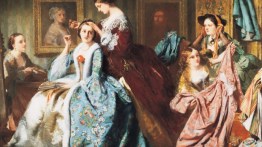
No one watches Antiques Roadshow for the antiques. Instead we’re hanging on the punter’s reaction to his three-grand valuation. ‘It was very precious to Aunt Mabel; we’d never dream of selling it,’ says the mouth. ‘Fortnight in Barbados,’ say the eyes. The Antiques Magpie by the Roadshow’s Marc Allum exhibits the same preference for stories over objects. Allum tells us that ‘drop-dead gorgeous’ comes from Victorian dresses (as in Winterhalter’s painting above) whose green dye contained arsenic, and that French forks have their crests on the back because they were laid face down on the table.