More from Books

The repression, anger and bloodshed of our own Game of Thrones

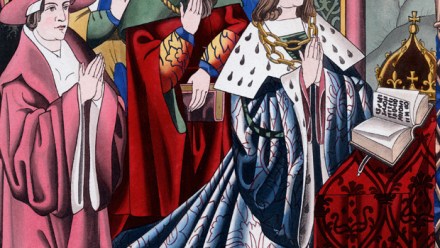
When I took up archery it was a relatively niche sport. Then Game of Thrones came along, and everyone wanted a longbow. Since the HBO series put the Wars of the Roses back on the map, we have had novels by Philippa Gregory and Conn Iggulden, and this autumn there will be a history of the wars by Dan Jones. Now comes the first of Toby Clements’s Kingmaker stories, set in the febrile age of mad King Henry VI of the House of Lancaster. Winter Pilgrims takes us to Lincoln, where Thomas, a 20-year-old monk and book illuminator, and Katherine, a young nun who has had enough of emptying her prioress’s chamber-pot, find themselves discharged from their respective cloisters and their duties to God.

Nature inspired P.J. Kavanagh – but so did ghosts, dreams, grief and God

P.J. Kavanagh, if not dismissed or relegated, is often shall we say bracketed, as a ‘nature poet’. The truth is, he’s as much of a nature poet as William Cowper was: in other words a good deal more than ‘a man who woos a rural muse’. While Kavanagh is also mentioned as a successor to Louis MacNeice and Edward Thomas, and is known for his portraits and tips of the hat to many other poets, such as Robert Lowell, Ivor Gurney and Yeats, it is, in fact, Cowper whose echo I myself hear most clearly.

Narcotically-induced mischief in an urban wasteland

Fifteen minutes by rail from Paddington, Southall is a ‘Little India’ in the borough of Ealing. An ornate Hindu temple there, the Shree Ram, is set back from the beep and brake of traffic on King Street. When I visited, a pooja (prayer meeting) was underway. Incense fumes — a sweet suffocating presence — wafted round statuettes of the blue-skinned Krishna. The priest was surprised to see me: ‘You are coming from — ?’ ‘Paddington.’ ‘But you don’t look particularly Indian.’ ‘I’m not Indian.’ (With his sandalwood caste-mark and Nehru shirt, the priest himself was of Gujarati origin.) Racially diverse, Southall is distinctly out-at-elbow and peeling paint, but bustling all the same.

Original Sin

When first they ushered me into that hall To take my place on a cheap fold-out seat, My eyes clamped shut, and so missed all The conjured stillness of the school: young feet Unshuffled, heads dropped down in donned respect, And teachers, too — attendant, cramped in rows Of less observant hush. A time to reflect On whispers, echoed hymns, light-cold windows. In truth, I pitied most the ones on-stage: for though I felt secure behind my teen- Devout, dismissive, atheistic rage, I couldn’t quite pretend I hadn’t seen the way they thumbed the book — unsure of it, The prayer, the weary Morning, all. Please sit.

Looking for the meaning of life? Come to Constantine Phipps’ poetic theme park

A favourite game of mine is to imagine Virgil and Homer today, plying their trade among the supermarkets and office blocks. What would they sing? Can modern life aspire to the epic, and can such a form still be understandable, even useful? C.S. Lewis, though he did translate the Aeneid beautifully, didn’t quite manage a similar feat with his bizarre modern epic, Dymer. It’s not a field many wish to enter. And yet Constantine Phipps, in his third book, What You Want, has made not only an epic, but a didactic epic, accessible, relevant and involving. In precise, lucidly flowing iambic pentameters, the poem is a meditation on the nature of being, married with a strong narrative. It stands aware of its influences: Lucretius is its guiding spirit and Dante its model.

For Roger Bannister, the four-minute mile was just the start

The title of this reflective and readable memoir refers to the author’s lifetime interests in sport and medicine — tracks which advanced not in parallel but with intersections. Few will be unaware that Roger Bannister was the first man to run a mile in under four minutes. The image of him breasting the tape scarcely needed reproducing on both the front and back cover of his book; even 60 years on, this moment is firmly imprinted on the country’s psyche. But how many will also be aware of his contribution to the study of the autonomic nervous system — or even what that system is, unless tempted to turn to Brain and Bannister’s Clinical Neurology, an 800-page encyclopaedia?

A truth too tender for memoir

It has been 14 years since Akhil Sharma published his first, widely acclaimed novel, An Obedient Father. Though its subject matter is very different, Family Life more than fulfils the expectations raised by that grim but compelling story of financial, political and moral corruption in India. Growing up in Delhi in the 1970s, the eight-year-old Ajay Mishra believed that his father ‘had been assigned to us by the government. This was because he appeared to serve no purpose.’ Everything changes when Mr Mishra leaves for America in 1978, followed a year later by Ajay, his 12-year-old brother Birju, and their mother.

Rod Liddle reminds me of old women moaning on the bus

Books by bellicose columnists with the initials R.L. are like buses — none comes along for ages, then two come at once. Having been given the heave ho from my last column some years back, I was looking forward to putting this regularly employed, high-profile Pushmi-pullyu through its paces before filleting it thinly and serving it up sliced seven ways. The best way to read the Liddle book is as a self-loathing joke, otherwise the sheer level of sumptuous hypocrisy may choke you; this is, after all, a book bewailing modern-day selfishness by the man who left the mother of his children months after their wedding in order to be with his young mistress.

A Colder War, by Charles Cumming – review

The title of Charles Cumming’s seventh novel is both a nod to the comfortable polarities of Cold War and also a reminder that our modern world is in some ways even chillier and less stable than the one it replaced. Once again, the central character is Thomas Kell, the MI6 agent who was trying to claw his way back from unmerited disgrace in Cumming’s previous novel, A Foreign Country. Even now, Kell is still on unpaid leave — which, though tiresome for him, is convenient for Amelia, the current ‘C’. They are old colleagues and, up to a point, friends, and she knows him for what he is: a fine intelligence officer caught between his own demons and the shifting, often ruthless expedients of his job.

From Anthony Trollope to Meryl Streep: the theatre of politics on stage and screen

On 1 October 1950 the BBC broadcast a seemingly innocuous little play by Val Gielgud. A light-hearted and critically unremarkable political comedy, Party Manners carried a number of pointed criticisms of Labour policy, taking pot shots at egalitarianism, tax-and-spend and big government. With Clement Attlee’s party enjoying only the slimmest of parliamentary majorities and a fresh election in the offing, some BBC executives feared that Party Manners might swing the balance in the Tories’ favour. Lord Simon of Wythenshawe, chair of the BBC governors and a Labour party member, cancelled a planned repeat showing, unleashing a storm in the House of Lords.

Why is ‘loo’ slang? Because Simon Heffer says so!

Did Simon Heffer’s new book come out on St George’s Day? If not, it probably should have done. If we ever needed someone to defend what’s left of our national culture from the massed armies of lefties, foreigners, proles, riff-raff, illiterates, young people, thin people and David Cameron, he would be our man. For three decades he has fought the good fight, a squat colossus of unquenchable fury, his red hair forever threatening to burst into flames, just because it can. He is one of the marvels of the age and, I now discover to my shock, exactly four days younger then me. We Cancerians have to stick together — although my moon is in Aries and his is in Taurus, which I’m told makes all the difference.

Patrick Leigh Fermor and the long, daft tradition of Brits trying to save Greece

Twenty-odd years ago, while on holiday in the deep Mani at the foot of the Peloponnese, I got into conversation with an old and only partially reconstructed Greek communist shop-owner. I had been showing him a bit of pottery I had found on the sea bed at Asomati, and he wanted to know what had brought me to the Mani in the first place and was it Patrick Leigh Fermor? I said no — not strictly true — and he seemed pleased.  Leigh Fermor, he said — and he was not prepared to elaborate — had not been good for Greece.

The American who dreamed of peace for the Arabs – but was murdered in their midst

‘Arabist’ is fast becoming an archaism. Perhaps it is already one. These days the word conjures up enchanting visions of racy manuscripts examined over sharbat in the great domed residences of sympathetic chargés d’affaires and lone camels bumping along like single-masted cutters on a sand-dune ocean. At the age of six I dreamed of becoming one after watching David Lean’s great film for the first time. (A few weeks later I saw Jurassic Park on video and decided that I fancied palaeontology instead.) It is tempting, even for those of us who take an Israeli line, to think that had the creation of a massive pan-Arab state followed the Paris Peace Conference, the last 100 or so years would have been much the better for it.

The yes-no-maybe world of Harrison Birtwistle

For better or worse, we live in the age of the talking composer. Some talk well, some badly, a few — the strong, silent types — keep their mouths shut, or have to have them prised open. Harrison Birtwistle belongs, by nature, to this last category. I once, a very long time ago, interviewed him for a radio programme, mercifully pre-recorded. Each tedious enquiry would be greeted by a long silence ending with a yes or a no or an ‘I don’t understand the question.’ Nothing would persuade him to contribute to my attempts at fitting him into some preconceived image of British music in the late 1960s. Fitting them in is of course precisely what talking to composers is supposed to do. Harry quietly — very quietly — declined to cooperate.

My desert island poet

If I had to be marooned on a desert island with a stranger, that stranger would be John Burnside. Not that he’s a literary Ray Mears: I rather doubt that catching fish with his bare hands or lighting a fire without matches are among his skills. Nor would he be an easy companion, since by his own account he is a brooder and an insomniac and a craver of solitude. He is the erstwhile resident of a mental institution. He also has complicated feelings about women. But he’d be my perfect companion, still. For one thing, the isle would be full of sounds and sweet airs that give delight, because Burnside is the finest poet writing in Britain today.

No one would want to live in Jane Gardam’s stories – but they’re an amazing place to visit

In the world of Jane Gardam’s stories the past is always present, solid and often unwanted and always too big, like a heavy antique sideboard crammed into a modern retirement flat. Her characters are easily imagined surrounded by such furniture, among them ex-pats returning after careers in Hong Kong or India, their houses full of the sad paraphernalia of former empire: elephant’s foot umbrella stands or old watercolours of Bengal. Many are seeing out their days in some poverty and solitude, occasionally visited but seldom comforted by their resentful grown-up children. There is no saccharine here. Relations between offspring and parents are marked by mutual disdain and almost wilful misunderstanding, lit up from time to time by flares of bewildering love.

The man who went to Hell and back – for a laugh

Since the passing of Auberon Waugh, there haven’t been many really successful right-wing comedians. The Mayor of London is one. Another is the American journalist and wit P.J. O’Rourke. The alliterative title of The Baby Boom, his 20th book, essentially sums up its author’s style, his childlike boisterousness, his resonant infantilism. Its scarcely less suitable subtitle — ‘How It Got That Way, And It Wasn’t My Fault, And I’ll Never Do It Again’— is almost as revealing, indicating a man engaged in a conversation with himself and determined to have the last word.

The fairytale life of Hans Christian Andersen

It has long been my habit, when approaching a new biography, to read the account of the subject’s childhood first, then jump to the deathbed, before settling down to the main narrative between. It was rather disconcerting, therefore, to find that Paul Binding’s life of Hans Christian Andersen eschews the deathbed and ends with the author’s last, not very cheering, written words rather than his last breath: The brewer is dead, Auntie is dead, the student is dead, him whose sparks of ideas ended up in the rubbish bin. Everything ends up in the rubbish bin. It is only in the chronology that we learn that Andersen’s 70th birthday was internationally acclaimed and that his funeral a few weeks later was attended by the King of Denmark and a multitude of admirers.