Houman Barekat

Absorbingly repellent: Ed Atkins, at Tate Britain, reviewed

From our UK edition

In the old days, you’d have to go to a lot of trouble to inhabit another person’s skin. Today you can simply buy a customisable 3D avatar from Turbosquid.com, animate it with your own movements by wearing a sensor-filled motion-capture bodysuit, and presto! Lifelike but eerily soulless, Ed Atkins’s video portraits occupy a strange visual hinterland between computer-game graphics and deepfake realism. The close-ups elicit a tingling revulsion: this seems to be a human being, but something is off A man tosses and turns in bed before his home is violently swallowed up by a sinkhole; a besuited talkshow host puffs away on Silk Cuts while conversing with the disembodied voice of a woman (Atkins’s mother) about her struggles with depression. In both videos, the artist is incognito.

A magnificent set of dentures still leaves little to smile about

From our UK edition

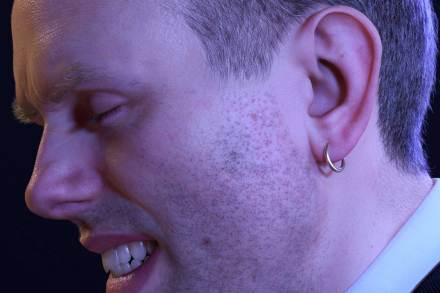
John Patrick Higgins is unhappy about the state of his mouth. His teeth resemble ‘broken biscuits’, a ‘pub piano’, ‘an abandoned quarry’ and ‘Neolithic stones. It’s all I can do to keep druids from camping out on my tongue each solstice.’ So he invests in a series of expensive interventions. He has seven gnashers removed, followed by three root canals, and acquires a natty set of dentures. They feel a bit weird at first (‘it’s like having an internal beak’), but ‘I look like the actor playing me in a Hallmark movie of my life.’ In this slim, refreshingly unpretentious memoir, Higgins, a middle-aged English filmmaker living in Belfast, chronicles his emotions as he undergoes successive rounds of treatment.

A thoroughly modern 18th-century heroine: The Future Future, by Adam Thirlwell, reviewed

From our UK edition

Adam Thirlwell’s latest novel begins in revolutionary France and chronicles the travails of its embattled celebrity heroine, Celine, who is being subjected to a campaign of malicious gossip about her sex life. She resolves to cultivate a coterie of influential writers to wrest back control of the narrative – cue earnest meditations on power, misogyny and the ability of the written word to shape reality. Meanwhile, she finds solace in female company, reflecting: In a society made of words and images and circulating and recirculating, all devoted to disinformation, it was very difficult to find any personal safety, and one minuscule form might just be this intense form of friendship between two women.

The dark side of racing: Kick the Latch, by Kathryn Scanlan, reviewed

From our UK edition

Kathryn Scanlan’s second novel Kick the Latch is adapted from the transcript of an interview with a family friend in her native Iowa. Its narrator, Sonia, looks back on her years as a racetrack hand in a series of vignettes. She recounts run-ins with violent men, a freak accident that put her in a coma, and interactions with assorted rural eccentrics, such as Bicycle Jenny, a notoriously pongy gardener who owns 70 chihuahuas, and Johnny Block, who keeps a pet crow and ‘some ferrets’. Animals ran amok on the trailer parks where she lived: ‘As soon as you stepped out your door the goose would come and – bam! – she’d nail you in the back of the leg... When I woke up, a goat was sat next to me, chewing on my sleeve.

Double trouble: August Blue, by Deborah Levy, reviewed

From our UK edition

The narrator-protagonist of Deborah Levy’s August Blue, an elite-level concert pianist called Elsa, is going through a difficult time. She recently walked off stage after messing up a Rachmaninoff recital in Vienna. More worryingly, she has just dyed her hair blue. At a market stall in Athens, she becomes entranced by a pair of novelty mechanical horses, but they’re snapped up by another customer with whom she becomes fixated. Elsa keeps noticing ‘the horse woman’ out and about, and starts to think of her as ‘a sort of psychic double’. She is deeply impressed when she sees her smoking a large cigar: ‘It was a poke at life. A provocation. She had attitude and confidence.

All about my mother: Édouard Louis’s latest family saga

From our UK edition

Shunned by his father and his peers because of his homosexuality, Édouard Louis (born Eddy Bellegueule in 1992) left his village in rural Normandy and moved to Paris, becoming the first member of his family to attend university. By his mid-twenties he had published three well-received autobiographical novels: about working-class machismo (The End of Eddy), his experience of sexual assault (A History of Violence) and the condition of the French welfare state (Who Killed My Father). In his latest book he turns the spotlight on his mother, revisiting ‘the succession of accidents that made up her life’. Monique Bellegueule had ambitions to train as a chef, but was derailed by teenage pregnancies and terrible relationships.

A universal language will always be an unattainable dream

From our UK edition

The comedian Sacha Baron Cohen, in his stage persona as the dim-witted interviewer Ali G, once asked Noam Chomsky if a person could simply invent a new language from scratch. The renowned linguist gave him short shrift: ‘You can do it if you like and nobody would pay the slightest attention to you because it would just be a waste of time.’ Throughout history, however, a motley array of eccentrics has done just this, and received a fair bit of attention.

Short and sweet: Xstabeth, by David Keenan, reviewed

From our UK edition

Aneliya, the Russian narrator of David Keenan’s enjoyably weird new novel, is worried about her dad. Tomasz’s modest music career is coming to an end; his wife left him years ago, and he lives in the shadow of his louche and much more successful best friend Jaco. ‘The famouser musician’ pulls some strings to get Tomasz one last gig, as a favour to Aneliya, with whom he is having a secret affair. Tomasz has a stinker in front of 20 people. An audio sample from his performance subsequently turns up on an obscure LP released under the mysterious moniker Xstabeth. The track is hailed in underground circles as a work of avant-garde genius. Duly heartened, father and daughter travel to St Andrews to watch some golf.

False pretences: No-Signal Area, by Robert Perisic, reviewed

From our UK edition

A journalist and poet based in Zagreb, Robert Perišic was in his early twenties when the socialist federal republic of Yugoslavia disintegrated in 1992. Croatia’s transition to capitalism inspired his 2007 novel Our Man in Iraq. Now No-Signal Area explores the search for meaning in a supposedly post-ideological world. Set in a fictitious town in a war-ravaged nation somewhere ‘between the East and the West’, it tells of two entrepreneurial cousins, Nikola and Oleg, who reopen a communist-era factory in order to produce an obsolete turbine from the 1980s, with the intention of selling it on the black market to an Arab dictator.

Adam Mars-Jones’s protagonist has disarmingly low self-esteem: Box Hill reviewed

From our UK edition

Short, fat and shy, the protagonist of Adam Mars-Jones’s latest novel doesn’t have much going for him; even his name — Colin — is unprepossessing. He’s just 18 when he meets an older man called Ray, who is the ringleader of a biker gang in deepest Surrey. The year is 1975 and the bikers are part of a burgeoning postwar subculture of overtly butch gay men. Enthralled by Ray’s rugged good looks and easy grace (‘the only person I’ve ever seen who could turn a page wearing leather gloves and not fumble’), Colin becomes his live-in lover and a kind of mascot-cum-communal sex object for his pals, attending their regular poker nights in the capacity of obliging receptacle.

Bawdy, it’s not — Strange Antics: A cultural history of seduction

From our UK edition

Anyone reading Clement Knox’s history of seduction for salacious entertainment is likely to be disappointed: it contains no mention of oysters or Barry White records, and only a very light sprinkling of bawdiness. Strange Antics is a serious and sober tome about libertinism and its consequences, thank you very much. Readers expecting ‘history’, in the conventional sense, will likewise be frustrated: though it dips into legal and political history, this book is principally composed of literary biography and criticism, as Knox draws on the lives of various cultural historical figures and several canonical novels to explore his theme — a format that has lately become something of a go-to for debut non-fiction authors.

Crime and puzzlement

From our UK edition

Tony White’s latest novel begins for all the world like a police procedural, following the delightfully named sleuth Rex King as he investigates the grisly murder of man in a Covent Garden theatre. Rex, who has a penchant for fish and chips, laments the tedium of police bureaucracy and frets over a cover-up relating to a death in custody.There is collegial bonhomie, conspiratorial winking and sardonic banter aplenty. The novel then cuts away to an altogether different setting. In an obscure rural enclave in southern France in the mid-1980s, a young Englishman on his gap-year fraternises with a gang of charismatic dissidents in a bohemian commune.

Dave Eggers’s satire on Trump is somewhat heavy-handed: The Captain and the Glory reviewed

From our UK edition

A feckless moron is appointed to the captaincy of a ship, despite having no nautical experience. The Captain has a propensity to grope women and brag about not paying his taxes, and in his younger days he ‘had hidden in the bowels of the ship looking at pornographic magazines’ while his peers went to war. Once in post he fires the entire navigational staff and has the ship’s manuals jettisoned. A mysterious voice in a vent urges him to take ever more drastic measures against the ship’s population, whereupon a number of ‘swarthy’ passengers are thrown overboard to drown. Utilities and basic freedoms are privatised as the Glory descends into despotism.

Homage to catatonia

From our UK edition

As a boy Josh Cohen was passive, dopey and given to daydreaming. Now a practising psychoanalyst and a professor of literature with several books to his name, he retains ‘a long and deep intimacy with lassitude and aimlessness’. Cohen believes the special affection reserved for pop culture’s fictional slackers, slobs and reverists — think Jeff Lebowski, Homer Simpson, Snoopy — suggests that humans are fundamentally inclined towards idleness: people are ‘as much given to saying no as to saying yes, as much to rest as to motion, as much to being as to doing’. Not Working: Why We Have to Stop explores the relationship between inertia and the life of the mind by revisiting the lives and works of several giants from cultural history.

Sleeplesss nights and endless daze

From our UK edition

A genre of memoir currently in vogue involves entwining the author’s personal story with the cultural history of a given phenomenon, so that each may illuminate the other. Mellow introspection and anecdotal whimsy are spliced with tidbits of cultural criticism; the prose is meandering and associative rather than linearly expository. This format can feel a little gimmicky, but in the case of Marina Benjamin’s Insomnia it is apt: the book’s digressive expansiveness and collage-like structure evoke the feeling of lying in bed at night with your thoughts racing – the freewheeling, seemingly autonomous tripping through utter banality, the night-time regurgitation of daytime crud...

A very bourgeois revolution

From our UK edition

The narrator-protagonist of D.J. Taylor’s new novel, a mild-mannered Oxford graduate named Nick Du Pont, has resisted the lure of a proper career to become a publicist for a flower-pop group called the Helium Kids. The story begins in 1964, with Nick and the band in the United States. It’s the year of the Civil Rights Act, and the Helium Kids’ entire tour is set in venues along the Mason–Dixon Line, prompting Nick to reflect on the ‘terrible, pulled-both-ways wonder of 1960s America’. He returns to the UK to find that here, too, the old world is giving way to the new: ‘There are houses going up all over the west side of Norwich. The girls stop being called Kate and Margaret and Mary and start being called Samantha and Jennifer and Suzanne.

Calling people out for ‘gaslighting’ is just a lazy but effective way of shutting down dissent

From our UK edition

Last month, the American short story writer Carmen Maria Machado spoke out about a disappointing interaction she had once had with the author Junot Diaz. She took Diaz to task regarding his male protagonists’ relationships with women, and was met with a ‘a blast of misogynist rage’. Diaz ‘went off’ at her ‘for twenty minutes’, ‘raised his voice’, ‘became enraged’ and ‘slid into bullying and misogyny’. An audio recording of the Q&A subsequently emerged online which appeared to contradict her account: Diaz, it seems, had been robust but courteous. Last week, Machado published a series of tweets complaining that social media users’ comments about the recording made her feel ‘gaslit and insane’.

Soft dystopias

From our UK edition

Science fiction, as any enthusiast will tell you, is not just about gazing into the future but also about illuminating the present. In a new collection of short stories by the veteran sf author M. John Harrison, lurid visions of aliens and spaceships play second fiddle to melancholic snapshots of plodding suburbia. Many of the tales in You Should Come With Me Now (Comma Press, £9.99) are set in leafy south-west London, amid the banality of modest affluence: from Putney to Chiswick, Twickenham and St Margarets, and along ‘the endless heartbreaking sweep of the A3 to the sea’. In ‘Cicisbeo’, a husband ensconces himself in his loft, and will only communicate with his wife via notes. ‘You found people like Tim all over London,’ the narrator explains.

Folk-tale redux

From our UK edition

Daniel and his big sister, Cathy, do not go to school. They live with their father, a gargantuan former prizefighter, eking out an autarkic existence as squatters on land belonging to the unscrupulous Mr Price; on a typical day they are engaged in woodwork, plucking mallards or tickling trout. Price’s personal fiefdom operates outside the law of the land, with violent henchmen enforcing his will. The children’s father had once worked as a fixer for him before turning renegade, rallying Price’s exploited workers and tenants into collective action to improve their lot. Price’s vendetta against him is pursued with icy determination across the pages of Fiona Mozley’s debut novel: ‘He must return to the fold.

Man Booker Prize 2017: Fiona Mozley’s debut novel is an old-fashioned portrayal of gender privilege

From our UK edition

Elmet by Fiona Mozley John Murray, £10.99, pp. 311 Daniel and his big sister, Cathy, do not go to school. They live with their father, a gargantuan former prizefighter, eking out an autarkic existence as squatters on land belonging to the unscrupulous Mr Price; on a typical day they are engaged in woodwork, plucking mallards or tickling trout. Price’s personal fiefdom operates outside the law of the land, with violent henchmen enforcing his will. The children’s father had once worked as a fixer for him before turning renegade, rallying Price’s exploited workers and tenants into collective action to improve their lot.