More from Books

What’s to become of Pedro Friedeberg’s letters?

The year 2015 has been designated one of Anglo-Mexican amity, with celebrations planned in both countries by both governments. But it looks as though one name will be missing from the list: Pedro Friedeberg’s. ‘Who?’ you may ask. Well, in 1982 I was in Mexico City to interview Gabriel García Márquez after he’d won the Nobel Prize for Literature. At a party given by a Mexican art-collector, I noticed several zany pictures on the wall. ‘They’re all by Pedro Friedeberg, my favourite Mexican artist,’ said the collector. I stared at one large framed square after another, at pictures in which the Old World and the New seemed conjoined in a frantic, electrified marriage. The following week the Mexican currency collapsed.

Just sign here…

This being the 800th anniversary of the signing of Magna Carta, it is not surprising that there should be two new biographies of King John; not surprising either that one should be billed as ‘The Making of a Tyrant’, the other as a story of ‘Treachery’ and ‘Tyranny’. King John has long been regarded as the worst English king: cruel, deceitful, avaricious, untrustworthy, incapable and cowardly. For some of us he remains indelibly the despicable younger brother of Richard the Lionheart, as so memorably portrayed by Claude Rains in the irresistible swashbuckling Errol Flynn movie The Adventures of Robin Hood.

The mask of death

Remember Ebola? It killed more than 8,000 people last year — before we were all Charlie — with a quarter as many again dying since January. Almost all the deaths have occurred in the war-weakened west African states of Guinea, Liberia and Sierra Leone; no licensed drug or vaccine yet exists for a virus that claimed its first victim almost 40 years ago in Zaire, now the Democratic Republic of Congo. The spread of that maiden epidemic northwards over the border with Sudan is the basis for Amir Tag Elsir’s punchy short novel, Ebola ’76, originally published three years ago and now translated with fluency and keen timing by two young Arabists, in a fetching edition from a small London outfit focused on African and Middle Eastern subjects.

Too Many Poets

Too many poets pack a line with thought But melody refuses to take wing. It’s not that meaning has been dearly bought: It has been stifled, by a hankering For portent, as if music meant too much. Sidney called this a want of inward touch. True poets should walk singing as they weep, As Arnaut Daniel once epitomised; But nothing written will be worth its keep Composed by one who has not realised This to be true, and tested his own song On others, seeing if they listen long Or turn away. Verse is a public act To that extent at least. As cruel as love, The wished-for gift declines to be a fact Except for the elect. The gods above Loll on their clouds and lazily look down To choose who gets the laurels of renown Even if deaf.

Attack of the night witches

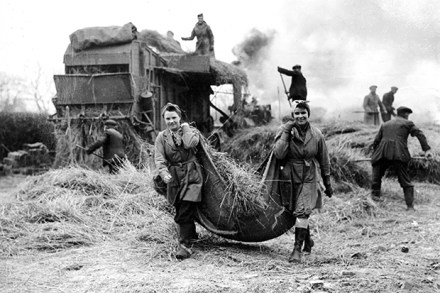
The name Lyuba Vinogradova may not ring any bells, but her ferrety eye for spotting a telling detail may already have impressed you. As Antony Beevor generously acknowledges in his introduction to this book, her work as his researcher in various archives played an important role in the creation of his triumphant Russian histories; she has also assisted Simon Sebag Montefiore and Max Hastings, among others. Here she brings to light the fascinating story of the world’s first and only all-female aviation regiments. As German troops advanced towards Moscow in 1941, the celebrated aviatrix Marina Raskova determined to form three ‘women’s regiments’: fighters, night bombers and long-distance bombers.

Even worms and vampire bats do it

I used to think we had five senses — sight, hearing, taste, smell and touch. And I used to think I knew how they worked. Using specialised instruments, such as eyes, ears and fingertips, they gave us information about the outside world. I imagined that the eye saw things, and then told the brain what those things looked like. I imagined that the fingertips touched things, and then told the brain what those things felt like. But now, every time I look at a book on neuroscience, I see that this nice cosy picture is absolutely wrong. Before I continue with this line of thought, let me say that this book is about the sense of touch, it’s by a professor of neuroscience at the Johns Hopkins School of Medicine, and it’s excellent.

The lure of fool’s gold

In 2008, the price of gold lofted above $1,000 an ounce for the first time in history, inspiring a rush of small-scale panners to head for the diggings with hope in their hearts. As the price of the metal fell and rose again — it nearly touched $2,000 an ounce in 2011 — journalist Steve Boggan contracted a touch of gold fever himself. He set off for California to find out who these chancers were. And to find some gold. I’ve taken Route 49 through inland California — Coloma to Sonora. The largely empty highway, which slices through heartbreaking landscape, is named of course after the fabled ‘Forty-niners’, and you can still smell, in those small towns with their jails and saloons and crummy hotels, the romance of possibility, the human capability to bet against all odds.

Scabrous lyricism

Irvine Welsh, I think it’s safe to say, is not a writer who’s mellowing with age. His latest book sees the return of ‘Juice’ Terry Lawson from the novel Glue and the short story ‘I Am Miami’ — now an Edinburgh taxi-driver in his mid-forties but still, in the face of some competition, possibly the most priapic character Welsh has ever created. With a penis he understandably nicknames ‘Auld Faithful’ and an unshakeable faith in the power of porridge (‘Complex carbs: set ye up fir a day’s shaggin’), Terry begins his latest adventures by pulling a grieving relative at a funeral — and, on the way home afterwards, two young American tourists.

Daring to be a Daniel

As I swink in the field of Thatcher studies, this book brings refreshment. It is a welcome and rare. Far too many writers attitudinise about Margaret Thatcher (for and against) rather than studying her. I doubt the author likes Thatcher much, but all the more credit to her that she makes a fair-minded effort to understand what she believed about God, and how she succeeded and failed in applying her beliefs. Not all who knew Mrs Thatcher agree that she was religious. In a way, they are right. She was not churchy or denominational, which is good. She was not sacramental (she once told me that her twins were baptised but ‘didn’t have the water’) or spiritual, which is not so good. But Denis thought she had a serious Christian faith, and I think he would know.

Early Christian alms race

Peter Brown’s explorations of the mindsets of late antiquity have been educating us for nearly half a century, ever since his great life of St Augustine in 1967. His latest book, relatively short in volume but very wide in scope, explores Christian attitudes to the afterlife, from the time of Cyprian of Carthage (martyred in 258) to that of Julian, Bishop of Toledo in the late seventh century. Julian put together an anthology called the Prognosticon Futuri Saeculi. He viewed his book as a compilation of the shared wisdom of Christianity. What in fact he demonstrated, in this ‘futurology of the Christian soul’ as Brown calls it, was the extreme variety of viewpoints over the previous 400-odd years. One would expect a difference over nearly half a millennium.

Some watcher of the skies

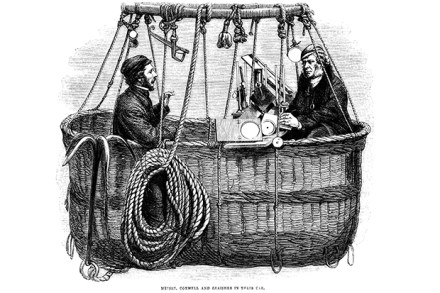
We live in an age of astronomical marvels. Last year Europe’s Rosetta spacecraft made a daring rendezvous with the comet Churyumov-Gerasimenko, revealing a bizarre double-lobed mountain of ice and rock with landscapes of vertiginous crags and ashen scree slopes. In our image-saturated age it’s easy to forget that such views are only possible through the intermediary of sophisticated technology: cameras and computers and the spacecraft that carry them halfway across the solar system. And yet this is nothing new. Ever since the Italian mathematician Galileo Galilei first turned his telescope to the heavens in the autumn of 1609, advances in technology and great strides in knowledge have gone hand in hand.

The self-taught maritime artist who transcends ‘naïve’ cliché

In the manner of Richard Holmes’s Footsteps, Julia Blackburn’s story of John Craske is as much autobiography as biography, as much about the hunt for information as the processed results of the search. The facts of John Craske’s life are briefly told: born in Norfolk in 1881 into a fishing family, he suffered some sort of mental and physical breakdown while training with the army in 1917 and for the remaining 25 or so years of his life dodged in and out of invalidism, sometimes bedridden for long periods, sometimes out fishing with his brothers, sometimes working as a fish merchant and perpetually supported and nursed by his devoted wife, Laura.

Justin Cartwright on redheads, anti-Semitism and the betrayal of Christ

Peter Stanford is a writer on religious and ethical matters. He was for four years editor of the Catholic Herald. Writing Judas: The Troubling History of the Renegade Apostle must have been a difficult task because there are no facts. Judas may quite possibly never have existed at all, and if he did, the Judas kiss may not have happened. Also, he may not have hanged himself. This is a fascinating story of febrile myth-making over two millennia, with very little historical fact. Stanford starts his pursuit of Judas with a visit to gloomy Hakeldama in Jerusalem, the place where Judas is traditionally said to have hanged himself — if he did hang himself.

Melissa Kite comes out fighting. Again

Madison Flight is a divorce lawyer, nicknamed ‘the Chair-Scraper’ for the number of times she leaps to her feet arguing in court. She has been contrary since birth, putting her mother through six days of labour before eventually being pulled out by forceps. ‘Is she saying no?’ asks the doctor, perplexed by the distinctive ‘Naaaaaaaaah!’ sound of her new-born wail. Madison’s life begins with her voicing dissent and argument fills every moment of her adult life.

The secret life of the short story

The short story likes to play the underdog. Famously unfavoured by publishers, it has none of the commercial clout of the novel. Denying itself the luxury of length, it is a martyr to the cause of shortness. When the short story writer Alice Munro was awarded the 2013 Nobel prize for literature, she seemed to personify the supposed modesty of her craft. With the blessing of the Swedish Academy, the short story had finally gained the status of a standalone art form: no longer, to quote Munro, ‘just something you played around with until you got a novel’. All this modesty seems at odds with the idea of an ‘epiphany’ — a device associated with the stories of Joyce, and the hallmark of two new collections by D.J. Taylor and Salley Vickers.

When Rex met Edith: a meeting of minds in interwar England

Rex Whistler — this book’s ‘bright young thing’ — was an artist of the 1920s and 1930s, and Edith Olivier, the ‘bluestocking’, was a novelist. They both deserve to be more famous than they are, and Anna Thomasson’s absorbing joint biography will doubtless make them so. They met through Stephen Tennant in 1924, when Olivier was 51 and Whistler was a 19-year-old student at what he called ‘the darling Slade’. She was snobbish and he was talented; liking one another from the start, they bonded over hair. Once Rex persuaded Edith to exchange her spinsterish bun for a ‘bingle’ — a daring combination of a shingle and a bob — she never looked back. Suitably attired, Olivier invited Whistler to her home, the Daye House in the grounds of Wilton.

Ghost Hands

Sant’Apollinaire Nuovo, Ravenna Your hands brush marble, feel impelled   To touch where crisp cold tesserae    Compose a fine array Of arches that once held   A gallery of courtiers with gifts they gave A throne in mosaic palace down a long cool nave.   Now strung between the arches like a tapestry   Hang folds that robbed Theoderic of his majesty. Yes, it was curtains for him and his court,   Walls cleansed of every sign That Arian’s heresy was taught   Here.