More from Books

The magic of bookshops

It is not uncommon for writers to be obsessed by bookshops. Some even find their writing feet through loving a particular bookshop and developing a habit, which helps to form the writers they become. And often they end up in a rage with the common run of bookshops. Why would they not? It is, or used to be, a numbers game, and most bookshops fail to stock most writers. But in recent years online outlets such as Amazon have changed the stocking (and the hating) game. Since proper bookshops became an endangered species, a use-them-or-lose-them energy pervades the bookish classes. It is a form of virtue signalling to go to your local, if you have one, order in what they haven’t got and pay more than you would online.

Bolsheviks on board

Full allowance must be made for the desperate tasks to which the German war leaders were already committed… Nevertheless it was with a sense of awe that they turned upon Russia the most grisly of weapons. They transported Lenin in a sealed truck like a plague bacillus from Switzerland to Russia. As so often, Churchill has the best lines. Here he is about one of the most famous episodes in European history: the safe passage given to Lenin by a Germany desperate for victory in the first world war. As long as German high command could dream up ways to eliminate the threat from either the West or East, there was hope it would not suffer defeat. Lenin, as Churchill wrote, was imperial Russia’s ‘Vengeance’.

More sinned against than sinning

The 55-year-old ’flu-ridden John Charles Wallop, 3rd Earl of Portsmouth, his feet in a basin of warm water, shivered in the dock with fever but also with fear. Would the jury, assembled in 1823 in London’s jam-packed Freemason’s Hall at the end of an unpredecentally sensational two-week trial, find him eccentric, delusional, simple-minded or, instead, stark raving mad? Elizabeth Foyster, a historian and senior lecturer at Clare College, Cambridge, was alerted to this enthralling, almost unbelievable true story with the caveat that the vastness of the material in Lambeth Palace archives concerning a scarcely remembered trial of a hugely wealthy, relatively obscure aristocrat had deterred anyone else from attempting to make sense of it.

Derring-do in the desert

The SAS was the first unit to be granted regimental status for generations. Its chief aim was to damage the enemy from behind their lines in the North African desert. It was an entirely independent unit, not answerable to any superior command and therefore anathema to the regular army mind. Its creator, David Stirling, had a record of complete allergy to discipline or serious work either at school at Ampleforth or later, briefly, at Cambridge, where the Master of his college sent him down after showing him a list of 28 transgressions and asking him to choose the three which ‘would be the least offensive to his mother’.

Over hill and dale

When it comes to speaking of foreign affairs, Rory Stewart is one of the few MPs who does not peddle bland abstractions. Many of his parliamentary colleagues inhabit a blah-blah land where terms such as ‘peace process’ and ‘international community’ have meaning. An upbringing in the Far East, where his father was a diplomat, as well as years spent in Iraq and Afghanistan, have given Stewart direct experience not only of nations but of town quarters, villages and individuals. Walking was his preferred method in Afghanistan, where he tramped across the country with a dog and a Punjabi fighting stick. The dog couldn’t keep up and died, but here for his latest tramp the Punjabi dang comes out again.

Jolly good fellows

‘Leonard Michaels (1933–2003) was one of the most admired and influential American writers of the last half century,’ states the blurb on this reissue of the author’s first and penultimate novel, originally published in the US in 1978. Admired and influential Michaels may have been, but that was largely in his homeland and then as an essayist and author of short stories, rather than as a novelist. The Men’s Club was not published in the UK until 1981 (by Jonathan Cape) and is only now, 35 years later, being made available in paperback by Daunt Books in the category of ‘lost classics’.

A puzzling phenomenon

Everyone has played it, or one of its manifold variations and rip-offs. Blocks of different shapes fall from the sky; you have to rotate and shunt them around so they fit perfectly together at the bottom, and then that horizontal line of blocks vanishes. This is Tetris, and it was created in 1984 by a Soviet mathematician called Alexei Pajitnov. But how it came to the West is a remarkably complicated cloak-and-dagger story, here given its first book-length treatment. The narrative opens with all the bad bravado of a Dan Brown novel, as one of the several businessmen chasing the rights to the game flies into Moscow for a meeting with Elorg, a department of the Soviet trade ministry.

Nazis and narcotics

Norman Ohler is rather hard on the Nazis, for compared to what our little group got up to in the late 1960s and 1970s, they were shrinking violets in the drugs department. We smoked cannabis, ate opium and sometimes took strong LSD; lines of uncertain content went up nostrils; and we swallowed countless uppers (speed) and downers (tranquillisers, sleepers for looning on). Speed was amphetamine sulphate. Benzedrine, Dexedrine, Methedrine were the three original brands, in rising strength. Soon there were many other names, including slang: Desoxyn, Durophet, Durophet-M (speed with Mandrax), French Blues, Purple Hearts, Black Bombers. Many were prescribed by doctors who didn’t regard them as outrageously dangerous.

Lessons in sex

Helen Gurley Brown’s internationally influential career, as the author of Sex and the Single Girl and editor of Cosmopolitan, is revealed in this intimate biography in 50 shades of pink. ‘Let it be understood at the outset,’ writes Gerri Hirshey, an American freelance journalist for many upmarket periodicals: Sex has imbued the soft core, hard times and glory days of this story — sex surrendered, sex wielded, lavished and revelled in, sex merely endured and sometimes coolly transactional, sex reimagined, promised and packaged on glossy magazine covers for global dissemination... Hirshey tells all about Helen’s life, every nook and cranny, from her childhood poverty in hillbilly Arkansas, steeply ascendant to the pizzazz of A-list Manhattan.

Too much glam

This mighty volume begs a question, although it doesn’t ask it, let alone answer it. Does anyone in the known universe really want to read 650 pages about glam rock? Simon Reynolds must do, because that’s how much he has written on the subject. All writers, if we are to be honest, write books because they themselves wish to read them. But what if you are the only person who wants to read it? It scarcely bears thinking about. Glam rock, as older readers may remember, was a phase of particularly visual and mascara-inflected pop that dominated Top of the Pops for a couple of years in the early 1970s. Before that, we had chug-a-chug blues rock and earnest singer-songwriters, and everyone had hair down to here.

The fallen Angel

Ashraf Marwan was an Egyptian-born businessman, a son-in-law to Nasser and a political high-flyer in the administration of Sadat, who fell off the balcony of his flat in Carlton House Terrace, central London, in June 2007. His death was watched with incredulity by business colleagues assembled in an office across the road, who recalled seeing two burly, possibly Middle-eastern figures framed in the tableau. Investigations were inconclusive. Marwan, then in his sixties, wasn’t well, but hadn’t seemed suicidal. On the other hand, he had been afraid, and with good reason, because plenty of people wanted him dead. Marwan had been a spy. That seems to be the most concrete element about his story.

Knight’s tale

In The Cousins’ War (1999), the Republican political strategist Kevin Phillips argued that three ‘civil wars’ had defined politics in the English-speaking world: the English Civil War, the American Revolution and the American Civil War. The ideological battle lines of 1641 recurred in 1776 and 1865, and not just because the Sons of Liberty and the Yankee industrialists were frequently descended from English Puritans. Broadly, all three revolts pitted Protestants against Catholics, reform against tradition, and yeomen against landowners. Civil war cuts across geography as well as families: Phillips compared pre-revolutionary America to the Balkans.

Frankly impenetrable

One day in April 1969 Theodor Adorno began teaching a new course entitled ‘An Introduction to Dialectical Thinking’. Feel free, the sociologist-cum-philosopher told the packed hall at Frankfurt University, to ask questions as I go. Two of his charges did so immediately. When was Adorno going to apologise for having set the cops on those campus protesters three months earlier? Before Adorno could reply, another student scrawled ‘If Adorno is left in peace, capitalism will never cease’ on the blackboard. At which point the whole class shrieked ‘Down with the informer!’ Then a group of women surrounded Adorno, bared their breasts, and showered him with rose petals. Grabbing his hat and coat, the hapless prof ran.

Eden’s folly

Until it was overtaken by the still more disastrous debacle in Iraq, the Suez Crisis of 1956 was widely judged to be Britain’s worst postwar foreign blunder. Not only, to use Talleyrand’s phrase, a crime, but an error of monumental proportions. The deceitful plot by Britain and France, in secret collusion with Israel, to invade Egypt disguised as peacemakers; restore the recently nationalised Suez Canal to western control; and overthrow Egypt’s charismatic nationalist leader Gamal Abdel Nasser into the bargain, went horribly and fatally wrong. Britain’s humiliating retreat, forced by a disapproving United States, marked the effective end of both the British and French empires, and raised the US to undisputed hegemony over the non-communist world.

All work, many plays

‘Krapping away here to no little avail,’ writes Beckett to the actor Patrick Magee in September 1969. To ‘no little avail’, note, not to ‘little or no’: there is a difference. It’s the difference that Beckett makes — I can’t go on, I’ll go on, and all that. This final volume of Beckett’s letters contains much krapping away to both no little and little or no avail. ‘Perhaps my best years are gone,’ remarks Krapp in the play, ‘But I wouldn’t want them back.

Free love’s fallout

Ann Patchett’s new novel is an American family saga involving six children, 50 years and too many coincidences to count. The premise is straight out of John Updike — a writer she admires — but her eye is on free love’s fallout, not its thrills. As the title hints, she’s interested in the larger family units that itchy-footed spouse-swappers inadvertently create when they do the dirty on their kin. It opens with Bert, a father of three with another baby on the way, sneaking a kiss from Beverly, a married woman hosting a christening party for her second child, Frances.

One dead in Ohio

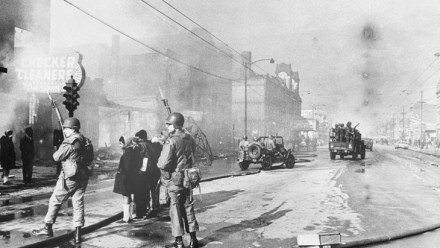
For the first time in living memory, a presidential candidate for a major party has received the enthusiastic endorsement of the Ku Klux Klan; one prominent former member of that fraternity — a Grand Wizard, I think: or was it a Grand Dragon? — is running for the US Senate. Members of the Black Lives Matter movement did not riot in Cleveland, but that is only because they were nearly always surrounded by troops of mounted policemen. It shouldn’t be surprising that some of us are looking back with hope and trepidation at the American Civil Rights movement of the 1960s. One of the most remarkable books the movement produced is this 1973 family memoir, newly reissued with an afterword by the author.

The art of listening

Rachel Cusk is a writer who provokes strong reactions in her readers, and her critical reputation has swung wildly in a short space of time. Many, who not long ago were offended by the overflowing emotion of her memoirs of motherhood and divorce, are now full of praise for her current trilogy of novels, admiring particularly their restraint. What’s interesting about this turnaround is that while Cusk’s mode of presentation has changed, her subjects — the uncertain nature of reality, the relation of the individual to society, and the calibration of power — have not. Moreover, switching her focus from an outraged, opinionated woman to a recalcitrant, enigmatic one, has intensified her writing and clarified her project.