Ursula Buchan

Svitlana Morenets, Michael Simmons, Ursula Buchan, Igor Toronyi-Lalic, Richard Morris & Mark Mason

From our UK edition

37 min listen

On this week’s Spectator Out Loud: Svitlana Morenets says that Trump has given Zelensky cause for hope; Michael Simmons looks at how the American healthcare system is keeping the NHS afloat; Ursula Buchan explains how the Spectator shaped John Buchan; Igor Toronyi-Lalic argues that art is no place for moralising, as he reviews Rosanna McLaughlin; Richard Morris reveals how to access the many treasures locked away in private homes; and, Mark Mason provides his notes on bank holidays. Produced and presented by Patrick Gibbons.


How The Spectator shaped John Buchan

From our UK edition

Amid the hullabaloo attending the 150th anniversary of the birth of John Buchan on 26 August – the walks and talks, the screenings of The 39 Steps, the think pieces in elevated publications, the new collection of essays – one facet of his extraordinary life is unlikely to get much of an airing. I am thinking of his work for The Spectator, little known now, yet crucial to his development as a writer. In early 1900, The Spectator was enjoying success as a readable Liberal Unionist, free trade, anti-Home Rule, political and literary magazine, popular with educated opinion-formers of a mildly conservative bent.

Ian Thomson, Patrick Kidd, Mike Cormack, Ursula Buchan and Richard Bratby

From our UK edition

36 min listen

On this week’s Spectator Out Loud: Ian Thomson on what the destruction of the Hotel Oloffson means for Haiti (00:54); Patrick Kidd analyses Donald Trump and the art of golf diplomacy (06:43); Mike Cormack reviews Irvine Welsh’s Men In Love (16:49); Ursula Buchan provides her notes on the Palm House at Kew (20:38); and, Richard Bratby argues that Johann Strauss deserves better than to be the victim of snobbery – plus listen to the end for an extract from Strauss’s Emperor Waltz (24:24).  Produced and presented by Patrick Gibbons.

The secrets of the Palm House at Kew

From our UK edition

The news that the Palm House at the Royal Botanic Gardens, Kew, will begin a £60 million, five-year renovation in 2027 brought back to me a slew of memories from 1978, when I worked there for several months. The extraordinary fame and innovative nature of this unique Victorian building, with its curvilinear, cruciform shape, designed by Decimus Burton and constructed by Richard Turner, seemed to confer a kind of grandeur and significance on an otherwise pretty lowly and scruffy horticultural student. The special treat was the periodic ‘weekend duty’ when, after turning the enormous iron key in the door at eight o’clock on a weekend morning, for two blissful hours I had the entire building to myself, before the visitors began to wander in.

Blooming marvellous: the year’s best gardening books

From our UK edition

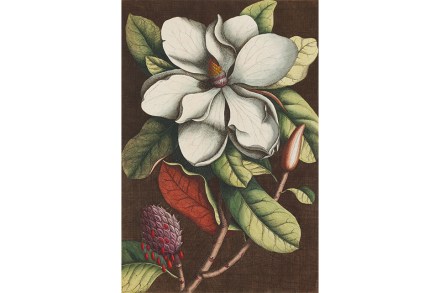
I am an absolute sucker for a handsome reproduction of a rare and highly illustrated natural history, preferably more than two centuries old. This may possibly be a niche interest, but Catesby’s Natural History was pronounced a wonder when it was first published and is a wonder still. Mark Catesby was ‘a procurer of plants’, sponsored by a group of rich, curious patrons, including William Sherard and Sir Hans Sloane, to explore and record the flora and fauna of the most southern of the Thirteen Colonies – the Carolinas and Florida, as well as the Bahamas Islands. He made several perilous trips in the 1720s, sketching his subjects live, and completing paintings in England. He finally published his text and 220 hand-coloured plates in 1747.

What can save Britain’s ash trees?

From our UK edition

The next time you drive or walk down a country road, you may well notice that something is not quite right. Look around and you might see that tall ash trees in the verge-side hedgerows are no longer as handsome, their leaves sparse and scattered, even brown and wilting, while naked branches point accusingly to the sky. A disaster is unfolding, which, on the face of it, seems hardly less serious than the one that hit the countryside in the early 1970s, after ‘Dutch’ elm disease was imported in timber from Canada and killed 30 million trees. This time, the victim is the European ash (Fraxinus excelsior). The disaster is plain, even to urban dwellers.

A walled garden in Suffolk yields up its secrets

From our UK edition

In the hot summer of 2020, during the Covid pandemic, Olivia Laing and her husband Ian moved from Cambridge to a beautiful Georgian house in a Suffolk village and began work on restoring the neglected, extensive walled garden behind it. She was vaguely aware that the garden had been owned and loved by the well-known garden designer and plantsman Mark Rumary, who had died in 2010. He had been the landscape director for the East Anglian nursery of Notcutts, and I remember him as a genial man overseeing extensive, award-winning tree and shrub exhibits at the Chelsea Flower Show in the 1980s. I once owned a copy of the Notcutts Book of Plants, written by him, which was an indispensable reference book for garden designers before the advent of the internet.

Magnolia will never go out of fashion

From our UK edition

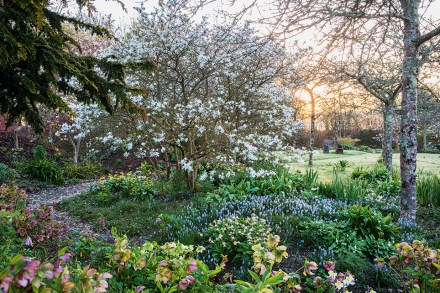
Last week’s news that a mature magnolia tree had been felled in a suburb of Poole, Dorset, because wood decay made it a threat to nearby houses, will have touched the hearts of gardeners everywhere. For, in the words of the plant collector E.H. Wilson, after whom Magnolia wilsonii is named, magnolias are ‘aristocrats of the garden’. This is scarcely hyperbole, since magnolias can trace their lineage back to the Pliocene epoch, and are famous for their noble stature, and beautiful, showy and often highly scented flowers.

The best of this year’s gardening books

From our UK edition

What makes a garden is an increasingly pressing question, in the light of what Jinny Blom, in her witty and wise What Makes a Garden: A Considered Approach to Garden Design (Frances Lincoln, £35), calls ‘hairshirt hubris’. By that she means the refusal of some gardeners to call any native plant a weed or any slug or aphid a pest. She wishes to inject a little sense into what has become an ill-tempered dialogue between ‘traditional gardeners’ and the self-deniers who cannot see gardens as anything but parcels of sacrosanct earth, in which any major intervention by a human is to be regretted. But to Blom, garden-making is one antidote to the modern curse of solipsism. ‘Gardens insist we care for them as much, or more, than ourselves.

Where to find the finest snowdrops 

From our UK edition

Who does not love a snowdrop? The pure white of their pendulous petals may be chilly, but who cares when they flower in the chilliest months, often on their own, or accompanied only by hellebores and aconites. I grow a number of snowdrop species and cultivated varieties, as well as unnamed seedlings that seem to appear out of nowhere, since these bulbs are relentlessly promiscuous. They pop up especially in shady borders under deciduous shrubs or among evergreen and herbaceous perennials, and they are the best sight to greet me on my daily garden walks in January and February.  The word ‘galanthophile’ does not quite convey the fanaticism of the true snowdrop lover.

A choice of gardening books for Christmas

From our UK edition

Do you ever think about the ground beneath your feet? I do. Having read a number of popular science books on this most precious of natural resources, I am now obsessed. So much has recently been discovered about the invaluable symbiotic relationships that form between microbes, fungi and plant roots in the soil that it feels perverse to turn one’s head away. Lately, the book that has most influenced my thinking (perhaps because it is a rattling read) is Soil: The Incredible Story of What Keeps the Earth, and Us, Healthy by Matthew Evans (Murdoch Books, £14.99). It’s the work of a no-nonsense Australian farmer and former restaurant critic who has bothered to read the latest research. And what he writes should astonish every gardener.

Who needs a hosepipe? The watering cans worth investing in

From our UK edition

In the hot, dry summer of 1976, I was working as a gardening student at Arboretum Kalmthout in Belgium. The temperatures in July were frequently 40°C by lunchtime, so we worked in the early mornings and through the evenings. My job was to drive a tractor pulling a trailer, on to which were placed dustbins full of water drawn from a borehole. These were ferried around the grounds so we could water rare, precious and drought-hating rhododendron and tree species. The owners of the garden were white-faced with apprehension all that month but the stratagem worked and we saved the lot. Something of that anxiety comes back to me, for my garden is at risk of losing plants from drought. We have had a measly 0.

In defence of slugs: gastropods are seriously misunderstood

From our UK edition

Slugs and snails are the bane of every gardener who tries to grow strawberries, leafy and tuberous vegetables, flowering bulbs and soft-shooted perennials. But Britain’s gastropods are ‘misunderstood’, according to Dr Andrew Salisbury, principal entomologist at the Royal Horticultural Society, which announced this month that it will no longer class slugs and snails as ‘pests’. That is because – along with earthworms, springtails and woodlice – they clear up dead plant and animal matter in the garden and thus balance their perfidy with benevolence. I am no slug-hater. I find them more fascinating than repellent and am especially intrigued by the great grey slug and its un-usual mating habits (look it up).

Earthly paradises: the best of the year’s gardening books

From our UK edition

Important historic gardens fall into two main categories: those made by one person, whose vision has been carefully preserved down the years, sometimes for centuries, and those that are altered and developed by succeeding generations. Rousham, in Oxfordshire, is an example of the first and Bodnant, in the Conwy valley in north Wales, the second. Books on both have been published this year. Francis Hamel is an artist, whose studio is in an old stable close to ‘the big house’ at Rousham, which was built in 1635 by the Dormer family.

The perils of an autumn Chelsea Flower Show

From our UK edition

Once upon a time, the Royal Horticultural Society staged a Great Autumn Show every September in their two Horticultural Halls off Vincent Square in London. It was a fine mixture of colourful nursery trade exhibitions and fiercely-fought amateur competitions, involving fruits, flowers and glowing foliage (Who could forget the amusing annual battle between the Dukes of Marlborough and Devonshire - or rather their head gardeners - over the prize for the best bunch of glasshouse grapes?).

Try forest bathing – by day and night – to ward off depression

From our UK edition

Ever since a consensus emerged that trees and, by extension, their ecosystems, were both vastly interesting and badly threatened, great tottering logpiles of books about woods or individual tree species have seen the light of day. Of these books, one of the most influential has been The Hidden Life of Trees (2018), written by Peter Wohlleben, who for many years has looked after a forest in the Eifel mountains in Germany. I read that book with interest, and needed no persuading that woodland trees form, in effect, a community, both as a result of the scents they give off and the interactions between their roots underground.

Party time: what is the cost of freedom?

From our UK edition

34 min listen

How free are we after freedom day?(00:27) Also on the podcast: Why does it take hours to refuel your car in Lebanon?(10:19) and finally… Is British gardening wilting or blooming?(21:21) With The Spectator's economics editor Kate Andrews, Michael Kill, CEO of the Night Time Industries Association, journalists Paul Wood and Tala Ramadan, author James Bartholomew and gardener and writer Ursula Buchan.

Gardening books for Christmas — reviewed by Ursula Buchan

From our UK edition

Dan Pearson is one of the finest of all British garden designers, blessed with sensitivity, a wonderful eye, deep plant knowledge and a willingness to experiment. In Tokachi Millennium Forest: Pioneering a New Way of Gardening with Nature (Filbert, £40) he describes how a 400-hectare parcel of agricultural land and forest in the shadow of the Hidaka Mountains on Hokkaido has been returned to an augmented natural landscape, thanks to a newspaper magnate, Mitsushige Hayashi, with deep pockets and vaulting ambition, who bought it 30 years ago.

Thanks to Covid, village shows are withering away

From our UK edition

I measure out my summer in invitations to judge classes of flowers, fruit and vegetables at local village shows. The flower-show calendar is as changeless and as adamantine in its continuity as the high days and holy days of the Christian liturgical year. Or rather it was. In the past, as I have prepared to set out to one of these shows, armed with my RHS Horticultural Show Handbook, schedule of entry classes, tape measure (to assess the longest runner bean) and gardener’s knife (to cut into a beetroot’s bloody heart), I have sometimes thought how pleasant it would be to stay at home in my own garden, for judging is very precise and tiring work.

Gardening is a powerful antidote to grief, pain and loss

From our UK edition

Viewed from a purely private garden perspective, this has been a ver mirabilis. The blossom has been wonderful and long-lasting, the sun has shone on the daffodils and tulips, and there has been enough moisture in the ground for impressive growth in trees, shrubs and vegetables. Thanks to lockdown and all its confinements, I have enjoyed an intensity of engagement with my garden I’ve rarely experienced since the days when I was a young, mustard-keen apprentice gardener. I feel as if I have watched every leaf unfurl, every flower open, every bird swoop across the lawn. Spring gardening, with its pleasant, mindful monotony of pricking out seedlings and pulling up speedwell, has soothed my nerves, consoled my sadness, calmed my fears, and brought a welcome sense of proportion.