More from Books

Treacherous Old Father Thames

While its shape is famous — prominent on maps of London and Oxford — the Thames is ‘unmappable’, according to Diane Setterfield, because it not only ‘flows ever onwards, but is also seeping sideways, irrigating the land to one side and the other’. In Once Upon a River, she redefines the boundaries that separate land and water. The Thames ‘finds its way into wells and is drawn up to launder petticoats and to be boiled for tea’ and ‘from teapot and soup dish, it passes into mouths’. Setterfield places the Thames all around, underneath and inside her characters — it nourishes their crops but also destroys them; it hydrates people but drowns them. It’s an understatement to say that the river is a character in this novel.

A deadly box of chemicals

Do you remember the swine flu panic a decade ago? Jeremy Brown, the author of this book, describes it here. In March 2009, 60 people died in Mexico. The cause: a flu-type virus. The Mexican government ‘closed schools, banned public gatherings, and ordered troops to hand out face masks at subway stations’. This flu crossed the border into the United States. The media monitored the outbreak with grim enthusiasm. Soon, people in 74 countries were infected. The WHO ‘declared it a pandemic’. Or perhaps you don’t remember the swine flu panic of 2009. Not many people do. The main reason I do is that I met an epidemiologist on a train in March of that year; he was having the most intense week of his life.

Lies born from fantasy

What is the most repulsive sentence in English/American literature? Even as a 12-year-old American boy, I cringed when reading, in Ernest Hemingway’s For Whom the Bell Tolls: ‘But did thee feel the earth move?’ At school I bought the myth of Hemingway as the master craftsman of American letters, teaching us to keep our sentences short and our syllables few. At university, however, I was privileged to be taught by R.S.

How we lost to Big Brother

There is a trend in non-fiction — in fact my editor has been on to me about this lately — to reveal things. Apparently, readers like to feel they’ve got the inside track, even when there are no secrets to uncover. Perhaps this drove Yasha Levine to call his new book Surveillance Valley: The Secret Military History of the Internet. It promises to shine a light on the close and ongoing relationship between state surveillance and Silicon Valley. There are two problems with this. First, most of it is not secret. Second, I don’t think it’s right.

Another blessed Waugh memorial

Auberon Waugh was happy to admit that most journalism is merely tomorrow’s chip paper but, of all the journalists of his generation, his penny-a-line hackery seems most likely to endure. What made him so special? Like all great writers, it was a combination of style and substance. He had a lovely way with words — he could write a shopping list and make you want to read it — and his libertarian diatribes were wonderfully unorthodox, lambasting pompous humbugs on the left and on the right. Yes, he could be outrageous (and often gloriously rude), but even his most outlandish opinions contained a grain of truth. Above all, he was funny.

A never-ending mystery

In an age where ‘authenticity’ is prized above all things (even if what this actually means is that — like, say, Trump — you are just celebrated for being authentically narcissistic), it seems a rare kind of delight to investigate a spiritual/mystical philosophy of which it is airily claimed that: ‘It’s meaningless to speak of authenticity.’ Wow. Double-blink. Welcome to the curious but fascinating world of Harry Freedman’s Kabbalah: Secrecy, Scandal and the Soul, a cheerfully non-partisan, no-frills attempt at demystifying one of the world’s most mysterious, opaque and esoteric spiritual traditions. Yes. Kabbalah… or…um… Cabala. Freedman certainly has his work cut out here.

Life at the Globe | 17 January 2019

    IN ASSOCIATION WITH THE PRINCIPAL PARTNERS OF SHAKESPEARE’S GLOBE’S 2019 SUMMER SEASON One of the things about Shakespeare that always makes you marvel is how insistently he speaks to the present moment — any present moment you choose. Academic literary critics wince when you start bandying around phrases like ‘eternal truths’, so let’s just say Shakespeare has a way of chiming with current events. The Globe’s Richard II opens next month, the first in that chain of history plays that continues with Henry IV parts one and two and culminates with Henry V, all of which are part of the summer season.

The journalist as sleuth

Despite being well-travelled as the BBC’s world affairs editor, John Simpson doesn’t roam far from home in his spy thriller, Moscow, Midnight (John Murray, £20). Life and art intermingle, in both subject matter and character. The hero is named Jon Swift, a veteran journalist bristling under new media regimes. When government minister Patrick Macready is found dead — presumably from a solo sex game gone wrong — Swift takes it upon himself to clear up a few loose ends. Soon he’s under investigation himself, ostracised, and journeying to Moscow to work a connection to a number of Russians who have met similar ‘accidental’ fates. Swift is cynical, unreconstructed in his view of women, a bit snobbish at times.

Behind the top 20

This is a story of resurrection. A mere three decades ago, club football in England was a professional game largely and listlessly run by amateurs. Fans shuffled in decreasing numbers to obsolete stadia redolent of pie and pee. Lives were lost in the tragedies of Bradford, Hillsborough and Heysel. The sport was scarcely entertainment; it was certainly not a business. Yet today the Premier League is the world’s richest sporting brand. How this happened is a tale told with much verve and some wit by two experienced sports journalists.

The mask of death | 17 January 2019

Here is a novel set in the no man’s land between past and present, a fertile and constantly shifting territory whose precise boundaries are unique for each reader. Its author, Jeff Noon, is probably best known for his intellectually adventurous science fiction (his first novel, Vurt, won the Arthur C. Clarke award) and also, to readers of The Spectator, as a crime fiction reviewer. The labels are unfairly reductive, however, since his work has never slotted neatly into genre categories. On the face of it, Slow Motion Ghosts looks as if it might buck the trend and be Noon’s first straight crime novel (if such a thing exists). Set in 1981, in the aftermath of the Brixton riots, the plot centres on the ritual murder of a young musician named Brendan Clarke.

The human chimera – part lion, part goat

Richard Wrangham embraces controversy, and appears to enjoy munching apples from carts he upsets himself. While his new book seems to be the history of an amalgam of moral and political virtues and vices, its thesis is actually the large claim that these have evolved; and he has no compunction about writing that the foundation stone of good behaviour is the possibility of capital punishment (against it though he is in today’s world). It’s not just that the logic of his argument requires this hypothesis; he has found examples of premeditated (‘proactive’), co-operative (‘coalitionary’) killing in the Pleistocene record, providing an empirical basis for his claims about our evolution. Chimpanzees have (reactive) murderous rages.

A serious tease

Is there anything one can never laugh about? A question inevitably hanging over humour writing, it’s best answered by the masters of the genre who, rather than inventing jokes (a skill many possess), notice life’s winks and chuckles and tease them out of their surrounding matter, even if the latter happens to be of grave concern. Teffi was one of those writers. Born in 1872 in St Petersburg, by her early twenties Nadezhda Lokhvitskaya was a housewife with three children stranded in a provincial town; by her early thirties she was back in the capital, a literary celebrity writing for various publications under a snappy pseudonym, her witticisms quoted ‘in the streets, in trams, in clubs, in living rooms, at student gatherings’.

Music and revolt

On 13 August 1977, a demonstration by the National Front was routed in the streets of Lewisham by thousands of anti-fascist activists. The latter’s elation palled, however, when they saw the evening news frame the event as a battle between rival extremists. Among the critical voices were Labour’s deputy leader Michael Foot and the Daily Mirror, which branded the anti-fascists ‘as bad as the National Front’. The NF’s opponents learned a valuable lesson at remarkable speed. Just weeks later, they launched the Anti-Nazi League at the House of Commons, with Neil Kinnock and Peter Hain on the steering committee and a medley of celebrity supporters that included Iris Murdoch, Brian Clough, Melvyn Bragg, Dave Allen, Warren Mitchell and Prunella Scales.

Their finest hour

On 22 January last year, the entrance whiteboard at London Underground’s Dollis Hill carried a brief factual statement: On this day in history On the 22–23 January 1879 in Natal, South Africa, a small British garrison named Rorke’s Drift was attacked by 4,000 Zulu warriors. The garrison was successfully defended by just over 150 British and colonial troops. Following the battle, 11 men were awarded the Victoria Cross. A female passenger complained that it was ‘celebrating colonialism’. The board was wiped clean and a suitably opaque quote from Martin Luther King substituted: ‘We are not the makers of history. We are made by history.

Voices from the recent past

Interviews, like watercolours, are very hard to get right, and yet look how steadily their art has become degraded and under-appreciated. Each and every Shumble, Whelper and Pigge in our media fancies that an interview can be tossed off: you need only switch on the microphone and let the person speak. Radio is the worst culprit. John Fowles was on a US book tour when the announcer muddled his notes and introduced him as ‘the singing nun of Milwaukee’. Inevitably hitting the wrong note, too many interviewers rely on the rickety scaffolding of the unpublished novelist, seizing on, say, their subject’s white socks, and then truffling up some unpalatable morsel from their past with which to spring an ambush — resulting in a locked jaw that no road drill could unclamp.

Trysts among the trees

In this current era of identity politics and a more fluid approach to gender and sexuality amongst a younger generation, it’s somewhat surprising to be reminded that there remains one letter in the ever-shifting LGBT acronym that is still considered something of an unspoken taboo: male bisexuality. One only has to count the number of, say, professional sportsmen who admit an attraction to men as well as women to see how far there is still to go. Luke Turner makes no secret of his bisexuality, and is all the better a person — and a writer — for it.

Good and evil on an epic scale

David Keenan’s debut novel, This is Memorial Device, about a small town in Lanarkshire and its post-punk scene, showed that it wasn’t easy being Iggy Pop in Airdrie. For the Good Times, his second, set in 1970s Belfast, shows that it isn’t easy being a Perry Como-loving one of the boys in the Ardoyne. In NI parlance, Sammy McMahon and his three friends are connected. This involves participation in punishment beatings, arms raids, killings, explosions and internecine feuds. But Sammy and his friends are not paramilitaries of the type you might imagine — the guerrilla ideologue or the Donegal tweed-wearing killer. This lot, travelling around in a van decorated with a painting of Mickey Mouse, tend more to a Mafioso wiseguy and Droog mutation.

Life at the Globe

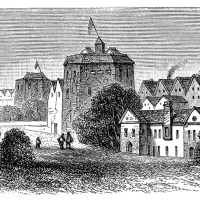
  IN ASSOCIATION WITH THE PRINCIPAL PARTNERS OF SHAKESPEARE’S GLOBE The Globe was the occasion of drama before the first line was even spoken from its stage. In the snowy winter of 1598, three days after Christmas, Shakespeare and his colleague Burbage resolved a falling-out with the landlord of their then Shoreditch theatre in the liveliest way possible. Noting that the landlord owned the ground on which the theatre stood but not, technically, the theatre itself, they showed up mob-handed with ‘swords daggers billes axes and such like’, pulled the theatre down beam by beam, loaded it on to wagons and headed south.