Mary Kenny

Lockdown and the pandemic of loneliness

From our UK edition

32 min listen

In 1930, the American novelist Thomas Wolfe wrote these chilling words: 'The whole conviction of my life now rests upon the belief that loneliness, far from being a rare and curious phenomenon, is the central and inevitable fact of human existence.'It's an idea that, for many of us, is harder to shrug off now than it was a year ago. Loneliness has many dimensions and, after nearly a year of intermittent lockdowns, its consequences are piling up. We've talked before on Holy Smoke about the lockdown's devastating effect on churchgoing – but, as my guest Mary Kenny points out, there's been an across-the-board suspension of the small-scale social activities that mean so much in particular for older people.
Goodbye to Catholic Ireland

From our UK edition

46 min listen

Rarely has a religious culture collapsed more rapidly than that of Catholic Ireland, which just 30 years ago seemed indestructible. Incredibly, it looks as if the Irish Church will have ordained more bishops than priests in 2020. It goes without saying that the Irish abuse crisis has hugely accelerated the process of secularisation in what was once the most Catholic of countries. Young people in Ireland now refer to the clergy with a withering disdain verging on hatred. My guest today, the celebrated Irish journalist, broadcaster and playwright Mary Kenny, offers a more nuanced analysis of the powerful and paradoxical world in which she grew up: one in which Catholic clergy and lay people could be simultaneously fervently pious, warm-hearted and yet paralysed by petty snobbery.

Humiliating the IRA was a fatal mistake

From our UK edition

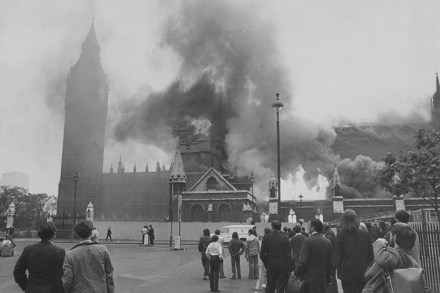
It was said that Reginald Maudling, as home secretary, once boarded a plane in Belfast and immediately requested a stiff drink, muttering: ‘Get me out of this awful bloody country!’ This does not appear in Ian Cobain’s compelling, interwoven narrative about a killing in Lisburn, near Belfast, in April 1978, but it emblemised some of London’s attitudes to what was sometimes called ‘Ulster’. Even during the height of the Troubles, with daily shootings, bombings and killings, the Province was frequently ignored at cabinet level: the spirit of Maudling prevailed in both Conservative and Labour administrations. By Cobain’s measure, Labour’s Roy Mason was as bad as any Tory.

Would the real St Patrick have appreciated the contemporary marketisation of his Saint’s day?

From our UK edition

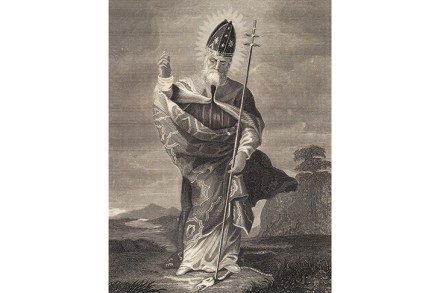
St Patrick’s Day, on 17 March, is now regarded as a prime opportunity for Irish politicians to travel abroad on a mission for ‘brand Ireland’. They fly off overseas, armed with the symbol of the shamrock, alerting their hosts to the shiny new liberal Ireland which is such a fabulous investment opportunity — and don’t forget the low corporation tax! Few national saints have the global reach of Patrick: it has been calculated that church bells ring out in 800 worldwide locations to celebrate the feast day of this Roman Briton who brought Christianity to Ireland in the early 5th century. Jewish bakeries in New York sell green bagels and horses run at Cheltenham in his honour.

The cult of Patrick

From our UK edition

St Patrick’s Day, on 17 March, is now regarded as a prime opportunity for Irish politicians to travel abroad on a mission for ‘brand Ireland’. They fly off overseas, armed with the symbol of the shamrock, alerting their hosts to the shiny new liberal Ireland which is such a fabulous investment opportunity — and don’t forget the low corporation tax! Few national saints have the global reach of Patrick: it has been calculated that church bells ring out in 800 worldwide locations to celebrate the feast day of this Roman Briton who brought Christianity to Ireland in the early 5th century. Jewish bakeries in New York sell green bagels and horses run at Cheltenham in his honour.

Dublin’s Jewish museum

From our UK edition

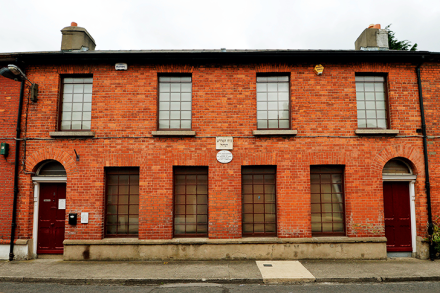
I love small museums, and the Irish Jewish Museum in Dublin is a little gem, located in the neighbourhood once known as ‘Little Jerusalem’, a centre of Jewish life around the South Circular Road. The museum itself is a converted terraced house at 3 Walworth Road, within walking distance of the streets so evocative of Leopold Bloom’s Dublin. It is crammed with impressive artefacts from Jewish life in Ireland — Torah scrolls, a menorah in the shape of a harp — but also with small details and modest memorials of Irish Jewish life, which is now so sadly in decline. (There are estimated to be hardly 1,000 Jews in Ireland today, and many of them are older people whose offspring have gone elsewhere.

The Irish Times: read by the smug denizens of Dublin 4 and responsible for the Celtic Tiger property bubble

From our UK edition

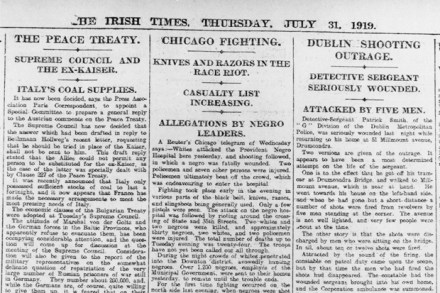
The most successful newspapers have a distinct personality of their own with which their readers connect. In Britain, the Daily Mail and the Guardian are perhaps the best examplars of that. In Ireland, the decent, if slightly smug, denizens of Dublin 4 know exactly where they are with the Irish Times, and that it will connect with them and reflect their values. Sometimes a newspaper’s personality even defies its actual content, and change encompasses an unexpected continuity. The Guardian moved seamlessly from being the organ of non-conformist opponents of horse-racing to the first newspaper in Britain to print the word ‘cunt’. And yet the personality remains intact — priggishness being an essential element.

The wonders of Wexford

From our UK edition

I might have had chance to visit the famed Wexford Opera Festival when I was walking out with Bernard Levin — who was mad about the annual October event — but he never took me along, on account of calling me a ‘vile fidget’ during opera performances. Still, Wexford is a grand place to visit at any time, often having been, for me, a handy overnight stay after reaching Ireland at nearby Rosslare. Yet a more beautiful way, I think, to get to Wexford is by train from Dublin, which takes just over two hours. You travel down the lovely east coast of Ireland, with the sea on one side and the mountains and lush greenery on the other for much of the journey.

Wild, wild times

From our UK edition

There are, I believe, only two jokes in Diarmaid Ferriter’s latest voluminous tome: one, citing Liam Cosgrave, sometime Taoiseach, considered a rather dull character, who apparently said that ‘the Jews and the Muslims should settle their differences in a Christian manner’ (which is almost as insightful as the Tyrone newspaper which once carried the headline: ‘Catholics and Protestants unite against ecumenism’). The second is a quotation from a woman in Sandy Row, in deeply Loyalist Belfast, expressing her distaste for a United Ireland with the words ‘Dublin would have us practising celibacy on the streets’.

Sweetness and light

From our UK edition

Yes, shamefully, I did immediately look myself up in the index, since I had known Mary Robinson (née Bourke) when we were both young feminists in Dublin in 1970. Indeed, she sat in my Dublin flat sharing ‘conscious-raising’ sessions, and I published one of the first political interviews with her — which has been cited in all previous biographies of the lady. Our paths, to say the least, have diverged. She became President of Ireland (and annoyingly, a very good one), and has graduated to being one of the world’s great panjandrums, UN High Commissioner for Human Rights, with 49 honorary doctorates from universities all over the globe and honours from half a dozen countries, including the Presidential Medal of Freedom bestowed by President Obama.

IRELAND NOTEBOOK

From our UK edition

You could not mistake the atmosphere in Dublin this week: the state visit of the Queen and Prince Philip has had the full panoply of a historic occasion. It was obvious that the Irish state was wholeheartedly committed to its success, with the most formal protocols in place. Both David Cameron and William Hague have accompanied the Queen for part of the trip, which is highly unusual. The Queen agreed to visit locations associated with those who rose against the Crown — the Garden of Remembrance in Parnell Square — and showed a graceful sense of respect. It has been impressive and even moving. Yet it was also sad — at least in Dublin. Because there is a small but extremely violent minority of dissenters, Dublin city was eerily empty of people.

In defence of Mary Whitehouse

From our UK edition

The first time I interviewed Mary Whitehouse was for the Evening Standard in 1965. She seemed to me a narrow-minded schoolmarm, and after our encounter I wrote a teenagerish attack on her. I was thrilled by the satire boom that had been launched by That Was The Week That Was, and I loved other shows that she opposed, such as Till Death Us Do Part. In the event, Charles Wintour, then the Standard’s editor, spiked my article. ‘You haven’t understood the point about Mrs Whitehouse,’ he said. ‘She’s challenged the system. She has annoyed the hell out of the Director-General of the BBC, [Hugh Carleton Greene]. But she’s got a constituency behind her and she’s making an impact.

Was the Abdication necessary?

From our UK edition

At least one very startling claim emerges in this study: according to her own account, Wallis, Duchess of Windsor, never consummated her first two marriages. Indeed, she never allowed any man (before the Duke of Windsor, presumably) to touch her ‘below the Mason-Dixon line’. If this is true, it makes a nonsense of the Abdication, since an unconsummated marriage, within Christian canon law, is automatically grounds for annulment. This would mean that the lady was not — or did not need to be — a divorcee, and thus her pairing with Edward, Prince of Wales, should have raised no objection whatsoever.

Too close for comfort

From our UK edition

It was the late Lord Deedes who once succinctly explained to me what it was like to live through the second world war. I had said to him, ‘Those Battle of Britain boys were so brave’.And he had replied, almost impatiently, ‘No, it wasn’t bravery we felt. It was a strange, deep, primitive compulsion that we were up against it. We had our backs to the wall. It was us or them.’ To any defender of Irish neutrality during the second world war — among whom I would count myself — the Deedes doctrine explains everything. It particularly illuminates Winston Churchill’s leadership.

Diary – 11 August 2006

From our UK edition

Edinburgh ‘Oh, God, you couldn’t buy that publicity!’ people exclaimed as Mel Smith appeared on the front page of a clutch of newspapers, on radio and TV and finally on the world news channels. Mel is Winston Churchill in my play Allegiance (which depicts the night that Churchill and Michael Collins got drunk together in 1921), and a fracas had arisen about his entitlement to smoke the Churchillian cigar. Heroic Mel was insisting on lighting up the Havana on stage, in defiance of Scotland’s draconian anti-smoking laws.

Diary – 22 November 2003

From our UK edition

Miranda Sawyer’s Channel 4 programme pleading for the abolition of the age of consent, Sex Before 16: Why the Law is Failing, featured the following adults: the editor of a sexually frank magazine for young girls, Bliss; a QC as a legal expert; a child protection expert; an MP; three experts in ‘teenage sexuality’; a liberal-minded historian; and a contraceptive nurse. The aggregate opinions of these experts mostly hovered around ‘empowerment’ and ‘education’, advancing arguments as to why ‘kids’ under 16 years should be trusted to decide for themselves ‘when to have sex’, as it is now so unromantically called. There seems no allowance for the pleasure of romantic yearnings: the mechanics of ‘having sex’ are all.

Sex and the City means family values

From our UK edition

The sexually explicit scenes in Sex and the City – now into its last series on Channel 4 – make me feel like Maurice Chevalier: I'm so glad that I'm not young any more. It is not that I feel, as my husband Richard West does, that it is all quite 'filthy' and 'disgusting' (he recalls with fondness the Old Aussie saying 'There's nothing worse than toilet talk from sheilas'): goodness me, I'm no prude. It is just that some of the sexual gymnastics, particularly as demonstrated by Samantha and the young men she picks up, seem somehow both humiliating and competitive. I mean, you look at Olympic swimming and marvel at what the human body can accomplish, but you do not imagine that you are supposed to do likewise in the municipal pool the next day.