More from Arts

Multiple choice | 24 November 2007

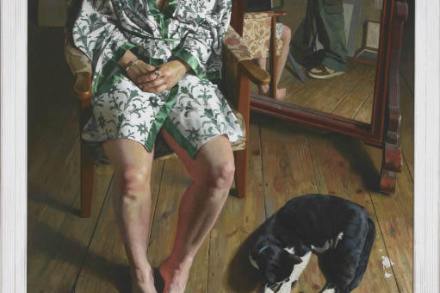
Lynn Painter-Stainers PrizePainters’ Hall, until 1 December Art competitions suffer from a basic problem: how to apply a first-past-the-post system designed for racing to art. In some cases, contestants don’t even qualify for the same event — this year’s Turner Prize, typically, pits film and photography against installation. To avoid this sort of stupidity, the Lynn Painter-Stainers Prize — now holding its third exhibition at Painters’ Hall — confines itself to ‘creative representational painting’ displaying ‘the skill of draughtsmanship’. But even this allows for invidious differences of subject, medium and approach. How is it judged?

Elemental forces

Len Tabner Messum’s, 8 Cork Street, London W1, until 1 December For those of us who live in the British Isles there are two unassailable facts. We are island dwellers who live surrounded by turbulent seas. Our emotional lives, in other words how we experience our existence and express ourselves, often have recourse to rich literary and visual traditions centred on two subjects: the land and the sea. The progenitors of a visual sensibility were Constable and Turner. Both artists pushed the boundaries in terms of how art materials could be handled, and how subject matter, such as farmland, mountains, beaches and the sea, and the intrinsic four elements (air, light, water and earth), could be interpreted as an expression of sentiment and awe.

Snowy and friends

Hergé’s Adventures of Tintin is at the Playhouse Theatre, London, 6 December to 12 January; 0870 060 6631. The first time I saw Hergé’s Adventures of Tintin on stage it starred a West Highland white called Chester, playing Snowy. The dog’s is a walk-on part only; he’s rapidly substituted for a talking actor with a shock of white hair. But talk about canine ego-trips! He belonged to the show’s musical director, who told me that Chester soon started to ‘autograph’ the scenery every night before making a stage-door appearance where kids would queue up to stroke him. Chester lapped it up. He was not, it is true, a fox terrier as per the Tintin books, but then again no fox terrier I’ve ever met is all white like Snowy.

Musical misfit

Demand for new musicals has reached the point where investors are ready to sink funds into a whole new method of production — the we-can’t-write-a-musical-so-let’s-write-a-musical school of musicals. In the latest effort the 1985 film Desperately Seeking Susan has been crossbred with the songs of Blondie. A terrible ugliness is born. The songs don’t fit the film and the film doesn’t fit the theatre. Bored housewife, Roberta, mooches around New York looking for romantic kicks while her cold, philandering husband half-heartedly tries to find her. Feeble aims, ghastly people. Susan, the pivotal figure, is an attitude rather than a character, a random parasite whose gimme-all-you-got-and-get-lost outlook is hard to warm to.

Dual control

Le Nozze di FigaroThe Royal Academy of MusicL’elisir d’amore; Albert Herring Glyndebourne on Tour in Norwich It seems that every opera company that thought it might be a bit naff to stage Le Nozze di Figaro last year has decided that it would be smart to put it on this year, so that I have never seen any opera so often as Figaro during the past ten months — and, if there is any that it’s a good idea to see that often, this is surely the one. The scurry of those opening bars of the overture lifts the spirits as surely as the grandeur of the first bars of the Meistersinger prelude, each of them promising in its own way a period of bliss ahead, each of them a comedy which, however disruptive some of its constituent elements, is finally reassuring.

Playing safe

Rambert Dance Company, Sadler’s Wells I am more and more convinced that getting easily bored is symptomatic of growing old. Twenty years ago, when I was 24, I stopped being a ballet boy and devoted myself to writing about dance; I seldom suffered from boredom, even when watching delectable rubbish. Nowadays, as soon as I realise that things are not exactly exciting, I plunge into a disheartened state. Indeed, what I consider to be a symptom of age, others might regard as ‘experience’. And, in the end, ‘experience’ is something one acquires only by growing old.

Shiver down the backbone

‘Just relax your fingers. Stick them on the fingerboard around the seventh fret. Bang!’ Jimi Hendrix comes to Radio Three. Even though the stations are slowly morphing into each other, with Michael Morpurgo being read on Radio Two (rather well by Robson Green, apart from his ascent into comically high falsetto every time he has to take on the voice of a woman) and Charles Hazlewood playing Britten alongside Curtis Mayfield also on Two, it’s still a bit of a shock on a Saturday night on Three to stumble across that unmistakable blaze of sound. Had I swapped stations by mistake? But there it is again. Dong, dong chang dong, dong chang: the chords at the beginning of ‘Purple Haze’.

True lies

You cannot trust a single frame of any reality television show. I don’t mean they are deliberately mendacious, though some are, but nobody behaves normally when a camera is on them. Take those spontaneous conversations on speakerphone as someone bowls along in the car. You’re talking, you’re wondering if your hair is right, the poor cameraman is scrunched up in the footwell, and you’re trying to drive. It’s as artificial as rhinestone. Also, there’s the menace of the narrative. Television people love narratives; a programme has to tell a story. But most people’s lives aren’t stories at all. One thing happens, then another, and at the end of one month things are much the same as they were. So the editing has to create the narrative.

Lines of beauty | 17 November 2007

The date of George Frederick Bodley’s death (1907) offers a partial explanation for a commemorative exhibition, but ‘comes the hour, comes the man’ also applies, and in this case the man is Michael Hall, the editor of Apollo magazine, who for some years has studied Bodley’s work and succeeded in presenting it as a key to understanding many aspects of the late-Victorian mind, rather than simply as the oeuvre of a skilled but possibly rather conventional designer whose successors followed him into a dead end of style. He is the instigator and curator of this small exhibition in the V&A + RIBA Architecture gallery at the V&A. There is a book coming, but for that we shall have to wait a little longer.

Inspired and not-so-inspired

Reinhard Keiser is not a name that triggers many associations in most opera lovers’ minds, even the most frenzied devotees of the Baroque. He was a big figure in his time, though, and there have been odd recordings of his works, so he ranks with Traetta and Cimarosa from later in the 18th century as someone to arouse curiosity. With each of these composers, as with many others, I have had the experience of turning on the radio and hearing a stretch of their works without knowing what the music was, and finding I had to listen to the end because what I was hearing was impressive enough for me to want to hear more.

A Buddhist bows out

One of the most gilded careers in our post-war musical life ends next week when Robert Tear sings in public for the last time. At least he thinks it will be the last time. ‘There’s nothing in the diary,’ he says. ‘But I’m not disappointed. After 50 years it is wonderful to be relieved of fear. It has made me believe that life could have been like this for ever!’ Tear is singing the Blind Judge in a concert performance of Erich Korngold’s little-known 1927 opera, Das Wunder der Heliane, at the Royal Festival Hall, and he is clearly enjoying the discovery. ‘Korngold came at the end of a generation, the fruit of Wagner that was already wine.

Pistols pack a punch

‘Anyone in the building under 40?’ asks Johnny Rotten. Yes, I am (just): and, by the looks of things, about 20 others among 3,000-odd punters at the Brixton Academy, come to see the Sex Pistols in their middle-aged prime. Punk isn’t dead. It just drives a people-carrier these days. But age cannot wither these amazing 30-year old songs. The set opens with the sonic attack of ‘Pretty Vacant’--the best pop record ever, in my book--as Steve Jones’s ferocious guitar forms the wall of sound upon which Rotten’s words are sprayed like seething graffiti. It is five years since I last saw the Pistols, and it appears that Jones has been eating all the pies since that particular ‘farewell’ concert at Crystal Palace.

Sweet sounds of the Seventies

Is there a more irritating figure in British public life than Richard Branson? The beard, the cuddly sweaters, the toothy grin, the self-advertisement, the torments of the damned involved in travelling on one of his trains or planes. No news story in recent weeks has cheered me up as much as the one about Branson injuring himself while jumping off the roof of a Las Vegas hotel in yet another of his ridiculous publicity stunts. His wounds weren’t serious but were enough to hurt his pride: the perfect result. I travelled to New York and back with Virgin Atlantic last week. The food was disgusting, the service inattentive and the leg room in economy almost comically inadequate even for someone as short as I am.

Hopeless propaganda

The Arsonists, Royal Court; The Giant, Hampstead; The Bicycle, MenKing’s Head   Strange happenings in theatreland. Three London playhouses have taken it into their heads to mount a sustained attack on the avant garde. Result â” carnage! Careers are in tatters. Reputations have been shredded. Some of these playwrights will never be seen again. In August the Donmar cruelly demonstrated that N.F. Simpson was unworthy of adult attention by staging two of his silliest playlets alongside a slice of tedious cleverness by Michael Frayn. Last month the Royal Court embarrassed Ionesco by putting on his dated sci-fi fantasy, Rhinoceros. Next the Almeida started knocking lumps out of Caryl Churchill with a resuscitation of her 1970s dodo, Cloud Nine.

Conquests and coffins

One of the few certainties about Henry V is that every performance is a political act, or will certainly be read as such. On BBC2’s Newsnight Review the other day, Michael Gove wondered whether there’d been a single production since Olivier’s triumphalist film of 1944 that hadn’t been anti-war, anti-patriotic and anti-heroic. Although that isn’t totally true (see Emma Smith’s superb 2002 CUP edition of the play), it’s near the mark. Famously, or perhaps infamously, Michael Bogdanov’s 1980s version had the English soldiers embark for France under a banner inscribed ‘F**k the Frogs’ and singing ‘’Ere we go, ’ere we go, ’ere we go again’.

Hijacked by the people

The blogosphere is threatening to take over the airwaves and even the great Eddie Mair is feeling ruffled. Last Saturday, half an hour of PM, his five o’clock current affairs programme on Radio Four, was hijacked by ‘the people’. Instead of running straight through till six, Mair had to break off halfway through to launch the new mini-version, iPM. Mair has been reminding us for weeks now of the existence of the PM blog. ‘Just log on to bee bee cee dot co dot u kay forward slash eye pee em’ has been said by him so often that a hint of repetitive strain is beginning to enter his normally smooth-as-velvet-cream delivery.

Blown away by Napoleon

For much of the summer my brother Dick spends his weekends either as a skirmisher with the Voltigeurs in Napoleon’s Grande Armée or depending on which side needs the extras as a redcoat of the 9th Regiment of Foot. He has frozen his balls off at the battle of Jena. He is fluent in complex early-19th-century musket drill. He even alters his facial hair configurations according to whether or not the soldier he’s playing would or wouldn’t be allowed a beard. Some people think re-enactors are silly. My friends Robert Hardman and Andrew Roberts like to put on a sort of E.L. Wisty voice and tease them thus: ‘By day I am a British Telecom engineer. But at the weekends I am Prince Rupert of the Rhine!!!’ I, however, think re-enactors are ruddy marvellous.

The age of the train

Eight thousand years ago the Thames was a tributary of the Rhine. And if the cities had actually existed, you would have been able to walk from London to Rome without getting your felt-bound feet wet. Since then, geology has given us the Channel, a practical and psychological barrier that defines national identity. The idea of a tunnel beneath this barrier dates back to the Treaty of Amiens 1751. Here reach exceeded grasp and the first realistic — although the word is used loosely — proposals were made to Napoleon by a mining engineer, Albert Mathieu, in only 1802. Mathieu wanted to turn the mid-Channel Varne bank into an island, with shorter tunnels going north to England and south to France. Nothing came of it.