Alan Powers

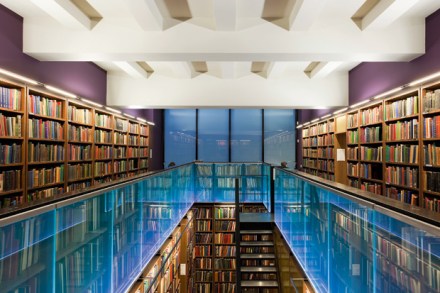
New wonders among old shelves at the London Library

From our UK edition

The Royal Court Theatre, the Young Vic Theatre and the London Library (above) are buildings of varied character and rich history. What they have in common is that each has been unpicked and reassembled by the architects Haworth Tompkins, recently announced as winners of the RIBA London Architect of the Year. This firm, founded in 1991, often gets chosen to make practical improvements to existing institutions and manages to make them work with a panache that allows the original building to retain its character. In an architectural world where severe contrast between old and new confronts the alternative of invisible and seamless extension, they have always managed to get somewhere in between.
House rules | 8 October 2011

From our UK edition

Britain needs more houses, and the government’s highly unpopular draft National Planning Policy Framework (NPPF) at least asks how to get them — the right question even if it gives the wrong answer. Anyone who deals with the planning system knows how overblown it has become, and that the cost and effort can exhaust a developer, to the extent that the good intentions of a scheme drain away at the crucial moment of building. The existing planning system may be imperfect but, if it is to be simplified, it needs to be better at eliminating bad designs, not the reverse. Prodigious amounts of brain power and energy have been devoted to making the well-intentioned suet pudding that is the planning system of today.

Triumph of tenacity

From our UK edition

If you are driving along the A14 coming west towards Cambridge, the tower of Bury St Edmunds cathedral suddenly pops up on the skyline at a bend in the road. I saw it this way in March, when the pinnacles, battlements and ogee windows first emerged from plastic sheeting and scaffolding. By June, the whole thing was stripped down to the golden stone. If you didn’t know, you might imagine that this was an over-thorough conservation job on a late mediaeval building, rather than something constructed in the past six years. The new work at the cathedral, which includes much besides the tower, looks so natural and right that, once it has weathered, it will probably be mistaken for something 500 years older.

Vertically challenged

From our UK edition

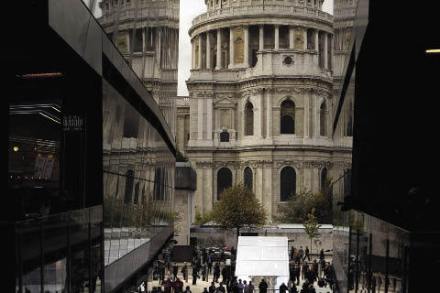
St Paul’s Cathedral is quite rightly something of a national obsession. No other building has protected ‘view corridors’ as a result of legislation in 1935, when new building regulations allowed the surrounding buildings — notoriously a telephone exchange to the south — to overtop the cathedral’s cornice line. These corridors, extending like an unseen net as far afield as Richmond Hill, make architects unaccountably cross, as if they were an unfair curb on the alliance of art and Mammon. Thank God they are there, and that the tallest buildings, springing up once again like genetically modified beanstalks, are at least corralled east of Bank. St Paul’s Cathedral is quite rightly something of a national obsession.

Classical peaceniks

From our UK edition

The Three Classicists RIBA, until 29 May The Berlin Wall separated two sets of people who shared a history and language. In the same way, architecture has been divided into two groups, Classicists and Modernists, each convinced of their own rightness, and refusing to acknowledge the other’s existence. But suddenly it seems that they are offering each other flowers. The exhibition Three Classicists opened recently with an array of Ionic volutes, Corinthian acanthus and sash windows. For the Royal Institute of British Architects this show would once have been as unthinkable as giving the Royal Gold Medal for Architecture to the Prince of Wales, and two major professional journals, having despised classicism for 50 years and more, have commented politely.

Gothic dream

From our UK edition

Horace Walpole’s Strawberry Hill Victoria & Albert Museum, until 4 July ‘I waked one morning at the beginning of last June from a dream, of which all I could recover was that I had thought myself in an ancient castle (a very natural dream for a head filled like mine with Gothic story) and that on the uppermost banister of a great staircase I saw a gigantic hand in armour. In the evening I sat down and began to write without knowing in the least what I intended to say or relate.’  Thus Horace Walpole related the origin of the first ‘Gothic’ novel, The Castle of Otranto, published in 1765.

Halfway to heaven

From our UK edition

When some 700 people throng the auditorium at Earl’s Court to hear a debate about whether eco houses are ugly, then a frustrated tree-hugger like myself may feel that we are halfway to heaven, not that I plan to share my Elysium with Germaine Greer in ranting mode if I can avoid it. When some 700 people throng the auditorium at Earl’s Court to hear a debate about whether eco houses are ugly, then a frustrated tree-hugger like myself may feel that we are halfway to heaven, not that I plan to share my Elysium with Germaine Greer in ranting mode if I can avoid it.

Give a dog a bad name

From our UK edition

Alan Powers on Parliament Square Does nobody love Parliament Square? Days before the Mayoral election, Tristram Hunt called it a ‘terrible place: inaccessible, ugly, polluted and grotty’ in the Guardian. When the Mayor of London cancelled the scheme for pedestrianising at least two of the roads around the square within days of his election, there was dismay that the still-unpublished plans for its improvement should be abandoned. If the proceedings within the Palace of Westminster are sometimes absurd, this parallel drama on the street outside was equal in sound and fury. Could commentators distinguish between the square itself and the traffic that circulates around it?

Concrete and carbuncles

From our UK edition

‘London smells Tory,’ announced Ian Martin, the Beachcomber of architectural journalism post-Boris in his weekly column in the Architects’ Journal. Heritage wars have broken out over the future of a concrete housing scheme, Robin Hood Gardens in East London by Alison and Peter Smithson, that is beloved of architects, but not, it seems, of many others. The Guardian devoted a page to complaints from classical architects that they were excluded en bloc from the Riba awards that lead to the Stirling Prize, and The Spectator is shortly to conduct a debate on whether Prince Charles’s opinion, delivered nearly 25 years ago, concerning glass stumps and monstrous carbuncles, remains as valid today. Does architectural style have a simple relationship to political position?

Popular appeal

From our UK edition

Last time it was cows, this time it’s sheep. I’m not talking about an agricultural show, but about the London Architecture Biennale, which begins today when Lord Foster will be herding sheep across the Millennium Bridge towards Smithfield Market. In 2004 it was cows approaching Smithfield from the opposite direction, down St John Street, and, appropriately, across Cowcross Street. Peter Murray, the director of the Biennale, has a knack for eye-catching publicity and, since his earliest student magazine productions in the 1960s, has worked tirelessly to make architecture less boring.

Lines of beauty | 17 November 2007

From our UK edition

The date of George Frederick Bodley’s death (1907) offers a partial explanation for a commemorative exhibition, but ‘comes the hour, comes the man’ also applies, and in this case the man is Michael Hall, the editor of Apollo magazine, who for some years has studied Bodley’s work and succeeded in presenting it as a key to understanding many aspects of the late-Victorian mind, rather than simply as the oeuvre of a skilled but possibly rather conventional designer whose successors followed him into a dead end of style. He is the instigator and curator of this small exhibition in the V&A + RIBA Architecture gallery at the V&A. There is a book coming, but for that we shall have to wait a little longer.

Ignoring fossil fuels

From our UK edition

Earlier this year, a book appeared celebrating the first ten years of the Stirling Prize for architecture. Back in 1996, recession was only just ending and the National Lottery just beginning. It was the end of a bleak time for architects, doubly afflicted by the criticisms of the Prince of Wales. One unexpected benefit of the Prince’s attentions, however, was that the public was eager for stories about architecture, and the Stirling Prize managed to change these from bad news to good. A building that wins will always be a hostage, and this year, for the first time, the glitter looks a little tarnished in places.

Moving on

From our UK edition

Listing page content here Twenty years ago, Britain was gripped by an architectural battle of styles. The Lloyd’s building in the City opened, representing the hopes for a resurgence of modernism, while Quinlan Terry’s classical Richmond Riverside was beginning to emerge from scaffolding like a vision by Canaletto. Since 1986, a great deal has happened, but readers of Roger Scruton’s article in The Spectator of 8 April (‘Hail Quinlan Terry: our greatest living architect’) would know nothing of it.

Rootstock of radicalism

From our UK edition

London is about to experience two exhibitions about early 20th-century Modernism. The V&A is mounting a substantial themed display of design, art, film and life, based primarily on France and Germany before 1930. Tate Modern will exhibit jointly the work of two faculty members of the Bauhaus, Josef Albers and Laszlo Moholy-Nagy. In anticipation, two exhibitions outside London demonstrate outgrowths from this core of experience, supposedly the rootstock of radicalism in the past 100 years of art and design. At Kettle’s Yard, Cambridge, Starting at Zero: Black Mountain College 1933–57 shows how the European modernist diaspora improbably made one of its significant early landfalls in North Carolina, in a small, underfunded independent arts college. The potter and poet M.C.

Regency revival?

From our UK edition

W.S. Gilbert’s parody of Oscar Wilde, Reginald Bunthorne, wanted to make a minor scandal with his belief that ‘art stopped short in the cultivated court of the Empress Josephine’. In 1881 he was prophetic, although taste took at least 50 years to catch up. The English equivalent of Empire, the Regency period, has exerted a fascination that peaked in the period 1935–55, and has never completely faded. The Bunthornes of Bloomsbury in the 1980s, as noted by John Martin Robinson and Alexandra Artley in The New Georgian Handbook 20 years ago, were busy swagging their curtains, Egyptianising their cat flaps and faking ormolu in their reclaimed rooming houses. Dr Robinson has now provided the book that would have been a compulsory accessory in those far-off days.

Importance of ornament

From our UK edition

The Modern Movement in architecture had scarcely succeeded in abolishing ornament before people began to speculate about how and when it would return. In Britain, the historian Sir John Summerson, as a young journalist, found it hard to believe that architecture would be able to communicate without it beyond the initial period of purification which he and many others believed was a necessary transitional phase.

Draughtsman of genius

From our UK edition

C. R. Cockerell RA (1788–1863) The Professor’s Dream is the title of a small exhibition (until 25 September) in the Tennant Room at the Royal Academy, a relatively new space that links with the John Madejski Fine Rooms, formerly the piano nobile of old Burlington House. Who was this professor, and what was his dream? For an architect of extraordinary ability, Cockerell seems destined to be overlooked, while some of his contemporaries, including Soane and Pugin, have entered the consciousness of the art-loving public. He was a designer and draughtsman of genius, the finest classical architect to work in the Victorian period.

Take the yellow brick road

From our UK edition

Ever since W.S. Gilbert’s Lady Jane lamented, ‘Oh, South Kensington!’ in Patience, 1881, the place has carried a regretful quality. Owing to the extraordinary lack of confidence shown by successive governments and Treasury officials in the educational values that Prince Albert hoped to promote through the estates of the 1851 Commission, the gentle, south-facing slope of Brompton became, over the course of time, a palimpsest of build structures, not all of which deserve the title of architecture. ‘Here tears are absolutely vain — there is no remedy,’ said Beresford Pite, the Professor of Architecture at the Royal College of Art, bewailing in 1905 the loss of the opportunity for a north-south axis leading to the Albert Hall.

Printing matters

From our UK edition

This year marks the 70th anniversary of Penguin Books, a company that has done more for design in Britain than any other commercial or government organisation. The slightly improvised look of the earliest sixpenny paperbacks launched by Allen Lane in the summer of 1935 was put aside in 1947 when the German–Swiss typographer Jan Tschichold came to set new rules and standards of impeccable consistency. He was one of many émigrés in the field of design who, before and after the war, inspired laid-back English design with a new understanding of rigour and principle.