Lead book review

The enlightened king of Iraq

‘King of Iraq’ has an odd ring even to those who know that Iraq was called Mesopotamia and was part of the Ottoman empire before falling into and out of the clutches of the British. Many people, including Iraqis, seem unaware that it was a monarchy until 1958. Some 45 years after its overthrow, members of Iraqi families that flourished in those royal days launched ambitious plans to restore the monarchy after Saddam Hussein’s demise. One of them was Ali A. Allawi, the author of this first major biography of Iraq’s founding father, King Faisal (r. 1921–1933).

Has land ownership changed our lives for better or for worse?

If the gentle reader has any concerns that a study of land ownership might tend to the dry, they will be dispelled in the very first pages of this book by the spectacular flamboyance of its opening. There is not an economist in sight. Instead, we have the piratical figure of the Sir Humphrey Gilbert — Elizabethan seadog, soldier and mathematician, ‘openly bisexual’, and with the arresting habit of ‘decapitating his enemies after battle [and] then lining the path to his tent with their severed heads’ — returning in 1583 from the first expedition to create an English colony in North America. Sir Humphrey Gilbert stands proxy for a momentous historical transformation.

What Englishmen learnt from Europe

The pattern of foreign travel by wealthy young Englishmen that became known as the Grand Tour began in the Renaissance and matured in the 17th century. In its origins it was a training for statesmanship. The state’s takeover of the church, which had done so much of the state’s official business, enlarged the employment opportunities of the nobility and gentry. So did the expansion of the government’s administrative resources and ambitions. But with the opportunities came challenges. Monarchs needed their advisers and officials and diplomats to be skilled and knowledgeable. So noblemen and gentlemen urged their sons to look beyond the accustomed pleasures of the hunting field and get down to educational business.

Reviewing reviews of reviews — where will it all end? 

About halfway through reading this collection of essays I had one of those hall-of-mirrors moments. These are mostly book reviews, you see: high-toned, long-form New York Review of Books-type review-essays, given — but book reviews nevertheless. There I was, dutifully noting what David Lodge wrote about what Martin Stannard had to say about Muriel Spark, for instance. At once I found myself entertaining the baseless, pleasing notion that, some years from now a collection of my own book reviews would appear in an edition called something awful like Writing Things Down or Twelve-Point Garamond.

My family’s better days

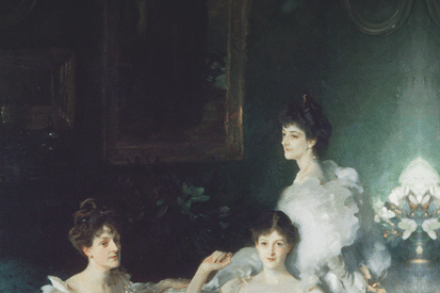
The Sargent painting reproduced opposite suggests the wealth and comfort that these three sisters, Mary, Madeline and Pamela, were born to. Their father, Percy Wyndham, was the younger son of Lord Leconfield of Petworth, Sussex. He was his father’s favourite, and was left by him as much of the immense Wyndham riches as was possible. With his inheritance Percy bought a 4,000-acre estate in Wiltshire, romantically named Clouds, where he built a vast country house, designed by Philip Webb. Pamela, the youngest sister (and my great-grandmother), is seated on the sofa, flanked by her two siblings.

‘She’s the most important Jewish writer since Kafka!’

The Brazilian novelist Clarice Lispector was a riddlesome and strange personality. Strikingly beautiful, with catlike green eyes, she died in Rio de Janeiro in 1977 at the age of only 57. Some said she wrote like Virginia Woolf (not necessarily a recommendation) and resembled Marlene Dietrich. She was ‘very, very sexy’, remembered a friend. Yet she needed a great many cigarettes, painkillers, anti-depressants, as well as anti-psychotics and sleeping pills to get through her final years. Lispector had great fortitude over her illness, it was said, and suffered the ravages of ovarian cancer equably and without complaint. According to her biographer Benjamin Moser, Lispector’s was a life fraught with the shadow of past failures and past sorrows.

How we lost the seasons

So, what are you doing with your Christmas decorations? Still up? Did the tree get put out on 2 January? Maybe you’re holding out until the Twelfth Day, on the basis that it’s bad luck to have the decorations up after that? Or are you going out on a limb and keeping your holly, bay and ivy up until 2 February, Candlemas? This last is in fact the correct answer for traditionalists; prior to Victorian times, people kept the Christmas season going, along with the greenery, right up until Candlemas. Mind you, given that Christmas trees only caught on with Prince Albert, pre-Victorians didn’t have the problem of pine needles dripping all over the carpet.

How honest was Bernard Berenson?

When the great Jewish-American art expert Bernard Berenson died in 1959, he had acquired the status of a sort of sage. He was the relic of a prewar culture that had vanished. He was an embodiment of the idea of connoisseurship that had at once given birth to a great boom in art collecting and yet that was, by the end of his life, being superseded. When Berenson embarked on the career that would see him widely accepted as the world’s foremost authority on Old Masters, the painters of the Italian Renaissance were barely regarded in the US. He died — at 94 — in the age of Andy Warhol. The very span of his life gives his story resonance.

If only Craig Raine subjected his own work to the same critical scrutiny he applies to others’ 

It’s important not to be too immediately dismissive of poor Craig Raine. Book reviewers and editors like him, who invent rigid literary principles and then dismiss anything that fails to embody them, have been on the decline since the 1970s. It’s true that one would probably sooner go for guidance to a generous reader who tries to discover what an interesting book is seeking to do, and how it achieves it. But the principle-wielder is an endangered species, and however ill-founded the principles themselves may be, as readers we might welcome the existence of one or two. The trouble is, no one is really interested any more.

In the steppes of a warlord

I suspect travel writing was once a fairly simple business: the author travelled somewhere, the reader did not; the author explained what the place was like and the reader was duly informed and even entertained. Dr Uno von Troil, for example, went to Iceland in 1772 and served up lurid descriptions of the devil holes and lairs of Beelzebub (geysers). None of his readers had been to Iceland; no one was inclined to argue with Uno von Troil. Later, with the advent of mass travel in the 19th century, Uno von Troil’s former audience could go by steamer to Iceland (or ‘Hell’) and witness the infernal pools themselves.

Spectator writers’ Christmas book choices

Byron Rogers Rhys Davies by Meic Stephens (Parthian, £20). This is the first full-length biography of the grocer’s son from the Valleys who, in the course of a long and industrious life spent mainly in London (where guardsmen were), wrote over 100 short stories and 20 novels and was hailed as the Welsh Chekhov. Helpfully, he encouraged his countrymen to follow his example: ‘Stop thinking of yourself as a Welsh writer. Consort as much as possible with people who dislike Wales or, better still, are completely indifferent to her.’ A funny and quite delightful book.

Spectator writers pick their books of the year

Mark Mason JFK’s Last Hundred Days by Thurston Clarke (Allen Lane, £20) brilliantly captures Kennedy’s entire life through the prism of his final months. Deliberately thrusting his crotch for an official portrait, musing about assassination (he even acts it out in a game of charades, covered in ketchup), folding his monogrammed handkerchiefs to hide the initials because he disliked ostenatious wealth, putting a black marine at the centre of a ceremonial line-up … the hero, like the devil, is in the detail. Emailing my friend Travis Elborough about his and Nick Rennison’s A London Year (Frances Lincoln, £25), I wrote simply: ‘You bastard.’ Great idea, expertly researched and beautifully packaged (it’s even got a ribbon!

Why do we pounce on Wagner’s anti-Semitism, and ignore that of the Russian composers?

Before ‘nationalism’ became a dirty word, it was the inspiration for all sorts of idealistic and reform-minded people. This was never more true than in the history of music. Clearly, subsequent events have discredited some of those 19th-century ideals. It is striking, however, that we have become uncomfortable with Wagner’s German nationalism while continuing to regard Smetana’s Czech nationalism as an admirable, even inspiring quality. At times one feels that some musical nationalists are given too easy a ride — as if what happened in the opera house couldn’t conceivably affect anything outside it.

How we beat Napoleon

It feels the height of ingratitude to blame Jane Austen for anything, but it probably is her fault that most people seem to think that the only impact that the Napoleonic War had on British life was to bring Mr Wickham and the militia into the lives of the Bennet girls.

George Orwell’s doublethink

This is the most sensible and systematic interpretation of George Orwell’s books that I have ever read. It generously acknowledges the true stature of the great works — most notably, Animal Farm, Down and Out in Paris and London and The Road to Wigan Pier. It rightly sees the second world war as having brought forth some of Orwell’s finest writing. Yet it does not deify him, and it acknowledges that this strange, drawling, gawky Etonian, who wore common sense like a carapace, was occasionally as capable as the next journalist of writing undiluted tosh. Witness his claim in an article of 1940 that if he thought a victory in the present war would mean a new lease of life for British imperialism, he would be inclined to ‘side with Russia and Germany’.

How to avoid bankers in your nativity scene

In the vast Benedictine monastery of Monte Oliveto Maggiore between Siena and Rome, the cycle of frescoes depicting the life of St Benedict by Giovanni Anionio Bazzi includes a charming self-portrait of the artist standing with a couple of pets at his feet, for all the world a 16th-century Italian Dorothy with a brace of Totos. (A detail of the painting is reproduced overleaf.) Bazzi did not earn his popular soubriquet of ‘Sodoma’ for nothing — though Vasari is not always reliable — but if his life was the scandalously licentious and dishonourable thing that Vasari would have us believe, then this only places him in the mainstream of the world described in Alexander Lee’s fascinating new book.

What caused the first world war?

The centenary of August 1914 is still almost a year away, but the tsunami of first-world-war books has already begun. The government tells us that 1914 must be commemorated, not celebrated, and ministers worry about British triumphalism upsetting the Germans. But the debate about Germany’s responsibility for the outbreak of war in 1914 won’t go away. Historians are divided into those who blame Germany — John Rohl, Max Hastings — and those who point the finger at someone else, such as Serbia (Christopher Clarke) or Russia (Sean McMeekin) or even Britain (Niall Ferguson). The blame game is of course conceptually flawed. The international system in 1914 was seriously dysfunctional. The alternative to searching for scapegoats is to examine the system.

England’s 100 best Views, by Simon Jenkins – review

I couldn’t decide on starting England’s 100 Best Views whether it was a batty idea for a book or a perfectly sensible one. Why write about something that begs to be seen? Would this not be better as a collection of photographs, with helpful accompanying maps and perhaps a checklist that, once filled in, entitled you to a badge from Big Chief I-Spy? On the other hand, as Jenkins (he’s Sir Simon, of course, but book reviews know no distinctions of rank) explains in his introduction, a view is more than just a picture: it is something mobile — a collocation of geography and geology, the built environment and the weather, the movements of birds and mammals, and the mood of the person taking it in.

Colette’s France, by Jane Gilmour – review

Monstrous innocence’ was the ruling quality that Colette claimed in both her life and books. Protesting her artless authenticity, she was sly in devising her newspaper celebrity and ruthless in imposing her personal myths. She posed as provincial ingénue, wide-eyed young wife of the Paris belle époque, scandalous lesbian, risqué music-hall performer, novelist of prodigious output, theatre reviewer, beautician, seducer, the most feline of cat-lovers and, ultimately, garlanded literary lioness. Yet her phoniness should not deter people from reading her books. Although most of her work resembled an imaginary autobiography, it was never self-obsessed or constricting.

To ‘Flufftail’ from ‘Pinkpaws’: The Animals is only good for celebrity-spotting

There is a fine old tradition of distinguished literary men addressing their loved ones by animal-world pet names. Evelyn Waugh saluted Laura Herbert, the woman who became his second wife, as ‘Whiskers’. Philip Larkin’s letters to his long-term girlfriend Monica Jones are full of Beatrix Potter-style references to the scrumptious carrots that his ‘darling bun’ will have unloaded on her plate at their next meeting should wicked Mr McGregor not get there first. Wanting to soften the blow of his sacking by the BBC Third Programme in the early 1950s, John Lehmann went off on holiday with an intimate known to posterity as ‘the faun’.