Features

Cooking the books: the rise of fake libraries

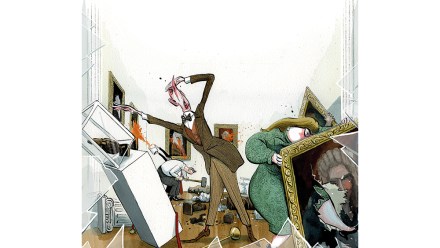
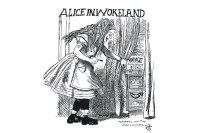
There is a growing fashion for fake books. Not fake as in written by a series of AI prompts, but fake as in things – cleverly painted empty boxes, or a façade of spines glued to a wall – designed to mislead the casual onlooker into thinking that they are books. A recent New York Times article highlighted the trend. It featured various interior designers offering spurious arguments in favour of fakes over real books: they can be a practical solution for hard-to-reach shelves; a smart example of upcycling unwanted volumes destined for landfill; useful and humorous storage boxes. Neat, quirky design solutions are, however, the least of it. This fashion signals a profound shift in our attitude to books.

Harry’s crusade: the Prince vs the press

Self-pity is one hell of a drug. On Tuesday, a day late, Prince Harry appeared in the High Court to ‘give evidence’ against the Mirror. The only testimony he was willing to provide, however, was his familiar gloop about the pain he suffered growing up rich, famous and royal. He can’t help himself, poor boy, and we should probably stop indulging him. We won’t, though. In a 49-page witness statement, the Duke of Sussex tried once again to make peace with himself by blaming the press for everything. ‘You start off as a blank canvas while they work out what kind of a person you are and what kind of problems and temptations you might have,’ he declared.

How women became essential to the mafia’s survival

The Calabrian mafia, the ’Ndrangheta, were once something of a side-show compared with the more famous Sicilian mafia. Now they are the largest criminal organisation in Europe. Last month, European police arrested more than 130 ’Ndrangheta members in Italy, Germany, Belgium, Portugal and Spain in a coordinated swoop codenamed ‘Eureka’. Almost all have been charged with drug-dealing, money-laundering or crimes of violence. The mafia wife never asks about her husband’s work any more than he would dare criticise her cooking The ’Ndrangheta traditionally specialised in kidnapping, operating in the inaccessible region of Aspromonte, the toe of Italy, for centuries out of reach of the forces of law and order.

Can cloning bring endangered species back from the brink?

This spring, San Diego Zoo’s Wildlife Alliance proudly announced the arrival of Trey, a newborn colt. Trey is a Przewalski’s horse – the last wild horse species on the planet, and one of the least pronounceable (say ‘zhuh-varl-skis’ and you’ll be close). It was another small conservation victory. But Trey is particularly unusual, because this little pony is a clone. Isn’t it too late for our battered ecosystems to start mucking around with cloning? Trey is genetically identical to Kuporovic, a stallion whose cells were cryonically preserved in 1980. He’s also a genetic twin of Kurt, the first ever cloned Przewalski’s horse, born in 2020. This is big news in the cloning world: until now, cloning has only produced one individual from an endangered species.

Is anywhere safe for Paul Kagame’s critics?

After weeks of travelling – first Paris, then Kinshasa – I was looking forward to my evening at L’Horloge du Sud in Brussels. Known for its poisson liboké (fish wrapped in banana leaf) and other African specialities, the restaurant is popular with the city’s African diaspora. I’d been invited by a Pan-African thinktank to discuss my book on Rwanda. It was not to be. The day before, I got a call from the Benin journalist due to chair the event. He sounded rattled. The restaurant owner, he said, had been receiving complaints from pro-government Rwandan groups in Brussels, along with threatening emails and anonymous calls from Rwanda itself.

The trouble with returning the Benin Bronzes

Once, museum curators saw their job as collecting, conserving and displaying to the public works of art or humbler objects that were beautiful, interesting and representative of a time and a place. Now many of them want to get rid of, or at least hide away, objects that they pronounce shameful. Cambridge University, under its present administrators, has been following the fashion. The Fitzwilliam Museum has taken down a painting by Stanley Spencer – ‘Love among the Nations’ – on the grounds that ‘Raised on the moral rightness of British imperial rule, Spencer imagines civilisation firmly in the West and savagery in its colonies’. So that’s you dealt with, Spencer.

Red Rishi: the Prime Minister’s political makeover

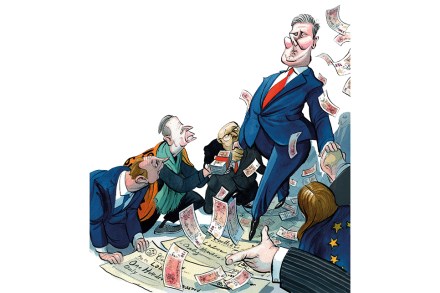
What kind of conservative is Rishi Sunak? This time last year, there was a clear answer: he was a fiscal hawk who was worried about how much the government had to borrow to fund the Covid crisis. As chancellor, he was always fighting with the prime minister over high spending. When Sunak tried to raise the national insurance rate, he did so partly to send his party an important message: the borrowing and spending has to stop. Now Sunak is in No. 10 and Boris Johnson isn’t around to demand more spending. There has been a Budget and a list of priorities – and Sunak’s agenda is starting to emerge. It includes a tax burden not just higher than any time in the 1970s, but any time in postwar history. A record proportion of the workforce are paying the higher rate of tax.

Dr Jean Twenge: Gen Z aren’t OK

There’s never been an older generation that didn’t complain about the younger one. Parents tut and fuss over errant youth. That’s the way of it. But in the end the kids come around. Swingers grow into Karens. The wild child pays his bills. But kids these days… they do seem different. It’s not just that we, the older generations, are worried about them, but that they’re desperately worried about themselves. And according to Dr Jean Twenge, a psychologist at San Diego State University who studies generational changes, we’re right to worry. Almost 30 per cent of American girls have clinical depression and it’s the same across the Anglosphere. The suicide rate for ten- to 24-year-olds has tripled.

Gag order: China’s stand-up comedy crackdown

‘The Chinese Communist party is probably the funniest thing that exists,’ the dissident artist Ai Weiwei once told me, ‘but it doesn’t have a sense of humour.’ The brave band of comics in China’s fledgling stand-up comedy scene are discovering that poking fun at the grim-faced old men who run the country with an ever-tighter grip is a dangerous pursuit. Last month, at a comedy club in Beijing’s Dongcheng district, 31-year-old Li Haoshi mocked a military slogan coined by President Xi Jinping. Li said that ‘Forge exemplary conduct! Fight to win!’ reminded him of his two dogs chasing a squirrel. A clip of the show spread rapidly online.

My life as a meth addict

I’ve spent most of my adult life addicted to amphetamines, including crystal meth. I first tried speed when I was 17 at a techno party while visiting Germany. I had been struggling with my A-levels and always found school hard because I was constantly exhausted, sleeping for 12 hours a day and still falling asleep during lessons. I was depressed and sometimes felt like I didn’t want to live any more. Speed changed all that. For the first time ever, I was motivated, I could concentrate and I felt that I could deal with life. I went from failing school to becoming a straight-A student, and I honestly don’t think I would have graduated without speed. I took it like people drink coffee. On meth, you feel like you’re having an epiphany every minute.

Don’t cancel Beatrix Potter

I spoke too soon. Beatrix Potter, I suggested in an afterword to my 2016 biography of the author and illustrator, had escaped the distortions of sexual and racial revisionism that now blight so many eminent and long-dead British writers. But no longer. Last week a specialist in postcolonial literature at a northern university accused Potter of failing to acknowledge her indebtedness to an oral storytelling tradition of enslaved Africans working on American plantations. Welcome, please, a new Potter for the 21st century: exploitative, colonialist, dishonest. Potter’s concealment, claims Dr Emily Zobel Marshall, ‘[feeds] into a damaging and recurring appropriation of Black cultural forms that continues today’. Blimey.

How Ireland lost its craic

So, which country is putting health warnings and calorie counts on bottles of alcohol for the benefit of its citizens? Nope, not Canada or New Zealand. But you’re getting warm… It’s Ireland, the country that gave us Guinness, Jameson, Bushmills and, for those who like that kind of thing, Baileys. That’s right: a health warning just like for cigarettes. But instead of rotting lungs, presumably there’ll be a lovely picture of a liver with cirrhosis. What effect will it have on me? None, dear reader, none. I drink to forget this sort of thing. But that’s the way Ireland is going (actually has gone) for a generation: not so much the nanny state as the Miss Trunchbull state, one that would swing you round by your pigtails.

Has Ukraine’s counter-offensive been overhyped?

The talk about a big spring counter-offensive has been beneficial for Ukraine. It has helped persuade western allies to donate arms, while unnerving Russia and offering hope to those longing for the conflict to end. The idea has been promoted by every Ukrainian official from the President downwards, but when hope turns to hype, there’s a problem – and Kyiv may soon end up paying the price for its own PR success. People are asking where the ‘big push’ is and Volodymyr Zelensky’s team is trying to manage expectations. They are speaking of whatever comes next as another stride in the ongoing war, rather than the final step to an inevitable victory. The trouble is, the high expectations of Ukraine’s allies may now turn into a liability.

Can Trump’s opponents prove him wrong on Ukraine?

Boris Johnson, Britain’s most sought-after Churchill impersonator, visited Texas on Monday to urge a group of rich right-wing Americans to never, never, never give in to Vladimir Putin. ‘I just urge you all to stick with it,’ Agent Bojo told a private lunch of conservative politicians and donors in Dallas. ‘You are backing the right horse. Ukraine is going to win.’ Johnson wasn’t paid to speak at the lunch, though it’s worth noting that he only stopped over in Texas on the way to the SCALE Fintech conference in Las Vegas, where he is expected to receive a six-figure sum for talking about the future of innovation alongside Saudi Arabia’s ambassador to the US. Nobody said freedom was free.

Why are my son’s teachers constantly on strike?

It is a bright Wednesday morning in May. My son, T, a Year 8 pupil, should be at school and I should be working, but instead we are playing tennis. We are also listening to ‘Romeo and Juliet’ by Dire Straits because he’s supposed to be studying the play in class so I figure I can cover both PE and English literature in the next half an hour before we head home and I start the work I’m meant to be doing. For them academies are a Tory ruse designed to hand over control of schools to nasty capitalists My son isn’t ill and isn’t playing truant. His school, along with five others in Lewisham, south London, is in the middle of 13 days of strike action called by the National Education Union (NEU).

The curious business of fertility

I’ve always wanted children. Friends sometimes tease me about my broodiness, apparently uncommon among single 29-year-old men. But unless I’ve accidentally knocked someone up in the past few months, I’m going to be an older parent than mine were by the time they had me. I suppose that’s normal. The average age at which couples start a family has risen consistently since the mid-1970s. I’m told not to worry: look at Mick Jagger, whose youngest child was born when he was 73. Men don’t suffer from the same biological restraints as women. One acquaintance insists rather admirably that she’s going to have children by 25, regardless of the consequences. She also insisted on smelling me to test my pheromones and, therefore, our compatibility.

Jeremy Clarke remembered: by Boris Johnson, Sophie Winkleman, Eric Idle and more

Boris Johnson    When Jeffrey Bernard died in 1997, it seemed possible that we would never again have a regular Low Life columnist in The Spectator – or no one half as good. We needed someone who could match Taki for appalling frankness, for saying the unsayable; but not about the denizens of Gstaad or New York nightclubs. Low Life meant the opposite milieu. We needed our man with the half-eaten packet of prawn cocktail flavour crisps and the monster hangover, our man in the pub lock-in, the ferret show, the debtors’ court, the A&E at 3 a.m. with the drunk guy going crackers. It had to be someone who knew how to argue with social workers. We needed a new literary Hogarth.