Timothy Garton Ash

Timothy Garton Ash, Professor of European Studies at Oxford University, is currently writing a history of contemporary Europe.

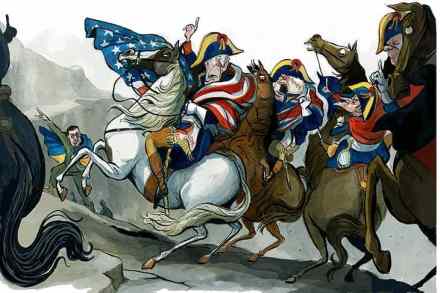
Europe needs to step up on Ukraine

From our UK edition

Vasyl, a burly, tattooed infantry commander who lost a leg to a Russian mine on the eastern front, sits swinging his remaining leg on the edge of the treatment table in the ‘Unbroken’ rehabilitation clinic in Lviv. He’s been inside the Russian trenches 50 times, he tells me. His stories are reminiscent of the first world war. I ask him what Ukraine needs for victory. Answer: ‘Motivated people.’ His T-shirt proclaims ‘no sacrifice, no victory’. After we shake hands and I wish him luck, he suddenly jumps off the table and starts skipping at amazing speed, his blue skipping rope whizzing around under his one foot, while he looks at me with a broad grin, as if to say ‘Here’s your answer’.

The need for speed in Ukraine: the West must be bold

From our UK edition

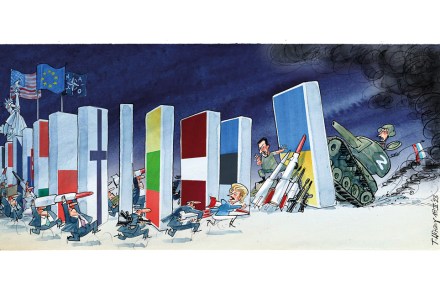
Kyiv General Valeriy Zaluzhny, stocky, forceful, apple-cheeked, sits at the desk in Kyiv from which he commands all Ukraine’s armed forces. I ask him what they need from the West. First, air defence. With a twinkle in his eye, he unzips his khaki fleece to reveal a garish T-shirt demanding ‘F-16s!’ Next on his list are long-range missiles such as the American ATACMS and the Franco-British Storm Shadow, so they can hit Russian targets beyond the range of their current armoury. Now the General jumps up, disappears behind a glass-fronted office cupboard into an improvised sleeping area, and returns with another T-shirt, this time calling for missiles. It seems he has a T-shirt for every weapon system.

How Ukraine can win

From our UK edition

If Ukraine lasts for another thousand years, people will still say, ‘This was their finest hour.’ The Ukrainians’ magnificent defiance will shape their country’s image in the world for generations to come, as the lone stand led by Winston Churchill did for Britain. But what almost certainly awaits Ukrainians in the next few days is far worse than what the British went through in 1940. They are about to face a Russian campaign of long-distance bombardment and siege to try to break their will to resist, through fear, hunger, thirst, cold, sickness and all the other consequences of indiscriminate destruction. Mariupol has already been devastated. Now the Chechen butcher Ramzan Kadyrov has announced he is in Ukraine, knife sharpened for more butchery.

Vlad the Invader

From our UK edition

35 min listen

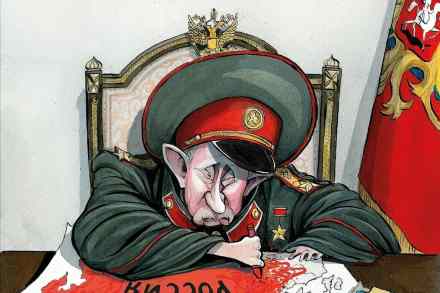
In this week’s episode: What does Putin really want for Russia?For this week’s cover story, Niall Ferguson writes about how Putin seems to be trying to recreate the Russia of the Past, while this week's diary by Timothy Garton Ash says the West has misunderstood his intentions, Niall and Timothy join the podcast along with Mary Dejevsky a columnist for the Independent. (00:48)Also this week: Should there be women-only spaces on trains? Jeremy Corbyn suggested it when he was Labour party leader and now Scotland seems to be flirting with the idea. Mary Wakefield says in this week’s Spectator that although she enjoys the idea of lady carriage, it doesn’t make much sense.

The West missed its chance to help Ukraine

From our UK edition

Yet another east European tragedy is unfolding before our eyes. We have watched this movie for more than 80 years. In 1938, Czechoslovakia was abandoned to its fate by Neville Chamberlain at ‘Munich’. In 1945, at the Yalta conference, it was Poland’s turn — and the eastern half of our continent lost to Soviet domination. Then the Soviet invasions of Hungary in 1956 and Czechoslovakia in 1968, followed in 1981 by a ‘state of war’ in Poland. ‘Goodbye to all that’ we naively thought after the end of the Cold War, but in 2008, Vladimir Putin’s Russia seized chunks of Georgia.

The beauty of the Normandy memorial

From our UK edition

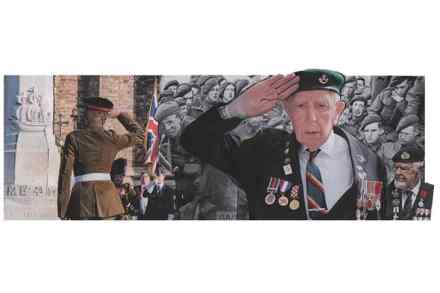
As the cross-Channel ferry noses into Ouistreham, I have a perfect view westward along the D-Day beaches. The excitement of arrival is heightened by the fact that this is the first time I have travelled to the Continent since Covid struck. Not since the age of 17 have I been absent from what the English call ‘Europe’ for so long — although of course, living in England, I have been in Europe all the time. My first objective on this trip is to see the new British Normandy Memorial at Ver-sur-Mer, the very place where my father landed with the first wave of the 6th Green Howards shortly after H-hour, 7.25 a.m., on D-Day in 1944. Located atop a high coastal bluff, the memorial commands a spectacular view of the Normandy beaches.

The fall of the Wall and my years as The Spectator’s man behind the Iron Curtain

From our UK edition

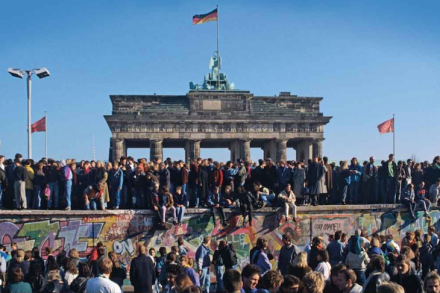
Bliss was it in that dawn to be alive, but to be young was strictly optional. Most of the heroes of 1989 were middle-aged. The leaders of the velvet revolutions, the Vaclav Havels and Lech Walesas, had been through prison, tough times and many a defeat before this incredible victory. Sure, there were often students in the front line — blithe, unattached, unafraid; but what was most moving to me, as I talked to people in the crowds in Leipzig, Gdansk or Prague, were the older men and women who had endured so much and never believed they would see this day. Women who for 28 years had never even set foot on the other end of their own street, because the Berlin Wall cut across it. Men like the East Berlin porter who told me: ‘Now people are standing up straight...

I was the man from Spekta

From our UK edition

Bliss was it in that dawn to be alive, but to be young was strictly optional. Most of the heroes of 1989 were middle-aged. The leaders of the velvet revolutions, the Vaclav Havels and Lech Walesas, had been through prison, tough times and many a defeat before this incredible victory. Sure, there were often students in the front line — blithe, unattached, unafraid; but what was most moving to me, as I talked to people in the crowds in Leipzig, Gdansk or Prague, were the older men and women who had endured so much and never believed they would see this day. Women who for 28 years had never even set foot on the other end of their own street, because the Berlin Wall cut across it. Men like the East Berlin porter who told me: ‘Now people are standing up straight...

Diary – 21 July 2016

From our UK edition

These days, you only need to turn your back for five minutes and you’ve missed another horror. The Turkish coup may have been foiled by incompetence, Facetime and people power, but President Recep Tayyip Erdogan is seizing the chance to consolidate his increasingly authoritarian regime. My friend Ayse Kadioglu, one of Turkey’s brave, embattled liberal intellectuals, compares the bombing of the parliament building in Ankara to the Reichstag fire of 1933 — not in the sense of being a put-up job, but as a pretext for strangling democracy. Our new Foreign Secretary needs to produce more than a rude limerick in response. In the last fortnight I have made my annual migration from Oxford to Stanford, so out of the Brexit frying pan into the Trump fire.

The Timothy Garton Ash prize for European writing – winner announced

From our UK edition

In this week's issue of The Spectator, Timothy Garton Ash announces the winner of the prize founded in his name for European writing. Below is the extract from his diary, as well as the winning entry.  I’m delighted to learn that a former student of mine, Annabelle Chapman, is the first winner of The Spectator’s Timothy Garton Ash Prize — and especially so because she writes about Poland and eastern Europe. Nice though it is to have a prize offered in my name, it does make me feel vaguely, well, deceased. I recall a bibulous Spectator lunch many years ago when the question came up if so-and-so was dead. Alexander Chancellor memorably responded, ‘Er, I don’t think he is… completely.

A conservative case for staying in

From our UK edition

I open a dusty binder and look at my yellowing Spectator articles from Poland, Germany and Russia in the dramatic 1980s. And here’s one from Brussels in 1986, suggesting that Britain was edging towards finding its role in the European Community. Ho ho. Back then, Charles Moore was the editor and I was the foreign editor of this magazine. He shared my passion for the liberation of eastern Europe, while becoming increasingly dissatisfied with the western European Community, but he let me make the case for it. Now, 30 years on, Charles and I stand on different sides of a historic national argument. This makes for a curious role reversal. I am a lifelong liberal (small ‘l’) but my argument for staying in the EU is fundamentally conservative (small ‘c’).