Features

Less sex please, we’re British

Jeer if you will, but I was shocked by the latest Bridget Jones book, Mad About the Boy. I was shocked by the sex. No, honestly. Compared with its predecessors, including a one-off series about how Bridget got pregnant but wasn’t sure by whom, this latest book ratchets up the raunch quite markedly. Granted, Bridget is having it off with a boy of 29 (to her 51), but there weren’t any passages from her previous diaries like this: ‘Oh God. What was I thinking having sex all night? The whole makeup/breakup thing somehow whipped Roxster and me up into a sexual frenzy and neither of us could stay asleep. Was actually hanging upside down from the side of the bed with Roxster holding both my legs in the air whilst thrusting in between them when suddenly —’.

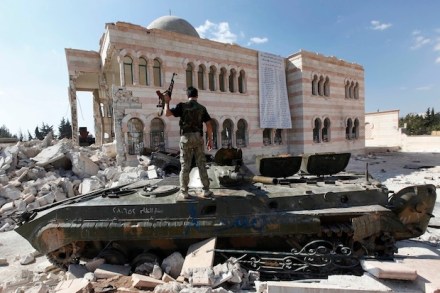
A new Islamist alliance among Syria’s rebels has given Assad the enemy he wants

   Amman — Beirut — Istanbul I recently bumped into a senior officer with the rebel Free Syrian Army who was waiting in the passport queue at the Turkish border. I didn’t recognise him at first, out of uniform and without his entourage, and I told him so. He was following the example of the 7th-century Second Caliph, Omar bin al Khattab, he replied. The caliph was so humble he took turns with his servant riding a horse to Jerusalem to receive the city’s surrender. There was no imagery from Islamic history when I first met the officer a year ago. He was one of those ‘rebels’ western officials have in mind when they describe a ‘secular, moderate’ armed opposition.

The war on Christians

Imagine if correspondents in late 1944 had reported the Battle of the Bulge, but without explaining that it was a turning point in the second world war. Or what if finance reporters had told the story of the AIG meltdown in 2008 without adding that it raised questions about derivatives and sub-prime mortgages that could augur a vast financial implosion? Most people would say that journalists had failed to provide the proper context to understand the news. Yet that’s routinely what media outlets do when it comes to outbreaks of anti-Christian persecution around the world, which is why the global war on Christians remains the greatest story never told of the early 21st century.

Notes on …The Tarn Valley

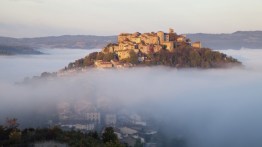
Why didn’t I know about the Tarn Valley? I’d often been right next door. But here, north-east of Toulouse, between the baking fields of Gers and the rocky mountains around Carcassonne, is this best-kept secret. It’s a lush region of great rivers, rolling green hills and towns with magnificent red-brick gothic architecture and is sometimes referred to as the Triangle d’Or (mostly by estate agents). The sea is three hours away in either direction, which is a boon, meaning that even in August it was eerily devoid of tourists. If the points on the triangle are the towns of Gaillac, Albi and Cordes sur Ciel, in between are any number of really beautiful bastide villages.

Do miracles happen?

Two recent popes are to be canonised on 17 April next year: Angelo Roncalli, Pope John XXIII, and Karol Wojtyla, Pope John Paul II. Both are being declared saints in haste: conventionally the Church has waited for a few hundred years for the dust to settle, with slow promotion from ‘venerable’ to ‘blessed’, before declaring de fide that a soul is with God in Heaven. To establish that this is indeed the case — that a soul is in Heaven — miracles have to be ascribed to candidates for canonisation. The saints themselves do not perform miracles: this is done by God at their request. He, God, interferes with the laws of nature to cure from terminal illnesses those who have prayed to the candidate.

Witch-hunting capitalism in Africa

   Johannesburg  I stumbled upon a grand story the other day, thanks largely to my girlfriend Shmerah, who is doing a masters in anthropology at the nearby University of the Witwatersrand. One afternoon some weeks ago, Shmerah informed me that she and her classmates were excited about the imminent arrival in Johannesburg of the Italian-American philosophy professor Silvia Federici, described as one of the planet’s foremost leftist theoreticians. We were in the car at the time, bickering about something or other. Knowing it would irritate me, Shmerah rummaged in her bag, produced one of Federici’s academic papers and proceeded to read it out loud.

If nurses are really ‘at breaking point’, they should stop working 12-hour shifts

Scarcely a month goes by, or so it seems, without one or other representative body of the medical profession complaining about how dangerously overworked and generally unappreciated its members are. The latest is the Royal College of Nursing — still smarting, perhaps, from the Francis report into the fatal negligence at Stafford Hospital — which found that nurses today are frequently stressed out and ‘forced to choose between the health of their patients and their own’. Forgive me, but they would say that, wouldn’t they? The preamble notes that morale has deteriorated since a similar RCN survey eight years ago published under the same self-fulfilling title, At Breaking Point.

If you think British banks are bad, you’ve never tried China’s

It’s hard to think of anything more badly run than a Chinese bank. Somalia perhaps, or the BBC’s remuneration committee. Certainly, Beijing’s embattled lenders make ours look like paragons of financial rectitude. We may dislike RBS et al for bringing our economy to its knees, but at least we’re not saddled with a cabal of banks inextricably linked to whoever resides in Downing Street. Let’s start with good old-fashioned service. We may complain about our banks, how they all look the same and bombard us with adverts that would patronise a two-year-old. But at least they pretend to care. China’s banks don’t. Service is dire wherever you go. Internet or mobile banking ranges from poor to non-existent.

Mark Carney has a £250,000 housing allowance – why would he care about rising property prices?

In popular myth, King Cnut the Great, more commonly known as Canute, set his throne on the sea shore and commanded the tide to retreat. One version has it that Cnut’s display was a sign of regal arrogance — though if the event ever did occur, it was more likely a rebuke to obsequious courtiers. Speaking of which, the financial media have been in thrall to a new king of finance since Mark Carney was elevated to the governorship of the Bank of England in July. His procession to office included previous high-ranking positions at Goldman Sachs, the Canadian Department of Finance and the Bank of Canada. If you’re in the mood for a wry smile, visit the Bank of England’s website.

If only more banks were more like Wonga

I know a lot of people who work in the financial industry. One on one, they are decent and kind. I’d trust them to look after my handbag in the pub while I went to the Ladies. But you know what? I wouldn’t trust many of them to look after my pension or my ISA. In fact I’m pretty damned sure that if I bought a financial product from them, they would devote themselves to slowly stealing my savings. I’m not alone in feeling like this. PressChoice does an annual survey asking journalists how much they agree or disagree with the statement ‘the financial services industry conducts itself in an open and honest way’. In 2008 the majority agreed.

Why Britain’s economy will overtake Germany’s

What’s the most surprising thing that could come out of the current economic upturn? A rapid revival in northern manufacturing? The City really getting behind small British businesses? Ed Balls admitting higher public spending wasn’t always the best way to promote growth? Any of these eventualities would be fairly amazing. But the biggest surprise would perhaps be this: a gradual realisation that the UK is on track to become the largest economy in Europe. In the 19th century, at the height of the industrial revolution, the UK outproduced all of its European competitors. It steadily lost that position, however, ceding industrial leadership to the Germans and the French. In the next couple of decades that pattern will start to reverse.

Al-Qa’eda targeted Kenya not because it’s a banana republic, but because it’s a symbol of African success

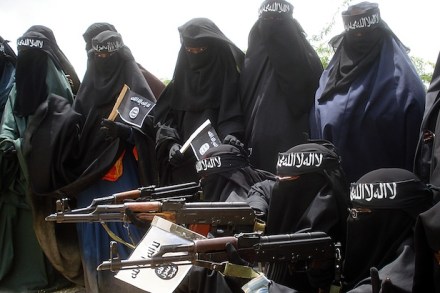
If Al-Shabaab was behind the terrorist attack in Nairobi, then the group has come a long way since its foundation in a derelict shampoo factory called Ifka Halane — ‘Clean and Shiny’ — in Mogadishu in 2006. I know a little about the group because I am the only westerner to have met its founder, Aden Hashi Ayro, before he was killed in a US air strike. In those days Al-Shabaab was a small militia providing muscle for the Islamic courts in Mogadishu. For a brief spell the courts did a good job of bringing a degree of law and order. Then Washington foolishly backed an Ethiopian invasion of the country. For Al-Shabaab, this was a godsend. Afghan-trained Salafists don’t enjoy fixing drains or street lights. Insurgency is much more worthwhile.

How we survived terror at Nairobi’s Westgate mall

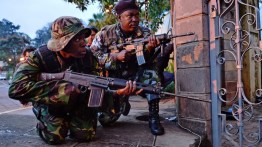
 Nairobi Kenya is one of those places where everybody knows everybody — and each one of us seems to have friends or relatives caught up in the Westgate shopping mall terrorist attack. My friends Simon and Amanda Belcher were on their way to lunch at the mall before catching a film at the cinema. They had parked their car on the top floor and walked past a marquee where a children’s ‘super chef’ cookery competition was about to start when gunfire erupted inside. Simon at first thought ‘firecrackers’. Then they heard shots from the ramp up to the car park. Walking towards them were two slim young men carrying AK-47s with their faces swathed in Arab scarves.

A man of his Times: Lord Danny Finkelstein

Thomas Barnes, who edited the Times from 1817 to 1841, declared that the ‘newspaper is not an organ through which government can influence people, but through which people can influence the government.’ There have been periods when principle guided the Times — for instance when the great war correspondent W.H. Russell exposed government incompetence in the Crimean War. At other times the newspaper has a tendency to become the organ of official opinion, impartially supporting any political party (just so long as it happens to be the one in power). Ten years ago its political pages resembled a New Labour noticeboard.

Notes on…The house museums of Paris

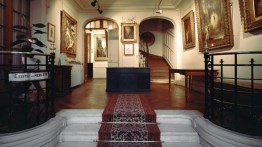
It doesn’t matter how many times they expand the Louvre or the Musée d’Orsay, Paris’s past is so colossally rich that it could never be squeezed into its great public buildings. The city has instead developed its own breed of ‘house museum’ — ready-made monuments to its distinguished inhabitants. It’s not just regular tourist stops like the Maison de Victor Hugo, either. In Montparnasse, the studios of artists Ossip Zadkine and Antoine Bourdelle display sublime sculpted figures in shaded gardens, and across the Seine from the Eiffel Tower you will find Balzac’s former village home, cramped among the Belle Époque curves and 1970s luxury towers of the 16ème.

Ukip, the gateway drug — how Cameron can exploit Nigel Farage

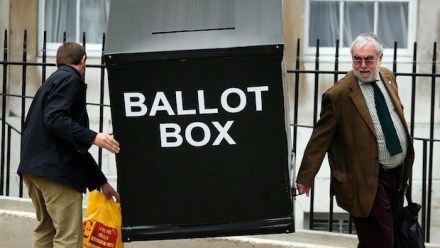
David Cameron heads to the Tory conference in Manchester in a far better position than he would have dared hope a year ago. Labour’s opinion poll lead is shrinking, the economy is finally recovering and Ed Miliband is running out of time to persuade the country that he’s a potential Prime Minister. Ordinarily, the Tory tribe would be in high spirits — but there is a spectre haunting this conference, which almost no one dares name: Ukip. Nigel Farage’s insurgent party is fast becoming an existential threat to the Tory party. The right in Britain is fractured — and fractured movements don’t win elections. In the 1980s, Margaret Thatcher romped to victory against a left that was split between Labour and the SDP.

Electric cars – the ultimate subsidy for the rich

This morning, Nick Clegg promised to take £500 million from taxpayers, and use it to subsidise electric cars. Last year, the Spectator's annual Matt Ridley Prize was won by an essay exposing the idiocy of the scheme - and the menacing social implications of subsidingof the rich.  My wife’s friend Charlotte earns £17,000 a year working as a teaching assistant, lives in a housing association flat and is having sleepless nights about paying her recent £124.78 electricity bill. My friend Toby earns £425,000 a year as a media lawyer, lives in a big house in Putney and every day the no doubt well-meaning but somewhat misguided people of Westminster City Council give him hours and hours of free electricity.

Chris Grayling: ‘I want to see our Supreme Court supreme again’

When I meet Chris Grayling in his departmental office, I do a double take. The Justice Secretary is not wearing a suit or even his Lord Chancellor’s robes but a pair of pale chinos and a pink Ralph Lauren button-down shirt. Noticing my surprise, Grayling reveals that this is his definition of ‘smart casual’: he’s off to a Tory away day straight after the interview. Grayling is 6ft 5 and his height makes his mood pretty obvious. Straight after the last election, his shoulders were hunched and his head was down. As he now admits, ‘I didn’t want us to go into coalition.’ Compounding his misery, he had missed out on a cabinet post despite having been shadow home secretary. But Grayling is now in cabinet and standing tall.