Features

Time for our leaders to stop talking about ‘justice’ in Syria if we can’t or won’t enforce it

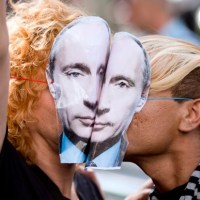
‘It’s about chemical weapons. Their use is wrong and the world shouldn’t stand idly by.’ — David Cameron, 27 August ‘The chemical massacre in Damascus cannot and must not go unpunished.’ — François Hollande, 30 August ‘We lead with the belief that right makes might, not the other way around.’ — Barack Obama, 31 August In their speech, in their manner and in their choice of language, the American President, the French President and the British Prime Minister have been impeccably clear about their motivations for military intervention in Syria. They don’t want to use force for economic gain. They aren’t in this for national interest.

The ideal death show

I am in a yurt, talking about death. Everyone is seated in a circle, and I am the next-to-last person to share. The last of the summer sun is shining through the entrance. At one end is a display coffin of biodegradable willow — there’s also tea and coffee, and coffin-shaped biscuits with skeleton-shaped icing. ‘I am a reporter,’ I say. ‘I’ve come to cover this event. But don’t worry, I won’t report what you share in this yurt. Also, I have cancer. I have been in treatment for one year, but now the treatment is over. I take one day at a time.’ There is silence, then hugs. I thought I would cry, but I don’t. Instead, I feel acceptance and a strange kernel of satisfaction.

The importance of not being called Nigel

You know what the real problem with Nigel Farage is? It’s not his politics, for they are a matter of personal taste. No, it’s something more objective. His name. And not that improbable surname, either, the one that makes him sound like a Bond villain. It’s the Nigel. There’s a passage in Julian Barnes’s novel Talking It Over which summarises the problem nicely. One of the characters, Oliver, used to be called Nigel until he changed his name by deed poll. ‘You can’t go through the whole of your life being called Nigel, can you?’ he explains. ‘You can’t even go through a whole book being called Nigel. Some names simply aren’t appropriate after a while.’ How true.

Hospital food isn’t a joke. It’s a scandal

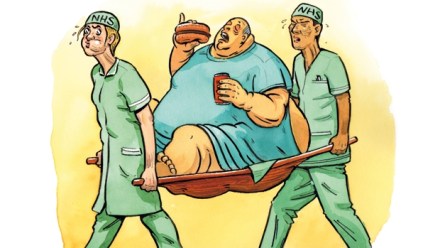
One of the patients I see regularly as a voluntary hospital visitor, who has been in hospital for weeks, seems to be getting better. Still skeletally thin, he is now sitting up and complaining. His problem is that he longs for a jacket potato with just butter. He hates beans. But he might as well ask for gravadlax and dill. On the hospital menu, baked potatoes only come with baked beans. I asked one of the Thai ladies who deliver the food if he could possibly have a plain spud. ‘Not possible,’ she said, ‘all with beans.’ She said she would go and ask someone, but who that might be I don’t know: I have never seen anyone in charge of food. ‘It’s hopeless,’ he told me. ‘I’ve asked them before, they won’t do it.

Seamus Heaney’s poems are for Protestants too

The one and only time I met Seamus Heaney, in 2007, he was making tea in the kitchen of his Dublin home when he asked — more modestly regretful than coy — ‘Did you have to do the poems at school?’ I grew up in Belfast, and certainly we had to do the poems at school. Even in the early 1980s, in a disputatious city that was frequently contemptuous of life but rarely of poetry, it was Heaney whose reputation already seemed cast in bronze. His lines on Northern Ireland defined us internationally, like it or not: it was clear that we had somehow grown someone big, a poetic prize -marrow. At that time, my flicker of vicarious pride was mixed with a sense of being informally exiled from the celebration.

Obama knows that America has lost its appetite for war

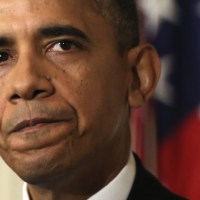
It was to Fort Belvoir that President Barack Obama repaired on Saturday, minutes after he announced that attacks by the Syrian government on a rebel stronghold in Damascus constituted ‘an assault on human dignity’ and a ‘serious threat to our national security.’ By using what the US government says was sarin gas, Syria’s dictator Bashar al-Assad crossed a ‘red line’ that Mr Obama had laid down a year before. The President has asked Congress to authorise an attack on Syria as soon as legislators return on 9 September. Fort Belvoir is home to the US army’s 29th Light Infantry Division. More to the point, it is the site of a terrific 18-hole golf course, and the President had a mid-afternoon tee-time with the Vice President.

Why zig-zagging Obama can’t be taken seriously on Syria

President Obama’s decision to seek  the endorsement of Congress for an attack on Syria fits into one or more definite patterns of behaviour, if not strategy. His preference, much praised by the media until recently, for ‘leading from behind’ suggests at least some aversion to risk and responsibility. It also fits into the general zigzag of his Middle Eastern policy since his Cairo speech reaching out to Islam. Intended to undercut the appeal of radical Islamism, the speech looked appeasing and so encouraged it.

Notes on…Sicily

It could be, in Sicily, there comes a time when you’ve had your fill of seaside calamari and cheap white wine. The sheer thrill of lying on a beach without goose-bumps never really fades, but by day four you may need a break from all the nakedness: Italians blackening in rows like sausages, or Brits, more lumpen, clumped in ones and twos, turning pink. If you can bring yourself to turn your back on the Med, it’s well worth it. From Palermo, take the coastal road, then turn right, inland on the A19 towards Catania. Or drive south on the world’s most surprising motorway, which leaps right over Monreale and lands on the cliffs above. Head south-east and soon the countryside will flatten into hills and plains of durum wheat baked yellow, waiting for harvest.

Parliament has finally woken up – because voters are keeping their MPs in line

They should have seen it coming. A government defeat on an issue of war may be unprecedented, but defeat on the Syria vote did not come out of the blue. You can certainly blame poor party management, failure to prepare the ground, underestimating the poisonous legacy of Iraq — but such failings are common enough. The biggest single factor is one that ministers, the media and MPs themselves have failed to understand: Parliament has changed. The consensus has long been that Parliament no longer matters. It is assumed to be the docile creature of the government, full of spineless or ambitious MPs who are the slaves of the party whips. In fact, unnoticed and under our noses, that has been becoming progressively less and less true throughout my 30 years in Parliament.

Notes on…Rome

Leave Florence and Sienna to the aesthetes. Let the in-crowd do Naples and Palermo. For the amateur Italophile, Rome is the destination. The eternal city is endlessly glorious, chaotic, stylish and funny: where else do you see nuns listening to iPods? Or medieval churches with condom machines by the doors? You can barely walk ten feet without coming across something that might change your life: obelisks, piazzas, churches, gardens and statues. All that antiquity makes Roman Catholicism seem distinctly modern. And there’s the hotels. I spent a Friday night in Rocco Forte’s Hotel de Russie on the Via del Babuino, near the Spanish steps, slap-bang in the best part of town. The room was more of a suite, or what a London estate agent would call a spacious nine-bedroom apartment.

The views that inspire writers

Unimaginatively, I usually take the same route for a morning walk when on holiday in Cornwall, over the dunes to Brea Hill, inspiration for Betjeman’s poem ‘Back From Australia’. I know the scenery so well I no longer see it. But for a change the other day I walked along the other side of the estuary and it was like seeing an entirely new landscape: the gently scalloped sandbanks, the clarity and blueness of the water, the breadth of the sky where it met Pentire Point. There were no clouds, which emphasised the white of the sails, the seagulls, the cabbage butterflies. Imagine having this as the view from your study, I thought. How inspired you would feel.

Welcome to Ryanair Britain

Which businessman is the most influential in the making of government policy? The answer came to me when I received a letter fining me £80 for forgetting to renew my car insurance by the correct date. But it could also have come to me had I forgotten to fill out of council tax enquiry form (fine £70), missed getting in my tax return by one day (£100), or got caught in a box junction in the King’s Road which has two sets of traffic lights in quick succession (£130). It is, I have come to believe, Michael O’Leary.

The charity that could make you love social workers

Is any public service more reviled than social work? Policemen, when not drinking with journalists, chase down baddies; firefighters save babies, and doctors cure diseases. Social workers, on the other hand, take away people’s children. They miss catastrophic abuse. In no news story are they ever -heroic. The perception of social work is unremittingly grim. It’s badly paid, box-ticking, mired in bureaucracy. Only go into it if you like being a martyr. Josh MacAlister, the chief executive of Frontline, wants people to imagine things differently. In a decade he thinks social work will be one of the main options for top graduates. At an Oxford careers fair, he suggests, students will be queueing up at the social work stand. Entry will be fiercely competitive.

David Cameron’s wars: How the PM learned to love precision bombing

What is the one consolation for an MP who has beaten all their colleagues to the top job? It can hardly be the luxury of having your life, circle and income open to alternate snorts of envy and derision. Nor can it be the quagmire into which nearly all attempts to solve the nation’s domestic problems now fall.  Only one thing allows prime ministers of a country such as Britain to feel they have power. That is exercising it. And nothing exercises power more than deciding which wars to fight. In opposition, David Cameron did not much like the idea of war, and derided his colleagues for their admiration of Tony Blair. Yet in office — as Syria is revealing — he is treading a very similar path.

Faulty towers

Ever since the Arab Spring sprang its bright new dawn, the old regimes of the Middle East — along with their economies — have fallen like dominoes. But one authoritarian regime, at least, stands taller than ever: Saudi Arabia. Its shimmery skyline, its modern minarets, all testify to the infallibility of petroleum-rich power. Yet there’s one enormous sign that Saudi may be headed for the skids. This year, the Saudis started construction of the Kingdom Tower, a 200-floor skyscraper which is due to be completed in 2017. This citadel has the backing of Prince Alwaleed bin Talal, and will be built by the Bin Laden family (the late Osama was a relation, though they disavowed him years ago). The building will have 59 lifts, luxury apartments, offices and a Four Seasons hotel.

The future made Thiel

Turn right along the American political spectrum and you find all kinds of curious species. First there are country club Republicans bemoaning the loss of their party to extremists. Then come Evangelical Christians, trying to reconcile themselves to voting for a Mormon. Further along, you find the Tea Party, crowing over their improbable rise and Mitt Romney’s choice of Paul Ryan as his running mate.

Why borders matter

There is no better way of discrediting an opinion than by attributing it to a psychological quirk or peculiarity. The task is then not to refute it, but to explain it away by reference to its murky psychic origins. For a number of years, doubt about the wisdom of a European project (whose end can only be seen as through a glass, darkly) was attributed by its enthusiasts to precisely such a quirk: one that combined some of the features of mental debility, arachnophobia and borderline personality disorder. One would not be altogether surprised to learn that the European Union had sent lobbyists to Washington to have Euroscepticism included in the forthcoming revised version of the Diagnostic and Statistical Manual of the American Psychiatric Association as a new diagnostic category.

A lesson in humility

When I went into teaching, 15 years ago, I came at it from various angles. One was the love of my subject. Genuinely. I definitely believed that I could make people love reading and writing, and make the world a better place. I was old enough not to be so naïve, but still… The other was a sartorial issue. I did an ill-advised massive spend on tweed. Mostly pink. Should have known better there, too. I did not go into teaching because ‘I loved kids’. How can you love ‘kids’ any more than you can love octogenarians, or Poles, or pole-dancers, or any other group of people? I left a good university with a good degree and no one suggested that I should go into teaching. In the 1980s, teachers were thought of as second-rate citizens.