Features

The roots of the matter

[audioplayer src="http://rss.acast.com/viewfrom22/panictimefordavidcameron-/media.mp3" title="Lara Prendergast and Louise Bailey, a hair extensions specialist, discuss the hair trade" startat=1622] Listen [/audioplayer]Perhaps you recall the moment in Les Misérables when Fantine chops off all her hair? The destitute young mother sells her long locks, then her teeth (a detail often excluded from child-friendly adaptations) before she is eventually forced into prostitution. It would be nice to think that her experience was no longer a reality, that the business of human hair had gone the way of the guillotine — but the truth is, it’s booming. The modern market for extensions made of real human hair is growing at an incredible rate. In 2013, £42.


Shrunk

 New York City Nothing says New York like a psychoanalyst’s couch. Think Woody Allen or those New Yorker cartoons. It fits our perception of east-coast Americans as all neurotic and self-obsessed. But that mental picture needs updating, because traditional psychoanalysis is in dramatic decline in its traditional heartland. Across the urban US, in fact, the profession is dying out or having to change drastically. New figures from the American Psychoanalytic Association reveal that the average age of its 3,109 members is 66, up four years in a decade. More seriously, the average numbers of patients each therapist sees has fallen to 2.75. Some shrinks now never meet patients, dealing with them only via the phone, Skype or email.

Remembering Raymond

I first heard of Raymond Carr, who wrote for this magazine for more than 40 years, when I was in Italy in the army at the end of the second world war, and I had a letter from my sister in London saying that she had met the most marvellous man who was not only very funny but immensely clever, and I must meet him when I got back. By the time I did, Raymond had moved from being a wartime schoolmaster at Wellington College to a being a resident fellow of All Souls, Oxford. He was, yes, both immensely funny and rather grand. Raymond Carr had been educated at Brockenhurst school, and then in 1941 won a history scholarship to Christ Church, Oxford, having continued his education (as he used to put it) by teaching himself the clarinet and supporting himself by performing in a jazz band.

Hillary’s left turn

The centrist Democratic party bequeathed to President Barack Obama by Bill Clinton is not the one he will leave to his successor. By every measure, it is more left-wing, and more populist both in spirit and ideological composition. And this poses serious problems for the campaign of the candidate seen as America’s most likely next president: Hillary Clinton. That she knows it’s a problem is obvious from the way her campaign has begun. ‘Everyday Americans need a champion, and I want to be that champion,’ she declared in a video released last weekend. Almost a year ago, launching the memoir of her time as Secretary of State, Clinton had begun testing populist themes. The nation, she said at the time, must ‘deal with the cancer of inequality’.

Scotland’s new national faith

The Church of England’s catechism begins ‘What is your name?’ The old Presbyterian catechism favoured in Scotland asked a better, sterner question: ‘What is the chief end of man?’ The difference is telling and, in this general election, illuminates something useful about the differences between politics north and south of the Tweed. Nicola Sturgeon is a populist, certainly, but she is offering something stronger on the side. If England’s election offers a meek choice between Cameron and Miliband, Scotland’s is a faith-based affair. The answer to the catechism’s question, in these irreligious days, appears to be that man’s chief end is to glorify Scotland and enjoy her for ever.

Easy virtue

Go to a branch of Whole Foods, the American-owned grocery shop, and you will see huge posters advertising Whole Foods, of course, but — more precisely — advertising how virtuous Whole Foods is. A big sign in the window shows a mother with a little child on her shoulders (aaaah!) and declares: ‘values matter.’ The poster goes on to assert: ‘We are part of a growing consciousness that is bigger than food — one that champions what’s good.’ This a particularly blatant example of the increasingly common phenomenon of what might be called ‘virtue signalling’ — indicating that you are kind, decent and virtuous. We British do it, too. But we are more sophisticated, or underhand.

Jews against Miliband

When he was seven, Ed Miliband was taken to visit his grandmother in Tel Aviv. Pointing to a black-and-white photograph in her home, young Ed demanded to know who ‘that man in the picture’ was. He was told the man, David, was his grandfather and had died in Poland many years before he was born. Only years later did Miliband realise that his grandfather had been murdered by the Nazis for being Jewish. Miliband’s parents only narrowly escaped a similar fate: fleeing Belgium as the German armies overran it in 1940, his 16-year-old father caught the last boat from Ostend to Britain.

‘Paint goes on living’

Maggi Hambling is 70 later this year, and a career that took off when she was appointed the first artist in residence at the National Gallery, in 1980, shows no signs of slackening in momentum. Hambling is still as uncompromising as ever, and as difficult to categorise. An artist of sustained originality and inventiveness who fits no pigeonhole and is part of no group, she is a resolutely independent figure (she enjoys the description ‘maverick’) who considers it her duty to keep questioning assumptions (her own as much as other people’s) and looking afresh at the world.

Fat chance

[audioplayer src="http://rss.acast.com/viewfrom22/theriseofleft-wingpopulism/media.mp3" title="Julie Burchill and Katie Hopkins discuss whether you can be fat and happy" startat=924] Listen [/audioplayer]I’m a very off-message type of fat broad; one who gladly admits she reached the size she is now solely through lack of discipline and love of pleasure, and who rather despises people (except those with proven medical conditions) who pretend that it is generally otherwise. I’m not attached to my fat in any but the most obvious way; would I lose it if I could snap my fingers? Without doubt. Would I work at losing it? Not a chance, Vance. ‘But it’s not about vanity,’ the weight bores bleat, ‘it’s about health.’ Hmm.

The Miliband agenda

Here's what to expect 52p top rate of tax Ed Balls won’t be looking for money when he says the ‘additional’ top rate of tax will go back up — there’s no evidence it will raise any. Top-band income tax will be 50p, which added to the extra 2p National Insurance would give Britain an effective top tax rate of 52 per cent. If it’s a temporary measure, as Balls has hinted, one-percenters will defer bonuses and disappear from the statistics (a problem, when they pay £1 in every £4 of income tax). If it’s permanent, they may scarper. If Balls really wanted to raise money from the rich he’d cut the 45p rate. But what he’s really after is banking public support by banker-bashing.

Fringe benefits | 9 April 2015

No election night is complete without a man dressed as King Arthur waving a plastic sword as the result is read out. Eccentricity is the bedrock of British democracy. The freedom of a madman to waste £500 to get on the ballot is precious. On these islands, we have a right to rave. And sometimes what we rant about is quite revealing. I’ve been fascinated by eccentric independent candidates ever since as a teenager I met Mr Mark Ellis, a perennial independent running against EU domination and casual littering. He used to patrol Sevenoaks high street with a shopping trolley, collecting rubbish. A profile in the local newspaper revealed that he slept on two chairs pushed together in his living room, and that he shared his house with a duck.

The age of the Skype Dad

Could you be a useful and loving father to your children if you only ever saw them on a computer screen? Most of us would say no. So much of being a parent is about being physically there. It’s curious then that our courts seem to think the opposite — that a chat via Skype or on an iPad is all a father needs to bond with and care for his child. British judges, like American ones, have to deal with increasingly complicated custody cases every year. We travel more these days, and so we meet our partners abroad. When these marriages break up (as four in ten marriages do), a foreign wife often longs to take the kids and head back home.

Hell on wheels

How many of the people driving mobility scooters these days actually need a mobility scooter? The invention of the vehicle was a great move forward (literally) for those who genuinely needed it: the disabled and the infirm. But then another group of users appeared. Rather slowly, admittedly, and wheezing as they did so, before settling their vast backsides into the soothing embrace of the scooter’s seat. Once there they sighed happily, popped another Kit Kat into their gob and contemplated a life where movement from A to B required a mere flick of the wrist, rather than all that tedious leg business. This supersized scooter squadron has conquered Britain with an ease that the Romans in their chariots could only have dreamed of.

The Catholic crack-up

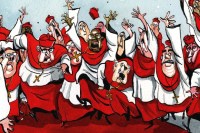
[audioplayer src="http://rss.acast.com/viewfrom22/edcouldstillwin/media.mp3" title="Freddy Gray and Damian Thompson discuss the Catholic crack-up" startat=1403] Listen [/audioplayer]A scurrilous rumour recently swept Rome: the Pope had summoned the Vatican’s finance czar over his expenses. When Cardinal George Pell admitted spending more than £3,000 on a designer kitchen unit, Francis quipped: ‘What, is it made of solid gold?’ That never happened, of course, but the tittle-tattle served a purpose. The story appeared in an Italian magazine just as Francis was deciding how much power to give Cardinal Pell over the curial accounts. Influential figures wanted to keep their money away from the cardinal’s prying eyes.

In defence of Christianity

Jeremy Paxman was on great form last week, reminding us that when it comes to being rude to prime ministers he has no peers. Jeremy’s rudeness is, of course, magnificently bipartisan. However elegant the sneer he displayed when asking David Cameron about Stephen Green, it was as nothing compared to the pointed disdain with which he once asked Tony Blair about his faith. Was it true, Jeremy inquired, that he had prayed together with his fellow Christian George W. Bush? The question was asked in a tone of Old Malvernian hauteur which implied that spending time in religious contemplation was clearly deviant behaviour of the most disgusting kind.

What happened to Julie Burchill on silent retreat

When I told my friends that I was planning to attend a silent retreat, they all laughed. It’s true that I am something of a convivialist; my idea of heaven is a big table in a warm restaurant, the table shimmering with the laughter of friends and the glugging of wine, and me picking up the bill. On the other hand, I was a solitary only child and I look back on those days with great fondness. Before the long stagger up the primrose path of pleasure started, the only companion I needed was a book; I well remember my mother crying because I preferred to sit in my room reading rather than hang around on street corners getting drunk and/or pregnant like a normal teenager.

‘The truth is hard’: an interview with Roger Scruton

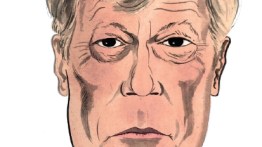
To the extent that Britain has philosophers, we do not expect them to address issues of any relevance to the rest of us. They may pursue some hermeneutic byway perhaps, but not the urgent or profound issues of our time. Roger Scruton has always been an exception in this regard, as in many others. He has spent his adult life thinking and writing about the nature of love, the nation state, belonging, alienation, beauty, home and England. But even his closest readers may gulp at the relevance of his latest subject matter. His new novel, The Disappeared, is set in the north of England and centres on the recent rape-gang cases. It’s a gripping, disturbing narrative dealing with abduction and abuse but also love, escape and a type of redemption.

The populist outsider who really could beat Hillary Clinton (clue: it’s not Elizabeth Warren)

 Washington DC   Bored American reporters are pining for a Democratic primary challenger to step up against Hillary Clinton in 2016. We don’t like coronations. It’s not just cynical Republicans who cheered at ‘emailgate’ — the crisis Clinton faced after it emerged she had used a private account for her emails as Secretary of State. It makes matters more interesting, and moves the spotlight on to other, less celebrated politicians. The media is consequently obsessed with the idea that Elizabeth Warren, a Massachusetts Democrat admired by Occupy Wall Street, can take on Hillary. The more logical opponent is Joe Biden, the Vice President. There’s also Bernie Sanders, self-described socialist senator from Vermont.