Philip Delves-Broughton

As New Yorkers flee, the suburbs are under siege

From our UK edition

New York ‘Land of the Flee’, screamed the New York Post front page this week. Moving vans are lining up in Manhattan. Residents have had enough. It had been ‘another bloody weekend in Gotham’ with 21 people shot, and a rising wave of non-gun violence. At 11 a.m. on Saturday, a man leapt on top of a young woman on a subway platform in midtown and began grinding against her until a group of bystanders forced him to stop. You can watch the whole thing on video and decide never to take public transport again. Living in New York has always felt like walking on a very narrow beam. The chasms on either side are the thrill of it. They create extremes of excitement, anxiety, achievement and despair. But many are now deciding: to hell with the city that never sleeps.

Indolence and experience

From our UK edition

 School holidays for the children of the affluent used to be about doing nothing in particular. Tagging along to a sun-baked villa, perhaps, or slouching around Verbier in search of familiar Harrys and Rosies. For the unlucky facing an exam year, there might be a week or two of cramming. But otherwise, these were the weeks of indolence and precious irresponsibility, the time to charge the batteries for the looming decades of early mornings in the City. Not any more. The battle for jobs is starting ever earlier, creeping grimly into these teenage years in the form of the ‘internship’. This is no summer job in a pub or a shop to make a bit of money, but a full-blown, put on a suit and go and lurk around adults professional try-out.

Why Carly Fiorina (probably) can’t save the Republicans

From our UK edition

The Republican party is showing all the attention span of a hyperactive toddler this primary season, moving from one shiny toy to the next. Donald Trump still dominates the nursery, like some giant plastic fire engine. But the pieces are starting to look careworn and the battery is going on the siren. The former neurosurgeon Ben Carson, now tied with Trump in some polls, is the teddy bear dragged around the playground a few times and now slumped in a corner. Fresh out of the box though is Carly Fiorina, the former chief executive of Hewlett Packard, gleaming amidst the gaggle of tired rivals. At the most recent Republican debate, Fiorina wore what seemed from podium height upwards to be an electric-blue wetsuit.

America is not facing a debt crisis. Why pretend otherwise?

From our UK edition

The maths of America’s financial problems are fairly simple. Every year the federal government spends more than it brings in so must borrow to fill the gap. This is fine when you’re young and healthy, with great prospects and you are borrowing to invest. But one day your lenders look at you and realise you’re not young and growing any more. You’re middle-aged and knackered. You are borrowing simply to spend and time is running out for you to pay back your debts. It’s an ugly moment for anyone, especially the most powerful country in the world. There are economists like Paul Krugman who argue that America is not like a household or a person. It can borrow and invest in ways unique to sovereign powers. Countries do not simply age and die.

How Hillary can win it – for the Republicans

From our UK edition

 New York [audioplayer src="http://rss.acast.com/viewfrom22/howtofixtherefugeecrisis/media.mp3" title="Philip Delves Broughton and Freddy Gray discuss how Hillary can swing it for the Republicans" startat=847] Listen [/audioplayer]Remember the fizz around Gordon Brown’s election campaign in 2010? The excitement he brought to the trail? The eerily intimate connection with the electorate? No, nor can I. But conjure up what you can and mix it with the thrill of a hot afternoon locked in a community centre discussing renovations to the ping-pong room and you’ll have a sense of the vibe around Hillary Clinton’s latest campaign for president.

The wrong man

From our UK edition

For the final three years of his 18-year career at Goldman Sachs, Jim O’Neill, the Treasury’s new commercial secretary with responsibility for developing the Northern Powerhouse, served as chairman of Goldman Sachs Asset Management, the company’s least-regarded and most bothersome unit. While two younger executives ran the business, O’Neill was dispatched to faraway conferences to bore audiences of docile suits with his views on whether Nigeria or Malaysia offered a better investment opportunity. When finally in early 2013 he resigned his sinecure, he was not replaced and his title was mothballed. Since then, he has been all but marching up and down Whitehall wearing a sandwich board pleading for a government job.

Running wild | 4 June 2015

From our UK edition

 New York It takes a strange bird to run for the White House. To think you’re worth all the fund-raising, the protection, the applause, the haters, the heel-clicking Marines. But with a mere 18 months till the next election, the field is taking shape: Hillary Clinton, still pitching herself as the nation’s benevolent grandma even after it emerged that she and her husband had in the past year raked in $25 million in speaking fees; Jeb Bush, 30 pounds lighter on his ‘paleo’ diet, trying to prove he’s not the Pete Best of the Bush family; and tucked in behind, various curiosities from the Senate (Ted Cruz, Marco Rubio and Rand Paul) and governors’ mansions (Chris Christie of New Jersey), all hoping they can channel some mysterious electoral force.

That’s not a ‘sharing economy’: that’s an invitation to sell your whole life

From our UK edition

Technology businesses have a genius for inflicting indignities on us and spinning them as virtues. When they don’t want to respect copyright, they talk about the ‘democratisation of content’. When they want to truffle through our contact lists and browsing histories, they talk about ‘openness’ and ‘personalisation’. A hundred years ago, when a widow had to take in lodgers to pay the bills, it was called misfortune. Today, when an underemployed photographer has to rent out a room in his house or turn his car into a taxi, it’s called the ‘sharing economy’. First Google took his job. Now Airbnb wants his house. Next they’ll be after his pets. In fact, they already are.

How to fight Europe’s demons of deflation

From our UK edition

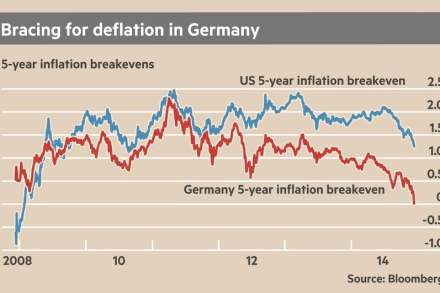
Deflation terrifies economists because once it starts, they have no idea what to do about it. When demand in an economy shrinks, companies cut jobs, and with fewer employed demand shrinks even more. The deflationary spiral is self-reinforcing. Central banks can cut interest rates to near zero and slosh money around like drunken lottery winners, but once hope flickers and dies, there is nothing they can do to persuade anyone to invest in the economy. Deflation took hold in Japan in the early 1990s and despite the government straining every sinew, its economy is still ailing 20 years on. Europe is right, then, to be in a panic. Inflation across the eurozone is just 0.

How to tell a tech bubble from a tech revolution

From our UK edition

There are two major schools of technology investing. The first believes that all investments these days are fundamentally technology investments. Every big company relies to a greater or lesser degree on the innovations and efficiencies of technology to replace the high costs and laggardly habits of human beings. The faster they do this, the higher their returns. The second school covets the pop and fizz of the new. It rejects the tedium of earnings-based valuations in favour of the helium of potential. It piles into the latest new share offerings and regards Twitter as the future of mobile advertising, not a punchline. One school feels like traditional, copper-bottomed investing, the other like a long night in Las Vegas. Each attracts investors with very different risk profiles.

The American economy vs gravity

From our UK edition

The American economy always feels better when the Super Bowl is on. Ads for trucks and beer fill the airwaves. It’s steak and cigar season for the corporate bigwigs, not a time for the calorie conscious. For a few days, they can forget about foreign labour and cratering emerging markets and wallow in the fantasy that America is still about men in faded jeans and worn baseball caps, doing practical things with their hands. Now the pigskin has been locked away until autumn, however, one can take a colder look at the behemoth. No doubt, it has been a fine few years to be rich in America. The crash of 2008 turned out to be an epic buying opportunity, and you didn’t even have to use your own money.

The future made Thiel

From our UK edition

Turn right along the American political spectrum and you find all kinds of curious species. First there are country club Republicans bemoaning the loss of their party to extremists. Then come Evangelical Christians, trying to reconcile themselves to voting for a Mormon. Further along, you find the Tea Party, crowing over their improbable rise and Mitt Romney’s choice of Paul Ryan as his running mate.

Watch out France: Nicolas Sarkozy is back, and he wants revenge

From our UK edition

Nicolas Sarkozy is angry — a ‘caged lion’, one of his closest friends told Le Monde last week. He is angry about the state of France, the state of his party, his perceived persecution by the courts, but perhaps most of all about the fact that he isn’t in the Élysée Palace to clean the mess up. If the French were to clamour for his return, he is reported to have told a Goldman Sachs conference in London this month, he would come back ‘for duty’s sake’. But Sarkozy is no Cincinnatus. He would not be treading wearily back from his plough to assume office for the good of France. He would be more like Obelix spying a wild boar. He would smack his lips and bear down greedily.

Hope? Yes. Change? No

From our UK edition

What a long and nasty campaign that was. It is hard to imagine that a political race of such magnitude could be so intellectually and emotionally bunged-up. But it’s over, and we can now ask ourselves what the point was of President Obama clubbing his way to another four years of access to the White House gym. What now? Because even after so many months of campaigning, it’s not entirely clear. Certainly not the way it was in 2008, when voters swooned over his promise of hope and change. Then, Obama promised light after the darkness of the Bush-Cheney years. He would bring peace and harmony, end wars and reconcile the partisans of Washington. This time, his promises were more grounded: competence, experience and more of his statist approach to managing the economy.

The despair bubble

From our UK edition

Economists, we should all have learned by now, are mostly quacks. They practise neither a science nor an art but a bad game of darts. Boozed up on shoddy theory and meaningless statistics, they wobble to the oche of public life, hurl an arrow at the backboard, then blame the flight, the lighting, anything but their own incompetence, when it falls to the floor. So why listen? Why bother with their endless fainting fits over the slightest flicker in the numbers? When they try to tally the Office of National Statistics’ claim that the British economy shrank by 0.

Bankers or bust

From our UK edition

Last year a single sector of British industry was responsible for generating 12 per cent of government tax receipts, with just 4 per cent of the workforce. You would think the government would be grateful to these hyper-productive worker bees, at a time when it needs every penny of tax. Solicitous even, as it is with ‘clean tech’ firms and Silicon Roundabout start-ups, which deliver nothing close to this kind of tax revenue. Not a chance. Because the sector is financial services, and three years after the financial world imploded — with Britain still plodding its way through the valley of economic death — banker bashing is still considered political gold.

Diary – 22 October 2011

From our UK edition

I arrived at the Occupy Wall Street protests on Monday morning, their one month anniversary, at 7 a.m. raring to go. That’s when the subway stations of Lower Manhattan are spewing out their banking spawn, when the streets are full of capitalist pillagers swarming off to suck what blood is left in the western economies. I was looking forward to a confrontation, some fist-shaking, at least some graphic shouting and argy-bargy. But at Zuccotti Park, I found everyone huddled beneath blue tarpaulin, fast asleep. Four weeks in, the radicals are exhausted. Surrounding the park, half the size of a football pitch and dotted with honey locust trees, stood groups of policemen, television vans and food carts all waiting for the protestors to get up.

A rich man for all seasons

From our UK edition

Multibillionaire Warren Buffett may sound cuddly, but he’s talking from both sides of his mouth August was a typical month for Warren Buffett, America’s second richest man. While the leisure classes lolled, he called for higher tax rates for the rich. If America had a debt problem, he wrote in the New York Times, it was high time the rich paid a greater share of their earnings to the government. Then, two weeks later, he sank his fangs into the fleshy rump of Bank of America, one of the bailed-out giants still staggering three years since the start of the financial crisis. Buffett had been circling Bank of America for a while, hoping that its problems would force it into his arms. It was simply a question of when not if they would have to take his money.

Degrees of optimism

From our UK edition

The speeches given to new graduates at American universities are a distinct literary form – and a measure of national mood To understand what is going on in America’s head, it is worth tuning in to the early summer hum of commencement addresses. These secular sermons, delivered by politicians, businesspeople, entertainers and other assorted worthies to those graduating from university, are a unique literary form which provides an excellent measure of the national mood. They offer the latest riffs on America’s great national themes, on ambition, equality, perseverance and optimism. In good times, they are giddy; in bad times, sober.

Bubble 2.0

From our UK edition

There is nothing more maddening to an old-school investor than a bubble. And especially a bubble in which young people are getting outrageously rich. But here we are, 11 years after the last technology bubble popped, in the midst of another of those exuberant moments. Facebook valued at $75 billion. Groupon, a three year old coupon business, at $25 billion. College dropouts with a knack for programming and a devilish knowledge of our online behaviours are suddenly worth more than a roomful of Goldman Sachs partners. The valuations are crazy, the value investors splutter. There are real businesses with real earnings worth nothing like these shooting stars. It’s immoral! Well, maybe. The most dangerous thought in any bubble is ‘this time it’s different’.