Stuart Wheeler

A warrant for exit

From our UK edition

On the 12th of January, 500 of the great and good, or at any rate the well-heeled, sat down to a sumptuous dinner at the Guildhall at a cost of £500 a head. This was to celebrate the 800th anniversary of Magna Carta, widely regarded as one of the most important documents in the world. Celebrate? A funeral procession would have been more appropriate. Clause 38 provided, ‘No judicial officer shall initiate legal proceedings against anyone on his own mere say-so, without reliable witnesses brought for that purpose.’ Yet the British government had given away, less than three months earlier, the protection provided by that clause. It voluntarily ‘opted in’ to the European Arrest Warrant.

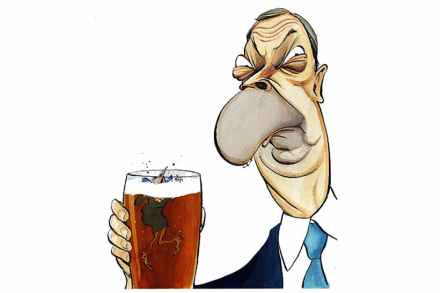
Making plans for Nigel

From our UK edition

When I was asked to write this article I intended to start by saying that Nigel Farage had to choose whether he preferred that Britain should leave the EU or that he should remain Ukip’s leader, because the two were incompatible. I hope I was wrong about that, but there is some truth in it, and Nigel stated his own view a couple of months ago. ‘It is frankly just not credible for me to continue to lead the party without a Westminster seat. What credibility would Ukip have in the Commons if others had to enunciate party policy in Parliament and the party leader was only allowed in as guest? Was I supposed to brief Ukip policy from the Westminster Arms? No — if I fail to win South Thanet, it is curtains for me. I will have to step down.’ But things have changed.

Stuart Wheeler – the secret to making money from spread betting

From our UK edition

Well, there are two ways. You can own a chunk of a successful spread-betting firm or you can be a spread-better and get things right. Miraculously, I have managed to do both. I shall come back to that. First, let me tell you how it works. How many runs will England make in the first innings of their next Test match? The bookmaker — all spread-betting firms are bookies, whatever gravitas they may attempt to assume — might quote 260–270. You think they will make more than 270. So you ‘buy’ at 270, staking £10 a run. England make 350 runs. So you are right by 80 runs and, at £10 a run, you make £800 profit. The quote at 260–270 might just as well have been a share price, in pence. It makes no difference.

Why I’m voting for Ukip

From our UK edition

I once gave the Conservatives their biggest ever donation, yet I recently took the difficult decision to support Ukip for the European elections on 4 June. So I have been expelled from the Tory party. I am not an observant person but I do not seem to have been cut by anyone since then; rather the opposite. Goodness knows how many people, ranging from a vicar to a pensioner, have told me that they have voted, and will vote this time, Conservative in all national elections but Ukip in the European elections. Lord Tebbit, while carefully avoiding specifically recommending Ukip, which would have been a catastrophe for the Tories as they would have had to expel him, suggested not voting for the three main parties or BNP. Spot the difference between that and recommending Ukip.

Painful truths

From our UK edition

Juan E. Méndez has a fantastic CV. Mercilessly tortured in Argentina, the country of his birth, when 30, he is now, four decades on, the UN Special Rapporteur on Torture, in other words, its chief investigator. In between, he has worked for Human Rights Watch for 15 years and been the United Nations First Special Adviser to the Secretary General on the Prevention of Genocide. Why does torture still exist? The author points out the painful truth: that many ordinary people have come to believe it to be not only inevitable but often even desirable. And some regimes try to deny that ‘enhanced interrogation techniques’ — waterboarding, sleep deprivation, stress positions, for example — constitute torture at all, thereby lending them legality.

A question of trust | 27 February 2010

From our UK edition

What are MPs worth? I don’t mean this literally. I hope they’re all each worth as much as they would like to be, or deserve to be. But what are they worth to us? They’re the product of our democracy. They’re the consequence of our centuries of stable constitutional development, and the enduring part of Britain’s place in history as the global pioneer of representative government. So to us they are worth quite a lot in fact. But even before their allowances are taken into account, MPs’ salaries immediately put them in the top 5 per cent income bracket. Moreover, this level of pay is unprecedented: you have never paid more for them. Are they worth that much?

Why Britain needs a referendum on the Lisbon Treaty

From our UK edition

[After the news that the British public want a referendum on the Lisbon Treaty, here's a exclusive blog from Stuart Wheeler. Stuart is one of the leading figures in the fight for a referendum, and he's secured a High Court hearing (which began yesterday) over the Government's refusal to hold one. Here at Coffee House, we wish him all the best with that, and thank him for his words below - Pete Hoskin] There is one issue in the United Kingdom that transcends age, gender and political persuasion – democracy. Democracy is the reason I am taking the Government to court this week. The people of Ireland will, on Thursday, get the right to decide whether to accept the Lisbon Treaty or not, but the people of Britain have had their right taken away.

Roll over, Mozart

From our UK edition

The author is nothing if not versatile. Apart from being the Observer’s music critic he has written books on a very wide variety of subjects. This book is about his experiences in the world of poker, specifically the form of poker that has taken the world by storm, No Limit Texas Hold’em. There is much good stuff. Poker players can be single-track-minded. ‘Who in the hell is this guy Saddam Hussein?’ asks one of the top poker pros. It reminded me of a Las Vegas blackjack dealer many years ago asking me where I came from. ‘England’, I told her. ‘Oh, that’s in Paris, isn’t it?’ she replied. The author has an amusing, though unkind, name for a holding of Ace King.

Only obeying orders

From our UK edition

Would you ever torture somebody? ‘Of course not’, you say. The author, Professor (of psychology) Philip Zimbardo, disagrees. His view is ‘any deed that any human being has ever committed, however horrible, is possible for any of us — under the right or wrong situational forces’. The evidence he adduces for this shocking proposition is formidable. Take two pieces of research, starting with the Stanford Prison Experiment. Twenty young male volunteers in Palo Alto, California, most of them undergraduates, none with psychological abnormalities, were divided at random in 1971 into ten ‘prisoners’ and ten ‘guards’. The guards were instructed to be tough.

The Tories must say No to torture

From our UK edition

The government is, on behalf of you and me, involved in the worst type of man’s inhumanity to man — torture. Yet with the honourable exceptions of William Hague and Andrew Tyrie, the Conservative party, the party I wholeheartedly support, the party that talks of compassionate conservatism, is failing to speak out about it when it should be shouting from the rooftops. Think of your wife or child screaming in unbearable pain, deliberately inflicted. The mere thought is enough for me to know that torture is unacceptable under any circumstances. Yet some people need to be convinced by other arguments. There are plenty. The first is that torture does not work.

The general and the particular

From our UK edition

‘Gays are cowardly.’ ‘Capricorns are self-confident.’ Both prop- ositions are (pace astrologers) simply untrue or, as the author puts it, spurious. ‘Gays are more likely to get Aids than non-gays.’ There is plenty of evidence for this, although of course not all gays get Aids. So this is what the author calls a non-universal but also non-spurious proposition. What follows? Should gays pay a higher health insurance premium? If not, why not? Would it be discrimination? I found this book fascinating. The author quotes William Blake: ‘To generalise is to be an idiot. To particularise is the alone distinction of merit .

Finding a way to beat Catch-21

From our UK edition

‘You’re not losing; we don’t care for that type of play here. Just cash in your chips and collect your check.’ Thus the Caesar’s Palace pit boss to your reviewer in the Sixties when in fact, contrary to what the author says, the casinos did already know about, and object to, players counting the cards at blackjack. Even if bits in the blurb such as ‘utterly gripping’ (of the book), ‘utterly corrupt’ (of Las Vegas) and especially ‘rich, sharp’ (of the dialogue) are something of an exaggeration, the story of how a group of young, highly intelligent MIT boys and girls took on Las Vegas, and beat them for millions of dollars, is fun.